June 10, 2026
The Geopolitical Risk Premium That Moves Oil Markets
Energy traders have a term for the extra cost baked into crude prices during periods of conflict: the geopolitical risk premium. It is invisible in normal market conditions, but during active hostilities near critical supply infrastructure, it can represent anywhere from five to twenty dollars per barrel of upside that would otherwise have no fundamental justification. When diplomacy advances and that premium begins to deflate, the speed and scale of the correction can be jarring, particularly for markets that had grown accustomed to pricing in sustained conflict.
That dynamic is playing out in real time as the reported US-Iran ceasefire deal oil prices relationship reshapes expectations across global energy markets. Understanding why oil prices respond so powerfully to diplomatic signals, and why the current situation is more complex than a simple headline trade, requires unpacking the layered mechanics of Hormuz supply flows, US inventory dynamics, and the structural role Iran plays in the global oil balance.
When big ASX news breaks, our subscribers know first
How Severe Is the 2026 Oil Price Correction?
The scale of the weekly decline recorded in late May 2026 is not routine market noise. Both major oil benchmarks have posted losses that rank among the steepest of the year.
| Benchmark | Weekly Decline | Price Level (May 29, 2026) | Last Comparable Weekly Loss |
|---|---|---|---|
| Brent Crude (July) | ~9% | $93.71 to $94.05/bbl | Week ending April 6 |
| WTI (US Futures) | ~8% | $88.89 to $88.90/bbl | Week ending April 13 |
| Brent cumulative drop since May 18 | >10% | — | Post-pause on Iran strikes |
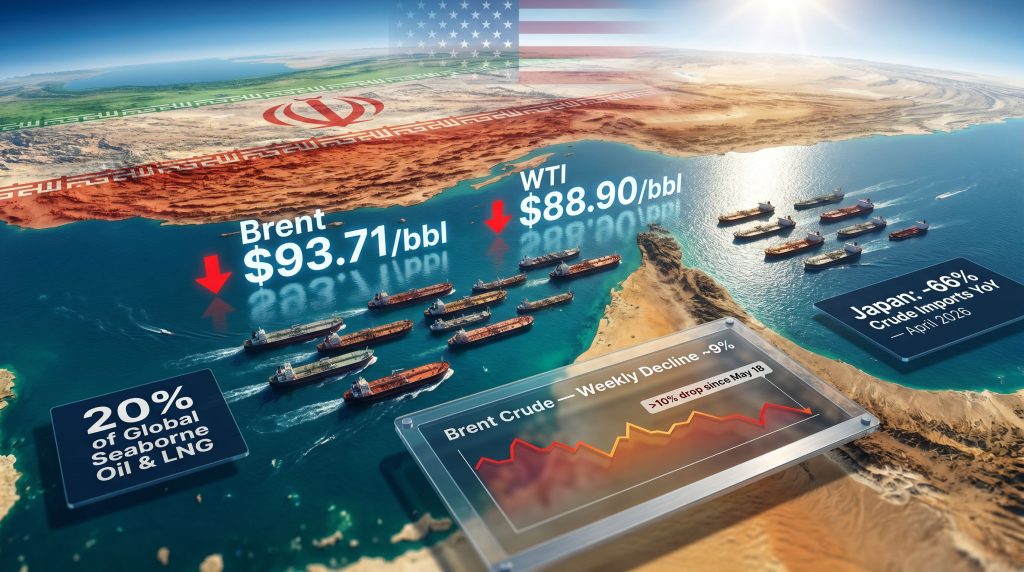
Brent crude futures for July delivery were trading at approximately $94.05 per barrel on the morning of May 29, 2026, down 34 cents or 0.3% in that session alone, having already shed roughly 9% across the week. WTI was essentially flat at $88.89, following a similarly steep weekly contraction of nearly 8%.
Both benchmarks experienced intraday price swings of up to $6 per barrel during recent sessions, a level of volatility that signals deep uncertainty rather than directional conviction. Conflicting reports — specifically ceasefire extension sources versus the absence of formal presidential sign-off — pushed prices sharply in both directions within single trading days. This kind of oscillation is characteristic of markets processing an event that has enormous supply implications but remains structurally unconfirmed.
Furthermore, as oil prices settled in mixed directions on conflicting ceasefire reports, traders were forced to simultaneously manage two fundamentally opposing supply scenarios within the same session.
"When a market swings $6 in a single session on a commodity as liquid as crude oil, it reflects something specific: the pricing mechanism is attempting to assign probability weights to two fundamentally different supply worlds simultaneously."
What the Reported 60-Day MOU Actually Contains
The reported agreement between the United States and Iran centres on a 60-day Memorandum of Understanding that would extend the existing ceasefire and initiate formal nuclear negotiations. As of May 29, 2026, the deal occupied a diplomatically ambiguous position: sources indicated it had been agreed at a negotiating level, but US President Donald Trump had not yet formally approved it, and Iranian state media had not confirmed its finalisation.
The significance of this gap cannot be overstated from a market mechanics perspective. Oil futures traders are not waiting for certainty — they are pricing in probabilities. A partially confirmed deal at the negotiating level creates what analysts describe as a probability-weighted outcome, where markets discount a portion of the supply normalisation scenario without fully committing to it.
This explains why Brent is trading near $94 rather than $100, but also why it has not fallen below $90 despite significant diplomatic progress. The reported MOU terms carry direct supply-side implications:
- Provisions for reopening the Strait of Hormuz to normal tanker traffic
- Potential US sanctions waivers that would allow Iran to resume broader international oil export activity
- A structured timeline for formal nuclear negotiations, which could extend or replace the 60-day framework
The critical bottleneck remains presidential approval. Without Trump's formal sign-off, markets cannot price in supply normalisation — only the possibility of it. Crude oil prices in 2025 and into 2026 have, however, been shaped by numerous geopolitical and logistical factors that extend well beyond this single diplomatic moment.
The Strait of Hormuz: Anatomy of the World's Most Important Energy Chokepoint
Why Does the Strait of Hormuz Matter So Much?
Few geographical features carry as much weight in global energy pricing as the Strait of Hormuz, the narrow maritime passage between Iran and Oman at the entrance to the Persian Gulf. Before the current conflict, roughly one-fifth of all global seaborne oil and LNG supplies passed through this waterway, making it the single most consequential chokepoint in the energy system.
Current traffic through the Strait represents only a small fraction of pre-conflict levels. The disruption is not theoretical or anticipated — it is actively reshaping energy supply chains in real time, and the evidence is measurable in trade data.
Japan provides the most compelling data point. As one of the world's most oil-import-dependent major economies, Japan relies heavily on Middle Eastern crude. In April 2026, Japan recorded a 66% year-on-year collapse in crude oil imports compared with April 2025. That single figure captures the severity of the Hormuz restriction better than any abstract discussion of shipping lanes.
"Japan's import collapse is functioning as a real-time severity indicator for the Hormuz disruption. A 66% decline means that energy-dependent Asian economies are not merely paying more for oil — they are receiving dramatically less of it."
What would a Hormuz reopening actually deliver to global markets?
- Immediate term: Rapid reduction in the geopolitical risk premium as traders reprice scarcity assumptions
- Near term (weeks): Gradual restoration of tanker routing, with insurance markets needing to re-engage on war-risk premiums before full traffic normalisation
- Medium term (months): Restoration of Middle Eastern export volumes to Asian and European buyers, with Iran's export capacity returning if sanctions waivers are granted
- Structural uncertainty: ING analysts have noted that even following a reopening, a full supply recovery trajectory remains uncertain given the logistical, infrastructure, and insurance complications that accumulate during extended conflict periods
US Inventory Data: The Counterforce Preventing a Deeper Sell-Off
While diplomatic progress is exerting downward pressure on the US-Iran ceasefire deal oil prices relationship, the physical supply picture inside the United States is simultaneously pushing in the opposite direction. The US Energy Information Administration reported for the week ending late May 2026 that crude oil, gasoline, and distillate stockpiles all declined, while refinery demand and consumer consumption both increased.
| Inventory Category | Weekly Direction | Demand Signal |
|---|---|---|
| Crude Stockpiles | Fell | Refinery run rates increasing |
| Gasoline Inventories | Fell | Consumer demand rising |
| Distillate Stockpiles | Fell | Industrial and transport demand firm |
| US Oil Exports | Fell 1.16M bpd to 4.4M bpd | Domestic absorption absorbing displaced barrels |
US oil exports fell by 1.16 million barrels per day, settling at 4.4 million bpd. This reduction reflects stronger domestic absorption — a signal that American consumers and refiners are drawing more heavily on available supply precisely as the global supply picture remains constrained.
This creates what analysts are describing as a dual pressure dynamic: reduced war risk from diplomatic progress provides a ceiling on further price increases, while tight physical supply provides a floor that prevents an aggressive sell-off. The market is caught between two legitimate pricing forces pulling in opposite directions.
"Falling inventories during a period of geopolitical uncertainty do not simply complicate the bearish case. They fundamentally alter the risk profile of being short crude oil at this moment."
Iran's Re-Entry and the OPEC+ Dimension
How Would Iranian Supply Re-Entry Affect OPEC+?
A detail that receives insufficient attention in standard market analysis is the interaction between potential Iranian supply re-entry and the existing OPEC+ production architecture. Iran's current export constraints are the product of both the Hormuz disruption and active US sanctions. OPEC's influence on global oil markets in 2025 established a framework that now faces a genuinely novel stress test if Iranian barrels re-enter the system.
A ceasefire extension combined with sanctions waivers would not simply add barrels to a neutral market backdrop — it would inject Iranian production into a system where OPEC+ member nations are actively managing quotas. Iranian production that re-enters international markets under sanctions waivers effectively operates outside the OPEC+ quota framework.
This creates a form of internal cartel tension that Saudi Arabia and other Gulf producers would need to manage. If Iranian barrels displace market share from quota-compliant producers, the incentive structure underpinning OPEC+ production discipline comes under pressure.
The interaction between the US-Iran ceasefire deal oil prices dynamic and OPEC+ production strategy will consequently be one of the defining pricing variables for the second half of 2026. A scenario in which Iran meaningfully restores export volumes while OPEC+ maintains current output levels would represent a significant net addition to global supply.
The next major ASX story will hit our subscribers first
Downstream Effects: Which Economies Stand to Gain Most
The consequences of a confirmed ceasefire and Hormuz reopening would not be distributed equally across global energy consumers. Geography and import dependency determine the hierarchy of beneficiaries.
-
Japan and South Korea face the most acute near-term benefit. Both economies are heavily reliant on Middle Eastern crude and have experienced the steepest supply disruptions during the conflict period. Japan's 66% import collapse is the most visible example of this vulnerability.
-
India imports a significant proportion of its crude from the Gulf and has been managing elevated energy costs throughout the conflict. A normalised Hormuz would reduce import bills and ease inflation pressures.
-
European LNG markets have been managing post-Russia supply restructuring simultaneously with Hormuz disruption. Restored LNG flows through the Strait would provide additional supply optionality to a market still adapting to a fundamentally altered supply geography.
-
US consumers would benefit indirectly through reduced global crude benchmarks, with downstream pressure on retail gasoline prices, though the magnitude would depend on the pace and completeness of Hormuz traffic restoration.
In addition, the trade war's effect on oil markets has already introduced additional layers of demand-side uncertainty that any ceasefire-driven price correction would need to navigate simultaneously.
Scenario Pathways: Where Oil Prices Go From Here
The range of outcomes from the current diplomatic situation is unusually wide by historical standards. Three distinct scenarios frame the market's forward pricing challenge.
| Scenario | Key Conditions | Brent Price Direction | Estimated Timeline |
|---|---|---|---|
| Deal Confirmed, Hormuz Opens | Trump approval secured, Iranian state confirmation, tanker traffic resumes | Significant downward pressure, possible sub-$90 | 2 to 4 weeks post-confirmation |
| Deal Stalls or Collapses | Negotiations break down, conflict escalates | Sharp rebound toward $100 or above | Immediate market reaction |
| Partial Agreement | Ceasefire extended but Hormuz remains restricted | Sideways trading with elevated volatility | Ongoing uncertainty window |
UBS analyst Giovanni Staunovo noted that while Hormuz shipping restrictions remain active and inventory levels continue declining, market attention is anchored on the probability of a confirmed US-Iran agreement. This framing captures the essential dynamic: the market has already moved significantly on expectation, but the fundamental supply situation has not yet changed.
Moreover, the broader impact of geopolitical tensions on global trade is reshaping how energy markets assign risk premiums in ways that extend well beyond any single diplomatic agreement. Meanwhile, Canadian energy executives facing oil price shocks have been navigating similar uncertainty — a reminder that the consequences of Middle Eastern supply disruption ripple through producer economies as well as consumer ones.
What the Market Knows That Casual Observers Miss
The Tanker Insurance Problem
Several features of this situation are not widely understood outside professional energy market circles. The first is tanker insurance complexity. Even when a chokepoint formally reopens, the restoration of full tanker traffic depends on war-risk insurance markets re-engaging at commercially viable premium levels.
During periods of active conflict, insurance underwriters either withdraw coverage entirely or price it prohibitively. When conflict ends, the re-pricing of war-risk premiums is a process that takes weeks to months, not days. This is a significant reason why ING analysts have cautioned that a Hormuz reopening does not guarantee rapid supply recovery.
Floating Storage and Refinery Configuration
The second factor is the role of floating storage. During extended supply disruptions, some traders and importers accumulate floating storage, keeping tankers loaded with crude anchored offshore rather than delivering to port. When supply normalises and freight rates adjust, this floating inventory can enter the market relatively quickly, adding a temporary additional bearish force beyond the resumption of normal export flows.
The third is refinery configuration dependency. Japanese, Korean, and Indian refineries are configured to process specific crude grades, primarily medium-sour Gulf crude. Supply disruptions that forced diversification to alternative crude sources created processing inefficiencies and quality mismatches. Restoring access to preferred crude grades would improve refinery margins in these economies, adding an additional demand pull for Middle Eastern barrels beyond simple volume restoration.
Furthermore, reporting on the potential Iran deal and the Strait of Hormuz has highlighted that the logistical and diplomatic variables are deeply intertwined, making a clean, rapid resolution less straightforward than headline coverage might suggest.
Frequently Asked Questions
What is the current Brent crude price following ceasefire reports?
Brent crude futures for July delivery were trading between approximately $93.71 and $94.05 per barrel on May 29, 2026, reflecting a weekly decline of approximately 9% — the steepest since early April 2026.
Has the US-Iran ceasefire deal been officially confirmed?
As of May 29, 2026, the reported 60-day MOU had not received formal approval from US President Donald Trump, and Iranian state media had not confirmed its finalisation. The agreement remained in a preliminary diplomatic stage.
Why have oil prices not fallen more sharply despite ceasefire optimism?
Falling US crude, gasoline, and distillate inventories are providing a structural price floor, preventing a more aggressive sell-off. The market is simultaneously managing reduced war risk and tightening physical supply — two opposing forces that create sideways price pressure at elevated levels.
What does the Strait of Hormuz disruption mean for global supply?
Before the conflict, the Strait carried approximately one-fifth of global seaborne oil and LNG supplies. Current traffic remains a fraction of pre-conflict levels, creating a structural supply deficit that is measurably impacting import-dependent economies, most visibly Japan, which recorded a 66% year-on-year crude import decline in April 2026.
What are the key risks to a bullish oil price scenario under a ceasefire?
The primary risks include failure of formal deal confirmation, breakdown in nuclear negotiations, delayed reopening of Hormuz due to insurance and logistical complications, and the re-entry of Iranian barrels into a market where OPEC+ production discipline could face renewed pressure.
Disclaimer: This article contains forward-looking analysis, scenario modelling, and market commentary that involves forecasts and assumptions. Oil prices are subject to rapid change driven by geopolitical, macroeconomic, and supply-side variables. Nothing in this article constitutes financial or investment advice. Readers should conduct independent research before making any investment decisions.
Want to Stay Ahead of the Next Major Commodity Discovery?
While geopolitical events like the US-Iran ceasefire reshape energy markets, Discovery Alert's proprietary Discovery IQ model scans ASX announcements in real time, delivering instant notifications on significant mineral discoveries across more than 30 commodities — explore Discovery Alert's discoveries page to understand how historic finds have generated substantial returns, and begin a 14-day free trial to position yourself ahead of the broader market.