May 24, 2026
Understanding the Global Economic Consequences of U.S. Tariff Threats
International trade relationships face unprecedented strain as economic coercion emerges as a tool for territorial ambitions. The intersection of Greenland and U.S. tariff threats creates complex challenges for established multilateral frameworks. Modern economies operate through interconnected supply chains that span continents, making unilateral trade actions potentially disruptive to global stability.
The World Trade Organization's dispute resolution mechanisms have historically managed trade conflicts through structured processes. However, when economic pressure serves territorial acquisition goals rather than commercial objectives, traditional frameworks may prove inadequate. This dynamic represents a fundamental shift in how nations approach international relations and resource control.
When big ASX news breaks, our subscribers know first
The Legal Framework of International Trade Enforcement
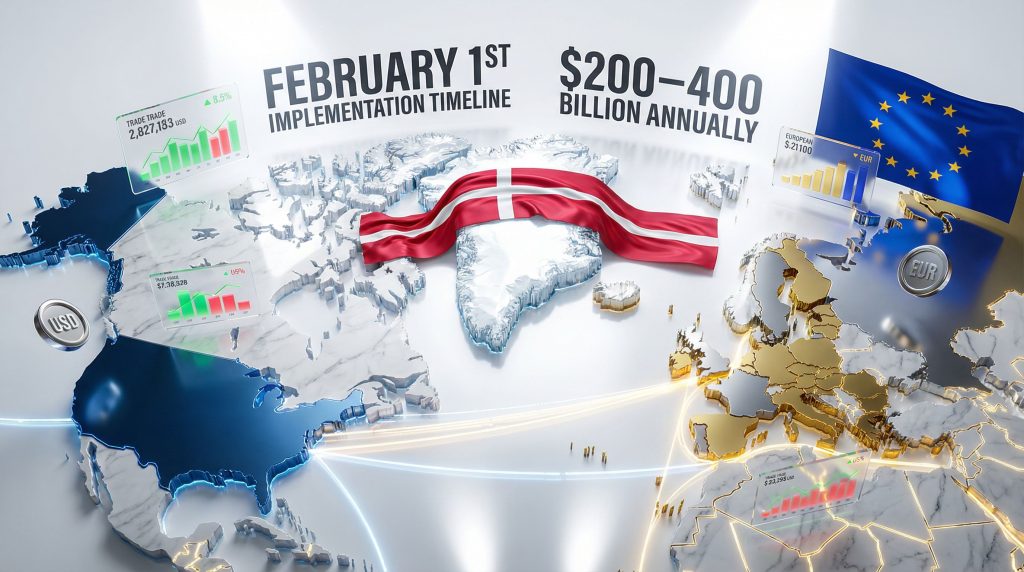
The February 1st, 2026 deadline for implementing 10% tariffs on specific European nations demonstrates the speed at which modern trade disputes can escalate. Under World Trade Organization protocols, unilateral tariff impositions require documented justification, typically through national security exemptions under GATT Article XXI or anti-dumping measures under Article VI.
WTO Compliance Requirements:
• National security exception must demonstrate genuine essential security interests
• Anti-dumping measures require evidence of material injury to domestic industry
• Emergency trade authorities invoke expedited procedures but remain subject to challenge
• Dispute settlement procedures provide formal mechanisms for affected parties
The General Agreement on Tariffs and Trade permits members to take actions considered necessary for essential security interests. However, this exception faces increasing scrutiny from the WTO Dispute Settlement Body. Furthermore, the 1867 Alaska Purchase, completed through diplomatic negotiation rather than economic coercion, illustrates historical precedents for territorial transfers through peaceful means.
Section 301 of the Trade Act of 1974 grants presidential authority to address unfair trade practices. In addition, Section 232 provides broader executive powers for national security concerns. Congressional oversight mechanisms exist for both authorities, creating constitutional constraints on sustained unilateral action against allied nations.
European Response Mechanisms and Economic Countermeasures
The European Union's Anti-Coercion Instrument, formally adopted in December 2021, provides Brussels with comprehensive tools to counteract economic pressure from non-EU countries. According to recent EU discussions, this framework enables cross-sectoral countermeasures beyond traditional sector-specific trade disputes.
Implementation Process:
• Investigation phase to assess coercive actions
• Consultation with affected member states and industries
• Proportionate countermeasure design matching coercive impacts
• Recovery period allowing diplomatic resolution before escalation
The instrument targets actions that coerce EU members, distort trade flows, or create external pressure on EU decision-making processes. Unlike traditional trade disputes focusing on specific sectors, this framework enables simultaneous responses across multiple industries and economic sectors.
European pharmaceutical and medical device manufacturers maintain significant supply relationships with U.S. markets. For instance, the Netherlands plays a crucial role in semiconductor equipment manufacturing, particularly through advanced lithography technology. These interconnections create mutual vulnerabilities that complicate unilateral trade actions, particularly when US tariff pressures mount.
Congressional Authority and Constitutional Constraints
The U.S. Constitution grants Congress primary authority over interstate commerce under Article I, Section 8. Military deployment authorization requires Congressional approval beyond the 60-day limit established by the War Powers Resolution. This separation of powers creates significant constraints on executive trade policy against NATO allies.
Constitutional Framework:
• Executive tariff authority operates within Congressional delegated parameters
• Section 301 and Section 232 authorities face potential Congressional limitation
• NATO Article 5 invocation would require Congressional consultation
• Sustained economic warfare may trigger legislative oversight mechanisms
The Trade Act of 1974 provides executive authority for trade actions, but Congressional oversight exists through committee review processes and potential legislative limitations. However, NATO obligations create additional complexity when economic actions target alliance members simultaneously.
Critical Supply Chain Vulnerabilities and Dependencies
European suppliers maintain important positions in several critical sectors affecting U.S. economic security. Pharmaceutical supply chains involve complex multi-nation manufacturing and component sourcing arrangements. Consequently, medical device production requires specialised materials and components that cross multiple national borders.
Pharmaceutical Supply Dependencies:
• Active pharmaceutical ingredients from multiple European sources
• Specialised manufacturing equipment requiring European technology
• Research and development partnerships spanning transatlantic relationships
• Regulatory approval processes involving mutual recognition agreements
Advanced manufacturing sectors demonstrate similar interdependencies. Semiconductor equipment production involves highly specialised technology with limited global suppliers. Furthermore, telecommunications infrastructure components require ongoing technical support and upgrade pathways that span international borders.
The energy sector shows particular complexity through liquefied natural gas import relationships and renewable energy technology patents. These long-term contractual arrangements resist rapid reconfiguration without significant economic costs to multiple parties, especially when considering critical mineral security implications.
Historical Precedents for Economic Coercion and Territorial Control
Modern international law establishes strong protections against forced territorial transfers. The United Nations Charter Article 2(4) prohibits threats or use of force against territorial integrity or political independence of member states. This framework applies to all 193 UN member countries.
Case Study Analysis:
Crimea (2014): Russia's annexation preceded international sanctions rather than following economic pressure. Western sanctions failed to reverse territorial control despite comprehensive implementation across multiple sectors.
Hong Kong (1997): The peaceful transfer occurred under pre-existing treaty obligations established through the Sino-British Joint Declaration of 1984. No evidence suggests economic coercion driving the territorial arrangement.
East Timor (2002): Independence resulted from UN-supervised referendum processes following Security Council Resolution 1264. The multilateral legal framework enabled peaceful resolution without coercive economic measures.
League of Nations sanctions during the 1930s-1940s period demonstrated limited effectiveness for territorial objectives. United Nations sanctions regimes have primarily served defensive rather than acquisitive purposes throughout their operational history.
The next major ASX story will hit our subscribers first
Financial Market Responses to Trade Tension Escalation
Currency markets reflect investor concerns about sustained economic conflict between allied nations. The tariff investment impact demonstrates how Greenland and U.S. tariff threats affect global financial stability. According to recent market data, the dollar declined 0.3% against major trading partners as markets responded to ongoing tensions.
Commodity Market Impacts:
• Brent futures rose 19 cents (0.3%) to $64.13 per barrel
• U.S. West Texas Intermediate gained 25 cents (0.4%) to $59.69
• Oil prices found support from dollar weakness and Chinese economic data
• Trans-Atlantic trade route uncertainties affect shipping costs
Market analyst Tony Sycamore noted that dollar weakness sparked by tariff threats offered support for oil commodities. This relationship demonstrates how trade disputes can influence broader commodity markets through currency mechanisms, particularly when examining trade war oil impact.
Chinese economic performance data showed 5.0% growth for 2025, meeting government targets through record global market share gains. China's refinery throughput rose 4.1% year-on-year whilst crude oil output grew 1.5%, both reaching all-time highs according to government data.
NATO Alliance Obligations and Economic Security
The North Atlantic Treaty establishes multiple frameworks for member cooperation beyond traditional military alliance obligations. Article 2 commits parties to peaceful dispute settlement and cooperation consistent with UN purposes. In addition, Article 3 requires maintaining individual and collective capacity to resist armed attack.
Treaty Framework:
• Article 5 defines collective defence against armed attacks
• Economic coercion interpretation remains legally contested
• Consultation mechanisms exist for addressing alliance concerns
• Informal economic coordination occurs through NATO Economics Committee
NATO Article 5 has been formally invoked only once, on September 12, 2001, following the terrorist attacks. Whether systematic economic coercion constitutes an armed attack requiring collective response remains unresolved in international legal scholarship.
Enhanced cooperation frameworks exist for economic coordination among alliance members. However, these remain distinct from collective defence obligations. The alliance lacks formal Article 5 equivalent mechanisms for economic threats specifically.
Global Resource Markets and Strategic Material Access
Greenland contains significant rare earth element deposits according to U.S. Geological Survey mineral assessments. These materials prove essential for renewable energy technology and defence applications. Global rare earth production remains concentrated, with China controlling approximately 60% of global production capacity.
Critical Mineral Dependencies:
• Rare earth processing requires specialised facilities and expertise
• Supply chain security involves multiple international partnerships
• Alternative sourcing requires substantial investment and time
• Strategic stockpiling provides limited buffer capacity
European rare earth processing capacity represents approximately 45% of global refinement capability according to industry assessments. This geographic distribution creates interdependencies that resist rapid reconfiguration without significant economic disruption.
The territorial dispute highlights broader resource security concerns affecting multiple nations. Arctic regions contain substantial untapped mineral wealth, including deposits essential for modern technology applications. Climate change impacts create new access possibilities whilst raising environmental protection concerns.
Third-Party Nation Strategic Positioning
Non-aligned nations view the escalating dispute as an opportunity to strengthen relationships with European partners whilst maintaining U.S. trade connections. China has increased diplomatic engagement with European capitals since tariff threats emerged. Consequently, Russia enhanced Arctic military positioning in response to increased regional attention.
Strategic Response Patterns:
• Diversified supply chain partnerships reduce single-source dependencies
• Enhanced diplomatic engagement creates alternative relationship options
• Economic hedging strategies protect against trade disruption risks
• Regional cooperation frameworks provide multilateral alternatives
Canada strengthened sovereignty assertions in Arctic territories through increased patrol activities and infrastructure investments. Furthermore, India diversified supply chain partnerships to reduce exposure to potential trade disruptions. These responses demonstrate how bilateral disputes can reshape broader international relationships, especially when considering US‑China trade war implications.
Potential Diplomatic Resolution Pathways
Several mechanisms exist for resolving the current tensions without sustained economic conflict. Enhanced defence cooperation agreements could provide increased U.S. military presence in Greenland through negotiated arrangements. Joint resource development ventures might address strategic material security concerns.
Resolution Framework Options:
• Bilateral defence cooperation expansion
• Multilateral Arctic governance agreements
• Technology transfer partnerships for critical industries
• Climate change adaptation cooperation initiatives
UN-supervised territorial status referendums provide precedented mechanisms for addressing sovereignty questions. International resource-sharing agreements could address strategic material concerns without territorial transfer requirements. These approaches maintain respect for sovereignty principles whilst addressing legitimate security interests.
Long-Term Implications for International Trade Governance
The precedent of using tariff threats for territorial acquisition could fundamentally alter global trade governance frameworks. If successful, this strategy might encourage other powers to weaponise economic relationships for geopolitical objectives. Furthermore, the World Trade Organization's dispute resolution authority faces potential erosion if members bypass established procedures.
Systemic Risk Factors:
• Reduced multilateral cooperation in trade policy
• Increased bilateral agreement complexity and conditionality
• Enhanced economic nationalism affecting long-term partnerships
• Weakened international institution effectiveness for dispute resolution
Bilateral trade agreements may incorporate territorial and sovereignty clauses previously considered outside commercial frameworks. Enhanced economic nationalism could reduce long-term partnership stability across multiple sectors. These changes would significantly influence future approaches to economic statecraft and international cooperation.
The outcome will establish important precedents for how economic power intersects with territorial sovereignty in the modern international system. Resolution approaches that maintain respect for established legal frameworks whilst addressing legitimate security concerns may provide templates for managing similar future disputes regarding Greenland and U.S. tariff threats.
As European leaders consider unprecedented counter-measures, the global implications of these territorial and economic tensions continue to evolve.
This analysis is based on publicly available information and should not be considered as investment advice. The situation remains fluid and readers should consult current news sources for the latest developments. All financial figures and market data are subject to change and should be verified through primary sources.
Could Global Trade Tensions Create New Investment Opportunities?
Discovery Alert's proprietary Discovery IQ model delivers real-time alerts on significant mineral discoveries, instantly empowering subscribers to identify actionable opportunities ahead of the broader market, particularly during periods of supply chain uncertainty and resource security concerns. Begin your 30-day free trial today at Discovery Alert and secure your market-leading advantage.