May 23, 2026
Understanding the Strategic Context Behind US-Venezuela Energy Diplomacy
The intricate web of global energy partnerships stands at a potential inflection point as diplomatic channels between Washington and Caracas explore expanded petroleum cooperation frameworks. Recent developments signal a fundamental shift in how sanctions-affected energy markets might evolve, with the Chevron Venezuela oil licence expansion representing a pivotal moment in regional energy diplomacy. Furthermore, these negotiations carry implications extending far beyond bilateral trade relationships, particularly as oil price movements amid trade war tensions continue to reshape global markets.
What Does Chevron's Current Venezuelan Operating Framework Look Like?
Chevron Corporation maintains a unique position within Venezuela's constrained energy sector through specialized licensing arrangements that distinguish it from other American petroleum companies. The company operates as the sole U.S. oil major with active Venezuelan operations, functioning under specific Treasury Department exemptions that circumvent broader sanctions regimes.
The operational structure encompasses four distinct joint venture partnerships with Petróleos de Venezuela (PDVSA): Petroboscán, Petroindependiente, Petropiar, and additional collaborative arrangements. These partnerships represent decades of relationship building and technical expertise development within Venezuela's complex geological and political landscape.
Current production capacity operates significantly below historical levels due to infrastructure constraints and regulatory limitations. The existing framework permits limited export volumes primarily directed toward Chevron's downstream refining operations, with strict compliance monitoring ensuring adherence to sanctions exemption parameters.
Key operational characteristics include:
• Joint venture ownership structures varying by asset and development timeline
• Production capacity constraints imposed by sanctions compliance requirements
• Export destination limitations restricting market access opportunities
• Technical expertise sharing within approved operational boundaries
• Revenue distribution mechanisms governed by Treasury Department oversight
How Do US Sanctions Currently Limit Venezuelan Oil Operations?
The sanctions architecture constraining Venezuelan petroleum operations evolved through multiple phases beginning in 2017, with escalating restrictions fundamentally altering the country's energy export patterns. These measures targeted financial transactions, technology transfers, and market access mechanisms essential for large-scale petroleum production.
Venezuelan oil production declined from approximately 2.4 million barrels per day in 2016 to roughly 700,000 barrels per day by 2023, representing a 70% reduction in output capacity. This dramatic decrease resulted from combined effects of sanctions pressure, infrastructure deterioration, and reduced international investment.
Primary sanctions mechanisms include:
• Financial transaction restrictions limiting payment processing through international banking systems
• Technology transfer prohibitions preventing access to advanced extraction and refining equipment
• Market access limitations restricting crude oil sales to specific geographic regions
• Secondary sanctions threats deterring third-party companies from Venezuelan engagement
• Asset freezing measures targeting Venezuelan government petroleum revenues
The economic impact extends beyond production volumes to encompass infrastructure degradation, skilled workforce emigration, and reduced exploration activities. Venezuela's petroleum sector requires an estimated $200-300 billion in investment over the next decade to restore production capacity to historical levels.
When big ASX news breaks, our subscribers know first
Analyzing the Proposed License Expansion Framework
What Would an Expanded License Enable Chevron to Accomplish?
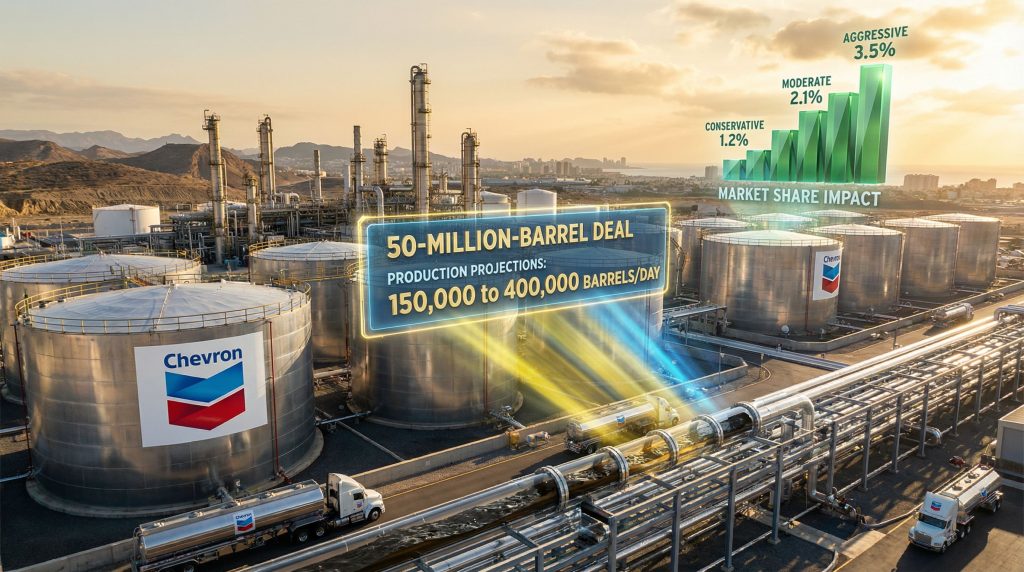
Negotiations between U.S. and Venezuelan officials centre on a framework potentially involving up to 50 million barrels of Venezuelan crude oil supplied to American markets. This volume represents a significant expansion from current export levels, requiring substantial operational and logistical scaling across multiple production assets.
An expanded licensing arrangement would enable several strategic capabilities:
• Increased export volumes to Chevron's refinery network, particularly facilities optimised for heavy crude processing
• Third-party sales opportunities expanding market access beyond Chevron's downstream operations
• Enhanced production optimisation through relaxed operational constraints and expanded technical cooperation
• Infrastructure investment authorisation enabling capital expenditure on production enhancement projects
• Extended supply chain integration connecting Venezuelan production with North American energy markets
The proposed framework requires careful consideration of timeframe specifications, as the 50 million barrel figure lacks clarity regarding annual versus cumulative volume targets. According to Reuters, industry analysts estimate this could translate to approximately 150,000-400,000 barrels per day depending on implementation timeline and operational scaling capacity.
Which Other US Energy Companies Could Enter the Venezuelan Market?
Recent diplomatic pressure from the Trump administration extends beyond Chevron to encompass other major American petroleum companies, including ExxonMobil and ConocoPhillips. These companies maintain complex historical relationships with Venezuelan operations, involving both commercial interests and outstanding legal disputes.
ExxonMobil's Strategic Position:
ExxonMobil operated significant Venezuelan assets until 2007, when the government nationalised foreign petroleum operations. The company maintains outstanding arbitration claims exceeding $1.6 billion related to asset expropriation, creating potential barriers to re-engagement without comprehensive dispute resolution.
ConocoPhillips' Historical Assets:
ConocoPhillips similarly faced asset nationalisation, with ongoing compensation negotiations affecting potential market re-entry strategies. The company's previous Venezuelan operations included heavy crude production facilities and significant infrastructure investments requiring substantial rehabilitation.
Valero Energy's Downstream Connections:
Valero Energy maintained historical relationships with PDVSA through refined product trading and crude oil processing arrangements. The company's specialised heavy crude refining capacity positions it advantageously for potential Venezuelan crude intake under expanded licensing frameworks.
Market entry considerations include:
• Arbitration settlement requirements for companies with outstanding expropriation claims
• Treasury Department licensing procedures for new sanctions exemption applications
• Technical due diligence processes evaluating asset conditions and rehabilitation requirements
• Political risk assessment frameworks addressing operational continuity under changing political conditions
Macro-Economic Implications of the 50-Million-Barrel Deal
How Would This Volume Impact Global Oil Supply Dynamics?
The proposed Venezuelan oil supply arrangement represents approximately 0.5-1.0% of global daily crude oil production, with concentrated impact on regional heavy crude markets and U.S. import composition. In addition, this volume would position Venezuela among the top 10 U.S. crude oil suppliers, significantly altering North American energy supply diversity while coinciding with the broader oil price rally and tariffs discussions shaping international trade dynamics.
Projected Market Impact Analysis:
| Scenario | Daily Volume | US Import Share | Price Impact |
|---|---|---|---|
| Conservative | 150,000 bbl/day | 1.2% of imports | $2-4 reduction |
| Moderate | 250,000 bbl/day | 2.1% of imports | $4-7 reduction |
| Aggressive | 400,000 bbl/day | 3.5% of imports | $7-12 reduction |
Current U.S. crude oil imports average approximately 6.3 million barrels per day, with Canada, Mexico, and Saudi Arabia representing the largest suppliers. Venezuelan crude would likely displace imports from other heavy crude producers, particularly affecting Canadian oil sands and Mexican heavy crude market share.
Regional price implications extend beyond direct substitution effects:
• Heavy crude price differentials may compress as Venezuelan supply increases market competition
• Refinery margin optimisation through access to discounted Venezuelan crude grades
• Transportation cost advantages from reduced shipping distances compared to Middle Eastern suppliers
• Strategic petroleum reserve considerations regarding Venezuelan crude storage and emergency preparedness
What Are the Geopolitical Risk Factors?
Venezuelan political stability remains a critical variable affecting long-term energy cooperation sustainability. Recent electoral disputes and international recognition challenges create uncertainty regarding policy continuity and operational security for American companies.
Primary Risk Categories:
• Political succession uncertainties affecting contract sanctity and operational permits
• OPEC+ coordination challenges as Venezuela potentially increases production outside quota frameworks
• Regional energy security implications for Latin American petroleum supply chains
• Policy reversal probabilities under future U.S. administrations with different foreign policy priorities
• Secondary sanctions risks affecting third-party service providers and technology suppliers
OPEC's global oil influence requires careful monitoring, as Venezuelan production increases could necessitate quota adjustments among other member countries. Current OPEC+ agreements allocate Venezuela a production target of approximately 1 million barrels per day, significantly below historical capacity but above current output levels.
Disclaimer: Political risk assessments involve significant uncertainty and speculation regarding future government policies and international relations. Investment decisions should incorporate comprehensive due diligence and professional political risk analysis.
Investment and Infrastructure Analysis
What Capital Requirements Would Support Expanded Operations?
Venezuelan petroleum infrastructure requires substantial rehabilitation and modernisation to support expanded production targets. Industry estimates suggest $15-25 billion in capital investment would be necessary to restore production capacity to 1.5-2 million barrels per day over a 5-7 year timeframe.
Infrastructure Investment Categories:
• Production facility upgrades including wellhead equipment, pumping systems, and processing facilities
• Pipeline rehabilitation addressing corrosion, capacity constraints, and safety compliance
• Port and terminal improvements enhancing crude oil loading and export capabilities
• Refinery modernisation optimising heavy crude processing and product quality specifications
• Technology integration implementing modern monitoring, safety, and environmental systems
Chevron's 2026 capital expenditure guidance ranges from $14-18 billion globally, with Venezuelan operations representing a relatively small portion of total spending. However, the Chevron Venezuela oil licence expansion could require incremental investment of $500 million to $1.5 billion annually depending on production scaling ambitions and infrastructure conditions.
How Would This Affect Chevron's Global Portfolio Strategy?
Venezuelan operations integration within Chevron's global portfolio requires balancing political risk exposure against attractive economics and strategic positioning benefits. The company's diversified geographic presence provides risk mitigation while Venezuelan assets offer unique heavy crude access and downstream integration opportunities.
Strategic Portfolio Considerations:
• Risk-adjusted return optimisation comparing Venezuelan projects with alternative global opportunities
• Downstream integration benefits leveraging existing refinery infrastructure for Venezuelan crude processing
• Geopolitical diversification reducing dependence on Middle Eastern and other politically sensitive regions
• Technology transfer opportunities applying advanced extraction techniques to mature Venezuelan fields
• Long-term supply security establishing reliable heavy crude access for specialised refining operations
Current Chevron guidance indicates 15-20% of capital expenditure allocated to international projects, with Venezuelan operations potentially representing a significant portion of this allocation under expanded licensing scenarios.
Competitive Landscape and Market Positioning
What Strategic Advantages Would Early Market Entry Provide?
Chevron's established Venezuelan presence provides substantial first-mover advantages as sanctions relief creates opportunities for expanded American energy company participation. These advantages encompass operational knowledge, regulatory relationships, and infrastructure familiarity developed over decades of in-country experience.
Competitive Positioning Benefits:
• Relationship capital with PDVSA technical teams and government stakeholders
• Operational expertise in Venezuelan geological conditions and production challenges
• Regulatory knowledge regarding compliance frameworks and licensing procedures
• Infrastructure access to existing production facilities and export terminals
• Market intelligence regarding Venezuelan crude quality specifications and processing requirements
Venezuelan proven oil reserves exceed 300 billion barrels, representing the world's largest proven reserves base. However, much of this resource base consists of heavy crude requiring specialised extraction and processing techniques, creating barriers to entry for companies lacking relevant technical expertise.
How Might This Influence Global Energy Company Strategies?
Expanded U.S.-Venezuela energy cooperation could establish precedents affecting international energy company strategies across multiple sanctioned markets. European majors, Asian national oil companies, and other international players may reassess Venezuela engagement strategies based on American companies' success and regulatory framework evolution.
International Competitive Responses:
• European energy companies (Shell, BP, TotalEnergies) evaluating Venezuelan market re-entry opportunities
• Asian national oil companies (CNPC, Sinopec, ONGC) potentially expanding Venezuelan partnerships
• Heavy crude suppliers (Canadian Oil Sands, Mexican state oil company) adjusting competitive positioning
• Regional Latin American players (Petrobras, Ecopetrol) considering expanded Venezuelan cooperation
• Independent oil companies exploring asset acquisition opportunities as major companies establish market presence
Heavy crude market dynamics could shift significantly if Venezuelan production approaches historical levels of 2-3 million barrels per day. This volume would represent approximately 20-30% of global heavy crude production, potentially affecting pricing structures and refinery margins across North American and European markets.
Regulatory and Compliance Framework Evolution
What Legal Mechanisms Would Govern Expanded Operations?
Treasury Department oversight mechanisms for expanded Venezuelan operations require sophisticated compliance frameworks addressing financial transactions, technology transfers, and revenue monitoring. These frameworks must balance operational flexibility with sanctions compliance while providing transparency for congressional and public oversight.
Regulatory Framework Components:
• Office of Foreign Assets Control (OFAC) licensing with specific operational parameters and reporting requirements
• Financial transaction monitoring through approved banking channels and escrow arrangements
• Technology transfer restrictions limiting equipment and technical service provisions
• Revenue distribution oversight ensuring compliance with sanctions objectives and Venezuelan government limitations
• Environmental and safety standards aligned with international petroleum industry best practices
Compliance monitoring systems require real-time transaction tracking, production reporting, and export verification to ensure adherence to licensing terms. Violations could result in licence suspension, financial penalties, and exclusion from future sanctions relief programmes.
How Would Success Be Measured and Monitored?
Performance evaluation frameworks for expanded Venezuelan licensing must address multiple stakeholder interests including U.S. energy security, economic benefits, foreign policy objectives, and sanctions policy effectiveness. These measurements require quantifiable metrics and regular assessment intervals.
Key Performance Indicators:
• Production volume achievements relative to licensing targets and timelines
• U.S. energy security enhancement measured through import diversification and supply reliability
• Economic benefit realisation including job creation, tax revenue, and energy cost impacts
• Compliance track record demonstrated through audit results and regulatory assessments
• Political stability indicators affecting operational continuity and investment security
Exit strategy considerations require predetermined triggers for licence suspension or termination based on political developments, compliance failures, or changed U.S. foreign policy priorities. These mechanisms protect American company interests while maintaining policy flexibility for future administrations.
The next major ASX story will hit our subscribers first
Long-Term Strategic Implications
What Does This Signal About US Energy Policy Direction?
The potential Venezuelan licensing expansion represents a fundamental shift from sanctions-focused isolation toward engagement-based energy diplomacy. This approach prioritises practical energy security considerations over purely punitive foreign policy measures, potentially establishing precedents for other sanctioned energy markets.
Policy Direction Indicators:
• Pragmatic engagement prioritising energy security and economic benefits
• Conditional sanctions relief tied to specific performance metrics and political developments
• Private sector leadership in diplomatic relationship rebuilding through commercial partnerships
• Regional energy integration supporting Western Hemisphere energy security objectives
• Precedent establishment for sanctions relief frameworks in other energy markets
Similar approaches could influence U.S. policy toward Iran, Russia, or other sanctioned energy producers, depending on geopolitical developments and energy market conditions. However, the tariffs impact on investments and broader US-China trade war impact demonstrate that each situation involves unique political, security, and economic considerations requiring tailored policy responses.
How Could This Reshape Venezuelan Economic Recovery?
Expanded petroleum export revenues could provide Venezuela with critical foreign currency needed for economic stabilisation and infrastructure rehabilitation. Government revenues from increased oil exports might exceed $10-15 billion annually under optimistic production scenarios, representing substantial resources for economic recovery programmes.
Economic Recovery Pathways:
• Infrastructure investment in transportation, utilities, and telecommunications systems
• Healthcare and education system reconstruction and modernisation
• Private sector development through improved business conditions and foreign investment attraction
• Currency stabilisation reducing hyperinflation and improving economic predictability
• Regional integration enhancing trade relationships with neighbouring Latin American countries
However, economic recovery success depends on governance improvements, corruption reduction, and institutional capacity building beyond petroleum sector revenues. Historical precedents suggest that oil revenue alone insufficient for sustainable economic development without comprehensive structural reforms.
Risk Assessment and Mitigation Strategies
What Are the Primary Operational Risk Factors?
Venezuelan operations involve multiple risk categories requiring sophisticated mitigation strategies and contingency planning. Political risks dominate but operational, financial, and reputational risks also require careful management and ongoing assessment.
Risk Category Analysis:
• Political instability affecting contract sanctity and operational continuity
• Infrastructure security including pipeline protection and facility safety
• Currency volatility complicating financial planning and revenue repatriation
• Environmental compliance addressing legacy contamination and regulatory standards
• Workforce management involving skilled labour availability and community relations
Mitigation Approaches:
• Political risk insurance through government-backed programmes and private insurers
• Operational diversification across multiple asset locations and production methods
• Financial hedging strategies addressing currency and commodity price volatility
• Stakeholder engagement programmes building community support and government relationships
• Emergency response planning for security incidents and operational disruptions
How Should Investors Evaluate These Developments?
Investment evaluation for Venezuelan energy exposure requires sophisticated risk-return analysis incorporating political scenarios, operational challenges, and market dynamics. Traditional petroleum project evaluation methods require modification to address unique Venezuelan risk factors and opportunity characteristics.
Investment Evaluation Framework:
• Scenario-based financial modelling incorporating multiple political and economic outcomes
• Risk-adjusted discount rates reflecting political and operational uncertainties
• Portfolio diversification analysis considering correlation with other emerging market investments
• Timeline sensitivity assessment evaluating investment payback periods under various scenarios
• Exit strategy development planning for adverse political or economic developments
Investment Disclaimer: Venezuelan energy investments involve significant political, operational, and financial risks. This analysis provides educational information and should not be considered investment advice. Potential investors should conduct comprehensive due diligence and consult qualified financial advisors before making investment decisions.
Due Diligence Considerations:
• Legal structure analysis ensuring appropriate asset protection and operational flexibility
• Partner assessment evaluating PDVSA financial condition and operational capabilities
• Regulatory compliance verification confirming adherence to all applicable sanctions and licensing requirements
• Market analysis assessing heavy crude demand trends and price forecasts
• Technology assessment evaluating infrastructure conditions and modernisation requirements
Strategic Positioning for Energy Market Evolution
What Are the Key Success Factors for Implementation?
Successful implementation of expanded Venezuelan energy cooperation requires alignment across multiple stakeholder groups, careful timeline management, and robust risk mitigation frameworks. Success depends on sustained political support, operational excellence, and favourable market conditions converging over extended periods.
Critical Success Factors:
• Sustained political support from both U.S. and Venezuelan governments across electoral cycles
• Operational excellence in safety, environmental compliance, and community relations
• Market timing optimisation capitalising on favourable crude oil pricing and demand conditions
• Stakeholder coordination among companies, governments, and local communities
• Infrastructure investment adequate for production scaling and export capacity expansion
How Will This Development Influence Future Energy Partnerships?
The Chevron Venezuela oil licence expansion could establish templates for sanctions relief mechanisms in other energy markets, influencing international energy diplomacy and private sector engagement strategies. Success could demonstrate viability of conditional engagement approaches over pure isolation policies.
Future Partnership Implications:
• Sanctions policy evolution toward conditional relief tied to specific performance metrics
• Private sector diplomacy expanded role in international relationship rebuilding
• Energy security prioritisation in foreign policy decision-making processes
• Regional integration enhanced cooperation within geographic energy basins
• Technology transfer frameworks balancing commercial interests with security considerations
The Western Hemisphere energy security framework could benefit significantly from Venezuelan integration, reducing dependence on Middle Eastern and other geopolitically sensitive suppliers. Furthermore, Petroleum Australia reports indicate that implementation requires sustained commitment from multiple stakeholder groups and favourable political conditions in both countries.
Long-term energy transition considerations also influence partnership sustainability, as global petroleum demand evolution affects Venezuelan asset valuation and strategic importance. Companies and governments must balance immediate energy security benefits against longer-term transition planning and investment strategies.
The Chevron Venezuela oil licence expansion represents more than a bilateral commercial arrangement; it signals a potential paradigm shift in how sanctions policies evolve to address complex geopolitical realities while meeting practical energy security needs. Success will depend on careful navigation of political, operational, and market challenges over the coming years.
This analysis provides educational information regarding potential developments in U.S.-Venezuela energy cooperation. Predictions and forecasts involve substantial uncertainty and should not be relied upon for investment or policy decisions without comprehensive professional analysis and due diligence.
Looking to Capitalise on Global Energy Market Shifts?
Discovery Alert's proprietary Discovery IQ model delivers real-time alerts on significant ASX mineral and energy discoveries, instantly empowering subscribers to identify actionable opportunities as geopolitical developments reshape resource markets. Begin your 30-day free trial today and secure your market-leading advantage while energy partnerships evolve worldwide.