
May 24, 2026
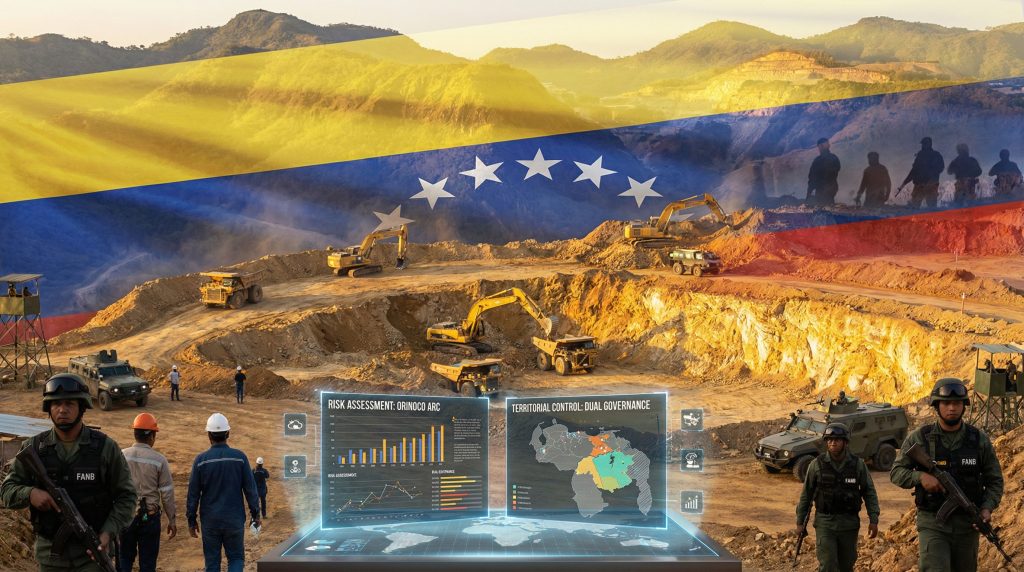
The intersection of resource extraction and criminal control represents one of the most challenging operational environments for international mining companies. In Venezuela, this complexity reaches unprecedented levels as traditional state authority competes with armed groups for territorial dominance across mineral-rich regions. Understanding these dynamics requires examining how criminal organizations establish parallel governance systems that fundamentally alter the risk calculus for global mining investment. Furthermore, Venezuela mining security concerns have intensified as criminal networks expand their territorial control while legitimate operators struggle to navigate increasingly complex operational environments.
What Makes Venezuela's Mining Security Challenge Unique in Latin America?
Criminal Governance vs. State Control – A Dual Authority Problem
Venezuela's mining security crisis differs fundamentally from other Latin American jurisdictions due to the systematic nature of criminal territorial control. Unlike Colombia or Peru, where illegal armed groups operate primarily as disruptors, Venezuelan criminal organizations have established comprehensive governance structures that include taxation systems, dispute resolution mechanisms, and labour control protocols.
Comparative Mining Governance Structures
| Country | State Control Level | Criminal Group Integration | Regulatory Framework Age |
|---|---|---|---|
| Venezuela | Fragmented | Systematic/Territorial | 26+ years (1999 base) |
| Colombia | Contested | Disruptive/Opportunistic | Regular updates |
| Peru | Dominant | Localised/Seasonal | Active modernisation |
| Chile | Complete | Minimal | Contemporary standards |
The Venezuelan model creates what security analysts term "dual sovereignty zones" where companies must navigate both official government requirements and informal criminal taxation. This parallel authority structure extends beyond simple extortion into complex partnership arrangements that can trap legitimate operators in compromising positions. Companies evaluating these risks should consider the various investment red flags that indicate potential criminal involvement in mining operations.
Transnational criminal networks have leveraged Venezuela's geographic position to create integrated smuggling corridors that span gold extraction, cocaine trafficking, and illegal migration. These multi-revenue criminal enterprises possess sophisticated logistical capabilities that often exceed those of legitimate mining operations in remote regions.
Geographic Vulnerability Assessment of Key Mining Regions
Venezuela's mineral wealth concentrates in interior regions where state presence remains limited and transportation infrastructure creates natural chokepoints for criminal control. The dispersion of mining assets across difficult terrain multiplies security challenges compared to coastal oil facilities that benefit from centralised infrastructure and maritime access.
Current intelligence suggests criminal organisations maintain operational control over significant portions of Venezuela's mineral extraction zones, creating security environments that exceed risk levels found in traditional conflict mining jurisdictions.
Border regions with Colombia and Guyana present additional complications as criminal groups exploit jurisdictional gaps and diplomatic tensions to establish cross-border smuggling networks. These tri-border areas have become staging grounds for criminal organisations seeking to monetise Venezuela's mineral resources through external markets while avoiding domestic oversight.
The Orinoco Mining Arc, despite containing substantial gold and rare earth potential, remains particularly vulnerable to criminal infiltration due to its remote location and limited government security presence. Companies considering operations in this region face security challenges that require military-grade protection protocols typically associated with active conflict zones.
When big ASX news breaks, our subscribers know first
How Do Armed Groups Control Venezuela's Mining Operations?
Revenue Extraction Mechanisms and Taxation Systems
Criminal organisations in Venezuela have developed sophisticated revenue extraction systems that go far beyond traditional protection rackets. These groups impose comprehensive taxation structures on mining operations that can include:
• Operational fees ranging from 10-30% of gross production value
• Equipment import taxes on machinery and technical supplies
• Labour recruitment fees for accessing controlled worker populations
• Transportation levies for moving materials through controlled territories
• Export facilitation charges for accessing smuggling networks
The systematic nature of these revenue streams indicates criminal organisations view mining control as long-term territorial governance rather than opportunistic extraction. This creates operational environments where legitimate companies become embedded within criminal economic systems regardless of their intentions or compliance efforts.
Forced partnership structures represent the most problematic aspect of criminal mining control. Armed groups often require foreign companies to accept local "partners" who serve as intermediaries for criminal taxation while providing legal cover for illegal revenue flows. These arrangements can expose international companies to anti-money laundering violations and sanctions breaches under multiple jurisdictions.
Workforce Control and Labour Exploitation Patterns
Criminal organisations maintain control over mining operations through sophisticated labour management systems that restrict worker movement and enforce production quotas through intimidation. These groups often control access to mining employment in their territories, creating captive labour markets that legitimate companies cannot avoid if operating in criminal-controlled zones.
Warning Signs of Criminal Organisation Involvement:
- Restrictions on worker communication with external contacts
- Mandatory use of specific transportation or logistics providers
- Requirements for cash payments to unnamed local representatives
- Prohibitions on direct government agency contact
- Unexplained production quota demands from non-company sources
Documentation of labour exploitation in Venezuelan mining districts indicates criminal groups use debt bondage, movement restrictions, and threats against family members to maintain workforce control. These practices create legal liability exposure for any company operating in affected regions, regardless of their direct involvement in exploitative practices.
Exit and entry restrictions imposed on mining personnel serve dual purposes for criminal organisations: maintaining operational security while ensuring worker compliance with illegal revenue extraction. Companies report incidents where employees have been prevented from leaving mining sites until production quotas were met or additional fees were paid to criminal intermediaries.
What Security Protocols Are International Companies Implementing?
Risk Assessment Frameworks for Venezuelan Mining Investment
International mining companies considering Venezuelan operations have developed comprehensive risk assessment protocols that extend far beyond traditional security evaluations. These frameworks incorporate criminal organisation mapping, sanctions compliance analysis, and multi-jurisdictional legal liability assessment to identify exposure points before committing resources. Additionally, understanding mining permitting challenges becomes crucial when operating in environments where legitimate regulatory processes intersect with criminal territorial control.
Step-by-Step Due Diligence Process for Security Evaluation:
- Territorial control mapping – Identify which areas operate under state vs. criminal authority
- Criminal organisation profiling – Document known groups, leadership structures, and revenue methods
- Local partner vetting – Conduct enhanced due diligence on all proposed Venezuelan counterparties
- Transportation corridor analysis – Map secure routes for personnel and materials movement
- Communications security assessment – Evaluate surveillance risks and secure communication needs
- Extraction planning – Develop contingency protocols for emergency personnel evacuation
- Legal compliance review – Analyse sanctions exposure and anti-money laundering risks
- Insurance feasibility study – Assess availability and cost of comprehensive risk coverage
Third-party security contractor vetting has become particularly complex in Venezuela as many local security providers maintain informal relationships with criminal organisations or government forces. Companies report difficulty identifying truly independent security services that can operate effectively without compromising relationships that could create legal exposure.
Intelligence gathering requirements for Venezuelan mining operations now include real-time criminal organisation activity monitoring, government security force capability assessment, and early warning systems for territorial control shifts. This intelligence infrastructure represents a significant operational cost that many mining projects cannot economically support.
Compliance Challenges Under U.S. Sanctions Regime
The anticipated general licences for Venezuelan mining operations create complex compliance environments that differ significantly from oil sector precedents. While oil operations benefit from established infrastructure and centralised control points that facilitate sanctions monitoring, mining operations' dispersed nature creates multiple potential violation points. Recent developments such as the US executive order for minerals may influence how companies approach Venezuelan operations under sanctions frameworks.
Mining vs. Oil Sector Compliance Requirements
| Compliance Factor | Mining Operations | Oil Operations |
|---|---|---|
| Geographic Monitoring | Multiple dispersed sites | Centralised facilities |
| Partner Oversight | Numerous local contractors | Established state entities |
| Revenue Tracking | Complex value chains | Direct sales mechanisms |
| Transportation Control | Multiple corridor options | Established export routes |
| Criminal Exposure Risk | High territorial overlap | Limited operational overlap |
Legal liability exposure for companies operating in criminal-controlled zones represents a significant compliance challenge that extends beyond traditional sanctions violations. Companies face potential prosecution under anti-money laundering statutes, human trafficking laws, and organised crime legislation in multiple jurisdictions if their operations inadvertently support criminal revenue streams.
The complexity of Venezuelan mining compliance has led some international companies to develop "compliance-first" operational models that prioritise legal risk management over operational efficiency. These models typically include extensive documentation requirements, third-party monitoring systems, and pre-approved extraction protocols that can significantly increase project costs.
Why Is Mining Security More Complex Than Oil Sector Recovery?
Geographic Dispersion vs. Concentrated Infrastructure
Venezuela's mining sector presents fundamentally different security challenges compared to oil operations due to the dispersed nature of mineral extraction activities. While oil facilities concentrate along coastal regions with established infrastructure and government presence, mining operations occur throughout interior regions where state authority remains contested and criminal organisations maintain territorial control.
Oil sector recovery has benefited from centralised infrastructure that enables efficient security deployment and monitoring. Chevron's achievement of record production levels at its Venezuelan project demonstrates how concentrated facilities can be effectively secured through focused resource allocation and established government cooperation protocols. Recent policy developments including the mining permits executive order may impact how companies navigate regulatory frameworks in challenging jurisdictions.
Transportation corridor vulnerabilities multiply for mining operations as mineral exports require overland routes through multiple criminal-controlled territories before reaching ports or border crossings. Unlike oil pipelines that provide direct facility-to-export connections, mining transportation depends on road networks where criminal organisations can impose taxation and control at multiple checkpoints.
Key Differences Between Securing Oil vs. Mining Operations:
Oil operations benefit from maritime access, centralised control points, and established infrastructure that enables efficient security deployment, while mining operations require protection across multiple dispersed sites connected by vulnerable transportation corridors through contested territories.
Criminal Network Integration in Mining Value Chains
Criminal organisations have achieved deeper integration within mining value chains compared to oil sector operations, creating security challenges that extend beyond physical asset protection. These groups control critical inputs including equipment procurement, labour recruitment, and logistics services that mining operations cannot easily replace or circumvent.
Hypothetical Security Breakdown Timeline for Foreign Mining Operation:
- Day 1-30: Initial criminal contact through "local partner" introductions
- Day 31-90: Gradual increase in "facilitation fees" and operational restrictions
- Day 91-180: Direct criminal organisation demands for revenue sharing
- Day 181-365: Complete integration into criminal taxation system or operational shutdown
- Year 2+: Company becomes unwilling participant in money laundering and organised crime
Corruption patterns affecting mining equipment, personnel, and product movement create systemic vulnerabilities that legitimate security measures cannot address through traditional approaches. Criminal organisations often control the very services and suppliers that companies need to implement security protocols, creating circular dependency relationships.
The embedded nature of criminal control in mining value chains means that companies cannot simply "secure" their operations without addressing broader territorial governance issues. This requirement for comprehensive security approaches significantly increases both costs and complexity compared to oil sector recovery efforts.
What Are the Investment Implications of Venezuela's Mining Security Crisis?
Capital Requirements for Comprehensive Security Operations
Security costs for Venezuelan mining operations represent unprecedented percentages of total capital expenditure compared to other international mining projects. Industry analysis suggests comprehensive security programmes can consume 15-25% of total project capex, compared to 2-5% in traditional high-risk jurisdictions. These elevated costs reflect the unique challenges posed by Venezuela mining security environments where traditional protection models prove inadequate.
Estimated Security Costs as Percentage of Mining Capital Expenditure
| Jurisdiction | Security Cost Range | Primary Risk Factors |
|---|---|---|
| Venezuela | 15-25% | Criminal territorial control, dual authority |
| DRC | 8-12% | Regional conflicts, government instability |
| Mali | 10-15% | Terrorism threats, political uncertainty |
| Peru | 3-7% | Social unrest, environmental protests |
| Chile | 1-3% | Standard industrial security |
Insurance and risk mitigation costs for Venezuelan mining projects often prove prohibitive or unavailable through traditional markets. Companies report difficulty obtaining comprehensive coverage for criminal organisation-related losses, forcing development of self-insurance models that significantly increase capital requirements.
The comprehensive nature of security requirements in Venezuela includes not only physical protection but also legal compliance monitoring, intelligence gathering, emergency extraction capabilities, and contingency planning for complete operational shutdown. These multi-layered security approaches require specialised expertise and infrastructure that traditional mining projects do not incorporate.
Timeline Projections for Stabilisation Scenarios
Short-term security outlook (1-2 years) for Venezuelan mining operations depends primarily on criminal organisation behaviour rather than government security improvements. Current intelligence suggests criminal groups view the potential influx of international mining companies as revenue opportunities rather than territorial threats, potentially creating temporary operational windows.
Security Outlook Timeline:
• Immediate term (6-12 months): Criminal organisations likely to accommodate international operations for revenue extraction
• Short term (1-2 years): Potential for increased territorial competition as multiple companies enter market
• Medium term (3-5 years): Security conditions dependent on government institutional capacity development
• Long term (5-10 years): Stabilisation requires comprehensive criminal organisation displacement and state authority restoration
Dependency on political stability and institutional reform creates investment timelines that extend far beyond typical mining project planning horizons. Companies must evaluate whether temporary operational windows justify comprehensive security investments when long-term stability remains uncertain. Understanding broader industry evolution trends helps contextualise these challenges within global mining sector developments.
Case studies from other post-conflict mining sector recoveries indicate that sustainable security improvements require 7-15 years of consistent institutional development, international cooperation, and economic diversification. Venezuela's timeline may extend longer due to the systematic nature of criminal territorial control and the country's economic dependency on resource extraction revenues.
How Can Mining Companies Navigate Venezuela's Interim Government Promises?
Evaluating Security Assurances from Rodriguez Administration
The Rodriguez administration's security commitments for international mining companies require careful evaluation against the government's actual capacity to provide protection in criminal-controlled territories. Current government security forces lack the resources, training, and territorial presence necessary to guarantee company safety in remote mining regions.
Track record analysis of Venezuelan government security commitments reveals significant gaps between official promises and operational reality. Previous security assurances to oil sector companies have proven inadequate when criminal organisations challenge government authority in contested territories.
According to reports from Venezuela's mining cooperation initiatives, US Interior Secretary Doug Burgum reported receiving assurances that the Venezuelan government would ensure security for companies conducting due diligence and reopening mining operations, including facilities previously operated 15-20 years ago. However, these commitments lack specific implementation details or enforcement mechanisms.
Gap analysis between government promises and operational capacity indicates the Rodriguez administration currently lacks the institutional infrastructure necessary to fulfil comprehensive security commitments. Government security forces remain concentrated in urban areas while criminal organisations maintain operational control over key mining regions.
Partnership Structures That Minimise Criminal Network Exposure
Joint venture models that reduce direct operational exposure offer potential pathways for international companies to access Venezuelan mining opportunities while limiting criminal organisation contact. These structures typically involve Venezuelan state entities assuming primary operational responsibility while international partners provide technical expertise and financing from outside controlled territories.
Red Flags Indicating Potential Criminal Organisation Involvement:
- Required use of specific local contractors with unclear ownership structures
- Demands for cash payments to unnamed intermediaries
- Restrictions on direct communication with government officials
- Unexplained operational requirements that lack commercial justification
- Local partners with limited verifiable business history or transparent ownership
Due diligence requirements for local partners and contractors have become essential components of Venezuelan mining security protocols. Companies must conduct enhanced background investigations that include criminal organisation affiliation checks, sanctions screening, and beneficial ownership analysis for all Venezuelan counterparties.
The complexity of Venezuelan partner vetting often requires specialised intelligence services and legal expertise that can significantly delay project timelines and increase development costs. Companies report that comprehensive due diligence processes for Venezuelan operations can take 6-12 months compared to 2-3 months in traditional jurisdictions.
The next major ASX story will hit our subscribers first
What Role Do U.S. Government Licences Play in Mining Security?
Scope and Limitations of Current Authorisation Framework
The anticipated general licences for Venezuelan mining operations will likely follow the oil sector model established through previous sanctions relief measures. These licences are expected to provide broad authorisation for mining activities while maintaining restrictions on direct government revenue transfers and prohibited entity transactions.
Comparison with existing oil sector licensing structures suggests mining licences will include similar reporting requirements, compliance monitoring protocols, and renewal mechanisms. However, the dispersed nature of mining operations may require more complex geographic and partner-specific authorisations than oil sector precedents.
Frequently Asked Questions About Operating Under Sanctions:
Can licensed companies operate in any Venezuelan territory?
Geographic restrictions may apply to areas controlled by specifically designated criminal organisations.
Do general licences eliminate all sanctions compliance requirements?
No, licences provide specific authorisations while maintaining broader sanctions framework obligations.
What happens if criminal organisations demand payments from licensed companies?
Such payments could violate anti-money laundering laws regardless of licence status.
How do licences address local partner requirements?
Partner vetting and sanctions screening remain mandatory regardless of general licence coverage.
Coordination Between U.S. Companies and Venezuelan Authorities
Information sharing protocols for security threats will likely require coordination between U.S. companies, Venezuelan government agencies, and American law enforcement entities. These multi-jurisdictional coordination requirements create complex reporting obligations that companies must navigate carefully to avoid intelligence sharing violations. Recent developments regarding US-Venezuela diplomatic relations may influence how these coordination frameworks develop.
Steps for Reporting Criminal Organisation Encounters:
- Immediate notification to company security leadership and legal counsel
- Documentation of all interactions, demands, and threats using secure communication channels
- Government reporting to appropriate U.S. and Venezuelan authorities within specified timeframes
- Legal consultation regarding sanctions compliance and law enforcement cooperation requirements
- Operational adjustment to minimise future criminal organisation exposure
- Ongoing monitoring of criminal organisation activity and territorial control changes
Liability protection mechanisms for companies cooperating with law enforcement investigations may require pre-established agreements with both U.S. and Venezuelan authorities. These coordination frameworks must address information sharing restrictions, evidence preservation requirements, and witness protection protocols for company personnel.
The complexity of multi-jurisdictional coordination in Venezuelan mining operations often requires specialised legal counsel familiar with sanctions law, international criminal law, and Venezuelan regulatory frameworks. Companies report that establishing appropriate coordination protocols can require 3-6 months of legal preparation before beginning operations.
What Are the Long-Term Security Scenarios for Venezuela's Mining Sector?
Best-Case Recovery Timeline and Requirements
Optimal security conditions for Venezuelan mining operations would require comprehensive institutional capacity building that extends far beyond current government capabilities. Sustainable security improvements depend on professional law enforcement training, territorial control restoration, and criminal organisation displacement through coordinated international cooperation.
Investment Required for Mining Sector Security Infrastructure
| Security Component | Estimated Cost (USD Billions) | Timeline for Implementation |
|---|---|---|
| Professional security force training | $2-4 billion | 3-5 years |
| Territorial control infrastructure | $5-8 billion | 5-7 years |
| Intelligence and monitoring systems | $1-2 billion | 2-3 years |
| Transportation corridor security | $3-5 billion | 4-6 years |
| International cooperation frameworks | $500 million – $1 billion | 2-4 years |
International cooperation frameworks for law enforcement would require coordination between Venezuelan authorities, regional partners, and international organisations to address transnational criminal networks. These cooperation agreements must include intelligence sharing, joint operations, and criminal justice capacity building components.
The scale of institutional development required for sustainable mining sector security suggests that even under optimal conditions, comprehensive stabilisation would require 7-10 years of consistent international investment and political commitment. This timeline assumes continued political stability and sustained international cooperation.
Worst-Case Scenarios and Risk Mitigation Strategies
Complete breakdown of government security assurances would leave international mining companies exposed to unrestricted criminal organisation control with limited recourse or protection options. This scenario could develop rapidly if criminal groups perceive government weakness or if territorial competition intensifies between different armed organisations.
Hypothetical Scenario – Complete Security Breakdown:
Government security forces withdraw from mining regions following criminal organisation territorial expansion, leaving international companies to negotiate directly with armed groups for operational continuity. Companies face choices between accepting criminal partnership or complete operational shutdown with asset forfeiture.
Exit strategy planning for international mining operations must include predetermined evacuation protocols, asset protection measures, and legal framework for operations suspension. Companies require established procedures for personnel extraction, equipment protection, and contractual obligations management during security emergencies.
Early Warning Indicators of Deteriorating Security Conditions:
- Increased criminal organisation territorial competition
- Government security force withdrawals from mining regions
- Escalating demands for criminal organisation revenue sharing
- Restrictions on company communication with external entities
- Violence against international company personnel or assets
Companies operating in Venezuelan mining must maintain constant security monitoring capabilities and predetermined thresholds for operational suspension. These early warning systems require real-time intelligence gathering and predetermined decision-making protocols that enable rapid response to changing security conditions.
How Does Venezuela's Mining Security Compare to Other High-Risk Jurisdictions?
Benchmarking Against DRC, Mali, and Myanmar Mining Operations
Venezuelan mining security challenges exceed those found in traditional conflict-affected mining jurisdictions due to the systematic nature of criminal territorial control and the absence of effective state authority in key mineral regions. Unlike the Democratic Republic of Congo or Mali, where mining companies face episodic security threats, Venezuela mining security presents continuous criminal organisation governance that affects all operational aspects.
Security Cost Structures Across High-Risk Mining Jurisdictions
| Jurisdiction | Security Costs (% of Capex) | Primary Threats | Government Capacity |
|---|---|---|---|
| Venezuela | 15-25% | Criminal territorial control | Limited/Contested |
| DRC | 8-12% | Armed group disruption | Fragmented but present |
| Mali | 10-15% | Terrorism/kidnapping | Focused but limited |
| Myanmar | 12-18% | Civil conflict zones | Authoritarian but effective |
| Afghanistan (pre-2021) | 20-30% | Taliban/terrorism | Minimal |
Success factors from other post-conflict mining recoveries indicate that sustainable security improvements require comprehensive approaches that address root causes of instability rather than symptoms. Countries like Sierra Leone and Angola achieved mining sector recovery through combinations of international peacekeeping, institutional development, and economic diversification programmes.
Key Lessons for Operating in Criminal-Controlled Mining Zones:
Successful mining operations in criminal-controlled territories require acceptance that traditional security approaches are inadequate and that companies must either engage with comprehensive territorial governance reform or accept operational integration within criminal economic systems.
The Venezuelan situation presents unique challenges because criminal organisations view mining control as long-term territorial governance rather than temporary resource extraction. This systematic approach to criminal control creates more comprehensive operational challenges than companies face in jurisdictions where criminal groups focus on episodic disruption or extortion.
Industry Best Practices for Extreme Risk Environments
Multi-layered security approach frameworks for Venezuelan mining operations must incorporate physical protection, legal compliance monitoring, intelligence gathering, and emergency extraction capabilities as integrated components rather than separate security functions. Traditional security approaches that focus primarily on physical asset protection prove inadequate in environments with systematic criminal territorial control.
Essential Security Infrastructure Requirements:
• Intelligence systems – Real-time monitoring of criminal organisation activity and territorial control changes
• Legal compliance frameworks – Continuous sanctions and anti-money laundering monitoring protocols
• Emergency extraction capabilities – Pre-positioned resources for rapid personnel evacuation
• Communication security – Encrypted systems resistant to criminal organisation surveillance
• Financial controls – Enhanced due diligence and transaction monitoring for all local payments
• Documentation protocols – Comprehensive record-keeping for regulatory compliance and legal protection
Community engagement strategies that reduce criminal organisation influence represent essential components of sustainable mining security in Venezuela. However, traditional community relations approaches may prove counterproductive in areas where criminal organisations provide essential services and maintain popular support through social programmes.
Companies must recognise that effective security in Venezuelan mining requires engagement with broader territorial governance issues rather than narrow facility protection. This comprehensive approach increases both costs and complexity while creating dependencies on political and institutional developments beyond company control.
The unprecedented nature of Venezuela mining security challenges suggests that traditional industry best practices may prove inadequate and that companies must develop innovative approaches specifically adapted to systematic criminal territorial control environments. These approaches will likely serve as models for mining operations in other jurisdictions where criminal organisations achieve comprehensive territorial governance.
Disclaimer: This analysis contains forward-looking statements and assessments based on current available information about Venezuelan mining sector conditions. Security situations can change rapidly, and companies should conduct independent risk assessments and consult with specialised security and legal professionals before making operational decisions. Investment in Venezuelan mining operations involves substantial risks including potential total loss of investment, legal liability exposure, and personnel safety threats.
Ready to Discover Tomorrow's Mining Winners Today?
Venezuela's mining security challenges highlight the critical importance of identifying emerging opportunities in more stable jurisdictions before they become crowded investment themes. Discovery Alert's proprietary Discovery IQ model delivers real-time alerts on significant ASX mineral discoveries, enabling investors to position themselves ahead of the market while avoiding the complex risk environments that plague operations in unstable regions. Begin your 14-day free trial today to access the actionable intelligence that transforms mining sector complexity into investment opportunity.