May 24, 2026
Venezuela's geological wealth and recent legislative reforms are positioning the country at the forefront of global critical mineral supply chain diversification. The Venezuela new mining bill represents a fundamental shift in the nation's approach to resource extraction, extending operational concessions and establishing modern regulatory frameworks. This transformation occurs amid unprecedented global demand for critical minerals strategy driven by clean energy transitions and technological advancement.
Legislative Framework Modernisation in Venezuelan Mining
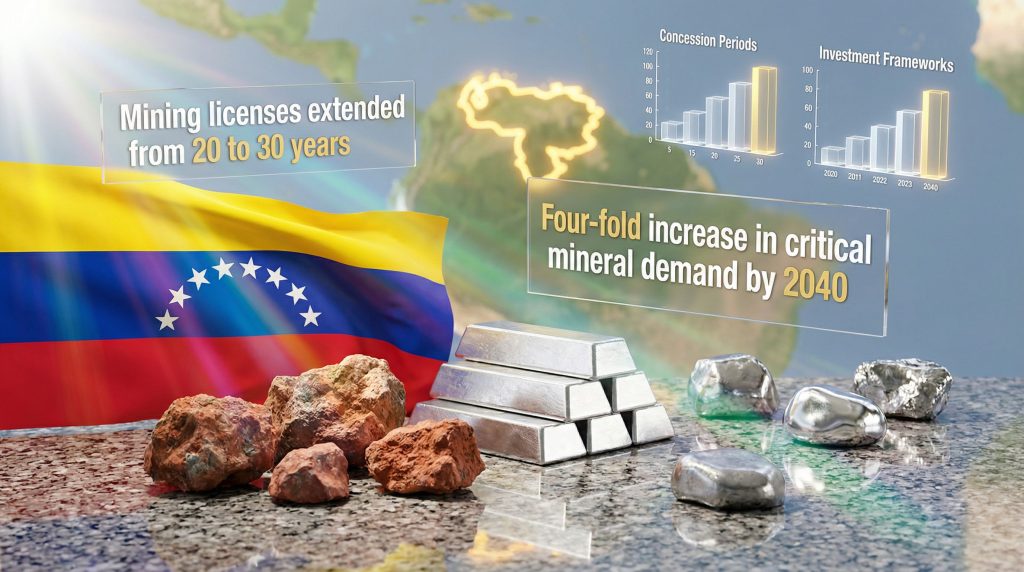
Venezuela's National Assembly has advanced comprehensive mining sector reforms through preliminary legislative approval, representing a fundamental shift in the country's approach to resource extraction and foreign investment. The Venezuela new mining bill extends operational concessions from 20 to 30 years, providing enhanced certainty for capital-intensive mining ventures requiring long-term planning horizons.
The legislative package establishes international arbitration mechanisms for investor-state disputes, addressing longstanding concerns about regulatory predictability. This framework specifically targets the replacement of outdated mining regulations from the late 1990s, creating modern legal structures for both domestic and international mining companies.
Extended Concession Terms and Investment Security
The 50% extension in mining licence duration from 20 to 30 years represents a critical competitive advantage for attracting international mining capital. This timeline aligns with industry standards for recovering investments in large-scale extraction projects, particularly those requiring substantial infrastructure development.
Mining companies typically require 7-10 years for exploration, permitting, and construction phases before achieving commercial production. The extended concession periods provide adequate runway for capital recovery and return generation, addressing a primary barrier to international investment in Venezuelan mineral resources. Furthermore, understanding mining permitting insights becomes crucial for successful project implementation.
Regulatory Architecture and Tax Framework
The reform establishes differentiated regulatory oversight for small, medium, and large-scale mining operations, acknowledging the varying technical and environmental requirements across operational scales. While specific tax calculation methodologies remain under development, the framework emphasises competitive positioning relative to regional mining jurisdictions.
Social fund establishment for mining workforce development indicates government commitment to sustainable resource extraction practices. These mechanisms align with international best practices for community benefit sharing and local economic development in mining regions. Additionally, recent mining tax reforms globally demonstrate the importance of stable fiscal frameworks.
When big ASX news breaks, our subscribers know first
Critical Mineral Resource Assessment and Global Context
Venezuela's geological profile encompasses multiple critical minerals essential for clean energy technologies, positioning the country as a potential multi-commodity supplier for global supply chains. Beyond bauxite reserves, the country contains significant deposits of beryllium, titanium, nickel, platinum, uranium, vanadium, lead, magnesium, and zinc.
The strategic timing of these reforms coincides with heightened global focus on supply chain resilience following recent geopolitical disruptions affecting traditional mineral sources. Manufacturing sectors increasingly prioritise geographic diversification to mitigate concentration risks in critical material supplies.
Bauxite Market Dynamics and Supply Chain Integration
Venezuela holds substantial bauxite deposits that could significantly impact global aluminium supply chains, particularly given the projected four-fold increase in critical mineral demand by 2040. Current global bauxite production remains concentrated among Australia, Guinea, and Brazil, creating opportunities for supply diversification.
The country's bauxite resources could serve multiple applications across clean energy value chains. For instance, the Venezuela advances reform initiative demonstrates the government's commitment to attracting foreign investment.
- Electric vehicle manufacturing: Aluminium components for battery housings and structural elements
- Solar panel infrastructure: Mounting systems and electrical components
- Wind turbine construction: Lightweight structural materials and transmission components
- Energy storage systems: Thermal management and containment applications
Historical aluminium processing operations at CVG Venalum and CVG Alcasa facilities demonstrate existing technical capabilities, though infrastructure rehabilitation remains essential for scaled operations. The bauxite project benefits analysis shows potential economic returns from well-managed operations.
Multi-Mineral Portfolio for Technology Applications
Venezuela's mineral inventory extends beyond bauxite into specialised applications for advanced technology sectors. The diversity of resources creates potential for integrated supply chain development serving multiple industrial applications.
| Mineral Category | Primary Applications | Clean Energy Relevance |
|---|---|---|
| Beryllium & Titanium | Aerospace, electronics | High-performance components |
| Nickel & Platinum | Battery cathodes, catalysts | EV battery technology |
| Uranium & Vanadium | Nuclear energy, flow batteries | Grid-scale energy storage |
| Lead, Magnesium, Zinc | Industrial processes | Manufacturing support materials |
This mineral diversity positions Venezuela as a potential one-stop supplier for integrated technology supply chains, reducing procurement complexity for multinational manufacturers. Moreover, the focus on energy transition minerals aligns with global sustainability goals.
Infrastructure Constraints and Operational Challenges
Despite substantial resource potential, Venezuelan mining development faces significant infrastructure and operational constraints that require systematic addressing. Power grid stability represents the most critical challenge for energy-intensive mining and processing operations.
What Are the Main Electricity System Challenges?
Historical electricity disruptions at the Simón Bolívar Hydroelectric Plant have previously affected aluminium smelting operations at major processing facilities. Mining operations, particularly bauxite extraction and alumina refining, require consistent power supply for optimal efficiency and cost competitiveness.
The hydroelectric dependence creates vulnerability to weather patterns, maintenance requirements, and operational disruptions. Alternative power generation sources, including natural gas thermal plants or renewable energy systems, would enhance operational reliability for mining ventures.
Power availability calculations become critical for investor due diligence, particularly regarding:
- Peak demand allocation between residential, industrial, and mining consumption
- Backup generation capacity for continuous mining operations
- Grid stability improvements through infrastructure investment
- Alternative energy development for mining-specific power needs
Security and Governance Framework Development
Illegal mining activities involving non-state actors present ongoing challenges for formal sector development. Establishing effective regulatory control over mineral extraction areas requires enhanced enforcement mechanisms and institutional capacity building.
The reform's success depends on government ability to control informal mining activities through enhanced law enforcement, establish supply chain traceability for international compliance, implement monitoring systems for environmental and social standards, and coordinate with regional authorities for cross-border security concerns.
International compliance requirements, particularly conflict minerals frameworks and certification schemes, necessitate robust governance systems for Venezuelan mining operations to access global markets.
Comparative Analysis with Global Mining Jurisdictions
Venezuela's reformed mining framework positions the country competitively relative to other emerging mining jurisdictions, particularly in concession terms and foreign investment access. However, the Venezuelan Parliament pushes mining reform to attract international capital.
Regulatory Competitiveness Assessment
| Jurisdiction | Concession Period | Foreign Investment | Arbitration Access | Political Risk |
|---|---|---|---|---|
| Venezuela (Reformed) | 30 years | Full access | International arbitration | Transitional period |
| Democratic Republic of Congo | 25 years | Joint venture required | Limited options | Moderate |
| Indonesia | 20 years | Partnership requirements | Domestic arbitration | Low |
| Chile | 30+ years | Full access | International arbitration | Low |
The reformed framework's competitive positioning depends on implementation effectiveness and political stability maintenance. International arbitration access provides essential investor protection mechanisms comparable to established mining jurisdictions.
Investment Decision Framework for Mining Companies
International mining companies evaluating Venezuelan opportunities require comprehensive risk assessment across multiple dimensions. Geological and technical factors include reserve size and quality verification through independent surveys, infrastructure development costs and timeline requirements, processing technology needs and local technical capacity, and environmental impact assessment and mitigation planning.
Political and regulatory considerations encompass regulatory continuity across potential political transitions, international recognition and diplomatic relations status, sanctions compliance and legal framework alignment, and contract sanctity and dispute resolution mechanisms.
Market and economic analysis involves global commodity demand projections and pricing trends, transportation and logistics cost optimisation, local workforce development and training requirements, and community engagement and social licence maintenance.
Implementation Timeline and Market Development Indicators
The Venezuela new mining bill requires second reading approval before becoming law, with implementation timeline dependent on regulatory framework development and institutional capacity building. The rapid policy implementation approach, characterised as moving at accelerated speed, suggests government commitment to expedited reform completion.
Legislative Process Completion and Regulatory Development
Key milestones for tracking reform implementation include National Assembly second reading vote (anticipated approval), regulatory framework publication and implementation guidelines, licensing process establishment and application procedures, international investor engagement and due diligence periods, and first mining concession awards under new framework.
What Are the Market Entry Strategies?
Successful mining development typically follows structured phases allowing for risk mitigation and staged capital deployment. Phase 1 encompasses exploration and resource definition (Years 1-3) including geological survey completion and reserve quantification, environmental baseline studies and impact assessment, community consultation and social licence development, and preliminary economic analysis and feasibility studies.
Phase 2 involves development and infrastructure (Years 3-7) covering detailed engineering and construction planning, infrastructure development including power and transportation, permitting completion and regulatory compliance establishment, and workforce development and training programme implementation.
Phase 3 focuses on commercial production and scaling (Years 7+) featuring production ramp-up and operational optimisation, market integration and supply chain development, expansion planning and additional resource development, and long-term sustainability and community benefit programmes.
Supply Chain Integration and Global Market Impact
Venezuelan mineral development could significantly influence global supply chain dynamics, particularly in critical minerals essential for clean energy transitions. The strategic positioning of new supply sources affects pricing, availability, and geopolitical considerations for consuming industries.
Geographic Diversification Benefits for Global Manufacturers
Manufacturing sectors increasingly prioritise supply source diversification following recent disruptions in global commodity markets. Venezuelan mineral participation offers reduced concentration risk through additional supply sources, enhanced negotiating power with existing suppliers, improved supply security through geographic distribution, and cost optimisation opportunities through increased competition.
The proximity to North American markets provides logistics advantages for Venezuelan minerals, particularly in transportation cost optimisation and supply chain responsiveness.
Technology Sector Integration Potential
Clean energy technology manufacturers require reliable, cost-effective mineral supplies for scaling production to meet climate transition goals. Venezuelan mineral participation could support electric vehicle supply chains through aluminium for lightweight vehicle structures, nickel for battery cathode materials, lithium processing support minerals, and manufacturing facility construction materials.
In addition, renewable energy infrastructure benefits from solar panel mounting systems and electrical components, wind turbine structural materials and generators, grid infrastructure and transmission line materials, and energy storage system containment and thermal management.
The next major ASX story will hit our subscribers first
Investment Risk Assessment and Mitigation Strategies
International mining companies require comprehensive risk evaluation frameworks when considering Venezuelan mineral investments. Political transition dynamics create both opportunities and uncertainties requiring careful analysis.
How Can Political and Regulatory Risks Be Managed?
The recent governmental transition presents mixed implications for mining investment decisions. While policy reform momentum suggests commitment to foreign investment attraction, political continuity across future transitions requires assessment. Key risk mitigation strategies include international arbitration mechanisms for dispute resolution, political risk insurance through multilateral agencies, staged investment approaches allowing for risk assessment at each phase, and partnership structures with local entities for regulatory navigation.
Operational Risk Management
Mining operations face multiple operational challenges requiring systematic risk management. Infrastructure dependencies encompass power supply reliability and backup generation requirements, transportation network capacity and maintenance needs, water supply and environmental compliance systems, and telecommunications and digital infrastructure capabilities.
Security and governance considerations include informal mining activity control and supply chain integrity, community relations and social licence maintenance, environmental compliance and international standard alignment, and workforce safety and international labour standard compliance.
Market Psychology and Investor Sentiment Considerations
Mining investment decisions involve complex psychological factors beyond purely financial calculations. Investor sentiment regarding Venezuelan opportunities reflects broader perceptions about political stability, regulatory predictability, and operational feasibility.
Institutional Investor Perspectives
Large-scale mining investments typically involve institutional capital sources with specific risk tolerance parameters and return requirements. Venezuelan mineral opportunities must compete with alternative global investment options across multiple evaluation criteria. Institutional investors increasingly emphasise environmental, social, and governance (ESG) considerations in mining investment decisions.
Venezuelan projects must demonstrate compliance with international standards for sustainable mining practices. Consequently, the convergence of critical mineral demand growth and Venezuelan regulatory reform creates a unique window for strategic positioning.
Strategic Timing and Market Positioning
Early entrants may capture advantageous resource positions and regulatory relationships before increased competition emerges. However, first-mover risks include higher regulatory uncertainty and operational challenges that later entrants may avoid through lessons learned and improved infrastructure.
The Venezuela new mining bill represents a significant development in global critical mineral supply chain evolution. Success depends on effective implementation of regulatory frameworks, infrastructure development, and international investment confidence building.
While substantial opportunities exist for supply chain diversification and clean energy technology support, investors must carefully evaluate political, operational, and market risks through comprehensive due diligence processes. Mining companies and institutional investors should monitor legislative finalisation, early licensing rounds, and infrastructure investment commitments as key indicators of reform success.
The strategic timing of these reforms aligns with global critical mineral demand acceleration, potentially positioning Venezuela as an important contributor to clean energy transition supply chains if implementation challenges are successfully addressed.
This analysis is based on publicly available information and should not be considered investment advice. Readers should conduct independent research and consult qualified professionals before making investment decisions. Political and regulatory developments may affect the accuracy of projections and should be monitored continuously.
Looking for Opportunities in ASX Critical Mineral Companies?
Discovery Alert's proprietary Discovery IQ model delivers real-time alerts on significant critical mineral discoveries, instantly empowering subscribers to identify actionable opportunities ahead of the broader market. Begin your 14-day free trial today and secure your market-leading advantage.