May 21, 2026
Understanding the Veracruz Coastal Environmental Crisis
Environmental governance frameworks face mounting pressure as contamination incidents expose critical regulatory gaps in emergency response systems. Traditional accountability mechanisms struggle when jurisdictional boundaries blur and responsibility becomes diffuse across multiple agencies and private operators. These systemic challenges reveal fundamental weaknesses in how nations prepare for, respond to, and recover from major environmental disasters, particularly in regions where deep‐sea mining concerns intersect with existing industrial activities.
When big ASX news breaks, our subscribers know first
Mapping Mexico's Gulf Coast Environmental Emergency
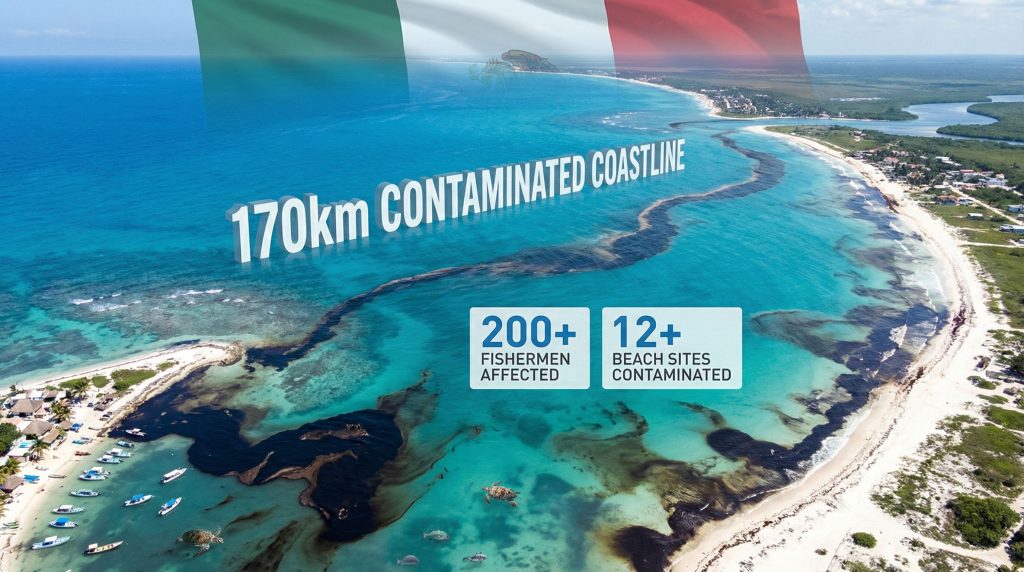
The Gulf of Mexico coastline confronts an extensive hydrocarbon contamination crisis spanning 170 kilometres across Veracruz and Tabasco states. This oil spill along Veracruz coast represents one of the most significant environmental challenges facing Mexico's southeastern region in recent years.
The contamination extends from Punta San Juan to Bocana Rio Temoloapan, creating a continuous corridor of environmental damage that transcends state boundaries. Alvarado and Coatzacoalcos in Veracruz bear the heaviest impact, while Tabasco's shoreline faces similar ecological disruption.
Economic Disruption During Critical Fishing Season
The timing of this environmental disaster compounds its economic impact significantly. The incident occurred during Lent season, traditionally the most crucial period for local fishing communities when demand for seafood reaches annual peaks. Fishermen now confront contaminated equipment and suspended operations precisely when their livelihoods depend most heavily on coastal resources.
Local fishing operations face immediate operational challenges:
- Net contamination requiring complete replacement
- Boat cleaning and decontamination expenses
- Revenue loss during peak seasonal demand
- Market confidence erosion in regional seafood products
Biodiversity Impact Assessment
The ecological consequences extend far beyond immediate economic disruption. Coastal lagoons, critical nursery habitats for multiple marine species, face contamination that could persist for months or years. These shallow water systems support complex food webs including commercially important fish species, crustaceans, and protected marine mammals.
Marine ecosystem stress indicators include:
- Disrupted feeding patterns in coastal bird populations
- Potential impacts on sea turtle nesting beaches
- Contamination of seagrass beds essential for manatee populations
- Shrimp farming operations at risk of water quality violations
The contamination affects approximately 12 beach sites in northern Veracruz and 4 coastal areas in southern Tabasco, with over 200 fishermen experiencing direct economic impact from the incident.
Institutional Response Failures and Coordination Gaps
Mexico's environmental regulatory architecture faces scrutiny as response coordination reveals significant institutional weaknesses. The Federal Attorney for Environmental Protection (PROFEPA) and state environmental agencies struggle with resource constraints and jurisdictional ambiguities that hamper effective emergency response. Furthermore, these challenges highlight the need for improved waste management solutions in coastal industrial operations.
Federal Agency Resource Limitations
PROFEPA's response challenges demonstrate systemic capacity gaps:
| Response Element | Identified Weakness | Impact on Recovery |
|---|---|---|
| Deployment Speed | Delayed arrival at contamination sites | Extended environmental exposure |
| Inter-agency Coordination | Insufficient communication protocols | Duplicated efforts and resource waste |
| Real-time Monitoring | Lack of continuous surveillance systems | Limited damage assessment capability |
| Emergency Protocols | Inadequate pre-positioned response plans | Reactive rather than proactive management |
The incident exposes fundamental flaws in Mexico's environmental emergency response framework. Current legal structures place excessive investigative burden on government agencies while providing limited mechanisms for rapid cost recovery from responsible parties.
State-Level Governance Challenges
Veracruz and Tabasco state environmental agencies face resource constraints that limit their capacity for independent response and long-term monitoring. Governor Rocío Nahle indicated that investigations point toward a private operator holding concessions granted during the previous Peña Nieto administration, highlighting the complexity of accountability across different political periods.
Inter-state coordination difficulties include:
- Jurisdictional boundary disputes over response authority
- Resource allocation conflicts between competing state priorities
- Information sharing barriers between state environmental agencies
- Tourism sector protection creating competing policy objectives
Source Attribution Controversy and Political Dynamics
The investigation into responsibility for this oil spill along Veracruz coast reveals deeper institutional challenges in Mexico's environmental accountability framework. President Claudia Sheinbaum categorically stated that PEMEX bears no responsibility for the contamination, while investigations focus on private sector vessel operations. However, this incident underscores the broader need for government intervention in industrial oversight.
Evolving Official Narratives
Government explanations have centred on private operator involvement rather than state enterprise responsibility. This positioning reflects broader political dynamics surrounding Mexico's energy sector governance and the role of private concessionaires in offshore operations.
Key institutional positions:
- Federal Executive: PEMEX denial of responsibility with private vessel investigation focus
- State Government: Private operator accountability linked to previous administration concessions
- Attorney General's Office: Ongoing investigation without preliminary findings release
- PROFEPA: Supporting cleanup efforts while maintaining investigative neutrality
Technical Investigation Constraints
Mexico's forensic analysis capabilities for hydrocarbon source identification face significant limitations. Hydrocarbon fingerprinting requires sophisticated laboratory equipment and expertise that may exceed current institutional capacity.
The absence of comprehensive offshore monitoring systems creates information gaps that complicate source attribution and delay emergency response activation.
Investigation challenges include:
- Limited vessel tracking coverage in affected offshore areas
- Insufficient real-time environmental monitoring networks
- Constrained laboratory capacity for chemical composition analysis
- Inadequate coordination between maritime and environmental authorities
Historical Concession Context
The reference to concessions granted during the Peña Nieto administration (2012-2018) introduces additional complexity to accountability determination. Energy sector liberalisation during this period created multiple private operators with offshore exploration and production rights, complicating the regulatory landscape for environmental oversight. These complexities mirror broader resource governance challenges across various industrial sectors.
Economic Sector Vulnerability Analysis
What are the Long-term Implications for the Fishing Industry?
Beyond immediate operational disruptions, the fishing sector faces potential long-term market access challenges. Consumer confidence in regional seafood products may require months or years to recover, particularly if contamination persists in commercially important species.
Market impact categories:
- Domestic consumption patterns shifting away from Gulf coast products
- Export certification requirements potentially restricting international sales
- Insurance premiums increasing for fishing operations in affected areas
- Equipment replacement costs creating financial strain for small-scale operators
Tourism Infrastructure Risk Assessment
Coastal tourism operations face reputational damage that extends beyond immediate beach closures. Hotel occupancy rates in affected municipalities may experience sustained declines as potential visitors avoid areas perceived as environmentally compromised.
The contamination affects tourism during a critical seasonal period when many coastal businesses generate significant portions of their annual revenue. Consequently, recovery timelines depend heavily on remediation effectiveness and public perception management.
Regulatory Framework Modernisation Requirements
International Best Practice Integration
Mexico's environmental liability framework requires substantial modernisation to address the gaps exposed by this incident. Strict liability standards for marine pollution, common in developed regulatory systems, could eliminate lengthy investigations whilst ensuring rapid response funding.
Comparative regulatory approaches:
| Country | Liability Standard | Response Funding | Monitoring System |
|---|---|---|---|
| Norway | Strict liability | Mandatory insurance | Real-time satellite surveillance |
| Canada | Joint and several liability | Government fund with cost recovery | Integrated coastal monitoring |
| United States | OPA 1990 strict liability | Oil Spill Liability Trust Fund | National Response System |
| Mexico | Fault-based liability | Limited government resources | Fragmented monitoring |
Enhanced Monitoring and Detection Systems
Recommended infrastructure improvements:
- Mandatory vessel tracking for all offshore operations
- Real-time environmental monitoring networks in coastal areas
- Automated spill detection and alert systems
- Satellite-based coastal surveillance programmes
- Integrated response communication platforms
Strengthened Accountability Mechanisms
Environmental liability reform should establish clear financial responsibility for contamination events regardless of fault determination. Mandatory environmental insurance requirements could ensure immediate response funding whilst protecting government resources. Additionally, this approach aligns with broader industry sustainability transformation efforts.
Policy reform priorities:
- Strict liability implementation for marine hydrocarbon releases
- Enhanced penalty structures creating stronger deterrence incentives
- Mandatory environmental insurance for offshore operators
- Streamlined cost recovery procedures for government response expenses
The next major ASX story will hit our subscribers first
Broader Energy Sector Safety Context
The Veracruz coastal contamination occurs alongside other significant safety incidents in Mexico's energy infrastructure. A fatal fire at the Dos Bocas refinery in Paraiso, Tabasco, on March 17, 2026, claimed five lives and highlighted broader safety governance challenges. Reports indicate that Mexican coastal communities remain vulnerable to additional contamination events.
The refinery incident involved oily water overflow from Cold Front No. 41 precipitation, creating flammable surface conditions that ignited when a vehicle passed through contaminated areas. This incident demonstrates inadequate perimeter safety controls and emergency response protocols.
Systemic safety issues include:
- Insufficient weather-related contingency planning
- Inadequate perimeter security and access control
- Limited coordination between direct employees and subcontracted workers
- Deficient emergency response and evacuation procedures
Long-term Environmental Governance Implications
Federal-State Coordination Enhancement
This oil spill along Veracruz coast demonstrates the urgent need for unified command structures in environmental emergencies. Clear jurisdictional boundaries and pre-established coordination protocols could eliminate response delays and resource duplication.
Institutional reform requirements:
- Joint training programmes for federal and state environmental agencies
- Information sharing protocols enabling real-time coordination
- Resource pooling agreements for emergency response equipment
- Community engagement frameworks ensuring local participation in recovery planning
Private Sector Integration
Enhanced environmental governance requires stronger integration of private sector capabilities and responsibilities. Public-private partnerships for monitoring and response could leverage industry expertise whilst maintaining regulatory oversight. Meanwhile, investigations reveal ongoing environmental impacts across the affected region.
How Will Market Psychology Affect Investment Decisions?
Environmental incidents create lasting impacts on investor confidence in Mexico's energy sector. Risk premium increases for offshore operations may drive up capital costs and insurance requirements, potentially affecting the competitive position of Mexican energy projects.
Investment risk factors:
- Regulatory uncertainty regarding liability standards and enforcement
- Reputational damage affecting international energy partnerships
- Insurance cost increases for offshore exploration and production
- Community relations challenges complicating project development
The incident occurs as Mexican crude prices approach $100 per barrel due to Middle East geopolitical tensions, creating a complex market environment where environmental risks intersect with geopolitical energy supply concerns.
Future Regulatory Trajectory
Mexico's environmental regulatory framework faces pressure for comprehensive modernisation. International best practices in strict liability, mandatory insurance, and integrated monitoring systems provide proven models for enhanced environmental protection.
The path forward requires substantial investment in monitoring infrastructure, institutional capacity building, and legal framework reform. In addition, without these improvements, Mexico's coastal communities remain vulnerable to future environmental disasters that could have been prevented or more effectively managed through stronger governance systems.
Investment Consideration: This environmental incident highlights the critical importance of comprehensive due diligence for energy sector investments in Mexico, particularly regarding environmental liability exposure and regulatory compliance costs.
The Veracruz coastal contamination represents a watershed moment for Mexican environmental policy. The response to this crisis will determine whether Mexico develops the institutional capacity necessary to protect its coastal resources and communities from future environmental emergencies. Ultimately, this oil spill along Veracruz coast serves as a crucial test case for Mexico's commitment to environmental protection and regulatory modernisation.
Ready to Capitalise on Mexico's Energy Sector Challenges?
Environmental crises like the Veracruz oil spill create significant market volatility and investment opportunities across energy and mining sectors. Discovery Alert's proprietary Discovery IQ model delivers real-time alerts on significant ASX mineral discoveries, helping investors identify actionable opportunities that emerge from global market shifts and sectoral disruptions. Begin your 14-day free trial today to position yourself ahead of market movements and secure your competitive advantage.