
May 23, 2026
Global mining markets increasingly recognise that regional workforce capabilities directly influence supply chain stability and investment allocation patterns. The copper sector exemplifies this dynamic, where production targets depend not merely on geological resources or capital availability, but fundamentally on technical human capital development. Strategic minerals demand for energy transition creates unprecedented pressure on producing regions to scale operational capacity rapidly, as detailed in various industry evolution trends.
Zambia presents a particularly compelling case study in this workforce-dependent growth equation. The country's ambitious copper production expansion plans collide with structural educational and training limitations, creating ripple effects throughout international mining investment flows. Understanding these dynamics requires examining both immediate operational constraints and longer-term institutional capacity building requirements.
The Strategic Dimension of Zambia's Workforce Gap
Critical Production Targets Meet Reality
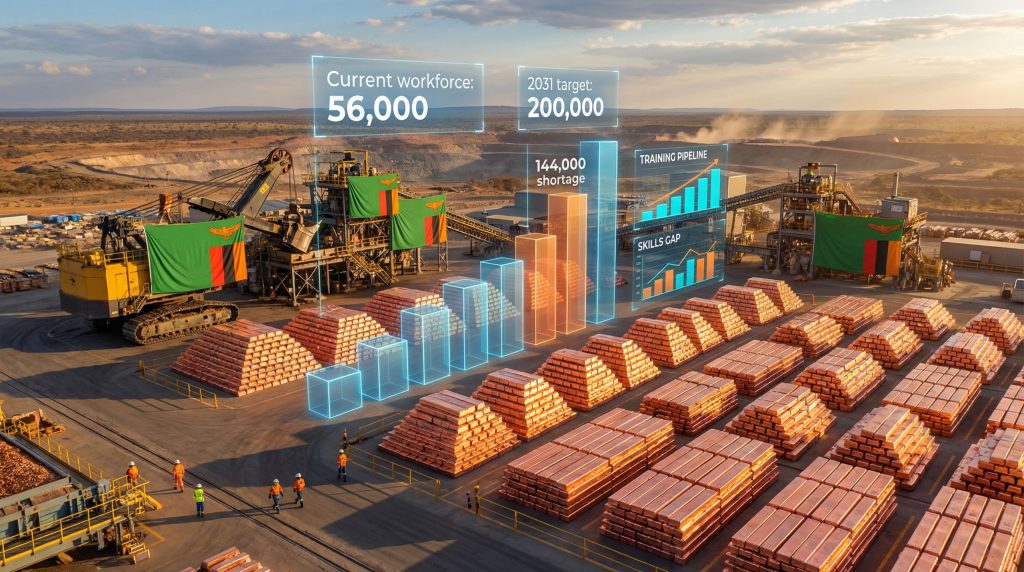
Zambia's mining sector faces an extraordinary scaling challenge. Current mining employment stands at 56,000 direct workers, yet achieving the government's 2031 copper production targets requires 200,000 direct mining jobs. This 144,000-person deficit represents more than a simple recruitment challenge – it constitutes a fundamental constraint on national economic strategy.
The mathematics of this expansion reveals the scope of institutional transformation required. Achieving these employment levels would necessitate nearly quadrupling the existing mining workforce within a seven-year timeframe. Historical precedent suggests such rapid workforce scaling typically requires 10-15 years in established mining jurisdictions with mature training infrastructure.
International Investment Risk Recalibration
Foreign mining companies now integrate workforce availability assessments into core investment decision frameworks. Traditional due diligence focused on geology, infrastructure, and regulatory environments. Contemporary project evaluation increasingly weights skills availability as a primary risk factor affecting project economics and development timelines.
This shift reflects lessons learned from projects where skills shortages created cascading delays and cost overruns. Mining companies report that skills-related bottlenecks can extend project development timelines by 18-24 months beyond original schedules, fundamentally altering internal rate of return calculations.
The mining skills shortage in Zambia directly impacts global copper supply chain planning. International mining corporations must now factor workforce development costs and timelines into project economics as core line items rather than peripheral human resources considerations.
Comparative African Mining Jurisdiction Analysis
| Country | Mining Workforce | Training Capacity | Competitive Position |
|---|---|---|---|
| Zambia | 56,000 | Limited TVET output | Skills-constrained growth |
| Botswana | Established base | Strong technical programmes | Competitive advantage |
| DRC | Large but unstructured | Minimal formal training | Political risk offset |
| South Africa | Mature workforce | Comprehensive institutions | High labour costs |
This competitive positioning analysis reveals how skills availability creates or constrains investment flows between African mining jurisdictions. Countries with established technical training infrastructure attract capital that might otherwise target geological opportunities in skills-constrained markets.
When big ASX news breaks, our subscribers know first
Technical Skills Categories Driving Bottlenecks
Traditional Mining Operations Expertise
The foundation of mining operations requires specialised technical roles that cannot be rapidly substituted or imported. Diesel mechanics, fitters, riggers, and coded welders represent artisan categories requiring 2-3 years apprenticeship under experienced supervision. Heavy equipment operators in mining contexts must understand load management in deep mining environments and preventive maintenance protocols for capital-intensive machinery.
These positions require mining-specific certification and experience that general industrial training cannot provide. Safety protocols, equipment specifications, and operational procedures differ substantially between mining and other industrial applications.
Current wage premiums for experienced artisans in Zambia have increased 40-60% over historical levels, reflecting acute scarcity. This wage inflation creates talent poaching between mining operations and discourages long-term skills development investment.
Advanced Technical and Engineering Roles
Mine engineers, geotechnical specialists, and surveyors require university-level training plus extensive field experience. Geological conditions in Zambian copper deposits demand specific expertise in rock mechanics, hydrology, and metallurgical processes that generic engineering programmes do not address.
Resource estimation experts and mine planning specialists combine geological knowledge with advanced software capabilities and economic modelling skills. These positions typically require 5-7 years to reach full competency, creating significant pipeline delays for workforce scaling.
Environmental management and health and safety specialists require current knowledge of international standards, risk assessment methodologies, and regulatory compliance frameworks. Furthermore, the complexity of modern mining environmental requirements demands continuous professional development that existing Zambian institutions struggle to provide.
Emerging Technology Integration Challenges
Modern mining operations increasingly depend on automation, remote operations, and data analytics capabilities. Zambia currently possesses virtually zero local capacity in these domains, creating complete dependence on international expertise for critical operational systems.
The integration of AI in mining operations requires specialised expertise that local institutions cannot yet provide. High-voltage electrical systems in modern mines require specialised certification and troubleshooting expertise. When these systems malfunction, operations depend entirely on international technical support, creating production delays and escalating operational costs.
SCADA (Supervisory Control and Data Acquisition) systems and real-time data analysis capabilities represent entirely new skill categories not addressed in current Zambian technical education curricula. These competencies require advanced technical certification combined with software troubleshooting abilities.
Management and Supervisory Capacity Gaps
Section and shift supervisors require operational experience combined with leadership and safety management capabilities. The scarcity of experienced local professionals creates mentorship bottlenecks that constrain supervisory development pipelines.
Project managers with mining experience understand specialised procurement, logistics, and coordination requirements distinct from general project management. Mining project management involves unique risk profiles, regulatory requirements, and stakeholder coordination challenges.
Procurement specialists in mining contexts must understand specialised equipment sourcing, vendor qualification processes, and international logistics coordination. These capabilities typically develop through extensive industry experience rather than formal education programmes.
Training System Structural Failures
TVET Capacity and Output Analysis
Zambia's Technical and Vocational Education and Training institutions produced only 800 qualified graduates in 2023, while industry requirements exceed 5,000+ graduates annually. This 84% shortfall represents a systemic capacity constraint rather than a temporary mismatch.
TVET programmes in mining require expensive laboratory equipment, hands-on training facilities, and qualified instructors with current industry experience. Capital investment requirements for comprehensive mining technical programmes exceed the financial capacity of most Zambian educational institutions.
Geographic distribution challenges compound capacity limitations. Training facilities concentrated in Lusaka and Kitwe cannot efficiently serve distributed mining operations across the Copperbelt region, creating accessibility barriers for potential students from rural mining communities.
University-Industry Curriculum Disconnect
Copperbelt University and the University of Zambia offer mining engineering programmes, but curriculum development cycles operate significantly slower than mining industry technology adoption. Academic institutions typically require 3-5 years to update curricula, while mining technology and operational practices evolve continuously.
Industry advisory board engagement remains limited, reducing feedback loops between current operational requirements and academic programme content. Consequently, this disconnect means graduates often require substantial additional training before reaching operational competency.
Research collaboration between universities and mining operations occurs sporadically rather than systematically. Limited industry-funded research programmes reduce opportunities for faculty to maintain current expertise in operational mining practices.
Knowledge Transfer Mechanism Inadequacies
Traditional apprenticeship and mentorship programmes face structural barriers in Zambia's mining sector. With only 56,000 total mining employees, the pool of experienced professionals available for systematic knowledge transfer remains severely constrained.
Expatriate knowledge transfer occurs irregularly and often focuses on immediate operational needs rather than systematic skills development. International experts typically engage in problem-solving roles rather than structured teaching and mentorship functions.
Work-based learning integration with formal education programmes lacks institutional coordination. Students often complete theoretical training without meaningful exposure to current mining operational practices, creating preparation gaps for employment transitions.
Government and Industry Strategic Responses
National Skills Development Framework Implementation
The Zambian government's Labour Market Information System (LMIS) represents an attempt to create real-time tracking of skills supply and demand across the mining sector. This system would theoretically enable more responsive training programme adjustments based on actual industry requirements.
However, LMIS implementation progress remains inconsistent, with limited real-time data collection and analysis capabilities currently operational. Effective labour market information systems require substantial technical infrastructure and ongoing data management capabilities that challenge current institutional capacity.
The Mining Sector Skills Strategy establishes broad policy frameworks for skills development coordination but lacks specific funding commitments and timeline accountability mechanisms. Policy frameworks without dedicated implementation resources typically produce limited practical outcomes.
Public-Private Partnership Models
Industry-funded training centre development represents the most promising avenue for rapid capacity expansion. Mining companies increasingly recognise that direct investment in training infrastructure provides more reliable workforce pipeline development than traditional recruitment approaches.
Corporate apprenticeship programmes allow mining operations to integrate skills development with project development phases. Companies can begin workforce development during licensing and permitting periods, using the typical 18-month lead time before production begins for systematic training programme implementation.
International partnership agreements with established mining education institutions offer potential for curriculum transfer and instructor development. However, these partnerships require substantial coordination and sustained funding commitments to achieve meaningful scale.
Technology-Enhanced Training Solutions
Virtual reality and simulation-based learning platforms could potentially overcome geographic constraints and reduce training infrastructure capital requirements. These technologies enable distributed delivery of hands-on training experiences without requiring expensive physical equipment at every training location.
Remote mentoring systems connecting Zambian students with experienced international mining professionals offer possibilities for knowledge transfer that transcends geographic limitations. However, these systems require reliable internet infrastructure and systematic programme coordination.
Digital certification and competency tracking systems could provide standardised skills verification across the industry. These systems would enable more efficient skills matching between workers and positions while providing career development pathway visibility for workers.
Strategic Workforce Planning for Mining Companies
Project Lifecycle Workforce Integration
Mining companies increasingly recognise that workforce planning must begin during early project development phases rather than waiting for production startup. The typical 18-month licensing-to-production timeline provides a critical intervention window for structured workforce development.
Early engagement with workforce solutions providers enables companies to identify specific role requirements, align hiring with project phases, and establish candidate pipelines before immediate production pressures emerge. This proactive approach contrasts with traditional reactive recruitment that occurs during production startup phases.
Regional talent pool mapping enables companies to understand skills availability across geographic areas and plan recruitment strategies accordingly. Companies with deep local knowledge often achieve better access to available skills and resources than those relying on centralised recruitment approaches.
Hybrid Workforce Strategy Development
Structured skills transfer programmes represent the most sustainable approach to addressing immediate skills needs while building long-term local capability. These programmes involve bringing experienced international professionals specifically to develop local capacity rather than filling operational roles indefinitely.
Effective skills transfer requires systematic planning that places local workers with basic qualifications onto structured development pathways. This approach enables progression into specialised roles over time while reducing dependence on expatriate expertise.
Cost-benefit analysis of training versus importing expertise increasingly favours investment in local development programmes. While initial training costs may exceed short-term recruitment expenses, long-term workforce stability and reduced expatriate costs provide superior economic outcomes.
Partnership Selection and Management
Successful workforce development partnerships require providers with established regional presence and demonstrated track records in mining skills development. Local presence enables better access to available talent pools and cultural understanding that improves programme effectiveness.
Mobilisation capability becomes critical when projects require rapid workforce scaling. Partners must demonstrate ability to coordinate complex recruitment, training, and deployment processes within compressed timeframes typical of mining project development.
Talent development track records provide the most reliable indicator of partnership success potential. Companies should evaluate historical outcomes, graduate employment rates, and long-term career progression of programme participants when selecting workforce development partners.
Economic Implications for Zambian Development
Mining Sector Growth Potential and Constraints
Zambia's economic diversification strategy depends fundamentally on mining sector expansion success. The mining skills shortage in Zambia creates a binding constraint on the country's ability to capitalise on global copper demand growth and energy transition opportunities.
Foreign worker dependency creates immediate operational capabilities but limits local economic development impact. Expatriate workers typically repatriate substantial portions of their earnings, reducing local economic multiplier effects from mining expansion.
Value chain capture opportunities require local technical capabilities that enable upstream and downstream industry development. Without adequate skills development, Zambia remains positioned as a raw material exporter rather than developing higher-value processing and manufacturing capabilities.
Regional Competitive Positioning Analysis
Skills availability increasingly influences investment flow patterns across African mining jurisdictions. Countries with established technical training infrastructure and demonstrated workforce development capabilities attract capital that might otherwise target geological opportunities in skills-constrained markets.
Investment redirection risks emerge when skills shortages create consistent project delays and cost overruns. International mining companies possess alternative investment opportunities across multiple African jurisdictions and will increasingly favour locations with reliable workforce availability.
Infrastructure development correlates strongly with skills availability. Mining operations require sophisticated support services, equipment maintenance capabilities, and technical expertise that depend on trained local workforces. Skills shortages constrain infrastructure development and reduce overall investment attractiveness.
Demographic and Social Development Considerations
Youth employment opportunity creation through mining skills development could address broader unemployment challenges in Zambia. However, realising this potential requires systematic career pathway development that connects rural youth with mining industry opportunities.
Gender inclusion strategies in technical mining roles remain underdeveloped in Zambian contexts. International best practices demonstrate that inclusive workforce development programmes can substantially expand available talent pools while addressing social development objectives.
Rural-urban migration patterns influenced by mining employment opportunities create both economic benefits and social challenges. Effective workforce development must consider community impact management and sustainable development approaches that benefit both mining operations and local communities.
The next major ASX story will hit our subscribers first
International Best Practice Adaptation Models
Australian Mining Skills Development Framework
Australia's TAFE (Technical and Further Education) system provides a potential model for systematic mining skills development that could be adapted for African contexts. This system combines industry funding, government support, and standardised curricula that align with operational requirements.
Industry levy systems in Australia fund skills development through mandatory contributions from mining companies based on workforce size and operational scale. This approach ensures adequate funding for training programmes while distributing costs across the industry.
Remote area training delivery mechanisms developed for Australian mining regions could address geographic challenges in Zambian contexts. These approaches include mobile training units, intensive residential programmes, and technology-enhanced distance learning solutions.
Canadian Mining Education Excellence
Canadian university-industry collaboration models demonstrate effective integration of academic research with operational mining requirements. These partnerships produce graduates with current technical knowledge while advancing mining technology development.
Indigenous workforce development strategies in Canada offer relevant approaches for inclusive skills development that could benefit rural Zambian communities. These programmes typically combine technical training with cultural considerations and community development objectives.
Technology transfer and innovation integration in Canadian mining education ensures that students learn current operational practices while contributing to technological advancement. This approach creates continuous feedback loops between education and industry development.
Chilean Copper Sector Workforce Development
Chile's state-led skills planning and coordination provides a framework for systematic workforce development that aligns with national economic development objectives. This approach involves government coordination of industry requirements with educational institution capacity.
International expertise attraction and retention strategies in Chile combine immigration policies with skills development programmes to create sustainable workforce expansion. These approaches could inform Zambian policies for managing expatriate expertise while building local capabilities.
Local content requirements and skills transfer mandates in Chilean mining operations ensure that foreign investment contributes to local workforce development. These regulatory approaches create incentives for systematic skills transfer rather than indefinite expatriate employment.
Investment Evaluation Framework Enhancement
Due Diligence Integration of Workforce Factors
Modern mining project evaluation must incorporate workforce availability risk assessment methodologies as core components of feasibility analysis. Traditional due diligence approaches that focus primarily on geological and financial factors no longer adequately capture project risk profiles.
Skills development cost integration in project economics requires understanding both direct training expenses and timeline impacts on cash flow projections. These costs often represent 15-25% of total project development budgets in skills-constrained environments.
Timeline impact analysis for skills-related delays must consider cascading effects on project financing, market positioning, and operational readiness. Skills shortages can extend project development timelines by 18-24 months, fundamentally altering investment returns.
ESG Integration Through Workforce Development
Local capacity building increasingly functions as a measurable sustainability metric that influences investment decisions and company valuations. Investors recognise that sustainable mining operations require local workforce development that creates long-term community benefits.
Community development through skills transfer programmes addresses social licence to operate requirements while creating operational workforce pipelines. These programmes demonstrate tangible community benefit that supports long-term operational stability.
Workforce development investments contribute to long-term social licence to operate by creating economic opportunities that extend beyond immediate mining operations. Communities with enhanced technical skills can support broader economic development that reduces dependence on individual mining projects.
Portfolio Risk Management Strategies
Geographic diversification considering skills availability enables mining companies to balance exposure between skills-constrained and skills-abundant jurisdictions. This approach reduces overall portfolio risk while maintaining exposure to high-potential geological opportunities.
Partnership strategies with established workforce providers create competitive advantages in skills-constrained markets. Companies that develop systematic workforce development capabilities can operate effectively in environments where competitors face skills-related constraints.
Technology adoption to reduce skills dependency represents a long-term strategy for operating in skills-constrained environments. Automation and remote operations capabilities can reduce workforce requirements while maintaining operational efficiency.
What Are the Key Success Factors for Mining Investment in Zambia?
Success in Zambia's mining sector requires junior mining strategies that prioritise workforce development alongside geological assessment. Companies must evaluate local talent availability as rigorously as they assess ore body quality.
Investment success depends on establishing partnerships with educational institutions and training providers before operational needs emerge. This proactive approach ensures workforce pipelines align with production timelines and reduces skills-related project delays.
Furthermore, successful companies invest in mining basics guide training for local communities, creating broader talent pools that support long-term operational sustainability.
How Can Mining Companies Navigate Skills Constraints Effectively?
Effective navigation of skills constraints requires hybrid workforce strategies that combine international expertise with systematic local capacity building. Companies should treat skills transfer as a core operational requirement rather than a peripheral human resources activity.
Technology adoption can reduce immediate skills dependency while local training programmes develop. Remote operations capabilities and automated systems provide operational continuity during workforce development phases.
Partnership selection becomes critical for companies operating in skills-constrained environments. Providers with proven track records in mining workforce development and local presence offer superior outcomes compared to generic recruitment services.
Strategic Outlook and Implementation Considerations
The mining skills shortage in Zambia represents both immediate operational challenges and longer-term strategic opportunities for companies, investors, and policymakers who develop systematic responses. Success requires coordination between government policy, industry investment, and educational institution development that extends beyond traditional sectoral boundaries.
Companies that invest early in workforce development gain competitive advantages in skills-constrained markets while contributing to sustainable economic development. These investments require patient capital and systematic planning but generate superior long-term returns through workforce stability and community relationship development.
International mining investment flows will increasingly favour jurisdictions with demonstrated workforce development capabilities and systematic skills planning. Countries that develop these capabilities attract higher-quality investment and capture greater value from their natural resource endowments.
Additionally, junior explorers funding models should incorporate workforce development costs as essential project infrastructure, similar to transport and power requirements.
The transformation required in Zambia's mining skills landscape demands unprecedented coordination between government, industry, and educational institutions. Furthermore, according to recent World Bank analysis, success depends on sustained commitment to systematic workforce development that treats skills as strategic infrastructure rather than operational overhead.
However, the Zambian mining sector faces significant challenges that require immediate attention from both government and industry stakeholders. Consequently, addressing these challenges through coordinated efforts will determine whether Zambia can capitalise on global copper demand opportunities or remain constrained by workforce limitations.
Disclaimer: This analysis is based on publicly available information and industry reports as of April 2026. Mining sector conditions, government policies, and workforce statistics may change. Investors should conduct independent due diligence and consult with qualified advisors before making investment decisions. Forward-looking statements regarding copper demand, production targets, and workforce development outcomes involve inherent uncertainties and should be considered speculative.
Want to Capitalise on Zambia's Mining Workforce Transformation?
Discovery Alert's proprietary Discovery IQ model tracks significant ASX mineral discoveries instantly, helping investors identify companies positioned to benefit from emerging market opportunities like Zambia's copper expansion. Access real-time alerts on mineral discoveries across 30+ commodities, ensuring you never miss the next major breakthrough that could transform workforce-dependent mining regions. Begin your 14-day free trial today and discover why subscribers gain critical market advantages in identifying actionable mining investment opportunities.