
June 10, 2026
The Hidden Economics of Zinc Smelting: Why Treatment Charges Are the Industry's Most Powerful Lever
Most commodities analysis fixates on metal prices as the primary driver of industry health. For zinc miners, that logic holds. But for zinc smelters, the more consequential number sits upstream of the LME price entirely. Treatment charges, the fees paid to smelters for converting raw concentrate into refined metal, function as the operational heartbeat of the processing sector. When they collapse, profitability collapses with them, regardless of where zinc trades on any given day. Understanding this mechanism is the key to understanding why Chinese zinc smelter production cuts over low treatment charges have become one of the most closely watched dynamics in global base metals markets through 2026.
When big ASX news breaks, our subscribers know first
How Treatment Charges Actually Work: The Operational Logic Behind Smelter Economics
The Core Revenue Architecture of Zinc Refining
Zinc concentrate, the raw material extracted and processed at mine sites, is not a finished product. It must be roasted, leached, and electrowon into refined zinc metal before it can serve industrial end-uses. Smelters perform this conversion service, and treatment charges represent the per-tonne compensation they receive for doing so.
Unlike LME zinc prices, which are globally transparent and continuously updated, TCs are negotiated bilaterally between concentrate sellers and smelters. This negotiation dynamic means TC levels are fundamentally a reflection of bargaining power, which itself is a function of concentrate availability relative to processing capacity.
When global mine supply is abundant, smelters have leverage. They can negotiate higher TCs because miners are competing to place material. When concentrate supply tightens, however, the dynamic inverts. Miners can offer lower TCs because multiple smelters are competing for the same finite volume of feedstock.
"Treatment charges are not simply a pricing variable. They are a real-time indicator of the structural balance between upstream mining output and downstream processing capacity. A TC collapse signals something deeply wrong in the concentrate supply chain long before it shows up in inventory or price data."
Annual Benchmarks vs. Spot TCs: A Structural Tension
The zinc TC market operates on two parallel tracks:
- Annual benchmark TCs are negotiated at the start of each calendar year between major miners and large smelters, establishing a baseline reference for the industry
- Spot TCs reflect current supply-demand conditions and can diverge sharply from annual benchmarks when markets tighten or loosen rapidly
- The spread between annual and spot TCs functions as a forward-looking signal of concentrate stress
- When spot TCs fall below annual benchmarks, it indicates that real-time demand for processing services has weakened relative to the contractual baseline
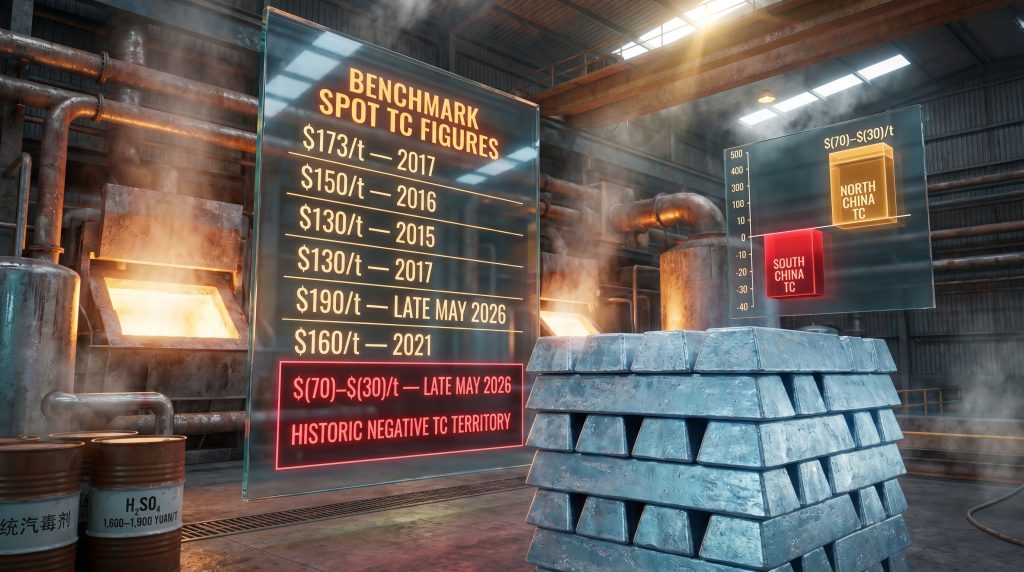
The table below contextualises how dramatically TCs have deteriorated across a multi-year horizon, a trend that aligns with broader global zinc production trends that have reshaped the sector:
| Period | TC Level (Approx.) | Market Condition |
|---|---|---|
| 2017 | ~$173/t | Balanced concentrate market |
| 2018 | ~$147/t | Early tightening signals |
| Q4 2025 | $120–$140/t (overseas sought) | Moderate supply pressure |
| Early Jan 2026 | $40–$70/t spot CIF China | Significant deterioration |
| March 2026 | $0–$30/t spot CIF China | Acute concentrate shortage |
| Late May 2026 | $(70)–$(30)/t CIF China | Historic negative TC territory |
The velocity of this deterioration across just five months of 2026 is historically unprecedented in the modern zinc processing sector.
Why 2026 Became the Year Chinese Zinc TCs Hit Record Lows
Converging Supply-Side Pressures Creating a Perfect Storm
The TC crisis unfolding through 2026 is not attributable to any single disruption. Rather, it reflects the compounding effect of several simultaneous supply constraints that have collectively removed meaningful concentrate volume from the spot market.
Global mine supply has been insufficient to match the processing appetite of China's large smelter fleet. China has built considerable refining capacity over the past decade, and when upstream mine output fails to keep pace, the imbalance expresses itself directly in TC compression. This dynamic is well documented by Chinese zinc smelters' production cut behaviour in prior cycles.
Critically, the import arbitrage window that might ordinarily allow Chinese smelters to supplement domestic concentrate with overseas material has remained firmly closed throughout 2026. Fastmarkets calculated import losses of approximately $566.92 per tonne through May 2026, worsening from the $537.93 per tonne loss recorded in April. These economics make overseas procurement commercially irrational, concentrating competitive pressure entirely within the domestic Chinese market.
The result is an intensely competitive domestic procurement environment where smelters are bidding aggressively for a finite pool of Chinese-sourced concentrate, driving spot TCs lower with each assessment cycle.
The Regional Dimension: South vs. North China Divergence
The domestic TC collapse has not been geographically uniform. Furthermore, regional variation reveals important structural differences in how Chinese smelters access raw materials:
- South China spot TCs plunged from 900–1,100 yuan/t in late April 2026 to (100)–100 yuan/t by late May, a near-total destruction of processing income within a single month
- North China spot TCs fell from 1,100–1,300 yuan/t to 300–500 yuan/t over the same period, a severe decline but one that left some residual processing margin intact
- The deeper collapse in South China is consistent with that region's greater reliance on imported concentrate through southern ports, where the import arbitrage loss has been most acutely felt
- Smelters in Shaanxi province, a significant hub for mid-sized zinc processing operations in China's northwest, have reportedly seen some of the most severe operational stress
The Arithmetic of Negative TCs: When Smelting Economics Invert
Understanding What Negative Treatment Charges Actually Mean
Negative TCs represent a genuine inversion of the smelter business model. Under normal conditions, a smelter receives a fee to process concentrate. When TCs turn negative, the smelter is effectively paying a premium above the intrinsic metal value of the concentrate just to secure feedstock. At the late May 2026 CIF China assessment of $(70) to $(30) per tonne, smelters importing overseas concentrate were losing money before a single tonne of zinc had been produced.
This is not a sustainable operating condition for any cost-sensitive facility. The question is not whether production pressure exists, but which operators can absorb the losses longest and which will reduce throughput first. For context, contrasting facilities in more favourable jurisdictions, such as the Boliden zinc smelter in Norway, highlight just how exposed Chinese operators are by comparison.
Tiered Vulnerability: Not All Smelters Face Equal Exposure
The financial impact of the TC collapse distributes unevenly across China's diverse smelter population:
| Smelter Tier | Characteristics | Current Status |
|---|---|---|
| Tier 1 (Large, integrated) | Diversified contracts, strong balance sheets, byproduct scale | Maintaining normal operations |
| Tier 2 (Mid-sized regional) | Moderate contract coverage, byproduct revenues insufficient | Operating below nameplate, extended maintenance |
| Tier 3 (Small, cost-sensitive) | High spot exposure, limited byproduct buffers | Reportedly running far below capacity in provinces like Shaanxi |
Market sources indicate that several refined zinc producers in Shaanxi province have already operated significantly below nameplate capacity, particularly among smaller facilities that lack the hedging infrastructure or long-term supply agreements of larger peers. Mainstream large smelters, however, have continued normal operations as of early June 2026, according to market intelligence gathered by Fastmarkets.
Sulfuric Acid: The Byproduct Revenue Buffer Holding the Sector Together
How Sulfuric Acid Revenue Changes the Smelter Economics Equation
What prevents an immediate wave of smelter shutdowns in the current environment is a revenue stream that sits entirely outside the zinc market itself. Zinc smelting is an inherently multi-product process. The roasting of zinc sulfide concentrate generates sulfur dioxide gas, which is captured and converted into sulfuric acid through a contact process.
Every tonne of refined zinc output carries with it an associated sulfuric acid yield of approximately 1 to 2 tonnes, depending on the sulfur grade of the input concentrate and the efficiency of gas-handling systems at each facility.
At prevailing Chinese domestic sulfuric acid prices of approximately 1,600–1,900 yuan per tonne through mid-2026, this byproduct stream has become a critical economic lifeline for many smelters. A facility producing 100,000 tonnes of refined zinc annually and generating 1.5 tonnes of sulfuric acid per tonne of zinc output would produce 150,000 tonnes of acid per year. At an average price of 1,750 yuan/t, that represents roughly 262.5 million yuan in annual byproduct revenue, a substantial buffer against TC losses, though insufficient to restore full profitability when TCs are deeply negative.
What Is Driving Elevated Sulfuric Acid Prices?
Several intersecting factors have supported domestic sulfuric acid pricing at elevated levels:
- China's export restriction on sulfuric acid, introduced in May 2026, reduced domestic supply available for export, tightening the internal market and establishing a price floor
- Strait of Hormuz shipping disruptions related to Middle East geopolitical uncertainty have curtailed sulfur supply flows through this critical maritime corridor, limiting Chinese sulfur import availability and supporting domestic sulfur prices
- Domestic sulfur prices on an ex-works basis have repeatedly reached new highs, raising input costs for sulfuric acid producers and reinforcing upward price pressure
- The combination of constrained import supply and elevated domestic demand has sustained acid pricing well above historical norms
The NDRC Price Ceiling: A Regulatory Complication
In early May 2026, China's National Development and Reform Commission, in coordination with the China Sulfuric Acid Industry Association, established a guidance ceiling price of 1,406 yuan ($207) per tonne for smelter-produced sulfuric acid sold to fertiliser manufacturers for May deliveries. This intervention targeted a specific supply chain segment, aiming to protect agricultural input costs at a time of elevated acid pricing.
The practical impact of this ceiling is more nuanced than it initially appears:
- The guidance applies specifically to smelter-to-fertiliser plant transactions, leaving industrial buyer pricing unregulated
- Market participants have noted that compliance is not uniform across the smelter population, with smaller facilities under production pressure less likely to adhere strictly to the ceiling
- The guidance creates a two-tier pricing structure: regulated sales to fertiliser producers at or below 1,406 yuan/t, and unregulated sales to industrial end-users at market rates
- This dynamic means that the effective sulfuric acid revenue realised by smelters depends heavily on their customer mix
"Smelters with a higher proportion of industrial customers relative to fertiliser plant customers may be insulated from the ceiling's revenue impact, while facilities heavily exposed to agricultural sector sales face a more constrained byproduct income ceiling precisely when they need byproduct revenues most."
Scenario Pathways: What Could Trigger Formal Chinese Zinc Smelter Production Cuts
Three Plausible Trajectories for Q3 2026
Scenario A: Organic TC Stabilisation
Smelters informally reduce throughput during summer maintenance windows, shrinking concentrate demand and allowing spot TCs to find a floor. Sulfuric acid prices remain elevated. No coordinated formal announcement emerges. Market rebalances gradually through Q3 2026.
Scenario B: Coordinated Production Cut Announcement
Historical precedent is instructive here. Chinese zinc smelters have previously coordinated planned output reductions in response to margin compression, with past coordination mechanisms involving industry meetings in provinces including Shaanxi. If spot TCs remain in deeply negative territory through June and July 2026, a formal coordinated 10% output reduction across major smelters becomes a plausible market outcome. Given China's approximately 40–45% share of global refined zinc production, a coordinated 10% cut would remove roughly 4–5% of global refined zinc supply, historically sufficient to shift the market from surplus toward deficit. The China metals market dynamics across other base metals suggest coordinated policy responses remain well within the government's toolkit.
Scenario C: Structural Rationalization
Prolonged TC compression forces permanent capacity closures among cost-sensitive smaller smelters. Middle East disruptions escalate, compressing sulfur supply further. The NDRC ceiling on sulfuric acid is more strictly enforced, reducing the byproduct buffer. This pathway represents the lowest probability but the highest market impact scenario, potentially reshaping China's smelter landscape structurally rather than cyclically.
The Summer Maintenance Window as a Strategic Output Management Tool
One lesser-appreciated aspect of the current situation is the role that scheduled seasonal maintenance plays as a commercially rational output reduction mechanism. Chinese smelters routinely schedule planned shutdowns during summer months to manage elevated cooling costs and perform routine equipment servicing.
In the current TC environment, what might ordinarily be a 2–3 week maintenance window could be extended to 4–6 weeks without triggering formal market announcements. Multiple simultaneous extended maintenance events across the smelter population could aggregate into a material supply reduction that effectively rebalances the concentrate market without any single facility making a formal production cut declaration. Market participants widely expect this dynamic to intensify if TCs continue deteriorating through June and July 2026.
The next major ASX story will hit our subscribers first
The TC-to-Price Transmission Mechanism: Historical Lessons for Market Positioning
How Smelter Economics Eventually Feed Back Into Zinc Prices
The pathway from TC compression to zinc price movement follows a well-established sequence, though the timing varies considerably depending on the depth of the TC trough and the responsiveness of upstream mining investment. In addition, base metal pricing delays can extend the lag between fundamental shifts and visible market repricing:
- TC compression signals concentrate tightness and compresses smelter margins
- Smelter output reductions, whether voluntary or forced, contract refined zinc supply
- LME and SHFE zinc inventories begin drawing down as supply falls short of consumption
- Upward pressure builds on refined zinc prices
- Higher zinc prices improve economics for miners, incentivising investment and output increases
- Concentrate supply gradually recovers, allowing TC normalisation
- The cycle resets from a new equilibrium
Historically, TC cycles have taken 12 to 24 months to fully normalise following acute compression events. The speed of recovery depends on whether upstream mining investment responds quickly enough and whether smelter capacity has been permanently retired or merely idled. Furthermore, commodity prices and mining performance data consistently show that prolonged TC troughs translate into delayed capital expenditure across the entire supply chain.
Key Market Indicators to Monitor Through Q3 2026
| Indicator | Bullish Signal for Zinc | Bearish Signal |
|---|---|---|
| Spot TC trajectory | Further deterioration triggers deeper cuts | TC recovery reduces cut probability |
| Sulfuric acid prices | Sustained elevation supports smelter margins | Price collapse accelerates formal cuts |
| Import arbitrage | Window opens, providing supply relief | Continued loss deepens domestic tightness |
| LME/SHFE inventories | Accelerating drawdown | Inventory builds signal demand weakness |
| Smelter utilisation data | Industry-wide below 80% | Nameplate capacity maintained broadly |
| Sulfur import volumes | Recovery reduces cost pressure | Continued disruption raises acid cost floors |
Industry analysts have also highlighted that zinc production cost outlooks from Wood Mackenzie point to structurally rising breakeven thresholds for smelters, reinforcing the view that the current TC environment is genuinely unsustainable for a significant portion of China's processing capacity.
Disclaimer: The scenarios, timelines, and price projections discussed in this article represent analytical frameworks based on publicly available market data and historical precedent. They do not constitute financial advice. Commodity markets involve significant uncertainty, and actual outcomes may differ materially from any projections discussed.
Frequently Asked Questions: Chinese Zinc Smelter Production Cuts and Treatment Charges
What are zinc treatment charges and who pays them?
Treatment charges are fees paid by zinc concentrate sellers, typically mining companies or trading firms, to smelters in exchange for converting raw zinc sulfide concentrate into refined zinc metal. They are quoted in US dollars per dry metric tonne of concentrate and represent the primary processing income for smelting operations. When TCs fall, smelter revenue from processing declines directly.
Why have Chinese zinc TCs turned negative in 2026?
Negative TCs emerge when concentrate supply is so constrained relative to processing capacity that miners can demand a premium above the intrinsic metal value of their material. In 2026, global mine supply constraints combined with import arbitrage losses exceeding $566 per tonne effectively locked Chinese smelters out of overseas markets, forcing intense competition for domestic Chinese concentrate and pushing spot TCs to historically negative levels.
Are formal production cuts underway among Chinese zinc smelters?
As of early June 2026, no coordinated formal industry-wide production cut had been announced. Smaller and mid-sized smelters, particularly in Shaanxi province, were reportedly operating significantly below nameplate capacity. Large mainstream smelters were maintaining normal operations, sustained in part by sulfuric acid byproduct revenues. However, Chinese zinc smelter production cuts over low treatment charges remain a credible near-term risk if conditions persist.
How does the sulfuric acid byproduct revenue buffer work?
For every tonne of refined zinc produced, zinc smelters generate approximately 1 to 2 tonnes of sulfuric acid as a process byproduct. At domestic Chinese prices of 1,600–1,900 yuan per tonne in mid-2026, this byproduct stream provides substantial supplementary income that partially offsets compressed TC revenues. However, at deeply negative TC levels, acid revenues alone cannot fully restore profitability for most operators.
What would a coordinated Chinese zinc production cut mean globally?
China accounts for roughly 40–45% of global refined zinc output. A coordinated 10% production reduction would withdraw approximately 4–5% of global supply. Based on historical precedents, this scale of curtailment sustained over six or more months has previously been sufficient to shift the global zinc market from surplus to deficit and generate upward price pressure on LME zinc. Investors tracking these signals are advised to monitor Business Times reporting on Chinese smelter grip on global rivals for the latest competitive dynamics.
Want To Be First When The Next Major Zinc Discovery Hits The ASX?
Discovery Alert's proprietary Discovery IQ model scans ASX announcements in real time, instantly identifying significant mineral discoveries — including in zinc and other base metals — and translating complex data into actionable investment insights before the broader market reacts. Start your 14-day free trial at Discovery Alert today, or explore how historic mineral discoveries have delivered extraordinary returns on the dedicated discoveries page.