August 4, 2026
The Structural Forces Reshaping Copper's Long-Term Supply Picture
Commodity markets are rarely as simple as their headlines suggest. When trading screens flash red or green in response to a tariff announcement or a geopolitical flare-up, the reflexive reaction often crowds out the more consequential question: what does the next decade of supply and demand actually look like? For copper, that longer-arc question increasingly points in one direction, and the ACG Metals copper outlook is making mid-tier producers with low-cost assets some of the most strategically valuable entities in the mining sector today.
Understanding where copper is headed requires stepping back from the daily noise of exchange inventory reports and policy speculation, and examining the geological, technological, and macroeconomic forces that are quietly compounding beneath the surface.
When big ASX news breaks, our subscribers know first
Why Copper's Structural Story Outweighs the Short-Term Volatility
Cyclical Noise Versus Decade-Long Trends
Throughout 2025 and into 2026, copper market participants have been pulled in multiple directions simultaneously. Section 232 tariff reviews, Middle East supply route concerns, and inventory divergences across the London Metal Exchange (LME), Shanghai Futures Exchange (SHFE), and Comex have all generated significant market commentary. Yet experienced copper producers understand that these forces, while real, are largely irrelevant to the economics of a mine that will operate for twenty or thirty years.
The critical distinction for anyone evaluating the copper price growth drivers, or indeed the copper sector broadly, is between cyclical price noise and structural supply-demand imbalances that compound over time. Copper's development cycle, from discovery through feasibility, permitting, construction, and commissioning, routinely spans ten to twenty years. That timeline means a project sanctioned today will produce copper through multiple economic cycles, multiple administrations, and multiple technology revolutions.
Building a business around short-term price signals rather than structural fundamentals is, in that context, a fundamental strategic error.
The Mid-Tier Copper Gap: A Structural Market Inefficiency
One of the least discussed but most commercially significant dynamics in the copper sector is the relative absence of pure-play, publicly listed mid-tier copper producers. The market currently offers investors a choice between giant diversified miners, where copper is one of many commodities on the balance sheet, and junior explorers with years of development risk ahead of them. The middle ground, scalable copper-focused companies with producing assets and institutional-grade liquidity, is notably thin.
This scarcity has a direct valuation implication. Pure-play commodity companies with sufficient scale have historically attracted premium valuation multiples, because they offer investors clean, direct exposure to a commodity thesis without the dilution of a diversified portfolio. As electrification, artificial intelligence infrastructure, and energy transition themes continue to accelerate, institutional demand for focused copper exposure is intensifying, and the supply of investment vehicles capable of meeting that demand remains limited.
"The copper sector currently lacks a deep bench of mid-tier pure-play producers, a structural gap that well-capitalised growth companies are actively positioning to fill."
ACG Metals: From Gold Producer to Copper Growth Platform
The Strategic Pivot and What It Signals
ACG Metals formally entered copper production through its acquisition of the Gediktepe copper-gold mine in Turkey in September 2024. At the time of its listing as a public company, ACG carried a market capitalisation of approximately $100 million. Within two years, that figure had grown to approximately $600 million, reflecting both operational progress and investor recognition of the copper thesis underpinning the company's strategy.
The Sulphide Expansion project at Gediktepe represents the operational centrepiece of this transition. The asset is shifting from gold and silver output to the production of copper and zinc concentrates, with copper as the primary product. First copper concentrate production is confirmed for August 2026, with annual production capacity expected to reach up to 40,000 tonnes of copper-equivalent once ramp-up is complete after 2027.
Gediktepe Project Metrics at a Glance
| Metric | Detail |
|---|---|
| Asset Location | Gediktepe, Turkey (Tethyan Copper Belt) |
| Acquisition Date | September 2024 |
| Primary Output (Post-Expansion) | Copper and zinc concentrates |
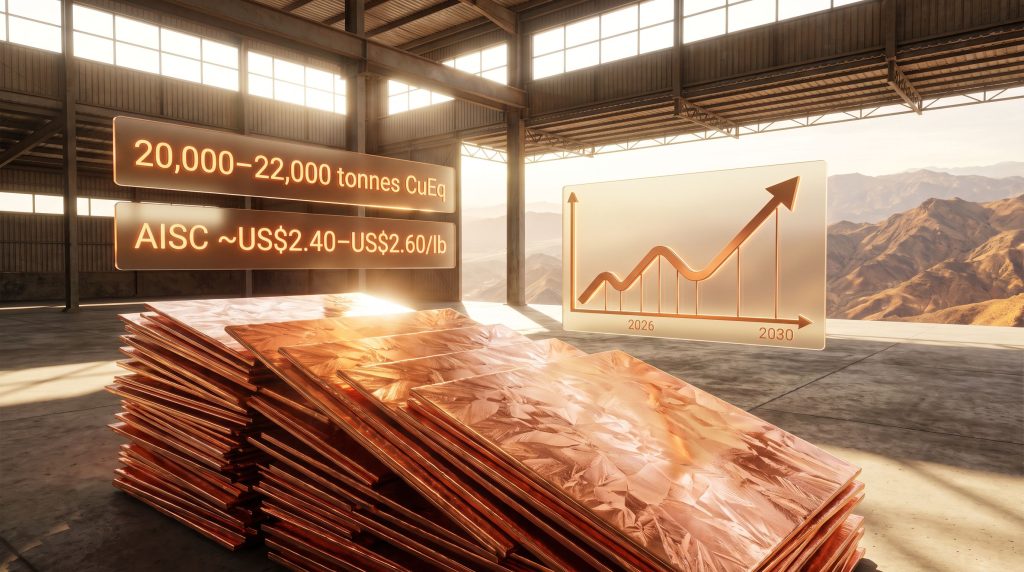
| 2026 CuEq Production Guidance | 20,000 to 22,000 tonnes |
| Long-Term Production Target | Up to 40,000 tonnes CuEq per annum (post-2027 ramp-up) |
| AISC Guidance | Approximately US$2.40 to US$2.60 per lb CuEq |
| First Copper Production | August 2026 (confirmed) |
The Tethyan Belt Advantage
Gediktepe sits within the Tethyan Copper Belt, a geological corridor that extends from Turkey through Central Asia and into Southeast Europe. It is one of the world's most prolific copper-forming environments, and the Tethyan Belt copper giants have long attracted major institutional interest. The belt's geological productivity reflects the ancient collision of the Eurasian and Gondwana tectonic plates, which created the hydrothermal systems responsible for concentrating copper and associated metals at economic grades across thousands of kilometres.
Beyond geology, the Tethyan Belt's location offers practical advantages. Proximity to European smelting infrastructure and established overland and maritime logistics networks reduces concentrate transport costs relative to more remote copper jurisdictions. ACG's stated acquisition strategy extends beyond Turkey into Sub-Saharan Africa, Chile, and Peru, all of which are recognised copper jurisdictions with operational mining infrastructure and established regulatory environments.
The Global Copper Supply Landscape: Operating Without a Safety Net
No Idle Capacity, No Buffer
What makes the current copper supply environment genuinely unusual is the absence of slack in the system. Unlike aluminium, where significant idle smelting capacity exists and can be reactivated when prices rise, or lithium, which experienced a supply surge in 2023 and 2024 as new projects came online, copper's global mine base is effectively running at full capacity.
This operational tightness means that disruptions, even at individual operations, translate directly into market price impacts. The force majeure declaration at the Grasberg mine in Indonesia, one of the largest copper mines in operation globally, removed approximately 200,000 tonnes of copper from the market. In a supply environment with genuine spare capacity, that volume could be partially absorbed. In the current market, it cannot.
Copper also differs structurally from metals like nickel and cobalt in that no single country or company controls a dominant share of global supply. This diversified production base is generally stability-positive, but it also means there is no central authority capable of coordinating supply increases in response to demand surges.
Ore Grade Decline: The Silent Erosion of Output
One of the least visible but most consequential forces shaping the copper supply picture is the long-term decline in ore grades at existing operations. This is not a new phenomenon, but it is an accelerating one. As the highest-grade portions of ore bodies are progressively extracted, miners must process ever-larger volumes of rock to produce the same quantity of copper.
The practical consequences are significant:
- Processing costs per unit of copper output rise as grades fall
- Energy and water consumption per tonne of copper produced increases
- Capital expenditure requirements for throughput maintenance grow over time
- The competitive advantage of being able to economically process lower-grade material becomes a genuine differentiator
For investors evaluating copper producers, ore grade is therefore not merely a technical metric but a long-term cost and production trajectory indicator. Assets with resilient grades, or with metallurgical processes optimised for lower-grade ore, carry structurally lower long-term cost risk.
The Discovery Deficit
World-class copper deposits are becoming genuinely rare discoveries. Notable recent finds such as those in Mongolia and the Democratic Republic of Congo represent statistical outliers in an otherwise thin discovery pipeline. The industry's exploration success rate for large, high-grade deposits has been declining for decades, driven by the depletion of shallow, easily accessible ore bodies and the increasing depth and complexity of remaining targets.
Even when significant deposits are discovered, the development timeline remains brutal. From initial discovery to first production, a copper mine typically requires ten to twenty years of drilling, feasibility study work, environmental and social permitting, engineering, and construction. Consequently, the global copper supply response to today's demand signals will not materialise until well into the 2030s at the earliest, if those deposits were discovered in the early-to-mid 2020s.
"The combination of declining grades at existing operations, full capacity utilisation across the global mine base, and a near-empty discovery pipeline creates a supply environment with very limited elasticity to demand shocks."
Multi-Sector Demand: Why Copper's Growth Story Is Diversified and Durable
Five Simultaneous Growth Engines
Previous commodity supercycles were often dominated by a single demand theme. China's infrastructure and urbanisation surge drove base metal demand for roughly two decades. Copper's current demand profile is fundamentally different: it is being shaped by multiple large, structurally independent growth sectors simultaneously.
- Artificial intelligence and data centres: The physical hardware underpinning AI computing, including servers, power distribution units, cooling infrastructure, and building services, is extraordinarily copper-intensive. Global data centre construction is accelerating at rates that have surprised even bullish forecasters.
- Electric vehicles: A battery electric vehicle contains approximately three to four times more copper than a conventional internal combustion engine vehicle. Motor windings, battery interconnects, charging infrastructure, and power electronics all rely heavily on copper's electrical conductivity properties.
- Grid modernisation and electrification: Upgrading transmission and distribution networks to handle higher load densities, integrate variable renewable generation, and support bidirectional power flows for vehicle charging requires substantial and sustained copper investment across most major economies.
- Defence sector expansion: Defence budgets across NATO member states and allied nations have been increasing materially. Modern weapons platforms, communications systems, electronic warfare equipment, and military vehicles all incorporate significant quantities of copper.
- Robotics and advanced manufacturing: Industrial automation and robotics deployment is scaling across manufacturing sectors globally, with each robot system requiring copper in its motors, sensors, and control electronics.
Demand Diversification as a Risk Management Feature
What makes this multi-sector demand structure particularly valuable from an investment thesis perspective is its inherent resilience. Historically, copper demand grew at approximately 2% per year globally, largely tracking construction and industrial production cycles. The current demand profile is expected to grow faster than global GDP for the foreseeable future, driven by these new and expanding sectors.
Furthermore, the probability that all five of these sectors simultaneously contract is extremely low. Each is driven by different economic, technological, and policy dynamics. If EV adoption temporarily plateaus due to consumer preference shifts, grid modernisation spending can absorb the slack. If data centre construction slows in one region, defence spending may be accelerating in another. This diversification fundamentally changes copper's risk profile compared to metals with more concentrated demand bases.
| Demand Driver | Historical Annual Growth | Forward Projection |
|---|---|---|
| Traditional infrastructure and construction | Approximately 2% per annum | Continues at baseline |
| AI and data centre buildout | Minimal (emerging category) | High double-digit percentage growth |
| EV fleet electrification | Emerging | Accelerating above GDP growth |
| Grid upgrades and renewables integration | Low | Sustained structural increase |
| Defence sector expansion | Cyclical | Budget-driven structural increase |
| Combined demand growth expectation | Approximately 2% per annum | Above global GDP growth rate |
Does Copper Have a Price Ceiling? The Aluminium Substitution Constraint
A Natural Price Brake That Many Analysts Overlook
While the structural copper supply and demand story is genuinely compelling, a rigorous analysis must also account for the natural constraint that aluminium substitution places on long-term price appreciation. This is a perspective that is less commonly articulated in the bullish copper narrative but is important for realistic price modelling.
Aluminium is lighter, cheaper per kilogram, and increasingly viable as a copper substitute in specific applications. As copper prices rise beyond certain thresholds, the economics of substitution improve for those applications where aluminium's lower electrical conductivity and different mechanical properties can be engineered around.
Where Substitution Works and Where It Does Not
The substitution dynamic is not uniform across all copper end uses. Understanding which applications are substitutable and which are not is essential for assessing the practical implications of this price ceiling.
Viable substitution zones:
- Low-voltage electrical wiring in certain electric vehicle applications
- Overhead power transmission lines (aluminium conductor steel-reinforced cable is already widely used)
- Some heat exchanger and radiator applications
Non-viable substitution zones:
- High-frequency electronics and precision connectors, where copper's conductivity is non-negotiable
- Electric motor windings, where conductor losses at reduced conductivity are unacceptable
- Plumbing, HVAC, and antimicrobial applications
- High-density circuit board applications
The practical implication for investors is that the copper price outlook is bullish but bounded. There is genuine upward pressure from structural supply deficits and demand acceleration, but a natural ceiling is defined by aluminium substitution economics. Sophisticated copper price modelling incorporates substitution elasticity at various price levels rather than assuming unlimited upside.
The next major ASX story will hit our subscribers first
Tariffs, Geopolitics, and the Art of Looking Past the Political Cycle
The Section 232 Copper Tariff: What Actually Happened
The US Section 232 national security review of copper imports generated significant market uncertainty throughout early-to-mid 2025. A tariff recommendation was originally expected by June 30, 2026. When the final determination was released, refined copper cathode, copper scrap, and several other product categories were excluded, a material outcome that shaped market positioning and relieved some of the most acute pricing distortions.
During the February to July 2025 period of heightened tariff uncertainty, Comex copper stocks surged as market participants front-loaded US inventory ahead of potential duties. Simultaneously, LME and SHFE inventories declined sharply, reflecting geographic arbitrage and pre-tariff positioning rather than genuine changes in underlying physical demand. This inventory divergence created temporary price distortions that obscured the true physical market balance. Post-tariff clarity, the expectation is that inventory normalisation will reassert the fundamental supply-demand signal.
Regional Copper Premiums as Market Signals
Regional cathode premiums provide a useful real-time indicator of physical market tightness beyond LME benchmark pricing. According to Fastmarkets copper analysis, the weekly copper grade A cathode premium, CIF Rotterdam, was assessed at $180 to $230 per tonne as of late July 2026, stable since mid-July. The copper grade 1 cathode premium, DDP Midwest US, was assessed at $0.07 to $0.09 per lb over the same period, also stable.
These premiums reflect regional supply and demand balances, logistics costs, and local market dynamics. Sustained premiums at these levels are consistent with a physically tight market rather than a speculative one.
Building for Multiple Administrations, Not One Policy Cycle
For a copper mine being sanctioned today, the relevant policy environment is not the current US administration or even the next one. A mine producing for twenty-five years will operate through four or five presidential terms, multiple commodity cycles, and technological shifts that cannot currently be anticipated. This reality shapes how disciplined copper producers approach project economics.
The most durable competitive advantage in this environment is a low-cost structure that remains profitable across a wide range of price and policy scenarios. ACG's stated AISC target of approximately US$2.40 to US$2.60 per pound of copper-equivalent reflects precisely this philosophy: building cost competitiveness that provides resilience regardless of which way the political or macroeconomic winds blow.
"For copper producers operating on decade-long investment horizons, building cost structures that can weather political cycles is more valuable than attempting to time policy outcomes."
ACG Metals' Growth Strategy: Beyond the First Asset
Acquiring Production Rather Than Building from Scratch
ACG's stated acquisition strategy prioritises producing or near-producing assets over greenfield development projects. This capital-efficient approach compresses the time from investment to cash flow, avoids the longest and most capital-intensive phase of the mining development cycle, and allows the company to build production scale more rapidly than organic exploration and development would permit.
Target geographies include the Tethyan Copper Belt, Sub-Saharan Africa, Chile, and Peru. These jurisdictions share several important characteristics:
- Established copper mining infrastructure and experienced workforces
- Developed regulatory frameworks with precedent for foreign investment
- Existing concentrate marketing channels and logistics networks
- Known geology with additional exploration upside potential
In addition, the ACG Metals corporate presentation outlines the company's broader consolidation vision, making clear that the Gediktepe acquisition is intended as the first step in building a diversified, multi-asset copper platform rather than a single-asset operation.
Key Execution Risks That Investors Must Monitor
The ACG Metals copper outlook is compelling at a structural level, but execution risks are real and material:
- Commissioning and metallurgical complexity: Transitioning a processing plant from gold extraction to copper-zinc flotation involves significant technical risk; delays or underperformance against production guidance would have direct financial consequences
- Acquisition discipline: Acquiring additional assets at attractive valuations in a competitive copper M&A environment requires consistent deal flow access, technical capability, and willingness to walk away from overpriced opportunities
- Capital markets access: Growing from a $600 million market capitalisation company to a large global producer requires sustained access to both debt and equity capital markets at terms that do not unduly dilute existing shareholders
- Jurisdictional risk management: Turkish operations carry political and currency exposure that must be managed through operational diversification and appropriate financial hedging
Copper Price Scenarios: Mapping the Range of Outcomes
The Three-to-Five Year Supply Pressure Window
The convergence of declining ore grades, full global mine capacity utilisation, a thin new project pipeline, and accelerating multi-sector demand creates a compelling case for sustained copper price appreciation over the 2026 to 2030 period. Short-term fluctuations driven by tariff cycles, inventory movements, and macro sentiment will continue to create volatility, but the structural direction of the market is upward. Understanding the ongoing copper supply crunch is therefore essential context for evaluating any copper producer in this environment.
| Scenario | Key Assumptions | Implied Price Direction |
|---|---|---|
| Bull Case | AI, EV, and grid demand accelerates above consensus; no major new supply; grade decline accelerates | Significant price appreciation; aluminium substitution threshold approached in addressable segments |
| Base Case | Demand grows above GDP; supply constrained but some new projects commissioned post-2028 | Gradual price appreciation with cyclical volatility |
| Bear Case | Global recession dampens EV and construction demand; aluminium substitution accelerates earlier than modelled | Price moderation but structural floor supported by supply constraints |
Why Patient Capital Has the Structural Advantage
The copper market's defining characteristic for long-term investors is that its structural dynamics do not resolve over quarters. Grade decline, discovery scarcity, and demand acceleration from new technology sectors are forces that compound over decades. Companies building low-cost, scalable copper production platforms during periods of market noise are positioning for a supply-demand inflection that the fundamentals consistently point toward. For those assessing broader copper investment strategies, the patient capital approach remains the most structurally sound.
Frequently Asked Questions: ACG Metals Copper Outlook
What is ACG Metals' copper production guidance for 2026?
ACG Metals has guided for 20,000 to 22,000 tonnes of copper-equivalent production from its Gediktepe operation in 2026, with first copper concentrate output confirmed for August 2026. All-in sustaining costs are guided at approximately US$2.40 to US$2.60 per pound of copper-equivalent.
When will Gediktepe reach full copper production capacity?
The Sulphide Expansion project at Gediktepe is designed to produce up to 40,000 tonnes per year of copper-equivalent once the ramp-up phase is complete, which is targeted for after 2027.
Why is ACG Metals focused on copper rather than gold?
ACG's management has identified copper as having more favourable long-term supply-demand dynamics than gold, including a structural supply deficit, rising demand from multiple high-growth sectors including AI infrastructure, electric vehicles, defence, and grid modernisation, combined with a scarcity of pure-play copper investment vehicles for institutional investors.
How does ACG Metals plan to grow beyond its current single asset?
The company has stated its intention to acquire additional producing or near-producing copper assets across the Tethyan Belt, Sub-Saharan Africa, Chile, and Peru, prioritising assets that can begin generating cash flow relatively quickly rather than long-dated greenfield development projects.
Could aluminium replace copper and undermine the demand thesis?
Aluminium substitution is a real constraint on copper price upside, particularly in lower-voltage electrical applications. However, substitution is not technically or economically viable across the majority of copper's end-use applications, meaning it functions as a natural price ceiling rather than a structural demand destroyer. A well-constructed copper price model accounts for substitution elasticity rather than ignoring it.
What is the biggest risk to the copper supply deficit thesis?
The primary risk is a significant and sustained global demand shock, such as a major economic recession that simultaneously suppresses EV adoption, construction activity, and technology infrastructure investment. Even in this scenario, the structural supply constraints from declining grades and minimal new project development would continue to provide a floor to the market over the medium term.
This article is intended for informational purposes only and does not constitute financial advice. Forward-looking statements regarding commodity prices, production guidance, and company valuations involve material uncertainty and may differ significantly from actual outcomes. Readers should conduct independent research and consult qualified financial advisers before making investment decisions.
Want to Capitalise on the Next Major Copper Discovery Before the Market Does?
Discovery Alert's proprietary Discovery IQ model scans ASX announcements in real time, instantly identifying significant mineral discoveries — including copper — and delivering actionable alerts to subscribers before the broader market has time to react. Explore historic examples of major mineral discoveries and their extraordinary returns, then begin your 14-day free trial at Discovery Alert to position yourself ahead of the next structural copper opportunity.