June 24, 2026
When Oil Markets Shift, Import-Dependent Economies Pay the Steepest Price
Energy economists have long understood that the most asymmetric risks in global oil markets fall not on producers but on large importers with limited domestic substitutes. When supply chains fracture, exporting nations adjust revenue streams. Importing nations absorb costs they cannot redirect. This structural reality sits at the heart of why the ADB oil price forecast India inflation GDP growth outlook for 2026 and 2027 carries consequences extending far beyond commodity trading desks, particularly for an economy as deeply exposed to imported crude as India.
Understanding the current situation requires looking through two lenses simultaneously: the near-term shock arithmetic of elevated crude prices, and the longer-term structural vulnerabilities that make India's macro outlook unusually sensitive to decisions made in West Asian oil fields thousands of kilometres from its borders.
When big ASX news breaks, our subscribers know first
India's Oil Import Dependency: The Foundation of Macro Vulnerability
India imports approximately 85 to 87 percent of its crude oil requirements, positioning it as one of the most import-dependent major economies anywhere in the world. This is not a temporary configuration but an entrenched structural feature of India's energy system, one that shapes fiscal arithmetic, monetary policy space, currency stability, and consumer price levels all at once.
Unlike commodity-exporting peers across Southeast Asia or the Gulf, a sustained period of elevated oil prices does not create revenue windfalls for India's government. Instead, it simultaneously widens the current account deficit, weakens the rupee through reduced foreign exchange inflows relative to import payments, and injects inflation through energy and agricultural supply chains. The rupee depreciation channel is particularly insidious because it creates a feedback mechanism: a weaker currency makes oil imports more expensive in domestic terms, which further widens the current account deficit, which places additional downward pressure on the currency.
This is why forecasts from multilateral institutions like the Asian Development Bank carry outsized analytical weight for Indian policymakers and investors. The ADB's regional mandate, comprehensive scenario modelling, and access to granular trade and energy data make its projections a credible anchor for planning purposes in a way that point-in-time market consensus often cannot replicate.
What the ADB's Oil Price Forecast Actually Says for 2026 and 2027
The ADB's April 2026 special update, published on April 29, represents one of the most consequential multilateral reassessments of the Asia-Pacific growth environment in recent years. The trigger was the prolonged nature of West Asian geopolitical disruptions that emerged in early 2026, which proved more persistent and supply-constraining than prior models had anticipated. Furthermore, this oil price shock has reverberated well beyond regional boundaries, affecting planning frameworks across multiple sectors.
ADB Chief Economist Albert Park confirmed the institution's revised reference scenario in an interview with PTI published by ET EnergyWorld on May 10, 2026. The key figures:
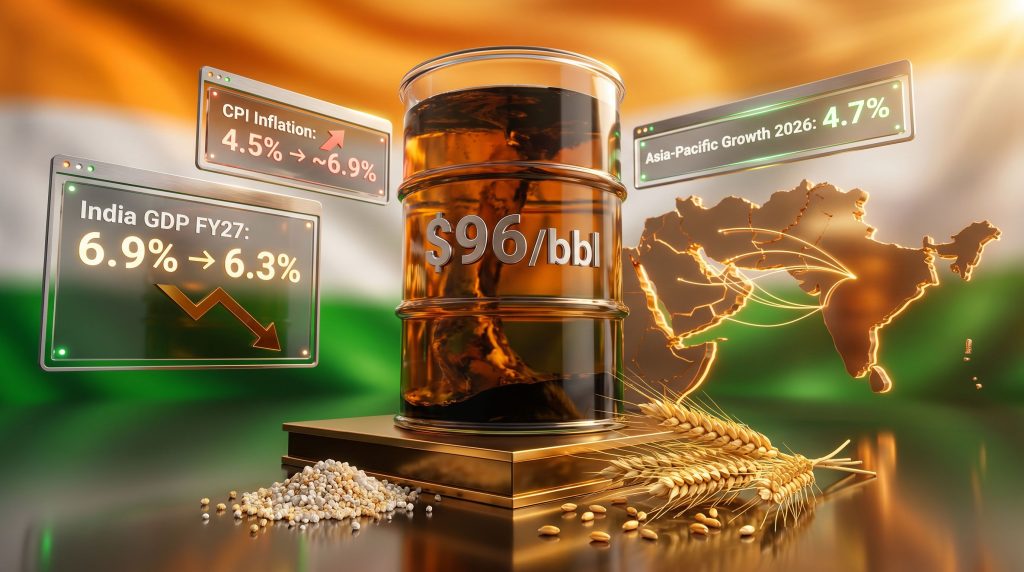
- $96 per barrel as the average crude oil price for 2026 under the new reference scenario
- $80 per barrel projected for 2027, reflecting gradual normalisation rather than a sudden correction
- Futures markets are themselves pricing elevated levels further into 2027, reinforcing the directional consistency of the ADB's forecast
A technically important observation from Park is the persistent premium of spot market prices over nearby futures contracts, which he attributed to acute near-term supply shortages. In commodity market terms, this contango-adjacent dynamic signals that the disruption is not merely anticipated; it is being experienced in real time across physical delivery markets. The spot premium indicates that buyers willing to take immediate delivery are paying substantially more than those contracting for future supply, a signature of genuine physical scarcity rather than speculative positioning.
The ADB's "higher for longer" thesis is not simply a cyclical call. It represents a structural reassessment of West Asian supply reliability, with compounding implications for import-dependent economies across developing Asia.
For India's fiscal planning framework, it is the duration of elevated prices rather than the peak level that matters most. A brief spike can be absorbed through strategic petroleum reserves or short-term fiscal accommodation. A sustained period at $96 per barrel forces structural recalibration across subsidy frameworks, monetary policy settings, and investment decisions.
The ADB Oil Price Forecast's Impact on India's GDP Growth
Baseline Growth Before the Oil Shock
Before incorporating the oil price shock scenario, the ADB had projected India's GDP growth at 6.9 percent for FY27 (the fiscal year ending March 2028), a figure already reflecting the resilience of India's domestic demand engine. According to the ADB, its April 2026 Asian Development Outlook characterised this baseline as "robust," underpinned by strong private consumption, public infrastructure investment, and the expanding trade relationships India has developed with the European Union, the United States, and New Zealand. The projected recovery to 7.3 percent in FY28 under the baseline scenario further reinforced the view that India's structural growth trajectory remained intact.
The Oil Shock Scenario: A 0.6 Percentage Point Drag
Under the ADB's modelled shock scenario, incorporating the $96 per barrel oil price environment, India's GDP growth is projected to be reduced by 0.6 percentage points in FY27, bringing the revised estimate to approximately 6.3 percent. Albert Park confirmed this figure directly, describing it as based on the ADB's model scenario and noting that the impact is expected to be concentrated in FY27, with India anticipated to recover in the following year.
Critically, Park observed that when China is excluded from the regional aggregate, India's 0.6 percentage point growth drag is broadly consistent with the Asia-Pacific regional average. This framing matters analytically: India's vulnerability is not idiosyncratic but systemic across developing Asia, suggesting the shock is driven by the shared trade war impact on oil prices and supply disruption rather than any India-specific policy failure or structural weakness.
How Oil Prices Transmit Into GDP: The Key Channels
| Transmission Channel | Mechanism | Estimated Impact |
|---|---|---|
| Energy import bill expansion | Higher crude costs widen current account deficit, pressuring rupee | CAD widening of approximately 0.4 to 0.5% of GDP per $10/bbl increase |
| Industrial input cost inflation | Petrochemical, logistics, and manufacturing cost escalation | Margin compression across energy-intensive sectors |
| Household consumption squeeze | Fuel and food price pass-through reduces real disposable income | Dampens private consumption growth |
| Fiscal pressure on oil subsidies | Government faces trade-off between subsidy burden and fiscal consolidation | Risk of 0.3 to 0.5% fiscal slippage |
| Remittance and export disruption | West Asian worker remittances and export logistics affected | Secondary income and trade effects |
Recovery in FY28: Structural Buffers Reassert
The ADB's modelling suggests the negative growth impact is transitory rather than persistent. Park noted explicitly that the oil shock would not negatively affect growth in FY28, with India expected to bounce back. The structural buffers that support this recovery include new trade agreements providing export diversification, ongoing public capital expenditure pipelines, and a growing middle-class consumption base that provides domestic demand resilience independent of external price shocks.
India's Inflation Outlook Under the ADB Oil Price Forecast
From 4.5 Percent to 6.9 Percent: The Inflationary Arithmetic
The ADB's baseline inflation projection for India in FY27 stood at 4.5 percent before the oil shock scenario was incorporated. Under elevated oil prices, Park confirmed that inflation would increase by 2.4 percentage points, reaching approximately 6.9 percent for the current fiscal year. This figure sits materially above the Reserve Bank of India's upper tolerance threshold of 6.0 percent, creating a significant monetary policy complication.
Park noted that India's inflation response is more acute than the regional Asia-Pacific average precisely because India is more reliant on imported oil and gas than most of its peers. The dual dependency on crude oil and natural gas price trends creates compounding inflationary pressures that single-commodity importers do not face to the same degree.
The Fertiliser-Food Price Spiral: A Secondary Inflation Risk
One of the least-discussed but most consequential transmission channels identified by Park is the fertiliser-to-food price pathway. As West Asian gas supply disruptions elevate global natural gas prices, ammonia production costs rise, which directly increases fertiliser manufacturing costs worldwide. The practical consequence unfolds in stages:
- Higher fertiliser costs incentivise farmers to reduce application rates to protect margins
- Reduced fertiliser use constrains crop yields, particularly for nitrogen-intensive staples like rice and wheat
- Lower domestic food output tightens supply against existing demand
- India's outsized role in global rice trade means domestic harvest shortfalls ripple outward into international food markets
- Combined domestic and international food price pressure feeds into India's CPI basket
- Food inflation compounds the energy-driven inflation already present in the system
Park explicitly identified this fertiliser cost channel as a distinct and serious concern, separate from direct energy price transmission. The significance for investors and policymakers is the lag structure: the fertiliser-to-food price transmission operates with a three to six month delay, meaning the full inflationary impact may not be visible in headline CPI data until late FY27.
This lagged transmission is one of the most underappreciated aspects of India's inflation sensitivity to oil price shocks. Markets monitoring month-to-month CPI data may systematically underestimate the cumulative inflationary pressure building through agricultural input cost channels.
El Niño as a Compounding Agricultural Risk
Concurrent El Niño conditions introduce additional uncertainty that Park acknowledged as genuinely difficult to model with precision. Adverse monsoon patterns associated with El Niño events can independently reduce crop yields, and when layered on top of fertiliser cost pressures, the combined effect on food prices becomes multiplicative rather than additive.
As economists have noted, heat waves and adverse weather events compound the economic damage already imposed by elevated oil prices, making India's agricultural exposure particularly acute. India's role in global rice trade amplifies this risk internationally. Whatever happens to India's harvest often has a significant impact on other countries, given India's share of global rice export volumes, meaning a domestic supply shortfall carries food security implications across Asia and parts of Africa.
Comparing the ADB Forecast Against Other Multilateral Institutions
| Institution | FY27 GDP Growth Forecast | Key Assumptions |
|---|---|---|
| Asian Development Bank | 6.9% baseline / 6.3% oil shock scenario | $96/bbl oil; West Asian disruption; domestic demand resilience |
| Reserve Bank of India | Approximately 6.9% | Aligned with ADB baseline; domestic monetary policy anchor |
| World Bank | Approximately 6.6% | More conservative on trade and investment recovery |
| IMF | 6.5% to 6.8% | Global slowdown risks; oil price sensitivity incorporated |
What distinguishes the ADB's analytical framework is its explicit separation of baseline projections from shock scenarios. Rather than providing a single-point estimate, the ADB's approach gives policymakers a probabilistic range anchored to specific oil price assumptions. For India, where the crude oil price assumption is the single most consequential variable in any macroeconomic model, this scenario-based framing provides more actionable planning intelligence than a consensus mean forecast.
The next major ASX story will hit our subscribers first
Policy Implications: Fiscal and Monetary Challenges
The RBI's Stagflationary Dilemma
With inflation projected at 6.9 percent under the oil shock scenario, the Reserve Bank of India faces a textbook stagflationary policy dilemma. Tightening monetary policy to bring inflation back within the 6 percent tolerance band risks amplifying the growth drag already imposed by higher energy costs. Maintaining an accommodative stance to protect the 6.3 percent growth trajectory risks allowing inflationary expectations to become entrenched, particularly if food prices escalate through the fertiliser channel simultaneously.
The RBI's policy response will likely depend on whether the inflation overshoot is perceived as supply-driven and transitory, which would favour tolerance and watchful waiting, or demand-amplified and persistent, which would favour measured tightening. The fertiliser-food price lag argues for early vigilance even when headline CPI initially appears contained.
Fiscal Policy and the Subsidy Trade-off
The ADB has cautioned against broad-based fuel subsidies or blanket tax reductions as responses to elevated oil prices, warning that such measures erode fiscal space without providing targeted relief to vulnerable households. India's state-owned oil marketing companies face significant margin compression at $96 per barrel crude, creating pressure for either retail price adjustments or government compensation mechanisms, neither of which is fiscally painless.
The fiscal arithmetic is unforgiving: every $10 per barrel increase in crude oil prices is estimated to widen India's current account deficit by approximately 0.4 to 0.5 percent of GDP, with corresponding implications for the rupee and the domestic inflation rate.
Sectoral Exposure to the $96 Per Barrel Oil Environment
| Sector | Exposure Level | Key Risk Factor |
|---|---|---|
| Aviation | Very High | Jet fuel constitutes 25 to 35% of operating costs |
| Road Transport and Logistics | High | Diesel price pass-through compresses margins |
| Petrochemicals and Plastics | High | Feedstock cost escalation |
| Agriculture | High | Fertiliser and diesel costs; yield risk via El Niño |
| Automotive Manufacturing | Moderate to High | Input cost inflation; consumer demand softening |
| IT Services and Exports | Low to Moderate | Indirect exposure via rupee depreciation |
| Renewable Energy | Neutral to Positive | Accelerated energy security rationale strengthens investment case |
The rupee depreciation channel functions as an amplifier across all import-exposed sectors. A sustained current account deficit widening under elevated oil prices creates structural downward pressure on USD/INR, which in turn makes every subsequent barrel of imported crude more expensive in rupee terms, creating a self-reinforcing pressure cycle that is difficult to interrupt without either foreign exchange intervention or demand compression.
Long-Term Energy Strategy: What the ADB Forecast Validates
Each successive oil price shock effectively functions as a real-world stress test of India's energy import dependency. The ADB's higher-for-longer thesis strengthens the economic case for accelerating domestic energy transition investments. In this context, the energy security challenges posed by import dependency become increasingly urgent, as solar, wind, and green hydrogen capacity directly reduces the structural exposure that amplifies macro vulnerability during supply disruptions.
Over a five to ten year horizon, reducing crude oil import dependency by even 10 to 15 percentage points through domestic renewable energy deployment would materially reduce the sensitivity of India's GDP growth, inflation trajectory, and current account balance to West Asian geopolitical events. The ADB's current ADB oil price forecast India inflation GDP growth projections implicitly quantify the cost of inaction: a 0.6 percentage point GDP drag and a 2.4 percentage point inflation overshoot represent measurable economic output foregone because of structural dependency that could, over time, be reduced through sustained domestic energy investment.
Furthermore, renewable energy solutions in mining and heavy industry represent one of the more compelling near-term investment opportunities to emerge from this price environment. Diversifying crude oil sourcing relationships, expanding strategic petroleum reserves, and deepening energy trade partnerships with non-West Asian suppliers are shorter-term policy levers that carry increased urgency under the ADB's scenario modelling.
ADB India Macro Outlook: Key Numbers at a Glance
| Metric | ADB Baseline | Oil Shock Scenario |
|---|---|---|
| Crude oil price average (2026) | Pre-shock assumption | $96 per barrel |
| Crude oil price (2027) | Prior estimate | Approximately $80 per barrel |
| India GDP growth FY27 | 6.9% | 6.3% (negative 0.6 percentage points) |
| India CPI inflation FY27 | 4.5% | Approximately 6.9% (plus 2.4 percentage points) |
| Asia-Pacific growth 2026 | 5.1% (prior projection) | 4.7% (revised) |
| India GDP growth FY28 | 7.3% | Recovery expected |
This article incorporates analysis based on the ADB's April 2026 Asian Development Outlook special update and remarks made by ADB Chief Economist Albert Park in an interview with PTI published by ET EnergyWorld on May 10, 2026. Forecasts and scenario projections represent the ADB's modelling assumptions as of the publication date and are subject to revision as geopolitical and market conditions evolve. This article does not constitute financial or investment advice. Readers should conduct independent research before making any investment or policy decisions.
Want to Identify the Next Major Mineral Discovery Before the Broader Market?
While oil price shocks reshape macro conditions across import-dependent economies, savvy investors are simultaneously positioning themselves in ASX-listed resource discoveries with significant upside potential. Discovery Alert's proprietary Discovery IQ model delivers real-time alerts the moment significant mineral discoveries are announced on the ASX — explore the historic returns major discoveries have generated and begin your 14-day free trial at Discovery Alert to secure a market-leading edge before the next opportunity emerges.