Understanding Advanced Nuclear Fuel Manufacturing Through Material Science Fundamentals
Nuclear fuel fabrication has evolved from traditional pellet-pressing operations into sophisticated material science enterprises requiring atomic-level precision. TRISO fuel fabrication represents the convergence of multiple engineering disciplines: ceramic chemistry, vapor deposition physics, fluidized bed dynamics, and statistical quality control methodologies. Each manufacturing step builds upon decades of materials research while addressing the unique challenges posed by radioactive feedstock materials and stringent containment requirements. Furthermore, the integration of AI in process control systems enhances precision across these complex manufacturing processes.
The transition from conventional uranium dioxide pellets to individually coated particles fundamentally changes how nuclear fuel interacts with reactor conditions. Where traditional fuel relies on external cladding for fission product containment, TRISO particles embed containment directly within each fuel kernel through engineered ceramic barriers. This architectural shift enables reactor designs with inherently different safety characteristics and operational parameters.
Chemical Vapor Deposition: The Foundation of Multi-Layer Containment Systems
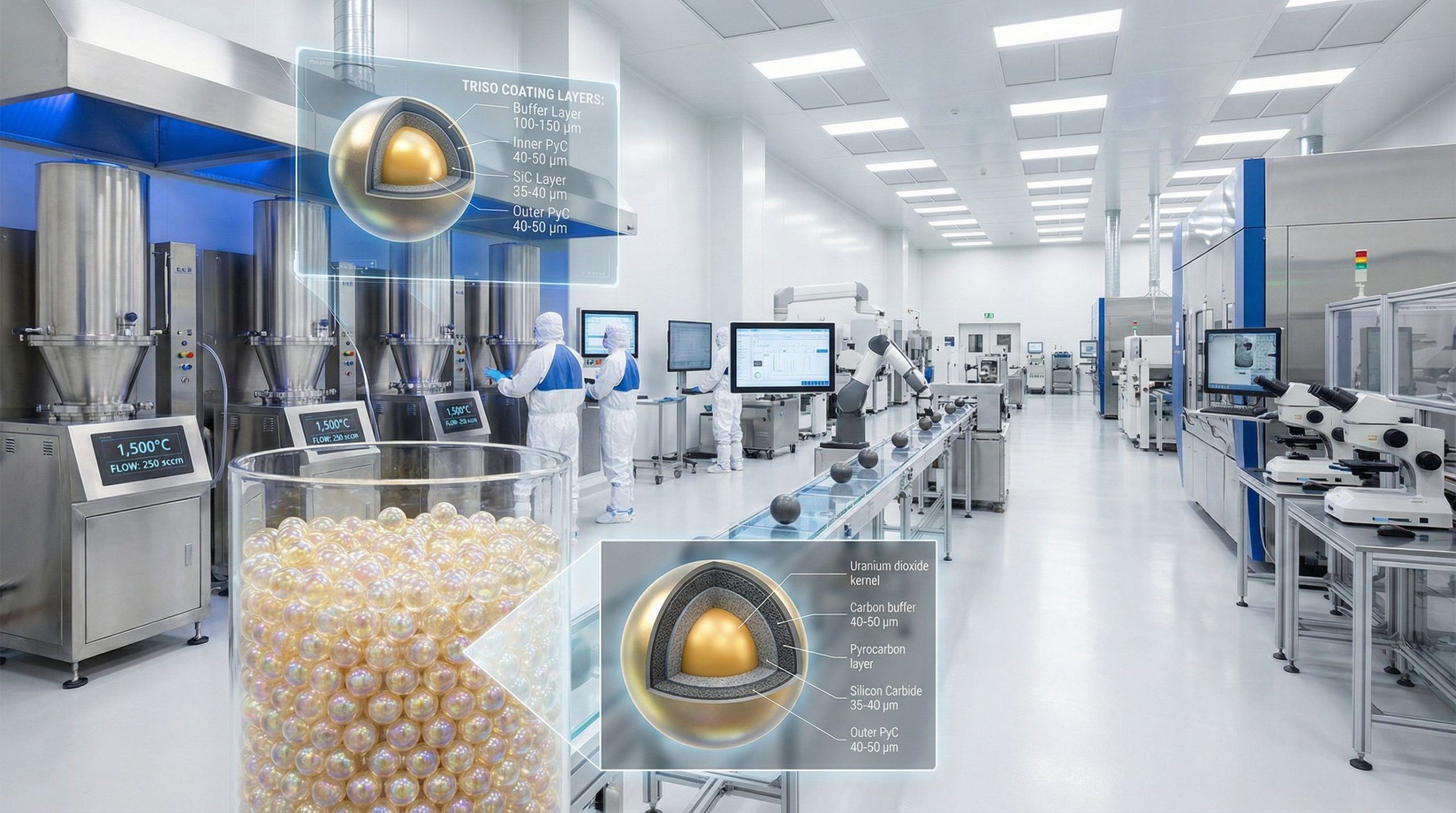
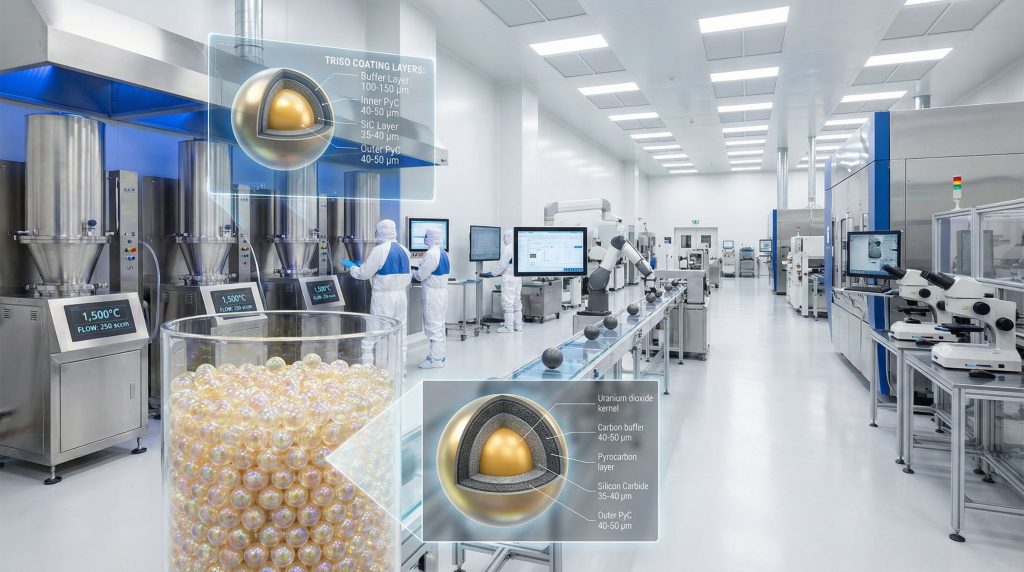
Chemical vapor deposition technology drives the core manufacturing process for TRISO fuel fabrication, creating the multi-layer ceramic coatings that define particle performance. The process operates through controlled chemical reactions between gaseous precursors and heated uranium kernels suspended in fluidized bed reactors. Temperature control within ±10°C across the entire bed volume ensures uniform coating properties, while gas flow regulation to ±2% precision maintains consistent chemical stoichiometry.
Pyrocarbon Layer Engineering and Density Control
Pyrocarbon coating layers serve distinct structural and accommodation functions within the TRISO architecture. The porous buffer layer (100-150 μm thickness) provides volumetric expansion space for fission gases and kernel swelling, operating at densities between 1.0-1.2 g/cm³. Dense pyrocarbon layers 40-50 μm thick achieve densities approaching 1.8-2.0 g/cm³, providing mechanical integrity during fuel handling and reactor operations.
Hydrocarbon precursor gases, typically methane or propylene, decompose at temperatures between 1,200-1,400°C to deposit carbon layers. Gas residence time control through fluidized bed dynamics determines coating uniformity, with coating rates ranging from 1-5 μm per minute depending on process parameters and desired layer properties.
Silicon Carbide Barrier Layer: Critical Fission Product Containment
The silicon carbide coating layer represents the primary engineered barrier against fission product migration, requiring the most precise deposition control within the TRISO manufacturing sequence. Methyltrichlorosilane (MTS) serves as the standard silicon precursor, decomposing at 1,500-1,600°C in controlled atmospheres to form dense SiC layers 35-40 μm thick.
Silicon carbide's effectiveness stems from its exceptional chemical stability and low permeability to metallic fission products. The coating must maintain stoichiometric Si:C ratios near 1:1 while achieving densities approaching 3.2 g/cm³. Deviation from optimal deposition conditions results in coating porosity or non-stoichiometric phases that compromise fission product retention.
Process Control Requirements:
- Temperature uniformity: ±5°C across particle bed
- Gas flow ratios: MTS:hydrocarbon ratios controlled to ±1%
- Residence time: Multiple passes through deposition zone
- Coating rate: 2-3 μm/minute for optimal density
Uranium Kernel Production: Sol-Gel Chemistry and Thermal Processing
Kernel manufacturing begins with sol-gel precipitation chemistry, converting uranyl nitrate solutions into spherical gel particles through controlled polymer chemistry. Uranium concentrations of 1.5-2.0 M in nitric acid solutions undergo controlled mixing with polymer additives to form gel networks. Droplet formation at 60-80°C produces uniform spherical particles with 500-800 micrometer diameters.
Multi-Stage Thermal Treatment Optimisation
Thermal processing converts gel particles into dense ceramic kernels through carefully controlled heating sequences. Each stage serves specific chemical and physical transformation purposes:
Drying Phase (100-150°C, 2-4 hours):
- Removes free water and residual organics
- Prevents kernel cracking during subsequent heating
- Maintains particle sphericity through controlled heating rates
Calcination Phase (500-700°C, 4-6 hours):
- Burns off organic polymer networks
- Requires reducing atmosphere to prevent uranium oxidation
- Converts gel structure to crystalline UO₂ precursor
Sintering Phase (1,400-1,700°C, 6-12 hours):
- Solid-state diffusion increases kernel density
- Target density: 10.4-10.7 g/cm³ for optimal thermal conductivity
- Reducing atmosphere prevents formation of higher uranium oxides
Statistical Quality Control: Managing Million-Particle Production Batches
TRISO fuel fabrication quality control operates on fundamentally different principles than conventional nuclear fuel manufacturing due to production scale. Individual batches contain millions of coated particles, making 100% inspection economically impossible. Statistical sampling methodologies provide batch-level assurance while maintaining production throughput.
Critical Quality Metrics and Measurement Standards
| Quality Parameter | Specification | Measurement Method | Sample Size |
|---|---|---|---|
| Coating thickness variation | <10% standard deviation | Optical microscopy | 100+ particles |
| Sphericity tolerance | >0.95 aspect ratio | Automated image analysis | Statistical samples |
| SiC coating integrity | <1 in 10,000 defects | Burn-leach testing | Batch representative |
| Uranium contamination | <10⁻⁵ fraction | Chemical analysis | Quality verification |
Advanced Characterisation and Defect Detection
X-ray tomography provides non-destructive three-dimensional imaging of internal particle structure with sub-micron resolution. This technique reveals coating delamination, internal porosity, and kernel geometry variations without sample consumption, enabling statistical assessment of structural integrity across particle populations. In addition, these advances directly support the nuclear waste disposal technology sector's requirement for precise containment verification.
Burn-leach testing serves as the definitive coating integrity verification method. Particles undergo oxidising thermal treatment at temperatures exceeding 500°C, converting any exposed uranium to soluble compounds. Intact coating systems prevent uranium dissolution, while defective particles release measurable uranium concentrations into leach solutions.
Current Industrial Manufacturing Capabilities and Scaling Challenges
X-energy TX-1 Facility Development in Oak Ridge
X-energy's TRISO-X subsidiary has selected Clark Construction Group for the building construction phase of its TX-1 fuel fabrication facility in Oak Ridge, Tennessee, representing a $48 million investment in the building construction component alone. The facility will manufacture TRISO fuel for the company's Xe-100 small modular reactor, with initial deployment planned at Dow Chemical's UCC Seadrift Operations facility on the Texas Gulf Coast.
The TX-1 facility represents the first of two planned Oak Ridge manufacturing locations, indicating X-energy's expectation of significant production volume requirements. Commercial TRISO fuel fabrication at this scale marks a transition from laboratory and pilot-scale operations to industrial manufacturing capacity.
BWXT's Chemical Vapor Infiltration Advances
BWX Technologies has successfully installed and tested a chemical vapor infiltration furnace at their Lynchburg Technology Center in Virginia, advancing additive manufacturing approaches for TRISO fuel forms. The CVI process solidifies pre-forms that accommodate TRISO particle integration, representing an alternative manufacturing pathway to traditional fuel compact pressing operations. However, these developments require sophisticated uranium market strategies to ensure stable raw material supply chains.
Kairos Power Collaboration and Commercial Production Planning
Kairos Power and BWXT announced collaborative exploration of optimised commercial TRISO fuel production, potentially including joint development of dedicated fabrication facilities. This partnership targets fuel supply for Kairos's 50-MWe Hermes 2 reactor with operational goals for 2030, utilising golf ball-sized annular graphite pebbles containing embedded TRISO particles.
Economic Analysis of TRISO Manufacturing Investment Requirements
Capital Equipment and Facility Cost Structure
| Manufacturing Component | Investment Range | Annual Capacity | Technical Complexity Level |
|---|---|---|---|
| CVD coating systems | $10-20M per production line | 100-500 kg/year | Very High |
| Quality control laboratories | $5-10M per facility | Throughput dependent | High |
| Kernel production lines | $3-8M per system | 1,000+ kg/year | Moderate |
| Fuel assembly operations | $2-5M per line | Variable by fuel form | Moderate |
Current cost estimates for small-scale TRISO production range from $50,000-100,000 per kilogram, with potential reduction to $10,000-20,000 per kilogram at commercial production scales. These economics depend heavily on production volume, equipment utilisation rates, and process yield optimisation.
Production Scaling Economics and Market Drivers
Commercial viability requires achieving economies of scale across multiple cost centres simultaneously. Equipment capital costs remain fixed regardless of utilisation rates, making production volume the primary driver of unit cost reduction. Quality control costs scale with batch frequency rather than production volume, creating incentives for larger batch sizes and improved process consistency.
Key Economic Factors:
- Equipment utilisation: >80% capacity required for competitive economics
- Process yield: >95% particle acceptance rates needed
- Labour productivity: Automation reduces cost sensitivity
- Regulatory compliance: Quality assurance represents 20-30% of total costs
Advanced Manufacturing Technologies and Future Process Development
Automation Integration and Process Control Innovation
Next-generation TRISO fuel fabrication facilities will incorporate real-time process monitoring systems with machine learning-based quality prediction algorithms. Automated particle handling systems reduce contamination risks while improving statistical sampling consistency. Advanced process control maintains coating parameter stability through continuous feedback loops rather than batch-based adjustments. These innovations align with broader industry evolution insights across various manufacturing sectors.
Emerging Technologies:
- Automated optical inspection with artificial intelligence defect detection
- Continuous CVD processing systems for improved throughput
- Statistical process control with real-time parameter optimisation
- Integrated fuel form manufacturing reducing handling operations
Alternative Coating Technologies Under Investigation
Research initiatives explore atomic layer deposition (ALD) techniques for ultra-thin, highly conformal coating layers. ALD offers superior thickness control and conformality compared to conventional CVD but currently operates at much slower deposition rates. Plasma-enhanced CVD processes may enable lower processing temperatures while maintaining coating quality.
Novel barrier materials beyond silicon carbide are under investigation, including refractory metal carbides and layered ceramic composites. These materials could provide enhanced fission product retention or improved thermal performance, though manufacturing complexity increases significantly. Furthermore, the intersection with copper-uranium investments creates opportunities for integrated materials supply chains.
Global Manufacturing Landscape and Strategic Considerations
International Production Capabilities and Technology Transfer
Global TRISO manufacturing capabilities remain concentrated in limited geographic regions, with most advanced development programmes in the United States, China, and Japan. China's HTR-PM reactor programme represents the most extensive current commercial TRISO fuel production, while Japan's HTTR experience provides decades of operational validation data.
Technology transfer considerations affect international collaboration opportunities, as TRISO fuel technology intersects with sensitive nuclear fuel cycle capabilities. Export control regimes limit technology sharing whilst domestic production programmes receive strategic priority in national energy security planning. Consequently, the World Nuclear Association provides crucial industry guidance on manufacturing standards and regulatory frameworks.
Regional Manufacturing Status:
- United States: Multiple DOE-supported commercial initiatives
- China: Operational commercial production for HTR-PM
- Japan: Demonstrated capabilities with HTTR operations
- Germany: Historical expertise from AVR/THTR programmes
What Challenges Face Commercial TRISO Production?
The transition from demonstration-scale to commercial TRISO fuel fabrication represents a critical inflection point for advanced reactor deployment. Manufacturing capability development determines reactor commercialisation timelines and influences global nuclear technology leadership positions. Investment decisions made in the next five years will establish the foundation for decades of advanced reactor fuel supply capabilities.
For ongoing coverage of TRISO fuel development initiatives and advanced nuclear manufacturing progress, readers can reference the American Nuclear Society's Nuclear Newswire publication, which provides regular updates on industry developments and technology advances.
Ready to Capitalise on Advanced Nuclear Fuel Opportunities?
Discovery Alert's proprietary Discovery IQ model delivers real-time alerts on significant ASX mineral discoveries, including uranium and rare earth elements critical to advanced nuclear manufacturing. Explore how major mineral discoveries can generate substantial returns by examining Discovery Alert's historic examples, then begin your 30-day free trial today to position yourself ahead of the nuclear materials market.