Understanding Advanced Rock-Breaking Technology in Modern Mining
The mining industry faces an ongoing challenge that has persisted since mechanized extraction began: how to efficiently manage oversized material that disrupts production flow while maintaining operator safety. Traditional approaches to secondary rock-breaking have long required human intervention in hazardous zones, creating both safety risks and operational inefficiencies. The emergence of autonomous rock-breaking systems represents a fundamental shift in how mining operations address this persistent bottleneck, leveraging advanced sensor technology and artificial intelligence to eliminate human exposure while improving operational consistency.
These sophisticated systems combine computer vision, sensor fusion, and robotic control to identify, target, and fragment oversized rock materials without direct human intervention. Unlike conventional hydraulic breakers that require manual operation, autonomous rock-breaking technology creates a protective barrier between operators and dangerous crushing environments while maintaining precise control over material processing.
What Is an Autonomous Rock-Breaking System and Why Does It Matter?
Defining Autonomous Rock-Breaking Technology
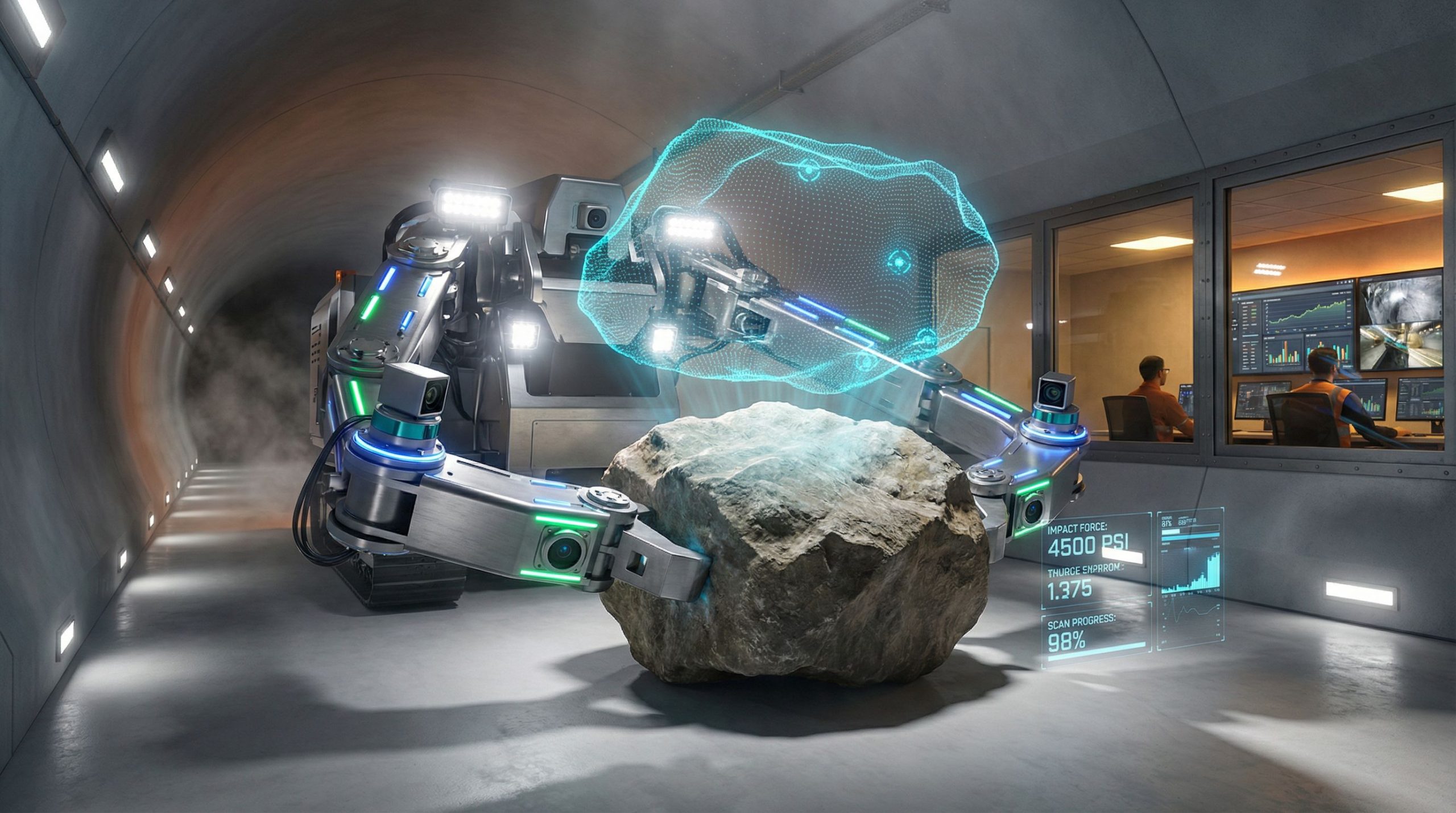
An autonomous rock-breaking system integrates multiple advanced technologies to perform secondary rock-breaking operations without requiring human presence in hazardous zones. These systems utilise real-time camera vision and sensor fusion to generate dynamic three-dimensional representations of ore masses, automatically identifying oversized boulders and executing precise breakage sequences.
The core technological components include:
• Computer vision systems that continuously scan and analyse material composition
• Sensor fusion technology combining multiple data streams for accurate environmental mapping
• Robotic boom control systems with autonomous movement planning capabilities
• Remote monitoring interfaces enabling operator supervision from protected locations
• Integration protocols for seamless communication with existing mine control infrastructure
This technology distinguishes itself from traditional hydraulic breakers and manual rock-breaking methods through its ability to operate continuously without direct human supervision while maintaining consistent performance standards regardless of shift changes or operator variability.
The Critical Role in Modern Mining Operations
Secondary rock-breaking represents one of the most critical ore flow control stages in mining operations. When large boulders or excessive fines halt ore streams, the economic impact extends far beyond the immediate blockage. Furthermore, production delays cascade through the entire operation, affecting downstream processing, equipment utilisation, and delivery schedules.
The economic consequences of these disruptions include:
• Direct production losses from halted ore flow during manual intervention
• Equipment downtime costs while operators clear blockages manually
• Safety incident risks that can result in extended shutdowns and regulatory scrutiny
• Labour inefficiency from deploying skilled operators to hazardous manual tasks
Traditional manual intervention methods require operators to work near crushers and grizzly areas, which represent some of the highest-risk zones in underground mining operations. Consequently, the combination of heavy machinery, dynamic loading conditions, and confined spaces creates multiple hazard vectors that autonomous systems effectively eliminate.
| Operational Factor | Traditional Manual Methods | Autonomous Systems |
|---|---|---|
| Safety Risk Level | High operator exposure | Remote supervision only |
| Response Consistency | Variable by operator skill | Standardised performance |
| Operational Availability | Limited to shift schedules | Continuous 24/7 capability |
| Multi-location Management | One operator per location | Single operator supervision of multiple systems |
How Do Autonomous Rock-Breaking Systems Work?
Real-Time Vision Processing and Environmental Analysis
Autonomous rock-breaking systems employ sophisticated visual processing technology to create comprehensive understanding of their operating environment. Camera-based detection systems continuously capture detailed imagery of ore masses, while sensor fusion technology combines multiple data streams to generate dynamic 3D geological modeling capabilities.
The system processes environmental data in real-time, constantly updating its understanding of material composition and spatial relationships. Machine learning algorithms analyse rock size distribution, material density variations, and structural characteristics to optimise breaking strategies for each specific situation.
Advanced environmental scanning capabilities enable these systems to:
• Adapt to changing ore composition and flow patterns
• Recognise different material types and adjust breaking approaches accordingly
• Account for dynamic loading conditions and equipment positioning
• Maintain operational effectiveness across varying environmental conditions
Intelligent Strike Planning and Autonomous Execution
Once the system completes environmental analysis, sophisticated algorithms determine optimal intervention strategies. The technology automatically identifies oversized boulders requiring fragmentation and plans precise strike positions to maximise breakage efficiency while minimising energy consumption and equipment wear.
Force calculation algorithms determine the appropriate impact energy for each breaking operation based on material characteristics and structural analysis. Moreover, the system plans breakage sequences that optimise fragmentation patterns, reducing the likelihood of creating additional oversized pieces that would require subsequent intervention.
Sequential breaking patterns are designed to:
• Maximise material fragmentation with minimal strikes
• Prevent creation of secondary oversized fragments
• Optimise energy efficiency and equipment longevity
• Maintain consistent material flow through downstream processing
Integrated Control Systems and Remote Communication
The autonomous boom control system plans and executes precise movements with millimetre-level accuracy, positioning breaking tools at optimal angles and distances for maximum effectiveness. Real-time process phase recognition enables the system to adapt its approach as breaking operations progress and material conditions change.
Integration with mine control infrastructure creates seamless communication between autonomous breaking systems and broader operational management platforms. This connectivity enables:
• Comprehensive operational monitoring from centralised control rooms
• Real-time system status updates and performance metrics
• Coordinated operation with other automated mining equipment
• Historical data collection for continuous performance optimisation
Remote supervision capabilities allow operators to maintain oversight and intervention authority while remaining in protected environments far from hazardous breaking zones. In addition, full intervention protocols ensure human control remains available when unexpected conditions require manual oversight.
Advanced autonomous rock-breaking systems process environmental data continuously, generating millimetre-accurate three-dimensional models that enable precise intervention planning within seconds of detecting oversized material blockages.
What Are the Key Safety Benefits of Autonomous Rock-Breaking?
Eliminating Human Exposure in High-Risk Zones
The primary safety advancement offered by autonomous rock-breaking technology involves complete elimination of operator presence in crusher and grizzly areas during blockage clearing operations. These locations represent some of the most dangerous working environments in underground mining, where operators traditionally faced multiple simultaneous hazards including heavy machinery movement, unstable rock formations, and confined space constraints.
Statistical analysis of mining safety incidents consistently identifies manual rock-breaking operations as high-frequency contributors to workplace injuries. By removing human presence from these intervention points, autonomous systems address a significant source of operational risk while maintaining effective material processing capabilities.
The technology creates fundamental improvements in several safety domains:
• Physical hazard elimination: Operators no longer work in proximity to active crushing equipment or unstable rock masses
• Environmental risk reduction: Elimination of exposure to dust, noise, and confined space hazards associated with manual intervention
• Equipment interaction safety: Removal of human-machine interface risks during dynamic breaking operations
• Emergency response improvement: Faster system shutdown capabilities without requiring operator evacuation from hazardous zones
Remote Supervision and Operational Control
Autonomous rock-breaking systems enable comprehensive operational oversight from protected control room environments, allowing single operators to supervise multiple breaking units simultaneously. This operational model transforms the traditional one-to-one operator-equipment relationship into a more efficient and safer supervision structure.
Remote supervision capabilities include:
• Real-time system monitoring: Continuous visibility into breaking system performance and operational status
• Multi-system management: Single operator oversight of several autonomous units across different locations
• Intervention authority: Maintained human control for manual override when conditions require direct operator input
• Emergency protocols: Rapid system shutdown and safety procedures accessible from protected locations
As Vesa Marttila, Global Sales Director and Breaker Booms Product Line Director at Normet Xrock, explained in the Engineering & Mining Journal: "Moving operators away from direct exposure at the crusher or grizzly sites fundamentally improves both safety and productivity."
Operational Continuity and Risk Mitigation
Autonomous systems provide consistent performance standards that eliminate variability associated with operator fatigue, skill differences, or environmental stress factors. This consistency contributes to overall safety by reducing unpredictable operational conditions and maintaining standardised response protocols.
The technology offers 24/7 operational capability without shift transitions that can create communication gaps or procedural inconsistencies. However, continuous operation reduces the accumulation of oversized material that might create more dangerous clearing conditions during manual intervention periods.
How much safer are autonomous rock-breaking systems compared to manual methods?
Autonomous rock-breaking systems eliminate direct human exposure in hazardous crusher zones, representing a fundamental safety improvement over traditional manual intervention methods while enabling comprehensive oversight from protected control room environments.
Which Industries and Applications Benefit Most?
Underground Mining Operations
Underground mining operations represent the primary application domain for autonomous rock-breaking technology, where confined spaces and complex logistics create particularly challenging conditions for manual intervention. Hard rock mining operations dealing with irregular ore sizes and unpredictable material characteristics benefit significantly from consistent autonomous response capabilities.
Coal mining operations encounter variable material consistency that creates frequent blockage events requiring intervention. The autonomous technology provides standardised response protocols regardless of material type variations, ensuring consistent operational flow through changing geological conditions.
Precious metals extraction operations, where production continuity directly impacts revenue generation, particularly benefit from the rapid response capabilities and 24/7 availability of autonomous systems. The elimination of production delays from manual intervention can significantly impact overall operational profitability.
Surface Mining and Quarrying Applications
Large-scale aggregate production facilities require consistent material sizing to meet downstream processing requirements and customer specifications. Autonomous rock-breaking systems provide precise fragmentation control that maintains quality standards while reducing manual intervention requirements.
Construction material processing operations benefit from the technology's ability to maintain strict size specifications through automated monitoring and intervention. Furthermore, the consistency of autonomous breaking patterns helps ensure product quality standards remain stable across extended production periods.
Dimension stone operations requiring precise fragmentation control can leverage autonomous systems' ability to plan breaking patterns that minimise waste and optimise material recovery. The precision available through automated strike planning often exceeds manual operator capabilities.
Processing Plant Integration
Primary crusher feed preparation represents a critical application where autonomous systems optimise material sizing before primary crushing operations. Proper feed preparation reduces wear on primary crushing equipment and improves overall processing efficiency.
Secondary crushing circuit integration benefits from autonomous systems' ability to maintain consistent feed characteristics, reducing variability in downstream processing and improving overall plant efficiency. The technology helps protect expensive processing equipment from damage caused by oversized material.
Material handling system protection through autonomous intervention prevents costly equipment damage and extends component service life. Consequently, the predictable intervention patterns help maintain optimal material flow characteristics throughout the processing chain.
| Mining Sector | Primary Advantage | Implementation Priority |
|---|---|---|
| Underground Hard Rock | Safety risk elimination | High |
| Coal Operations | Operational consistency | Medium-High |
| Surface Aggregate | Production efficiency optimisation | Medium |
| Precious Metals | Revenue continuity protection | High |
What Are the Economic and Productivity Advantages?
Labour Optimisation and Workforce Development
Autonomous rock-breaking technology transforms traditional labour deployment models by eliminating the need for skilled operators to work in hazardous crusher zones while creating opportunities for enhanced workforce utilisation. The shift from direct manual intervention to remote supervision enables more efficient allocation of human resources across multiple operational areas.
The technology enables workforce diversification by removing physical hazard barriers that previously limited operator roles to individuals comfortable working in high-risk environments. As noted by industry experts through autonomous rock breaking technology, this expansion creates "opportunities to a wider group of people who may not previously have been able to access operator or operational roles in the underground mining industry."
Key labour optimisation benefits include:
• Skill enhancement: Operators develop advanced technical monitoring and systems management capabilities
• Risk reduction: Elimination of hazardous zone exposure requirements opens positions to broader workforce demographics
• Efficiency multiplication: Single operators can supervise multiple autonomous systems simultaneously
• Training cost reduction: Reduced need for specialised hazardous environment training and certification
Production Throughput and Operational Consistency
Autonomous systems provide rapid response capabilities that significantly reduce production interruption duration compared to manual intervention methods. The technology's ability to identify and address blockages within minutes rather than requiring 15-45 minute manual response times creates substantial productivity improvements.
The elimination of shift change impacts on operational continuity provides 24/7 consistent performance without the productivity gaps associated with human schedule limitations. This continuous availability particularly benefits operations where material flow interruptions have cascading effects on downstream processing.
Improved crusher feed consistency through autonomous monitoring and intervention leads to:
• Enhanced processing efficiency: Consistent feed characteristics optimise crusher performance
• Reduced equipment wear: Predictable material sizing reduces stress on processing equipment
• Quality improvement: Standardised fragmentation patterns improve product consistency
• Throughput optimisation: Elimination of manual intervention delays maximises processing capacity utilisation
Maintenance Cost Reduction and Equipment Longevity
Predictable wear patterns resulting from consistent autonomous breaking techniques enable more accurate maintenance planning and inventory management. The standardised approach to force application and strike positioning reduces equipment stress variations that contribute to premature component failure.
Autonomous systems eliminate operator error factors that can cause equipment damage through improper technique or excessive force application. For instance, the precision available through computerised control systems optimises tool life and reduces replacement part requirements.
Long-term operational cost benefits include:
• Maintenance predictability: Consistent operation patterns enable accurate service scheduling
• Component longevity: Optimised force application reduces premature wear
• Insurance cost reduction: Improved safety records may reduce operational insurance premiums
• Regulatory compliance: Automated safety protocols help ensure consistent regulatory adherence
Mining operations implementing autonomous rock-breaking systems can achieve substantial return on investment through combined safety improvements, productivity enhancements, and operational cost reductions, with payback periods typically ranging from 18-24 months depending on operational scale and implementation scope.
What Technical Challenges and Limitations Exist?
Environmental and Operational Constraints
Underground mining environments present unique challenges for sophisticated sensor systems and computer vision technology. Dust accumulation on camera lenses and sensor arrays can compromise system accuracy, requiring robust cleaning systems and protective enclosures to maintain operational effectiveness.
Moisture and humidity variations in underground environments can affect electronic components and create condensation issues that interfere with optical systems. Temperature fluctuations from seasonal changes or ventilation system variations require environmental compensation in sensor calibration and system operation.
Integration complexity with existing mine infrastructure presents significant implementation challenges:
• Power system compatibility: Ensuring adequate electrical supply for autonomous systems without overloading existing infrastructure
• Communication network integration: Establishing reliable data transmission pathways in underground environments with limited connectivity options
• Physical space constraints: Accommodating autonomous system components within existing crusher and grizzly configurations
• Emergency protocol coordination: Integrating autonomous system safety procedures with established mine emergency response plans
Technology Maturation and Reliability Factors
Autonomous rock-breaking systems require extensive learning periods to optimise performance for site-specific rock characteristics and operational conditions. Different ore types, geological formations, and material hardness variations require system adaptation that may take weeks or months to fully develop.
Maintenance requirements for sophisticated sensor arrays and computer systems exceed those of traditional hydraulic equipment. Consequently, specialised technical knowledge becomes necessary for system servicing, potentially requiring additional training for maintenance personnel or external service contracts.
Backup protocols for system failures present operational challenges:
• Manual override capabilities: Ensuring human operators can safely intervene when autonomous systems malfunction
• Equipment redundancy: Maintaining backup systems to prevent production interruptions during autonomous system maintenance
• Diagnostic capabilities: Developing comprehensive system monitoring to predict and prevent failures before they impact operations
• Recovery procedures: Establishing protocols for rapid system restoration following technical difficulties
Investment and Implementation Considerations
High initial capital requirements for advanced autonomous systems can present significant financial barriers, particularly for smaller mining operations or those with limited capital budgets. The sophisticated technology requires substantial upfront investment that may not be immediately justified by operational scale.
Training requirements extend beyond basic equipment operation to include complex system monitoring, maintenance, and troubleshooting capabilities. This educational investment requires time and resources that may temporarily reduce operational efficiency during implementation periods.
Infrastructure modifications often become necessary to accommodate autonomous systems, including:
• Electrical system upgrades: Enhanced power distribution and backup systems for reliable autonomous operation
• Communication infrastructure: Robust networking capabilities for real-time system monitoring and control
• Physical modifications: Structural changes to accommodate sensor arrays and autonomous equipment positioning
• Integration systems: Software and hardware connections with existing mine management and monitoring platforms
How Is the Technology Evolving and What's Next?
Artificial Intelligence and Machine Learning Advancement
Current autonomous rock-breaking systems represent early implementations of AI in drilling & blasting mining, with significant potential for advancement through machine learning algorithm refinement and expanded data analysis capabilities. Future systems will incorporate more sophisticated pattern recognition that learns from operational experience across multiple sites and geological conditions.
Enhanced rock recognition algorithms will develop through continuous learning from operational data, improving accuracy in identifying optimal breaking points and predicting material behaviour. This advancement will enable more precise intervention strategies and reduced energy consumption per breaking operation.
Predictive maintenance capabilities using operational data analysis will transform equipment service approaches:
• Component wear prediction: Analysis of operational patterns to forecast maintenance needs before failures occur
• Performance optimisation: Continuous algorithm refinement based on breaking efficiency data and equipment performance metrics
• Environmental adaptation: Improved system response to changing operational conditions through accumulated experience
• Decision-making enhancement: More sophisticated algorithms for complex breaking scenarios involving unusual rock formations or equipment configurations
Integration with Broader Mine Automation
The future development trajectory for autonomous rock-breaking systems involves coordination with other automated mining equipment to create integrated operational ecosystems. Furthermore, coordination with autonomous haulage systems will optimise material flow management and reduce operational conflicts between different automated systems.
Integration with autonomous drilling systems will enable comprehensive mine planning optimisation, where breaking system capabilities influence drilling patterns and extraction strategies. This coordination will improve overall mine efficiency through better material size management from extraction through processing.
Development of fully autonomous mining operation ecosystems will transform traditional mining approaches:
• Coordinated equipment operation: Synchronised autonomous systems working together without human intervention
• Predictive operational planning: Systems that anticipate and prepare for operational challenges before they impact production
• Adaptive production optimisation: Real-time adjustment of mining strategies based on comprehensive operational data analysis
• Safety system integration: Comprehensive autonomous safety monitoring across all mining operations
Future Market Expansion and Adoption Trends
Increasing regulatory pressure for improved mining safety standards will drive broader adoption of autonomous rock-breaking technology as mining companies seek to eliminate high-risk manual operations. Regulatory bodies are likely to establish more stringent safety requirements that favour automated solutions over manual intervention methods.
Cost reductions in sensor technology and computing hardware will make autonomous systems accessible to smaller mining operations that currently cannot justify the investment. This market expansion will accelerate technology development and create economies of scale that further reduce implementation costs.
Global market growth projections for mining automation indicate substantial expansion opportunities:
| Development Phase | Timeline | Key Capabilities |
|---|---|---|
| Current Generation | 2024-2026 | Basic autonomous breaking with comprehensive remote supervision |
| Next Generation | 2026-2028 | Enhanced AI decision-making and integrated predictive maintenance |
| Future Systems | 2028-2030+ | Complete ecosystem integration and fully self-optimising performance |
The evolution toward comprehensive mine automation will position autonomous rock-breaking systems as essential components of modern mining operations rather than specialised solutions for specific safety challenges.
Frequently Asked Questions About Autonomous Rock-Breaking Systems
Implementation and Operational Questions
How long does it take to implement an autonomous rock-breaking system?
Implementation timelines vary significantly based on existing infrastructure, integration complexity, and operational requirements. Typical installations require 3-6 months for complete deployment, including system installation, integration testing, operator training, and performance optimisation.
What training is required for operators and maintenance staff?
Operator training focuses on system supervision, monitoring interface operation, and emergency intervention procedures. Maintenance staff require specialised technical training covering sensor systems, computer hardware, and diagnostic procedures. Training programmes typically require 2-4 weeks for operators and 4-6 weeks for maintenance personnel.
Can these systems work in all mining environments?
Autonomous rock-breaking systems are primarily designed for underground mining applications with crusher and grizzly configurations. Environmental factors such as extreme temperatures, excessive dust, or unique geological conditions may require customised system configurations or additional protective measures.
Technical and Performance Questions
How accurate are autonomous systems compared to experienced operators?
Autonomous systems provide consistent performance that eliminates human variability factors such as fatigue, skill differences, or environmental stress. While experienced operators may excel in specific situations, autonomous systems maintain standardised effectiveness across all operational conditions and time periods.
What happens if the system encounters unexpected rock formations?
Advanced autonomous systems include recognition algorithms for unusual material characteristics and decision-making protocols for unexpected conditions. When systems encounter scenarios outside their operational parameters, they can alert remote operators for manual intervention while maintaining safe operational status.
How do these systems handle equipment maintenance and tool changes?
Autonomous systems require regular maintenance similar to traditional equipment, with additional requirements for sensor cleaning and calibration. Tool changes typically require temporary manual intervention, though future systems may incorporate automated tool changing capabilities.
Cost and ROI Questions
What is the typical investment range for autonomous rock-breaking systems?
Investment costs vary significantly based on system complexity, integration requirements, and operational scale. Initial capital requirements typically range from several hundred thousand to over $1 million, depending on configuration and installation complexity.
How do operating costs compare to traditional manual methods?
Operating costs for autonomous systems include energy consumption, maintenance, and remote supervision labour, which generally prove lower than traditional manual operations when factoring in direct labour costs, safety-related expenses, and productivity improvements.
What factors influence the payback period for these systems?
Payback periods depend on operational scale, labour cost savings, productivity improvements, safety cost reductions, and maintenance optimisation. Operations with frequent blockage events and high labour costs typically achieve faster payback periods.
The Future of Safe and Efficient Rock-Breaking
Transformative Impact on Mining Safety Standards
Autonomous rock-breaking technology represents a fundamental transformation in mining safety philosophy, shifting from risk mitigation through protective equipment and procedures to risk elimination through technology-enabled remote operation. This approach establishes new benchmarks for acceptable safety standards in mining operations.
The widespread adoption of autonomous rock-breaking systems will likely influence regulatory frameworks and industry standards, creating expectations for technology-based safety solutions across all mining operations. As the technology demonstrates consistent safety improvements, regulatory bodies may establish requirements for autonomous safety systems in high-risk operational areas.
Industry-wide transformation potential includes:
• Safety culture evolution: Fundamental changes in how mining operations approach hazardous tasks
• Regulatory advancement: Development of new safety standards incorporating autonomous technology requirements
• Insurance industry adaptation: Revised risk assessment models recognising autonomous safety benefits
• Workforce development: Educational programmes preparing workers for technology-enhanced mining careers
Strategic Considerations for Mining Operations
Mining companies evaluating autonomous rock-breaking technology must consider both immediate operational benefits and long-term strategic positioning within an increasingly automated industry. Early adoption provides competitive advantages through improved safety records, enhanced operational efficiency, and workforce development capabilities.
Technology readiness assessment becomes critical for successful implementation, requiring evaluation of existing infrastructure, workforce capabilities, and integration requirements. Operations with adequate technical infrastructure and committed management support achieve more successful autonomous system deployment.
The economic case for autonomous rock-breaking systems strengthens as labour costs increase, safety regulations become more stringent, and technology costs decrease. Mining operations that delay adoption may face competitive disadvantages as autonomous technology becomes standard industry practice.
Long-term strategic benefits extend beyond immediate operational improvements to include enhanced corporate reputation, improved access to capital through superior safety records, and increased operational resilience through reduced dependence on specialised manual labour.
The integration of AI-enhanced exploration and data-driven mining operations represents a significant step toward comprehensive mine automation, positioning operations for future technology adoption and operational optimisation opportunities. As the mining industry continues evolving toward automated operations, autonomous rock-breaking technology serves as a foundation for broader technological advancement and safety improvement initiatives.
Are You Ready to Capitalise on Mining Technology Advancements?
As autonomous rock-breaking systems and other cutting-edge mining technologies reshape the industry landscape, savvy investors are positioning themselves to benefit from the companies driving these innovations. Discovery Alert's proprietary Discovery IQ model delivers instant notifications on significant ASX mineral discoveries, helping you identify technology-forward mining companies with breakthrough potential before the broader market recognises their value. Begin your 30-day free trial today to gain immediate access to the mining sector's most promising investment opportunities.