ADX Energy Ltd
- ASX Code: ADX
- Market Cap: $24,265,656
ADX Energy's HOCH-1 Well Delivers Stable, Water-Free Gas Flow In Austria – Testing Program Underway
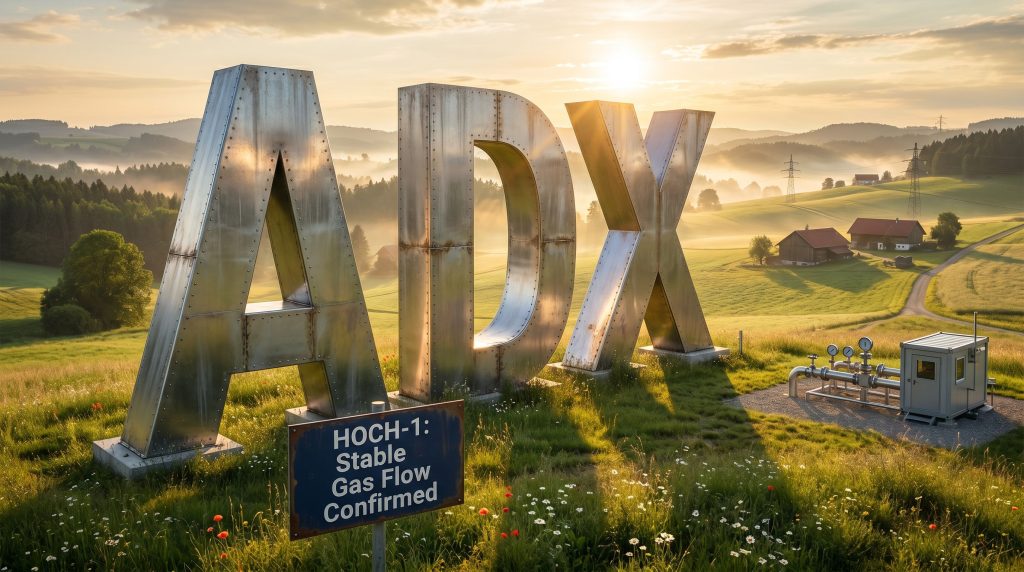
ADX Energy Ltd (ASX: ADX) has reported a stable, water-free gas flow rate of 2.7 million cubic feet per day (MMcf/d), equivalent to 450 barrels of oil equivalent per day (boepd), from the first test zone in its Hochfeld-1 (HOCH-1) shallow gas exploration well in Upper Austria. The ADX Energy HOCH-1 gas flow test results in Austria represent an encouraging early milestone for the company's broader exploration programme in the region.
The result comes from an 11-hour test of a single sandstone interval and represents only the first of up to eight gas reservoirs identified in the well. According to the ASX announcement, HOCH-1 has now been shut in for a two-week pressure build-up period to assess connected gas volumes and potential reserves from this initial zone.
When big ASX news breaks, our subscribers know first
First Zone Tested Delivers Stable Gas Flow
The HOCH-1 well was drilled, cased and completed on 15 May 2026 in the ADX-AT-I exploration licence area in Upper Austria. HOCH-1 is the first of three shallow gas prospects planned by ADX Energy Ltd in the region, with two further prospects fully permitted for drilling in 2026.
ADX Energy Ltd is the operator of HOCH-1 and holds a 50% economic interest in the Hochfeld prospect.
During drilling, the well encountered up to eight gas-bearing sand bodies within the Hall formation and the Base Hall formation, based on gas shows and wireline logging data. Production testing is being conducted in two phases:
- Phase 1 – upper Hall formation:
- Up to three firm zones to be tested
- A fourth contingent zone may be tested depending on results
- Phase 2 – lower Base Hall Channel formations:
- Targeting deeper channel sands interpreted from seismic and logging
The first interval tested, referred to as Zone 1, is a Basin Floor Fan (BFF) sandstone at a depth of 1,465 metres (interval 1,464.6 to 1,466.6 metres). Key test parameters reported by ADX Energy Ltd are summarised below.
Zone 1 Test Results – HOCH-1 Well
| Test parameter | Result |
|---|---|
| Flow rate (average) | 2.7 MMcf/d (450 boepd) |
| Test duration | 11 hours |
| Flowing wellhead pressure | 870 psi (~60 bar) |
| Water content | Water-free |
| Reservoir type | Basin Floor Fan (BFF) sandstone |
| Depth | 1,465 metres |
According to the announcement, down-hole pressure gauges were installed during the test to record reservoir pressure behaviour. These gauges restricted the flow in the well and reduced the measured flow rate at surface. ADX Energy Ltd stated that the gauges will be removed after testing, which means that unconstrained flow rates could be higher than those reported in this initial test.
Well Now Shut In for Pressure Build-Up to Estimate Connected Gas Volume
Following clean-up flow on 17 June and extended flow testing on 19 June, HOCH-1 has been shut in to record a Pressure Build-Up (PBU) over approximately two weeks. According to ADX Energy Ltd, this is intended to determine the connected gas volume of the Zone 1 BFF sand body.
The company interprets this BFF sandstone to have been deposited over an extensive area, consistent with pre-drill P50 to P10 area estimates of 5 to 8 km². In similar basins, furthermore, such large areal extents mean that even relatively thin sand bodies can host commercial gas volumes.
"The well testing program is providing encouraging results from the first basin floor fan sand interval (Zone 1) tested within the HOCH-1 gas discovery. The water free flow rate from this single sandstone alone is commercially attractive given current European gas prices of EUR 42 per MWh (US$ 14.10 MMbtu) as well as the increasing demand for local, European clean gas such as HOCH-1 pure methane (biogenic) gas. The basin floor sands encountered within the HOCH-1 well are interpreted to extend over an area in line with the pre-drill relatively large P50 to P10 area estimates, i.e. 5 to 8 km². Due to the potentially large area of deposition, relatively thin basin floor sands can provide commercial gas volumes – this has been the case for offset wells in the basin," said Ian Tchacos, executive chairman of ADX Energy Ltd.
The PBU response will consequently be analysed to estimate gas reserves from this single interval in HOCH-1 prior to testing additional BFF reservoirs and Base Hall Channel zones.
What Is a Pressure Build-Up Test and Why Is It Important?
A Pressure Build-Up (PBU) test is a standard reservoir engineering tool used to understand how much gas or oil is connected to a well and how easily it can flow.
In simple terms, the process involves:
- Flowing the well at a controlled rate for a period of time.
- Shutting the well in so no more fluid is produced.
- Measuring pressure over time at or near the reservoir level using down-hole gauges.
The pattern of pressure recovery after shut-in contains key information:
- Connected gas volume – if pressure recovers quickly and stabilises at a high level, it can indicate a larger connected reservoir. Slow or limited recovery can suggest restricted reservoir extent or barriers.
- Permeability – a measure of how easily gas can move through the rock. Higher permeability usually leads to better flow performance and higher sustainable production rates.
- Skin factor – represents any additional resistance to flow near the wellbore, often due to drilling damage or completion effects. A positive skin means extra resistance, while a negative skin can indicate improved flow near the well.
For investors, PBU results are important because:
- They support the conversion of a gas discovery into estimated reserves, which are a key value metric for energy companies.
- They help determine whether the well can support commercial flow rates over time, not just short-term test rates.
- They guide decisions on well completion, production facilities and field development plans.
In the case of the ADX Energy HOCH-1 gas flow test results in Austria, the company has stated that PBU data from Zone 1 will be used to estimate reserves for this BFF sandstone interval alone, which then becomes one of several building blocks for the overall single-well reserves potential.
Multiple Zones in One Well – Building a Production Profile
According to the ASX release, HOCH-1 has intersected up to eight sand intervals with gas indications, distributed between the Hall formation and the Base Hall formation.
Production testing is designed to evaluate these zones systematically. The announced sequence is:
- Zone 1 (tested) – BFF sandstone at 1,465 metres, delivering 2.7 MMcf/d water-free gas at 870 psi during an 11-hour test, now on PBU shut-in for approximately two weeks.
- Zones 2 and 3 – firm Phase 1 zones – located in the upper Hall formation, to be perforated and flow-tested after evaluation of Zone 1 PBU data, with testing order and duration adjusted based on inflow performance.
- Zone 4 – contingent upper Hall zone – may be tested depending on the results from Zones 1 to 3, identified through gas shows while drilling and log interpretation.
- Base Hall Channel zones – Phase 2 – targeting deeper channel-type reservoirs in the Base Hall formation, planned after completion of Phase 1 upper Hall testing.
ADX Energy Ltd noted that each sand interval is being perforated sequentially, followed by a brief clean-up flow before extended testing. The perforation and flow sequence will be adjusted depending on the inflow performance of each zone.
The stated objective is to determine the reserves potential associated with the multiple sand bodies intersected in HOCH-1, and whether the single production well justifies a tie-in for commercial production to nearby infrastructure.
For investors, the key point is that Zone 1 represents only one of several potential contributors to future production. Each additional productive zone could, therefore, add to the combined production rate and reserves per well, improving project economics if gas is ultimately brought to market.
Market Context: European Gas Pricing and Biogenic Methane
The ASX announcement references a European gas price of EUR 42 per MWh, equivalent to approximately US$14.10 per MMBtu, at the time of the release.
At this pricing level, ADX Energy Ltd considers the water-free flow rate from Zone 1 alone to be commercially attractive. This comment reflects the relationship between several factors:
- Shallow well depth of around 1,465 metres, which typically keeps drilling and completion costs lower than deeper wells.
- Existing gas infrastructure in Upper Austria, one of Europe's established hydrocarbon producing regions.
- The fact that test rates have been restricted by down-hole gauges, suggesting scope for higher rates once fully completed.
The company also highlights that HOCH-1 gas is pure methane of biogenic origin. Biogenic methane refers to gas formed mainly by the breakdown of organic matter by microorganisms at relatively shallow depths and lower temperatures. This differs from thermogenic methane, which forms from deeper burial and heating of organic material over long time periods.
In energy markets, biogenic gas can be viewed as attractive where there is strong interest in local gas supply rather than long-distance imports, as well as lower carbon intensity relative to higher-emission energy sources, subject to full life-cycle assessment.
While the announcement does not include specific emissions metrics, the emphasis on local, clean gas and pure methane aligns with broader European trends focused on security of supply and environmental performance.
Forward Program and Key Milestones
The ADX Energy HOCH-1 gas flow test results in Austria, combined with the broader shallow gas campaign in Upper Austria, provide several time-based events for investors to monitor. Based on the ASX release, the indicative sequence is as follows.
HOCH-1 and Upper Austria Program Milestones
| Milestone | Indicative timing | Reported purpose |
|---|---|---|
| Completion of Zone 1 PBU and analysis | ~2 weeks from 19 June (early July 2026) | Estimate connected gas volume and reserves for Zone 1 BFF sand |
| Testing of Zones 2 and 3 (upper Hall, Phase 1) | After Zone 1 PBU evaluation | Assess additional BFF sand performance and combined flow potential |
| Possible testing of Zone 4 (contingent) | End of Phase 1 | Evaluate additional upper Hall gas interval if warranted |
| Phase 2 testing – Base Hall Channel formations | Following Phase 1 completion | Test deeper channel sands for additional gas volumes |
| Commercial decision on tie-in of HOCH-1 | After full testing program | Decide on connection of well to infrastructure for production |
| Drilling of two additional shallow gas prospects | During 2026 | Extend shallow gas exploration and appraisal within ADX-AT-I licence |
According to executive chairman Ian Tchacos, the current program will consist of multiple flow tests and shut-in periods to estimate single-well reserves potential and flow rates from the various sand bodies. Further HOCH-1 results are planned to be reported as they become available.
The next major ASX story will hit our subscribers first
Why HOCH-1 Is Relevant to Investors in ADX Energy Ltd
The HOCH-1 testing update provides several data points that may be relevant for investors tracking ADX Energy Ltd:
- Reported commercial relevance of first test – management has described the 2.7 MMcf/d water-free gas rate from Zone 1 as commercially attractive at current European gas prices, even with flow constrained by down-hole gauges.
- Multiple potential reservoirs in a single well – with up to eight gas-bearing sand bodies identified, there is potential for cumulative production per well that could exceed the contribution of Zone 1 alone if subsequent zones perform positively.
- Reservoir scale and offset well reference – the interpreted 5 to 8 km² areal extent of basin floor sands is stated to be consistent with offset wells in the basin that have achieved commercial production from relatively thin sands.
- Shallow depth and existing infrastructure – the shallow nature of HOCH-1 and its location in an established producing basin could be positive for development costs and timelines if reserves and flow rates support commercialisation.
- Ongoing exploration and appraisal pipeline – with two additional shallow gas prospects fully permitted for drilling in 2026, ADX Energy Ltd has a defined programme that may generate further newsflow and additional reservoir data in the same region.
According to the ASX announcement, the technical and reserves information relating to Austria has been reviewed by Paul Fink, technical director of ADX Energy Ltd, a qualified geophysicist with 30 years of experience, in accordance with ASX Listing Rules 5.41 and 5.42.
Want to Know More About ADX Energy's Austrian Gas Discovery?
With stable, water-free gas flowing from just the first of up to eight identified reservoirs at HOCH-1, and two additional shallow gas prospects already permitted for drilling in 2026, ADX Energy Ltd (ASX: ADX) is advancing a well-defined exploration programme in one of Europe's established producing basins. To learn more about the company, its projects, and the investment case behind its Austrian gas campaign, visit the ADX Energy website at adx-energy.com.