ADX Energy Ltd
- ASX Code: ADX
- Market Cap: $18,252,254
ADX Energy's HOCH-1 Well Delivers Strong First Results, With Further Testing Ahead
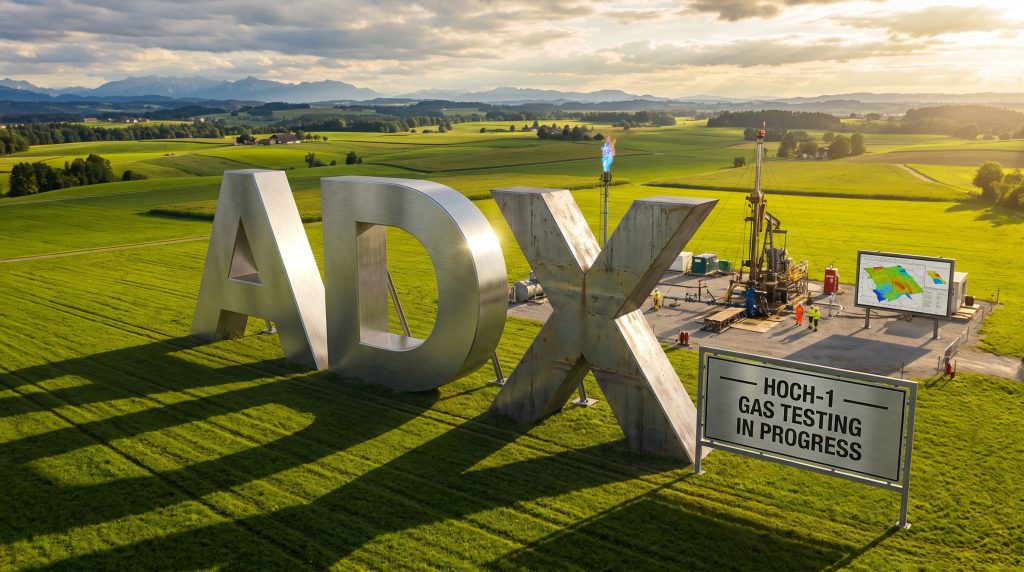
ADX Energy Ltd (ASX:ADX) has provided investors with an update on the testing program at its Hochfeld-1 (HOCH-1) shallow gas exploration well in Upper Austria, confirming that the ADX Energy HOCH-1 well test results in Upper Austria show the first tested zone delivered water-free gas flow at encouraging rates. Pressure analysis conducted after the initial flow test points to further reservoir productivity beyond what was recorded during the flow period itself.
Additional gas zones, including the prospective Hall Channel sands, are scheduled for testing from the week of 24 August, marking what could be a consequential phase of the HOCH-1 program.
When big ASX news breaks, our subscribers know first
What the First Test Zone Has Confirmed
The HOCH-1 well was drilled, cased and completed on 15 May 2026 after encountering up to eight biogenic gas reservoirs across two distinct formations, the Hall basin floor fan (Hall) and the Base Hall Channel (Hall Channel). Testing is being conducted in two structured phases.
According to the announcement, the initial Phase 1 test of the first Hall zone produced results that set a baseline for the program:
- Water-free gas was produced at a stable average flow rate of 2.7 MMCFPD (450 BOEPD) over an 11-hour test period
- Following the flow test, the well was shut in to allow a downhole pressure build-up analysis over approximately two weeks
- The pressure build-up analysis indicated excellent reservoir productivity, with a modelled flow rate potential of 3.5 MMCFPD (580 BOEPD)
- Sand body extent was confirmed at at least 600 metres from the HOCH-1 wellbore
| Metric | Result |
|---|---|
| Gas flow rate (11-hour test) | 2.7 MMCFPD (450 BOEPD) |
| Modelled flow rate potential (pressure build-up) | 3.5 MMCFPD (580 BOEPD) |
| Sand body lateral extent confirmed | At least 600 metres from wellbore |
| Gas type | Water-free |
| Total gas reservoirs encountered in well | Up to 8 |
| ADX economic interest in HOCH prospect | 50% |
These figures relate to only the first of up to eight gas reservoirs encountered in the well. The remainder of the testing program is yet to be completed.
"The HOCH-1 well testing results to date are encouraging. The first basin floor fan sand interval of the Hall formation tested has shown excellent productivity characteristics and lateral continuity." — Executive Chairman Ian Tchacos
A Two-Phase Testing Strategy
The HOCH-1 testing program is structured in two phases, each targeting different reservoir types within the well.
Phase 1 testing (underway, resuming week of 24 August):
- First Hall zone, completed, confirming 2.7 MMCFPD flow and 3.5 MMCFPD potential
- A second Hall zone and a Hall Channel zone will be perforated and produced together (comingled), followed by a shut-in and downhole pressure build-up to assess combined reservoir characteristics and extent
Phase 2 testing (to follow Phase 1):
- At least two deeper Hall Channel sand zones are planned for testing
- A workover rig will be required to drill out a cement plug to access these deeper zones
- Post-drill seismic mapping has indicated the potential for large stratigraphic trap areas associated with these zones
A brief delay to testing, attributed to logistical requirements around procuring an explosive licence for perforation, has reportedly been resolved. The program is, consequently, set to resume in the week commencing 24 August.
New Seismic Reprocessing Expands the Picture
A notable element of the update relates to post-drill work completed using recently reprocessed pre-stacked depth migrated (New PSDM) 3D seismic data. This new mapping of the Hall Channel sands has been correlated to nearby historic wells, with results said to have increased confidence in the lateral scale of the reservoirs being tested.
Key findings from the new seismic mapping, as outlined in the announcement, include:
- Hall Channel sands intersected in HOCH-1 can be correlated to wells approximately 2.5 to 3 kilometres away, indicating potentially large stratigraphic trap areas
- The upper Hall Channel sands (Phase 1 target) and lower Hall Channel sands (Phase 2 target) both show large lateral extensions, with a previously drilled well (M-001) located approximately 2.5 kilometres to the southeast of HOCH-1 intersecting the same structure
- One of the lower Hall Channel sands, a Phase 2 target, has gas reservoir indications supported by well log correlations to a historic well (F-001) located approximately 2.8 kilometres to the east of HOCH-1, supported by modern petrophysics interpretation
This combination of new seismic processing and well-to-well correlation is said to increase confidence that HOCH-1 has intersected sand bodies with meaningful areal extent, a factor relevant to estimating the scale of any potential resource.
"The relatively thin deep marine Hall Channel sands have yielded several relatively large gas discoveries ranging between 25 to 40 BCF. A single well to the East of HOCH-1 has recovered 10 BCF from several channel sands. The mapping of thin sands intersected in the HOCH-1 well which can be correlated to nearby historic wells has increased our confidence that the HOCH-1 well has intersected a number of potentially extensive sand bodies." — Ian Tchacos
Understanding the Reservoir Types: Hall Versus Hall Channel
For readers less familiar with subsurface geology, understanding the two reservoir systems being tested helps explain the design of the testing program.
What Are Hall Basin Floor Fan Sands?
Hall basin floor fan sands are more evenly distributed reservoirs formed by sediment deposited across the floor of an ancient marine basin. They tend to be laterally continuous, meaning a well intersecting them can access a larger connected volume of gas. The first tested zone, which confirmed the 2.7 to 3.5 MMCFPD flow rates, is a Hall fan sand.
What Are Hall Channel Sands?
Hall Channel sands are elongated, lens-shaped reservoirs formed within ancient submarine channels. They are typically narrower than basin floor fans but can be highly productive, and in this geological setting have reportedly been associated with discoveries in the 25 to 40 BCF range at nearby analogues.
Furthermore, two fundamentally different reservoir types are being tested within the same well. Success across both formations could diversify the resource potential of the HOCH-1 program and provide additional context for evaluating the broader ADX prospect inventory in the region.
Quick Glossary
- MMCFPD: Million cubic feet per day, a measure of gas flow rate
- BOEPD: Barrels of oil equivalent per day, a standardised unit for comparing different hydrocarbon types
- PSDM (Pre-Stacked Depth Migration): A seismic processing technique that improves the accuracy of subsurface imaging, particularly in complex geological settings
- Stratigraphic trap: A gas or oil accumulation formed by changes in rock type or structure, rather than a traditional fold or fault, often associated with channel and fan sand systems
- Pressure build-up analysis: A test conducted after shutting in a flowing well to measure reservoir pressure recovery, used to estimate productivity, permeability and reservoir extent
- Comingled production: Producing gas from two or more zones simultaneously through the same wellbore
What Comes Next: The Testing Timeline
| Phase | Target zones | Timing | Method |
|---|---|---|---|
| Phase 1, Zone 1 | First Hall sand | Completed (June 2026) | Flowed and pressure build-up completed |
| Phase 1, Zones 2 and 3 | Second Hall sand plus Hall Channel sand | Week of 24 August 2026 | Comingled perforation, flow, pressure build-up |
| Phase 2 | At least two deeper Hall Channel sands | Following Phase 1 | Workover rig to drill out cement plug, then test |
ADX has stated that further updates will be provided as results become available in the coming weeks.
Investment Considerations for the HOCH-1 Program
The ADX Energy HOCH-1 well test results in Upper Austria form one component of the broader ADX growth strategy in the region. The current update touches on several relevant points for the investment case.
First Zone Productivity
A stable, water-free flow rate of 2.7 MMCFPD from the first interval tested, with pressure analysis indicating 3.5 MMCFPD potential, demonstrates the reservoir system is capable of delivering measurable flow rates.
Multiple Zones Remain Untested
With up to eight gas reservoirs encountered in the well and only one tested so far, the remaining program carries additional exploration upside. Each further test result adds incrementally to the overall picture.
Hall Channel Sands as a Potential Step-Change Target
Seismic mapping completed post-drill, correlating HOCH-1 intersections to wells 2.5 to 2.8 kilometres away, points to the potential for large-scale stratigraphic traps. In the same geological system, nearby analogues have reportedly produced discoveries of 25 to 40 BCF, with one well recovering 10 BCF from channel sands.
Additional Wells in the Pipeline
HOCH-1 is one of three planned wells. ADX holds two additional shallow gas prospects fully permitted for drilling in 2026 in Upper Austria, meaning HOCH-1 results are expected to inform the approach to subsequent wells. In addition, ADX operates the HOCH prospect and holds a 50% economic interest, giving the company direct involvement in the testing program and exposure to any resource outcomes.
The next major ASX story will hit our subscribers first
Why the HOCH-1 Program Warrants Attention
The ADX Energy HOCH-1 well test results in Upper Austria have reached a notable stage in the overall testing program. A first flow test and associated pressure data have been recorded, with further phases still to come. The comingled Phase 1 test and the Hall Channel Phase 2 program could, however, add further detail to the scale of the reservoirs ADX has encountered.
The combination of early flow results, a multi-zone testing program resuming imminently, updated seismic mapping pointing to potential reservoir extensions, and two additional permitted wells in the pipeline makes this a program that warrants continued monitoring in the weeks ahead.
Key takeaway: ADX Energy has established an initial data point at HOCH-1 with confirmed water-free gas flow and reservoir characteristics from the first tested zone. With up to seven additional reservoir intervals yet to be tested — including the prospective Hall Channel sands historically associated with discoveries of 25 to 40 BCF in the region — and two further permitted wells in the pipeline, the ADX Energy HOCH-1 well test results in Upper Austria carry a number of near-term catalysts for investors to monitor closely.
Want to Follow the HOCH-1 Testing Program as It Unfolds?
With Phase 1 comingled testing of the Hall and Hall Channel sands resuming imminently and Phase 2 targeting deeper zones with potential step-change scale, ADX Energy's HOCH-1 program is entering a critical period. To learn more about ADX Energy, its 50% interest in the HOCH prospect, and its broader pipeline of two additional permitted wells in Upper Austria, visit the company's official website at adx-energy.com.