ADX Energy Ltd
- ASX Code: ADX
- Market Cap: $26,830,691
ADX Energy's Austrian Drill Bit Turns at 950 Metres — Results Due Within Days
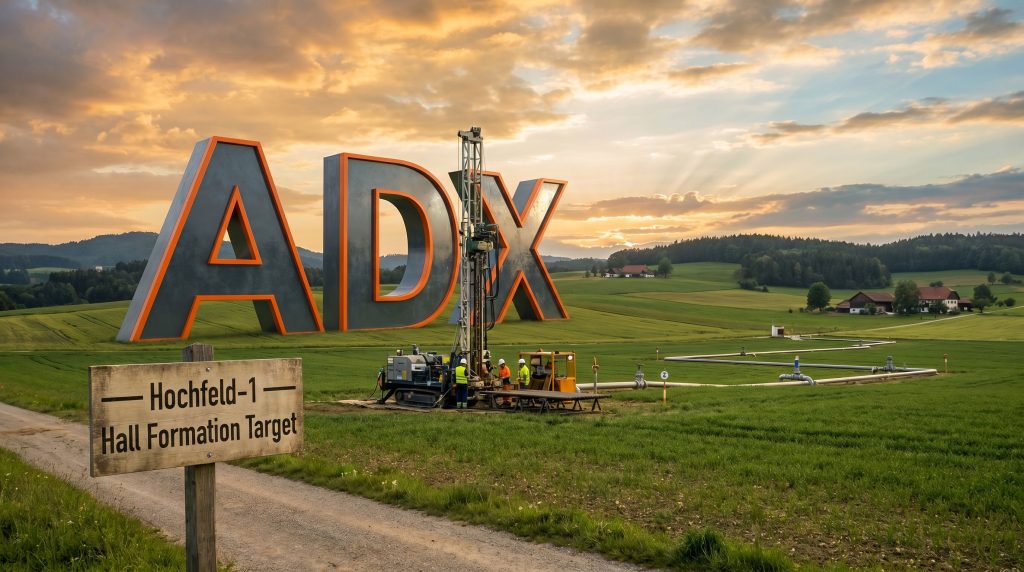
ADX Energy Ltd (ASX: ADX) has provided investors with a significant operational update on its Hochfeld-1 (HOCH-1) shallow gas exploration well in Upper Austria, confirming the drill is progressing on schedule and is now within approximately three days of reaching its target depth. This ADX Energy Hochfeld-1 drilling update in Upper Austria marks a pivotal moment for the company as it closes in on results from the first of three permitted shallow gas wells planned for 2026 — a programme targeting formations that nearby analogues have shown can produce at rates of up to 9 million standard cubic feet per day (mmscf/d).
When big ASX news breaks, our subscribers know first
Drill Bit Advancing Fast: Where Things Stand
As of 6:00 am CET on 3 May 2026, the HOCH-1 well was drilling ahead at a measured depth (MD) of 950 metres in 6⅛ inch hole, operated by the MND Drilling & Services MD-150 rig. Since the previous operational update, the team has completed a substantial sequence of well construction milestones:
- Drilled the 8½ inch hole section to a section total depth (TD) of 431 metres
- Run and cemented 7-inch casing
- Installed blowout preventors
- Drilled ahead in 6⅛ inch hole to 950 metres
The well is now targeting a total measured depth of approximately 1,430 metres (true vertical depth of 1,145 metres), with the expected top of the Hall formation reservoir at approximately 1,075 metres TVD (roughly 1,363 metres MD).
What Happens Next?
The path from here is short and well-defined:
- Continue drilling in 6⅛ inch hole to total depth (~3 days)
- Run wireline logs to evaluate the reservoir (~1–2 days after TD)
- Case and suspend the well if successful, ahead of production testing
Consequently, initial well results could be in investors' hands within approximately five days of this update.
What Is HOCH-1 Actually Targeting?
The HOCH-1 well is targeting biogenic gas (approximately 99% methane) trapped within Miocene-aged Hall formation sandstones — the same geological sequence that has delivered some of the most productive shallow gas wells in Upper Austria. Several nearby analogue wells have recorded initial production rates of up to 9 mmscf/d, equivalent to roughly 1,500 barrels of oil equivalent per day (boepd) — impressive numbers for a well drilled to little more than a kilometre depth.
The trap at HOCH is a combination structural-stratigraphic play, defined by a 3-way dip closure with a pinch-out seal. Critically, ADX's technical team has identified a Direct Hydrocarbon Indication (DHI) via 3D seismic amplitude responses and a Class 3 AVO signature — geophysical attributes widely associated with gas accumulations in this type of setting.
Furthermore, the technical case is strengthened by the company's observation that several wells drilled in the area prior to the availability of high-resolution 3D seismic data missed the reservoir entirely due to sandstone pinch-out. ADX's programme is specifically designed around the 3D seismic data to target the right structural position.
Understanding the Key Concept: What Is a Direct Hydrocarbon Indication (DHI)?
What Is a DHI?
A DHI is a distinctive response visible on seismic data that is directly associated with the presence of hydrocarbons — in this case, gas — rather than simply rock structure. At HOCH, the DHI manifests as a "soft kick" amplitude anomaly combined with a Class 3 AVO (Amplitude Versus Offset) response.
Why Does It Matter to Investors?
DHIs are one of the most reliable pre-drill indicators that a prospect contains real hydrocarbons rather than just the right structural shape. A classic DHI in a proven geological play like the Hall formation meaningfully increases a well's chance of success compared to prospects that rely on structure alone.
For ADX, the presence of both strong seismic amplitudes and a consistent AVO response across the HOCH prospect area is part of what underpins the technical team's assessment that HOCH carries a high chance of success.
Glossary of Key Terms Used in This Update
| Term | Meaning |
|---|---|
| MD (Measured Depth) | The actual length of the wellbore as drilled, including any deviation |
| TVD (True Vertical Depth) | The vertical depth below surface, regardless of wellbore deviation |
| BCF | Billion Cubic Feet — a standard unit for measuring natural gas volumes |
| mmscf/d | Million standard cubic feet per day — a unit for gas production rates |
| AVO | Amplitude Versus Offset — a seismic technique used to identify fluid type in reservoirs |
| DHI | Direct Hydrocarbon Indication — seismic attribute directly suggesting hydrocarbons |
| Hall Formation | The Miocene-aged sandstone target in Upper Austria known for high gas production rates |
| P50 / P10 / P90 | Probability-based resource estimates (50%, 10%, 90% confidence levels respectively) |
| Prospective Resource | Estimated gas that could be recovered from an undiscovered accumulation — carries risk of discovery and development |
The Resource Upside: Numbers That Put HOCH in Context
The HOCH prospect carries a Mean Prospective Resource of 8.0 BCF (gross) and a High Case (P10) of 17.3 BCF (gross), with ADX holding a 50% economic interest in the well. When combined with the adjacent SCHOE prospect — also permitted and planned for 2026 drilling — the combined unrisked recoverable resource picture across the ADX-AT-I licence looks like this:
| Prospect | Low (P90) Gross | Best (P50) Gross | Mean Gross | High (P10) Gross |
|---|---|---|---|---|
| HOCH | 1.5 BCF | 5.2 BCF | 8.0 BCF | 17.3 BCF |
| SCHOE | 1.9 BCF | 5.3 BCF | 6.4 BCF | 12.2 BCF |
| Total (ADX-AT-I) | 3.4 BCF | 10.5 BCF | 14.4 BCF | 29.5 BCF |
ADX net interest (50%): Low 1.7 BCF / Best 5.3 BCF / Mean 7.2 BCF / High 14.75 BCF
At current European gas prices, ADX has indicated that an 8 BCF discovery at HOCH would generate in excess of EUR 120 million in gross revenue — a figure that starkly illustrates the economic leverage on offer from what is a relatively straightforward shallow well programme.
It's worth noting that beyond these two drill-ready targets, ADX has identified up to ten shallow gas prospects across its ADX-AT-I and ADX-AT-II exploration licences, meaning HOCH-1 is potentially the first data point in a much larger exploration story.
Why the Economics Are Compelling: The Austrian Advantage
The HOCH-1 well sits at an interesting intersection of geological quality and commercial infrastructure. Even in a success case, a discovery only delivers value if it can be monetised efficiently. However, HOCH checks the key boxes:
- Shallow target: At approximately 1,145 metres TVD, this is an operationally straightforward and relatively low-cost well
- High flow rates expected: Hall formation analogues produce at up to 9 mmscf/d per well — meaning fast payback on capital if hydrocarbons are confirmed
- Pipeline access nearby: A tie-in to the Upper Austrian pipeline grid is estimated at just 2 kilometres from the drill site
- Cluster development potential: A HOCH discovery, combined with the nearby SCHOE prospect, could support a joint development scenario with shared gas processing infrastructure — materially reducing per-unit development costs
- European gas pricing: ADX has highlighted high European gas prices as a meaningful tailwind for the project economics
Executive Chairman Ian Tchacos has described HOCH-1 as "the first of three shallow gas prospects to be drilled in Upper Austria," with two additional permitted wells — GOLD-1 and SCHOE-1 — to follow in 2026.
What Comes Next: A Catalyst-Rich 2026 Drilling Calendar
The immediate catalyst is HOCH-1 reaching total depth and wireline logging results. The 2026 programme, however, doesn't stop there. ADX has three permitted shallow gas wells to drill this year across two exploration licences:
| Well | Licence | Status | Timing |
|---|---|---|---|
| HOCH-1 | ADX-AT-I | Drilling — ~3 days to TD | Imminent results |
| GOLD-1 | ADX-AT-II | Permitted | Post HOCH-1 |
| SCHOE-1 | ADX-AT-I | Permitted | Post GOLD-1 |
SCHOE and HOCH are described as technically independent prospects, meaning the geological risk on each is assessed separately — a positive feature for investors, as it means a result at HOCH either way does not directly affect the prospectivity of SCHOE.
In the success case at HOCH-1, the well will be cased and suspended pending production testing — the next step in converting a discovery into a reserves booking and ultimately into production.
The Investment Thesis: A Small-Cap Exploration Story with Near-Term Binary Catalysts
ADX Energy offers investors a concentrated exposure to a near-term exploration catalyst in a well-understood geological setting, with production economics supported by European gas pricing and efficient infrastructure access. Several features make this an unusually well-structured exploration story for a company of this size:
1. Near-term news flow: Results from HOCH-1 are days away — there is minimal waiting time for investors entering around this catalyst.
2. Geological de-risking: The presence of 3D seismic coverage, DHI confirmation, and direct analogues producing at high rates in the same formation provides a stronger technical foundation than many early-stage exploration programmes.
3. Portfolio depth: With up to ten prospects identified across two licences and three wells already permitted for 2026, a single dry hole does not eliminate the programme — the exploration inventory remains substantial.
4. Monetisation pathway is clear: A 2-kilometre pipeline tie-in distance, existing open-access infrastructure, and a potential cluster development with SCHOE mean that a discovery at HOCH has a defined and commercially realistic route to production.
5. Leverage to European gas prices: The EUR 120 million gross revenue figure cited by ADX for an 8 BCF discovery at current prices underscores the economic leverage available to a 50% working interest holder in a successful outcome.
The next major ASX story will hit our subscribers first
Why Investors Should Watch ADX Energy Closely Right Now
With the drill bit at 950 metres and total depth just days away, the ADX Energy Hochfeld-1 drilling update in Upper Austria signals that the company is approaching the most information-rich window of its current programme. The wireline logging results from HOCH-1 will be the first definitive test of the company's shallow gas exploration thesis — and if they confirm a discovery, they will simultaneously de-risk the two follow-on wells already permitted and queued for drilling.
The combination of a high chance of success assessment (based on DHI and AVO data), substantial resource upside (up to 17.3 BCF gross at the high case), compelling economics at current gas prices, and a further two-well programme ready to go makes this one of the more clearly defined near-term exploration catalysts on the ASX.
Key Takeaway:
"ADX Energy has positioned itself as a focused upstream gas explorer in one of Europe's most productive shallow gas basins, with the ADX Energy Hochfeld-1 drilling update in Upper Austria indicating imminent results and a further two permitted wells queued for 2026. With mean prospective resources of 8.0 BCF at HOCH alone — representing potential gross revenue in excess of EUR 120 million at current gas prices — and a technically de-risked geological setting, investors should be monitoring developments closely over the coming days."
Want to Track ADX Energy's Hochfeld-1 Results as They Come In?
With the HOCH-1 drill bit at 950 metres and wireline logging results just days away, ADX Energy (ASX: ADX) is approaching one of the most significant catalysts in its current exploration programme. Backed by Direct Hydrocarbon Indications, high-rate analogues in the same formation, and two further permitted wells queued for 2026, this is a story with considerable near-term news flow. To learn more about ADX Energy, its Austrian shallow gas exploration programme, and the investment case behind its three-well 2026 campaign, visit the company's official website at adx-energy.com.