June 21, 2026
The Physical Economy Behind the Digital Revolution
Every server rack humming in a hyperscale data centre represents not just computational power, but a concentrated demand signal for physical materials pulled from the earth. This is the underlying reality that separates the current AI infrastructure buildout from every preceding technology wave. Unlike the internet boom of the 1990s, which was largely a software and services phenomenon, the AI rollout has a measurable, growing, and multi-decade physical footprint rooted in mined commodities.
For investors and analysts tracking emerging market currencies, this distinction carries significant weight. The AI rollout to boost metals-rich EM currencies is not a speculative thesis built on sentiment alone. It is grounded in a straightforward observation: the countries that sit atop the world's most critical minerals demand are, in effect, sitting atop the raw material supply chain of artificial intelligence itself.
When big ASX news breaks, our subscribers know first
A New Supercycle With a Familiar Shape
Barclays strategists, writing in their 2026 Equity Gilt Study, drew a structural parallel between the current AI-driven commodity demand wave and the resource supercycle triggered by China's rapid industrialisation in the early 2000s. In both cases, a single transformative economic force cascades through global supply chains, generating sustained demand for raw materials that existing supply infrastructure struggles to match quickly.
The China-led boom ran for roughly fifteen years and reshaped the economic fortunes of copper-exporting nations across Latin America, iron ore producers in Brazil and Australia, and coal exporters across Asia. The current cycle, according to Barclays' analysis, shares that same structural architecture, but with characteristics that could amplify and extend its duration.
| Factor | China 2000s Supercycle | AI Infrastructure Cycle (2020s-2030s) |
|---|---|---|
| Primary Driver | Urbanisation and manufacturing | Data centre and grid expansion |
| Key Metals | Iron ore, coal, copper | Copper, rare earths, nickel, silver |
| Duration Expectation | Approximately 15 years | Multi-decade structural shift |
| Geographic Spread | Concentrated in Asia | Global, multi-regional |
| Policy Overlay | Primarily market-driven | Geopolitical and strategic sourcing |
One critical difference separates this cycle from its predecessor: the degree to which government policy is actively shaping which suppliers win and which are bypassed. Strategic mineral sourcing has become a national security priority for major economies, introducing a layer of demand support for politically aligned producers that operates independently of pure price signals.
From Software to Copper Wire: AI's Hardware Reality
Understanding why the AI rollout to boost metals-rich EM currencies carries such structural weight requires a clear picture of what AI infrastructure actually demands in physical terms.
A large-scale data centre requires enormous quantities of copper for internal wiring, power distribution, and connection to the electricity grid. Estimates from industry sources suggest a hyperscale data centre can consume several hundred tonnes of copper in its construction phase alone, before the ongoing demand from power grid upgrades required to feed its electricity appetite is even considered. Furthermore, the copper supply crunch that analysts have been flagging for several years is now intersecting directly with this structural AI demand wave.
Beyond copper, the full stack of AI infrastructure draws on a remarkably broad metals basket:
- Copper is essential for grid wiring, data centre cabling, power transmission networks, and electric vehicle charging infrastructure running alongside AI deployment
- Nickel underpins the battery and grid-scale energy storage systems required to manage the irregular electricity loads generated by large AI compute clusters
- Rare earth elements, particularly neodymium, dysprosium, and gallium, are critical inputs for the magnets used in chip-making equipment, industrial robots, and the cooling systems of high-performance computing hardware
- Silver plays a vital role in semiconductor contacts and in the solar photovoltaic systems increasingly deployed to power AI facilities with lower-carbon electricity
- Platinum-group metals feed into industrial catalysts, electrical systems, and the emerging hydrogen fuel cell technology being explored as an alternative power source for data centres
The physical commodity demand signature of AI infrastructure is not peripheral to the technology story. It is central to it. Every additional percentage point of global AI compute capacity adds directly to the long-run demand trajectory for these materials.
Which Emerging Markets Carry the Strongest Exposure
Chile and Peru: The Copper Anchor
Chile and Peru together account for a dominant share of global copper mine supply. Copper's role in AI infrastructure is effectively non-substitutable in the near to medium term. No commercially viable alternative material can replace copper at scale across power grids, data centre cabling, and transmission networks.
Barclays specifically identified Chile and Peru as among the developing nations positioned to benefit from the AI construction boom feeding into commodity prices. The mechanism is direct: sustained copper price strength improves both nations' terms of trade, expands export revenue, and generates additional fiscal receipts through mining royalties and corporate taxation.
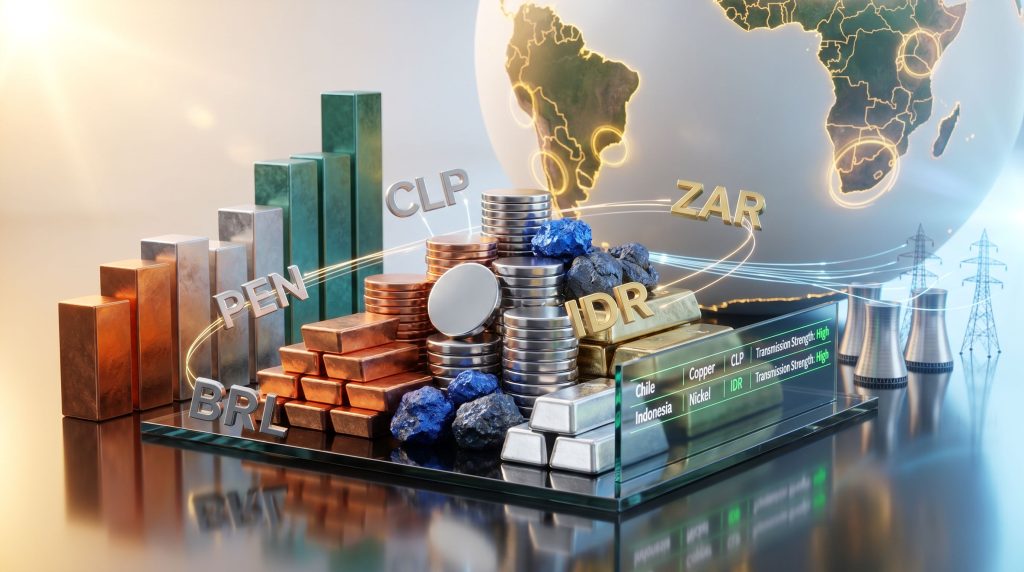
For the Chilean peso (CLP), copper's dominance in national export earnings means that sustained AI-driven price support translates relatively quickly into improved trade balances and reduced sovereign borrowing pressure. Peru's sol (PEN) follows a similar logic, though the transmission is complicated by the political instability that has periodically disrupted Peruvian mining operations and investor sentiment.
Indonesia: Nickel and the Battery Storage Connection
Indonesia holds the world's largest nickel reserves and has established itself as the dominant global supplier of nickel for battery and energy storage applications. The link to AI is indirect but structurally important: as AI compute demand drives electricity consumption higher, the requirement for grid-scale storage to manage load variability grows in parallel. In this context, Indonesian nickel dominance has become a focal point for strategic sourcing discussions among major economies.
The Indonesian rupiah (IDR) benefits through multiple channels simultaneously. Rising export volumes generate foreign exchange inflows, while the strategic importance of Indonesian nickel is attracting substantial foreign direct investment into downstream processing infrastructure. This FDI component creates a sustained source of currency demand beyond pure trade flows.
A lesser-appreciated dynamic in Indonesia's nickel story is the downstream value-add dimension. Indonesia has progressively restricted exports of unprocessed nickel ore, forcing investment into domestic smelting and refining capacity. Consequently, the FX benefit to Indonesia is increasingly captured at the processed product level rather than as raw ore exports, improving the quality and sustainability of foreign exchange inflows.
China: Rare Earth Dominance and Strategic Leverage
China's position in the rare earth supply chain is qualitatively different from other emerging market mineral stories. It controls a commanding share of global processing capacity for elements including neodymium, dysprosium, and gallium, all of which are essential to the chip-making equipment and magnet systems that AI hardware depends upon.
However, China rare earth restrictions have introduced fresh uncertainty into global supply chains, prompting major AI-consuming economies to accelerate efforts to diversify sourcing. This structural position gives China leverage over the AI supply chain that reinforces its trade balance independent of broader economic cycles, and the broader rare earth geopolitics are reshaping investment flows across the entire sector.
South Africa: Platinum-Group Metals and Industrial Demand
South Africa produces the majority of the world's platinum and palladium, metals with growing relevance to electrical systems, industrial catalysts, and the hydrogen fuel cell technology intersecting with AI energy infrastructure development. The South African rand (ZAR) has historically displayed strong sensitivity to platinum-group metal price cycles, making it one of the more responsive EM currencies to AI-related industrial demand shifts.
The Broader EM Metals Map
| Country | Key AI Metals | Currency | Transmission Strength | Primary Risk |
|---|---|---|---|---|
| Chile | Copper | CLP | High | Political and regulatory risk |
| Peru | Copper | PEN | High | Political instability |
| Indonesia | Nickel | IDR | High | Repatriation dynamics |
| South Africa | PGMs | ZAR | Medium-High | Fiscal and political risk |
| Brazil | Iron ore, lithium | BRL | Medium | Import dependency |
| DRC and Zambia | Cobalt, copper | Various | Medium | Governance risk |
| Argentina | Lithium | ARS | Medium-Low | Macro instability |
| China | Rare earths | CNY | Structural | Geopolitical overlay |
The Four Channels: How Metal Prices Flow Into EM Currency Markets
Understanding how commodity price strength actually transmits into currency appreciation requires mapping the specific channels through which the relationship operates.
Channel 1: Export Revenue Expansion. Higher commodity prices directly increase the US dollar value of a country's exports, generating larger foreign exchange inflows and improving trade balances. This is the fastest-acting and most direct channel.
Channel 2: Terms of Trade Improvement. When export prices rise faster than import prices, a country's terms of trade improve, meaning it acquires more purchasing power relative to the rest of the world. For copper-dominant exporters, a sustained AI-driven copper price uplift represents a structural terms-of-trade tailwind.
Channel 3: Fiscal Revenue Enhancement. Mining royalties, resource levies, and corporate taxes from expanded commodity revenues flow into government budgets, reducing fiscal deficits and lowering sovereign risk premiums. Compressed bond spreads attract foreign capital, providing a secondary support mechanism for currency appreciation.
Channel 4: Foreign Direct Investment Inflows. Rising commodity prices and strategic mineral demand attract long-term capital into mining and processing infrastructure. FDI inflows create sustained demand for local currencies as foreign investors convert capital into domestic assets.
Why the Currency Benefit Is Not Automatic
Commodity price strength is a necessary but not sufficient condition for EM currency appreciation. Four structural constraints can partially or entirely neutralise the FX benefit even in a strong metals price environment.
Production capacity limitations represent the first and most fundamental constraint. A country must be able to physically increase export volumes to capture the revenue upside of higher prices. Infrastructure bottlenecks, permitting delays, and labour shortages can prevent supply from responding to demand signals, leaving price gains unrealised in export revenue terms.
Profit repatriation dynamics are a less-discussed but critically important variable. If mining operations are controlled by foreign-owned companies that retain profits offshore rather than converting them into local currency, the host country captures only a fraction of the theoretical FX benefit. The ownership structure of a country's mining sector matters enormously for the real currency impact of commodity price cycles.
Import dependency offsets complicate the picture for many metals-exporting emerging markets. Countries that export copper or nickel while simultaneously importing fuel, machinery, and technology may find that the costs of those imports also rise during an AI infrastructure boom, partially or fully offsetting export revenue gains on a net terms-of-trade basis.
Macro policy and political risk represent the final and often decisive constraint. Local inflation dynamics, central bank credibility gaps, political instability, and capital controls can override commodity-driven currency tailwinds entirely. Countries with weak institutional frameworks may see commodity windfalls absorbed by inflation rather than expressed as nominal or real currency appreciation.
The next major ASX story will hit our subscribers first
The Geopolitical Layer: How Strategic Sourcing Reshapes the Playing Field
The AI and semiconductor supply chain has become a geopolitical priority for major economies, fundamentally altering the investment calculus for EM mineral producers. Governments across North America, Europe, and the Asia-Pacific are actively seeking to diversify sourcing away from concentrated suppliers for materials including neodymium, gallium, lithium, and cobalt.
This creates a bifurcation in EM currency outcomes that operates independently of pure commodity price dynamics. According to industry analysts tracking the AI-driven metals supercycle, the divergence between favoured and disfavoured EM producers is already becoming measurable in investment flows:
- Countries perceived as reliable, policy-aligned suppliers of AI-critical minerals are attracting premium investment and long-term offtake agreements that underpin export revenue visibility
- Countries with large reserves but geopolitical complications or governance concerns may see investment diverted toward less-endowed but more politically predictable alternatives
- The spread between these two groups of EM producers is likely to widen over the coming decade as supply-chain security mandates become more entrenched in major economy policy frameworks
A speculative but increasingly discussed scenario within the industry involves the potential for formal critical mineral trade corridors to emerge between major AI-consuming economies and preferred EM suppliers. Such arrangements could provide floor-price protections or volume commitments that structurally reinforce the currency benefit for favoured producers beyond what open market dynamics alone would generate.
Assessing the Long-Run Structural Thesis
The Barclays 2026 Equity Gilt Study's framing of the AI commodity demand wave as analogous to the China supercycle of the early 2000s provides a useful historical lens, while the geopolitical and policy dimensions of the current cycle introduce complexity that the earlier boom did not carry.
For investors monitoring EM currencies through the lens of the AI rollout to boost metals-rich EM currencies thesis, the analytical framework should be anchored in the four transmission channels and stress-tested against the four structural constraints for each country under consideration. The theoretical FX benefit is real and well-grounded, but its realisation depends on country-specific variables that vary considerably across the EM landscape.
The most durable currency beneficiaries will likely be those combining three characteristics: large, scalable mineral reserves in AI-critical commodities; institutional and regulatory environments that attract and retain long-term capital; and geopolitical positioning that aligns with the strategic sourcing preferences of the world's largest AI-investing economies.
The geography of AI's physical supply chain is becoming a meaningful determinant of EM currency trajectories for the coming decade. Nations that position themselves intelligently within that geography stand to benefit from one of the most powerful and sustained commodity demand cycles in modern economic history.
This article presents analysis and commentary for informational purposes only and does not constitute financial or investment advice. Currency and commodity markets involve significant risk, and forward-looking statements regarding price trends, investment flows, or economic outcomes are subject to material uncertainty. Readers should conduct independent research and consult qualified financial professionals before making investment decisions.
Want to Capitalise on the Next Major Mineral Discovery Driving This Metals Supercycle?
Discovery Alert's proprietary Discovery IQ model delivers real-time alerts on significant ASX mineral discoveries across copper, nickel, rare earths, and the full basket of AI-critical commodities — instantly translating complex geological announcements into actionable investment insights for traders and long-term investors alike. Explore how historic mineral discoveries have generated substantial market returns and begin your 14-day free trial at Discovery Alert to position yourself ahead of the market as this multi-decade infrastructure cycle unfolds.