Litchfield Minerals Ltd
- ASX Code: LMS
- Market Cap: $42,474,934
Airborne Survey Advances Lucy Creek Exploration
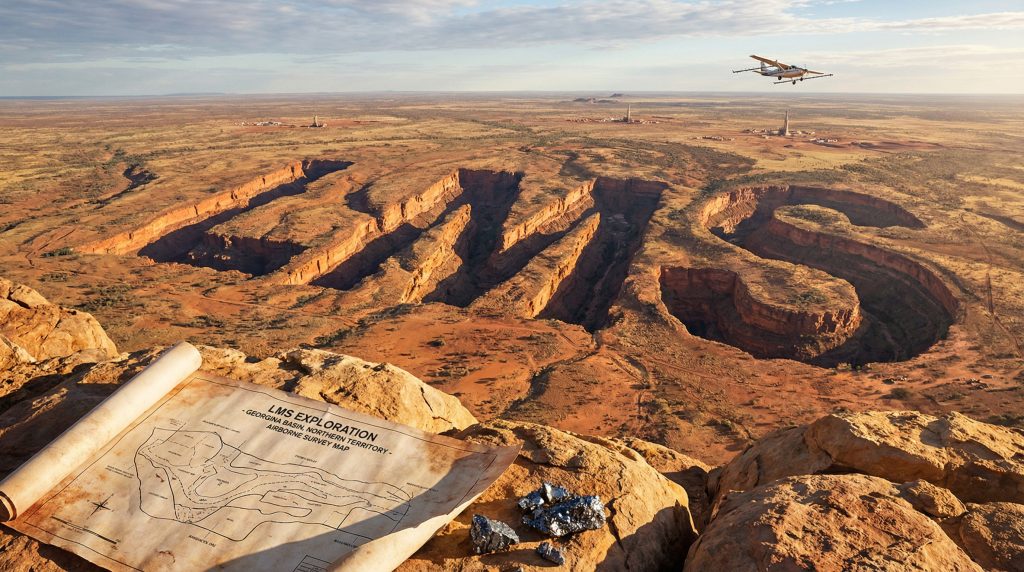
Litchfield Minerals Limited (ASX: LMS) has commenced a 5,523 line kilometre airborne magnetic and radiometric survey across its Litchfield Minerals Lucy Creek Project in the Northern Territory's underexplored Georgina Basin. The survey represents a significant advancement in exploring what the company considers could be a Bootu Creek-style manganese system with substantial scale and grade potential.
The Lucy Creek Project spans approximately 1,600km² of prospective manganese-bearing stratigraphy, with historical surface sampling returning exceptional grades including 54.2% Mn from previous explorers. Furthermore, Litchfield's own reconnaissance program delivered a peak grade of 45.2% MnO (35% Mn), confirming the project's high-grade potential across multiple prospects.
When big ASX news breaks, our subscribers know first
Strategic Location in an Underexplored Basin
The project location sits within the Georgina Basin, part of the vast Centralian Superbasin characterised by largely unmetamorphosed sedimentary sequences spanning from Cryogenian to Devonian periods. This intracratonic basin hosts extensive high-grade manganese mineralisation across broad areas, along with documented base metal anomalies and rare earth element (REE) enrichment.
Key Project Statistics:
- Survey Coverage: 5,523 line kilometres of high-resolution airborne magnetic and radiometric data
- Project Area: ~1,600km² of prospective manganese-bearing stratigraphy
- Multiple Prospects: Lucy Creek 2, Lucy Creek 4, MRS-79, MRS-80, GWM-90, LOC-44, and LOC-50
- Historical Grades: Up to 54.2% Mn from surface samples
- Litchfield Results: Peak grade of 45.2% MnO from 11-sample reconnaissance program
The airborne survey, conducted by contractor Magspec, will provide crucial geological understanding and target definition. In addition, it will include mapping of stratigraphy, regolith architecture, and alteration signatures linked to manganese-bearing systems.
Multiple High-Grade Prospects Confirmed
Historical exploration by Elkedra Diamonds and Auvex Manganese has confirmed ore-grade manganese across multiple prospects within the Lucy Creek Project area. The results demonstrate consistent high-grade mineralisation with favourable characteristics through manganese exploration techniques.
| Prospect | Peak Grade | Key Features |
|---|---|---|
| Lucy Creek 2 | Up to 52% Mn | Surface samples with hydrothermal textures |
| Halfway Dam | Up to 42% Mn | Excavated sedimentary material |
| Multiple Sites | 20-50% Mn range | Extensive surficial manganocrete and float |
Historical drilling intersected 1-3 metres of massive manganese at depths of less than 20 metres, with possible lower-grade replaced manganese zones extending deeper. The widespread occurrence of high-grade surface mineralisation indicates extensive erosion from thicker underlying seams.
Consequently, Litchfield's initial field campaign not only confirmed these high manganese grades but also identified base metal enrichment and hydrothermal pathfinder signatures. This supports the interpretation of a comprehensive mineral system with potential for both sedimentary and hydrothermal manganese deposits.
Understanding Manganese Systems: Sedimentary vs. Hydrothermal
Sedimentary manganese deposits form when manganese-rich sediments accumulate in specific environmental conditions, typically in marine basins with restricted circulation. These deposits can later be upgraded through hydrothermal processes, where heated fluids carrying additional manganese circulate through fractures and porous rocks, concentrating and enriching the original mineralisation.
For investors, this distinction matters because hydrothermal enhancement often results in higher grades and better metallurgical characteristics. The geological formations at Lucy Creek show evidence of both sedimentary accumulation and hydrothermal modification, similar to the successful Bootu Creek deposit model.
This dual-process system can create substantial, high-grade manganese resources that are economically attractive for mining operations. However, the presence of hydrothermal pathfinder signatures in Litchfield's samples suggests active fluid systems that could have upgraded primary sedimentary manganese to the exceptional grades observed across multiple prospects.
Bootu Creek Analogy: A Proven Development Model
Litchfield considers the Litchfield Minerals Lucy Creek Project conceptually analogous to the Bootu Creek manganese district, located approximately 110km north of Tennant Creek. Bootu Creek represents a successful example of strata-bound, hydrothermally modified sedimentary manganese deposits in the Northern Territory.
Bootu Creek Deposit Characteristics:
- Remaining Resources: ~6.86Mt at 13.18% Mn
- Historical Production: Exceeding 10Mt
- Deposit Type: Strata-bound, hydrothermally modified sedimentary
- Formation: Hydrothermal fluids along faults upgrading primary sedimentary manganese
The Lucy Creek setting demonstrates similar favourable characteristics for sedimentary-hosted manganese accumulation. Furthermore, it has potential structural and stratigraphic trap sites that could focus mineralising fluids through structural geology analysis.
The combination of scale, grade indications, and favourable basin architecture reinforces Litchfield's view that Lucy Creek represents a genuine opportunity to define a Bootu Creek-style manganese system.
Management Perspective on Development Potential
"We see genuine potential for Lucy Creek to host large, high-grade sedimentary and hydrothermal manganese deposits, and we are moving quickly to unlock that opportunity for shareholders." – Matthew Pustahya, Managing Director and CEO
District-Scale Potential with Limited Modern Exploration
Despite covering 1,600km² of prime manganese country, the exploration targets remain significantly underexplored with limited systematic drilling beyond historic RAB/RC holes (76 total, shallow depths <60m). This represents a substantial opportunity for a systematic exploration approach using modern techniques.
Exploration Advantages:
- Virgin Ground: Essentially unexplored beyond shallow historical drilling
- Structural Setting: Basin deformation from Alice Springs Orogeny created reverse faults and folds ideal for mineral traps
- Remote Sensing: Interpreted surface manganese mineralisation visible on satellite imagery
- Regional Context: Widespread manganese occurrences throughout the Georgina Basin
The area benefits from a laterite profile providing a strong horizon for iron, manganese, and uranium enrichment via groundwater circulation. For instance, aeromagnetic anomalies and seismic lines (including TEX09-02 crossing 17.9km of the tenement) indicate significant geological complexity that could host substantial mineral systems.
What Makes This Survey Programme Different?
The current 5,523 line kilometre airborne survey represents the most comprehensive geophysical programme ever conducted across the Lucy Creek Project area. This systematic approach differs significantly from previous ad-hoc exploration efforts through geophysical surveys.
Survey Specifications:
- Line Spacing: 200m across priority areas with 100m infill over key prospects
- Flight Height: 40m above ground level for maximum resolution
- Coverage: Complete project area with detailed focus on Lucy Creek 2 and Halfway Dam
- Technology: High-resolution magnetic and radiometric sensors
The 200m spaced lines with 100m infill over Lucy Creek 2 and Halfway Dam will provide detailed resolution for target definition. However, the broader survey coverage ensures regional geological understanding across the entire project area.
This comprehensive dataset will enable geological interpretation at multiple scales, from district-wide structural trends to prospect-specific target definition. In addition, the high-resolution data will support advanced geological modelling and resource estimation methodologies.
Systematic Development Programme Underway
Following completion of the airborne survey, Litchfield has outlined a systematic approach to advancing the Litchfield Minerals Lucy Creek Project through staged exploration programmes:
Immediate Next Steps:
- Complete interpretation of aeromagnetic and radiometric survey data
- Targeted ground mapping and field verification programmes
- Follow-up surface sampling and geochemistry across priority targets
- Gravity surveys over priority corridors to refine structural understanding
- Drill testing of highest-ranked targets subject to results
This methodical approach allows the company to integrate multiple datasets before committing to drilling programmes. Consequently, it potentially identifies the most prospective targets while managing exploration expenditure effectively through resource estimation methods.
The systematic programme design ensures that each exploration phase builds upon previous results, creating a comprehensive understanding of the mineralisation system before major capital commitments.
Investment Thesis: Undervalued Manganese Opportunity
Lucy Creek represents a compelling investment opportunity in the critical manganese sector, combining several attractive characteristics rarely found in a single project through mineral investment strategies.
Key Investment Drivers:
- Proven High Grades: Consistent results of 20-54% Mn across multiple prospects
- Large-Scale Potential: 1,600km² project area in proven manganese district
- Limited Competition: Minimal modern exploration creates first-mover advantage
- Established Analogues: Bootu Creek demonstrates commercial viability of similar systems
- Strategic Location: Northern Territory jurisdiction with favourable mining conditions
The combination of high-grade surface mineralisation, extensive project area, and limited systematic exploration creates a rare opportunity for resource discovery in an established manganese province. Furthermore, with global manganese demand driven by steel production and emerging battery applications, projects like Lucy Creek could become increasingly valuable.
Financial Position:
The company's systematic approach to exploration demonstrates prudent capital allocation. For instance, starting with cost-effective geophysics before drilling commitments maintains project momentum whilst managing expenditure.
The next major ASX story will hit our subscribers first
Why Should Investors Monitor Litchfield's Progress?
Litchfield Minerals has positioned itself as a focused critical minerals explorer with a systematic approach to unlocking value in underexplored territories. The Litchfield Minerals Lucy Creek Project represents the company's flagship manganese opportunity, supported by several competitive advantages.
Competitive Advantages:
- Technical Expertise: Experienced geological team with Northern Territory focus
- Systematic Approach: Methodical exploration programmes building comprehensive geological understanding
- Strategic Asset Base: Multiple projects across Northern Territory's proven mineral districts
- Management Execution: Demonstrated ability to advance projects through structured programmes
The company's commitment to modern exploration techniques positions Lucy Creek for potential resource discovery. However, this includes comprehensive geophysical surveys and systematic sampling programmes in a timeframe that could deliver near-term value catalysts through exploration timeline planning.
Upcoming Catalysts:
- Airborne survey results and interpretation (Q1 2026)
- Target definition and ranking (Q1-Q2 2026)
- Ground follow-up programmes (Q2 2026)
- Potential drilling programmes (Q2-Q3 2026)
Key Investment Takeaway
Litchfield Minerals has secured a district-scale manganese opportunity in one of Australia's most prospective yet underexplored basins. With systematic exploration programmes now underway and multiple high-grade prospects confirmed, Lucy Creek could emerge as a significant manganese discovery in the Northern Territory. Investors should monitor upcoming geophysical results and target definition as key catalysts for potential resource development.
Could Lucy Creek Become Your Next Manganese Investment Opportunity?
With systematic exploration programmes now underway across 1,600km² of prospective manganese country and multiple high-grade prospects already confirmed, Litchfield Minerals is methodically advancing what could emerge as a significant manganese discovery in the Northern Territory. The company's flagship Lucy Creek Project combines proven high grades of up to 54.2% Mn with district-scale potential in an underexplored basin, creating a compelling investment proposition in the critical manganese sector. To discover how Litchfield's systematic approach to unlocking value in this Bootu Creek-style system could benefit your investment portfolio, visit www.litchfieldminerals.com.au and explore the full scope of this emerging manganese opportunity.