August 5, 2026
Long-Duration Storage and the Alumina Industry's Decarbonisation Crossroads
The global energy storage conversation has largely been dominated by short-duration lithium-ion systems, but a quieter revolution is unfolding in heavy industry. The Alcoa vanadium flow battery for WA refineries is now emerging as a proving ground for long-duration storage technology. The economics are compelling, the technical fit is strong, and Western Australia's emerging domestic vanadium supply chain is creating conditions that simply did not exist five years ago.
Understanding why this moment matters requires stepping back from individual project announcements and examining the structural energy challenge facing refineries that operate continuously, consume electricity at enormous scale, and face mounting pressure to reduce both costs and carbon intensity simultaneously.
When big ASX news breaks, our subscribers know first
The Electricity Burden Inside an Alumina Refinery
Alumina refining is not a process that can be easily throttled up or down. The Bayer process, which converts bauxite into alumina, requires sustained high-temperature operations across digestion, clarification, precipitation, and calcination stages. This creates a consumption profile that is both relentless and peaky, with demand spikes during specific processing phases generating significant exposure to demand tariff charges.
In Western Australia, where Alcoa (ASX: AAI) operates three alumina refineries at Kwinana, Pinjarra, and Wagerup, the electricity challenge is compounded by the state's isolated grid infrastructure. Unlike the eastern seaboard's National Electricity Market, WA's South West Interconnected System (SWIS) is a standalone network with its own supply constraints, pricing dynamics, and renewable integration challenges. The bauxite and alumina supply chain also introduces upstream pressures that further complicate the decarbonisation picture for these operations.
The pressure to integrate renewable energy adds another layer of complexity. Solar and wind generation profiles do not align naturally with refinery load curves, creating periods of curtailment and periods of expensive grid draw. Without storage, the theoretical cost benefits of renewable procurement are partially eroded by these timing mismatches.
Key energy challenges facing WA alumina refineries include:
- Continuous, high-load operations that cannot be interrupted without process losses
- Peak demand tariff structures that penalise high instantaneous consumption
- Renewable energy intermittency that reduces the effective utilisation of green power contracts
- Grid reliability concerns in an isolated network with limited interconnection
How Vanadium Flow Batteries Actually Work
Unlike conventional battery chemistries where energy is stored within solid electrode materials, a vanadium redox flow battery (VFB) stores energy in liquid vanadium electrolyte housed in external tanks. During charging and discharging, electrolyte is pumped through a cell stack where electrochemical reactions convert vanadium ions between oxidation states, releasing or absorbing electrical energy in the process.
This architecture delivers a property that is genuinely unique among commercial battery technologies: the complete separation of power capacity from energy capacity. Power output is determined by the size of the cell stack, while energy storage is determined entirely by the volume of electrolyte in the tanks. For industrial applications where the storage requirement might be six, eight, or even twelve hours, this separation allows engineers to size each component independently and cost-effectively.
Vanadium flow batteries store energy in liquid electrolyte held in external tanks. Power capacity (MW) and energy capacity (MWh) can be independently scaled, making VFBs particularly suited to large industrial applications requiring long-duration storage of six hours or more.
The technical comparison between VFBs and lithium-ion battery energy storage systems (BESS) is instructive:
| Feature | Vanadium Flow Battery | Lithium-Ion BESS |
|---|---|---|
| Scalability | Independent MW/MWh scaling | Fixed ratio |
| Cycle life | 20,000+ cycles | ~3,000-6,000 cycles |
| Storage duration | 6-12+ hours | Typically 2-4 hours |
| Fire risk | Very low (aqueous electrolyte) | Moderate to High |
| Electrolyte reuse | 100% recyclable | Limited |
| Ideal use case | Long-duration industrial load shifting | Short-duration grid firming |
One dimension that rarely receives adequate attention in mainstream coverage is the end-of-life electrolyte economics. Because vanadium is not consumed during cycling, the electrolyte retains its chemical composition and market value across the battery's operational life. At decommissioning, the vanadium electrolyte can be recovered, resold, or redeployed into a new system. This creates a residual asset value that materially improves the long-term financial case relative to lithium-ion alternatives, where cathode materials degrade and carry limited recovery value.
Inside the Alcoa and Australian Vanadium MoU
The agreement between Alcoa and Australian Vanadium (ASX: AVL) establishes a framework for a scoping-level feasibility study examining whether a large-scale vanadium flow battery is technically and financially viable for deployment at Alcoa's Western Australian alumina refinery operations.
Several critical points define the scope and character of this arrangement:
- The agreement is a non-binding Memorandum of Understanding (MoU), establishing intent and process without committing either party to capital expenditure
- The study is scoping-level, meaning it sits at the earliest stage of the project development funnel, preceding any formal feasibility assessment or investment decision
- Key workstreams within the study are expected to encompass system design parameters, technical specifications, capital cost modelling, electrolyte supply chain assessment, and potential financing structures
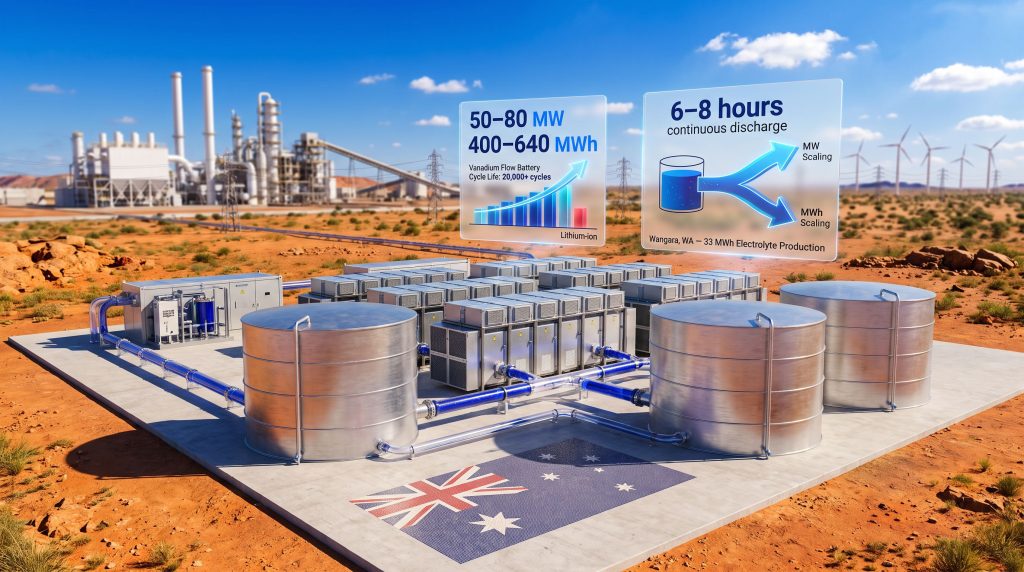
The system scale under evaluation is substantial. The proposed battery configuration targets 50 to 80 MW of power output with 400 to 640 MWh of energy storage capacity, representing approximately 6 to 8 hours of continuous discharge capability. If realised, a system of this scale would rank among the largest vanadium flow battery deployments anywhere in the world.
The primary operational objectives of such a system would centre on reducing peak electricity demand charges and increasing the proportion of renewable energy consumed across Alcoa's WA refinery network. Both objectives address direct cost pressures while simultaneously advancing the company's decarbonisation commitments. Furthermore, the role of critical minerals in energy transition planning adds broader strategic significance to this kind of industrial storage arrangement.
Western Australia's Domestic Vanadium Supply Chain: A Strategic Enabler
One of the most commercially significant, yet underappreciated, dimensions of this feasibility study is the proximity of a domestic vanadium electrolyte manufacturing capability. Australian Vanadium operates an electrolyte manufacturing facility in Wangara, Western Australia, with a targeted annual production output of 33 MWh of vanadium electrolyte.
For anyone with experience in deploying flow batteries at scale, the implications are considerable. Historically, electrolyte for large VFB projects has been sourced from international suppliers, primarily in China, creating exposure to currency risk, shipping lead times, quality consistency issues, and sovereign supply disruption. A WA-based manufacturing capability fundamentally changes the project economics and logistics profile for any large-scale deployment in the state.
One of the persistent barriers to vanadium flow battery commercialisation in Australia has been electrolyte import dependency. A WA-based electrolyte manufacturing capability fundamentally changes the project economics for any large-scale VFB deployment, reducing sovereign supply risk and enabling faster system commissioning.
The broader vanadium value chain potential in WA extends upstream from the Wangara facility. Australian Vanadium's primary project, the ATVM project located near Meekatharra in WA's Mid West region, holds a significant vanadium resource that could eventually feed domestic electrolyte production. A fully integrated WA vanadium chain, from in-ground resource through processing to electrolyte manufacture and battery deployment, would represent a genuinely rare industrial achievement in the Australian critical minerals landscape.
The Kalgoorlie Benchmark: What WA's Largest VFB Commitment Reveals
To contextualise the Alcoa feasibility study within WA's broader energy storage trajectory, the Western Australian Government's commitment of $150 million toward a 50 MW / 500 MWh vanadium flow battery to be manufactured and deployed in Kalgoorlie provides an important reference point.
This project represents one of the largest publicly committed long-duration energy storage investments in Australian history. Its significance lies not just in scale, but in what it signals about institutional confidence in vanadium flow battery technology at the grid level. When a state government allocates nine-figure funding to a specific battery chemistry, it accelerates the broader commercialisation pathway by demonstrating bankability, stimulating supply chain development, and attracting engineering capability.
For the Alcoa feasibility study, the Kalgoorlie project's existence matters in several practical ways. It suggests that project finance structures, grid connection processes, and electrolyte supply chains are being developed in parallel, all of which could reduce the transaction costs associated with moving the Alcoa project from scoping to implementation should the feasibility outcomes prove favourable.
It is important to note, however, that the Alcoa-AVL MoU is an independent commercial arrangement and has not been confirmed as receiving any form of government co-funding or strategic project designation at this stage.
The next major ASX story will hit our subscribers first
VFBs vs Lithium-Ion: The 20-Year Cost Reality for Industrial Operators
The upfront capital cost comparison between vanadium flow batteries and lithium-ion BESS almost always favours lithium-ion, and this remains true today. However, for industrial operators evaluating assets over a 20 to 25-year timeframe, the total cost of ownership calculation tells a more nuanced story.
| Cost Category | Vanadium Flow Battery | Lithium-Ion BESS |
|---|---|---|
| Upfront capital cost | Higher | Lower |
| Replacement cycles over 20 years | Minimal (electrolyte retained) | 2-3 full replacements |
| Operational lifespan | 25-30 years | 10-15 years |
| End-of-life electrolyte value | Recoverable and resaleable | Largely unrecoverable |
| Long-duration suitability | High | Low to Moderate |
For a refinery application requiring 6 to 8 hours of daily storage, a lithium-ion system would likely require two to three complete replacements over a 25-year asset life, each carrying substantial capital and disposal costs. A vanadium flow battery, by contrast, requires only maintenance of the cell stack and pumping infrastructure, while the electrolyte retains value throughout.
Hypothetical scenario: If Alcoa's WA refinery operations face peak demand charges during high-consumption processing windows, a 50 to 80 MW VFB system capable of 6 to 8 hours of continuous discharge could enable systematic load shifting away from grid peak pricing periods. Depending on the applicable tariff structure under the SWIS, this avoided demand charge could generate material annual savings, with the battery system progressively recovering its capital cost over its operational life. This remains a hypothetical framing pending the outcomes of the scoping study.
Consequently, the battery metals investment landscape increasingly recognises the long-term ownership advantages of vanadium-based systems for industrial operators with multi-decade planning horizons.
Key Risks That the Scoping Study Must Address
Investors and industry observers should approach this early-stage announcement with calibrated expectations. Several substantive uncertainties must be resolved before any investment thesis can be constructed around the project.
Technical risks include the challenge of scaling electrolyte supply to meet the demands of a 400 to 640 MWh system from a facility currently targeting 33 MWh of annual output. Significant capacity expansion at the Wangara plant, or supplementary supply arrangements, would be required.
Financial risks encompass the capital cost intensity of large-format VFB systems, the availability of project finance for a relatively novel technology class in Australia, and the sensitivity of the financial model to vanadium commodity price movements, given that electrolyte is both an input cost and a residual asset.
Regulatory and grid connection considerations in WA's SWIS network may require detailed technical studies given the scale of the proposed system and its interaction with refinery load profiles.
Most critically, the non-binding nature of the MoU must be clearly understood:
A scoping-level MoU does not obligate either party to proceed with construction, procurement, or capital deployment. The study outcome will determine whether a full feasibility assessment and ultimately a final investment decision is warranted. This should be interpreted as an early-stage signal of strategic intent, not a confirmed project.
Vanadium as a Dual-Purpose Critical Mineral
Vanadium occupies an unusual position in the critical minerals hierarchy. It serves as both a steel-strengthening additive, where it is used in high-strength rebar and structural steel alloys, and as the electrochemically active material in one of the most promising long-duration battery technologies available. This dual demand profile means vanadium pricing is influenced by both steel cycle dynamics and the pace of energy storage adoption.
For industrial VFB deployments of the scale being contemplated for the Alcoa vanadium flow battery for WA refineries, the procurement of electrolyte at competitive prices requires either long-term supply agreements, domestic production, or vertically integrated arrangements. Australian Vanadium's integrated position, connecting a domestic resource project to electrolyte manufacturing capability, positions it as one of very few companies globally that can offer genuine supply chain security to industrial battery customers in Australia.
The broader implications for domestic vanadium demand are significant. A single 400 to 640 MWh VFB deployment at Alcoa's scale would represent a meaningful increment in Australian vanadium electrolyte consumption, potentially catalysing further investment in domestic processing capacity and creating a demand anchor for upstream resource development. In addition, the momentum around renewable energy in mining operations broadly is accelerating the commercial case for exactly this kind of integrated storage solution.
Frequently Asked Questions
What is the proposed size of the vanadium flow battery being assessed for Alcoa's WA operations?
The system under evaluation targets 50 to 80 MW of power output with 400 to 640 MWh of energy storage, providing approximately 6 to 8 hours of discharge duration per cycle.
What is the purpose of the Alcoa and Australian Vanadium MoU?
The MoU establishes a framework for a scoping-level feasibility study assessing whether a vanadium flow battery is technically and financially viable for deployment at Alcoa's Western Australian alumina refinery operations. The full ASX announcement provides further detail on the terms and scope of the arrangement.
How does a vanadium flow battery differ from a lithium-ion battery?
Vanadium flow batteries store energy in liquid electrolyte contained in external tanks, enabling independent scaling of power and energy capacity. They offer significantly longer operational lifespans exceeding 25 years, very low fire risk due to aqueous chemistry, and superior economics for long-duration storage applications of 6 hours or more.
Is there a local vanadium electrolyte supply in Western Australia?
Yes. Australian Vanadium operates an electrolyte manufacturing facility in Wangara, WA, with a targeted annual production output of 33 MWh of vanadium electrolyte, providing a domestic supply option that reduces import dependency.
Is the Alcoa vanadium battery project confirmed to proceed?
No. The project remains at the non-binding MoU and scoping study stage. A formal investment decision would only follow completion of a full feasibility assessment demonstrating acceptable technical and financial parameters.
Strategic Takeaways
The Alcoa-AVL MoU and its associated scoping study represent an important intersection of industrial decarbonisation pressure, long-duration storage technology maturation, and an emerging domestic vanadium supply chain. The mining decarbonisation benefits of pursuing large-scale VFB integration are increasingly well understood, further reinforcing the strategic logic behind this collaboration. Several key dimensions define its strategic significance:
- A 400 to 640 MWh VFB system would rank among the largest vanadium flow battery deployments globally if it advances to construction
- WA's domestic electrolyte manufacturing capability at Wangara is a critical enabler that differentiates this project from comparable international proposals dependent on offshore supply
- The total cost of ownership case for VFBs over a 20+ year industrial asset life strengthens materially when full replacement cycles, end-of-life electrolyte recovery, and long-duration discharge requirements are properly modelled
- The scoping study must resolve significant questions around electrolyte supply scaling, project financing, and grid integration before a full feasibility phase can be justified
- The project exists within a broader WA energy storage landscape that has seen substantial public investment in vanadium battery technology, though no confirmed government co-funding for this specific project has been announced
This article contains hypothetical scenarios and forward-looking analysis based on publicly available information. It does not constitute financial advice. Readers should conduct their own due diligence before making investment decisions. The Alcoa-AVL MoU is non-binding and no final investment decision has been made.
Want to Track the Next Major Mineral Discovery Before the Market Does?
Discovery Alert's proprietary Discovery IQ model scans ASX announcements in real time, instantly identifying high-potential opportunities across vanadium, battery metals, and over 30 other commodities — turning complex data into actionable insights for investors at every level. Explore how historic mineral discoveries have generated exceptional returns on Discovery Alert's dedicated discoveries page, and begin your 14-day free trial today to position yourself ahead of the broader market.