Alliance Nickel Ltd
Alliance Nickel Unearths Encouraging Gold Results at a Site That's Never Been Drilled Before
Alliance Nickel Limited (ASX: AXN) has released assay results from its maiden reverse circulation (RC) drilling program at the Australia United tenement (M39/1130), part of the company's 100%-owned Wanbanna tenement package in the Eastern Goldfields of Western Australia. The Alliance Nickel gold drilling results at Australia United mark the first modern, systematic drill-testing of a site with a documented historical gold production record stretching back to the 1890s, and the early findings suggest there is considerably more to discover.
Ten RC holes were completed for a total of 720 metres, testing mineralisation around historical underground workings at Australia United. The headline intercepts from the program are:
- 3m @ 3.2 g/t Au from 34m in AURC001 (including 1m @ 8.1 g/t Au from 35m)
- 3m @ 3.2 g/t Au from 68m in AURC008
Mineralisation remains open both north and south along strike and at depth, and the company is already in discussions with third parties about a potential earn-in arrangement that could fund the next phase of exploration.
"These initial results are an encouraging outcome from a small first-pass program at a tenement that has never been systematically drill-tested, despite a recorded historical gold production of over 4,000 ounces at high grades. With mineralisation open along strike and at depth, there is a clear case for further work." — Paul Kopejtka, Managing Director & CEO, Alliance Nickel Limited
When big ASX news breaks, our subscribers know first
A Century of Gold, Zero Drill Holes Until Now
The Australia United site carries a well-documented historical footprint. Between 1899 and 1907, the greater Australia United area produced 4,022 ounces of gold at grades ranging from 28 g/t to 78 g/t — extraordinary figures by any measure. The tenement contains numerous historical workings, including multiple shafts and an open stope mined to surface across approximately 40 metres of strike length.
What makes this particularly notable from an exploration standpoint is that, despite this production history and the visible presence of significant underground workings, a review of historical records found no previous drilling at the tenement. The February 2026 RC program represents the first time modern exploration techniques and analytical methods have been applied to the site.
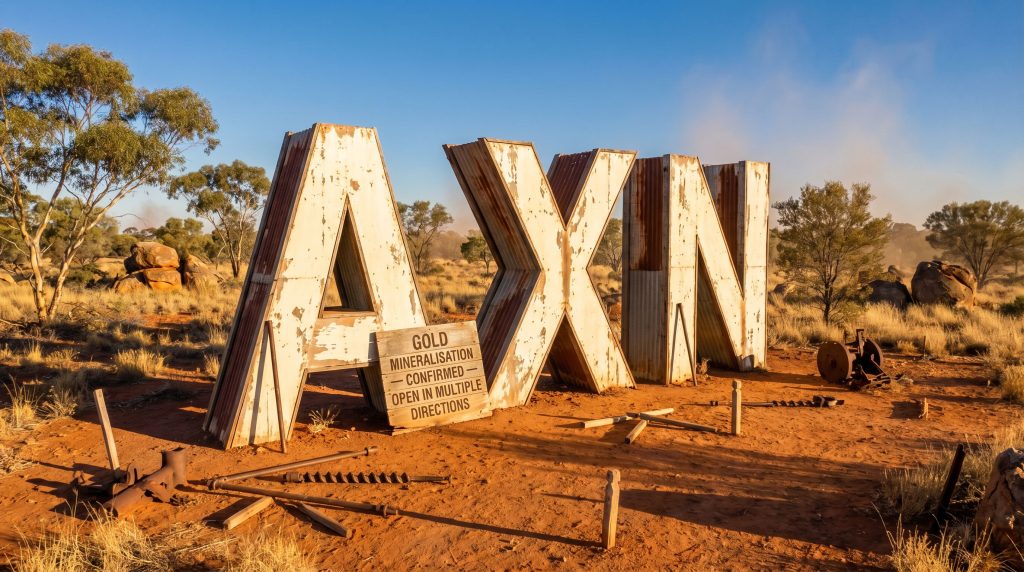
This context matters. Many of the region's most productive gold discoveries have been made by revisiting historically mined ground with contemporary drilling and geochemical tools. Furthermore, the Alliance Nickel gold drilling results at Australia United have now confirmed that gold mineralisation extends beyond the historical workings — and, critically, it remains open in multiple directions.
Breaking Down the Drill Results
The 10-hole program was designed on a 40m north-south line spacing and 20m east-west hole spacing, targeting the area around the old underground workings. All holes were drilled at -60° dip / 290° azimuth, oriented to intersect the interpreted NNE–SSW trending lode structure at a high angle.
The table below summarises the key drill hole details from the program:
| Hole ID | Type | EOH Depth (m) | Dip | Azimuth | Notable Result |
|---|---|---|---|---|---|
| AURC001 | RC | 48 | -60° | 293° | 3m @ 3.2 g/t Au from 34m (incl. 1m @ 8.1 g/t) |
| AURC002 | RC | 72 | -60° | 286° | — |
| AURC003 | RC | 48 | -60° | 293° | — |
| AURC004 | RC | 72 | -60° | 295° | — |
| AURC005 | RC | 108 | -60° | 291° | — |
| AURC006 | RC | 66 | -60° | 289° | — |
| AURC007 | RC | 72 | -60° | 289° | — |
| AURC008 | RC | 108 | -60° | 290° | 3m @ 3.2 g/t Au from 68m |
| AURC009 | RC | 54 | -60° | 289° | — |
| AURC010 | RC | 72 | -60° | 293° | — |
| Total | 720m |
In addition to the downhole intercepts, grab samples collected from areas adjacent to the main workings further support the prospectivity of the broader site:
- Three samples from old tailings south of the main workings returned an average of 2.4 g/t Au
- Four samples from the main spoil heap adjacent to Fardy's Shaft returned an average of 1.7 g/t Au
These surface samples, whilst not a substitute for systematic drilling, provide additional geological encouragement. They point to a mineralised system that extends across the broader tenement area, reinforcing the case for follow-up work.
What Is RC Drilling and Why Does It Matter Here?
Reverse Circulation (RC) drilling is one of the most widely used methods in gold exploration. A drill rig forces a hammer bit into the ground, and rock chips are returned to the surface via an inner tube using compressed air. Those chips are then collected, split, and sent to a laboratory for chemical analysis — allowing geologists to detect the presence and grade of gold at precise depths.
RC drilling is favoured in early-stage gold exploration because it is:
- Fast and cost-effective — a programme like this one can be completed in a matter of days
- Reliable for grade detection — chip samples provide a representative chemical profile of the rock being drilled
- Industry standard in Western Australia's Eastern Goldfields, where it has been used to make numerous significant discoveries
For investors, RC drilling results are the first concrete, analytically verified data point about what lies beneath the surface. Moreover, the Alliance Nickel gold drilling results at Australia United, representing positive first-pass data, now trigger the case for follow-up drilling to define the shape, size, and continuity of mineralisation.
Key Terms Glossary
- g/t Au: Grams of gold per tonne of rock — the standard measure of gold grade. Higher g/t equals higher concentration of gold
- Downhole width: The length of a mineralised interval measured along the drill hole path (not necessarily the true thickness of the ore body)
- True width: The actual thickness of the mineralised zone, corrected for the angle between the drill hole and the ore body. In this programme, true widths are estimated at approximately 85–95% of reported downhole widths
- Open along strike: Mineralisation has not been closed off in the along-strike direction, meaning it may extend further than drilled
- JORC 2012: The Australasian Code for Reporting of Exploration Results, Mineral Resources and Ore Reserves — the industry standard for transparent, accurate reporting of exploration data
What Comes Next: Follow-Up Drilling and a Potential Earn-In Deal
Alliance Nickel has outlined a clear set of next steps following these initial results.
Exploration Follow-Up
- Follow-up RC infill and extensional drilling to test along-strike and down-dip continuity of the mineralised zones identified in AURC001 and AURC008
- Structural interpretation incorporating chip logging data and downhole survey results to refine lode orientation and optimise future drill programme design
- Accumulation of sufficient data to support a JORC 2012 compliant Mineral Resource Estimate in due course, subject to further positive results
Could an Earn-In Deal Accelerate Progress?
Alongside the exploration pathway, Alliance is in active discussions with third parties regarding a potential earn-in arrangement over the Australia United tenement. Under such a structure, an incoming party would fund further exploration drilling and, subject to success, mine development — with Alliance retaining a continuing interest in the tenement, a royalty on production, or a combination of both.
This structure, if agreed, would allow Alliance to advance the Australia United gold opportunity without direct capital outlay, preserving the company's balance sheet whilst keeping upside exposure to any future discovery. The company has committed to updating the market if and when material terms are agreed.
| Milestone | Status |
|---|---|
| Initial 10-hole RC program | Complete |
| Assay results received | Confirmed |
| Earn-in discussions | Ongoing |
| Follow-up extensional drilling | Recommended — timing subject to earn-in outcome |
| JORC Mineral Resource Estimate | Future — conditional on further drilling |
The Broader Picture: AXN Is More Than One Asset
Whilst the Alliance Nickel gold drilling results at Australia United will attract attention, it is important to place them within the context of Alliance Nickel's broader portfolio. The company's flagship asset is the NiWest Nickel Cobalt Project, one of the highest-grade undeveloped nickel laterite resources in Australia.
A Definitive Feasibility Study (DFS) was completed in November 2024, confirming the technical and economic viability of a heap leach and direct solvent extraction operation. NiWest is positioned to produce low-cost, high-quality Class 1 nickel and cobalt sulphate for battery manufacturers and automakers in the electric vehicle (EV) sector.
The project benefits from access to existing primary mining infrastructure, including roads, a railway, and a gas pipeline, as well as proximity to Glencore's Murrin Murrin Operations. The Australia United gold tenement, sitting within the Wanbanna package in the Eastern Goldfields, represents an additional and distinct value layer — one that was previously unquantified given the absence of any historical drilling.
| Asset | Commodity | Status |
|---|---|---|
| NiWest Nickel Cobalt Project | Nickel, Cobalt | DFS complete (Nov 2024) |
| Australia United (Wanbanna Package) | Gold | First RC results received; follow-up drilling recommended |
The next major ASX story will hit our subscribers first
Why This Announcement Deserves Investor Attention
Several factors combine to make this a genuinely interesting development for investors tracking Alliance Nickel:
- No prior drilling: The Australia United tenement had never been systematically drill-tested before February 2026, despite over a century of historical production records — a meaningful exploration frontier
- High historical grades: Production grades of 28 g/t to 78 g/t signal a high-quality geological environment
- First drill confirms gold at depth: The programme has validated that gold mineralisation extends beyond the historical workings and remains open in multiple directions
- Capital-light pathway via earn-in: Further exploration could be funded by a third party, reducing the financial burden on Alliance whilst retaining upside
- Rigorous data quality: The programme followed JORC 2012 standards, used a NATA-accredited laboratory, and implemented a comprehensive quality control regime
- Complementary to flagship asset: The gold exploration upside sits alongside the company's fully-studied NiWest project, giving investors exposure to multiple commodity pathways
"Alliance Nickel has delivered the first credible, analytically verified exploration dataset from a tenement that spent over a century undrilled — and the results are encouraging. With mineralisation open along strike and at depth, a clear follow-up drilling plan in place, and earn-in discussions actively underway, the Alliance Nickel gold drilling results at Australia United have the potential to become a meaningful value driver alongside the company's flagship NiWest project. Investors should watch closely for updates on earn-in terms and the next phase of drilling."
Want to Be First When the Next ASX Gold Discovery Hits?
Discovery Alert's proprietary Discovery IQ model scans ASX announcements in real time, instantly identifying significant mineral discoveries like emerging gold opportunities across the Eastern Goldfields — visit the Discovery Alert discoveries page to see how historic finds have generated extraordinary returns, and start your 14-day free trial to ensure you're positioned ahead of the broader market.