Altair Minerals Ltd
- ASX Code: ALR
- Market Cap: $149,316,715
The recent Altair Minerals North Peters geophysics analysis has unveiled compelling exploration targets that could significantly expand the company's gold footprint in Guyana's emerging mining district. The comprehensive geophysical survey has identified multiple high-priority targets spanning over 3.4 kilometres of combined strike length, with the majority remaining completely undrilled despite adjacent holes delivering exceptional results.
Furthermore, the induced polarisation and resistivity surveys have revealed four major target areas, showcasing a 600-metre untested chargeability anomaly directly adjacent to hole MM4206, which returned 63m @ 2.25g/t Au from 55m. Moreover, a 2.7-kilometre resistive corridor has been outlined where only 600 metres has been drill-tested, highlighting substantial expansion potential.
The C1 Target: An Untested High-Grade Engine
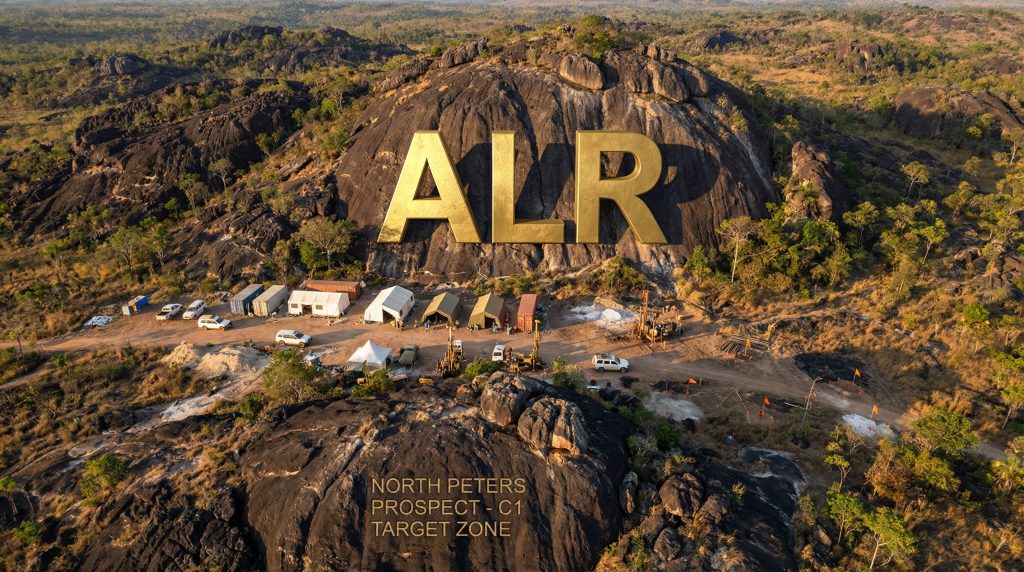
The crown jewel of the geophysical survey is the C1 Target – a prominent chargeability high spanning 900 metres of strike that remains almost entirely untested. This anomaly represents the strongest and most extensive geophysical signature across the survey area, yet drilling to date has only tested approximately 300 metres of its eastern margin.
Key C1 Target Statistics:
- Strike length: ~900m (only 300m tested)
- Depth range: 13m to 119m below surface
- Status: 600m+ strike completely untested and open to the north
The most compelling aspect of the C1 Target is that exceptional intercepts have been drilled away from the anomaly core, on its periphery. Consequently, this suggests that the untested core area may harbour even higher-grade mineralisation.
| Hole ID | Intercept | Depth | Position |
|---|---|---|---|
| MM4106 | 109m @ 2.04g/t Au | 47m | Eastern periphery |
| MM4206 | 63m @ 2.25g/t Au | 55m | Closest to peak (~250m NE) |
| MM0105 | 85m @ 4.81g/t Au | 24m | Eastern periphery |
| MM13808 | 89m @ 2.40g/t Au | 45m | Eastern periphery |
| MMMT003 | 43m @ 10.56g/t Au | Surface | Eastern periphery |
What is Chargeability?
Chargeability measures the polarisation effect produced by disseminated sulphides in rock, which are commonly associated with gold mineralisation. High chargeability readings indicate areas where sulphide minerals (and potentially gold) may be concentrated.
At North Peters, the strong association between gold intercepts and disseminated sulphides makes chargeability an excellent targeting tool for expansion drilling. However, the untested core areas present the most significant exploration opportunities.
When big ASX news breaks, our subscribers know first
The R1 Corridor: A 2.7km Structural Highway
The resistivity data has outlined an even more extensive target – the R1 resistive corridor extending approximately 2.7 kilometres along strike. This corridor coincides with the highest-grade mineralisation encountered to date and appears to represent a major structural control on gold emplacement.
R1 Target Highlights:
- Total strike: ~2.7km corridor identified
- Tested length: Only ~600m drilled to date
- Expansion potential: 4x current tested strike length
- Connection: Extends toward Old Granny target area
The corridor's untested extremities show particular promise. At the northwest end, hole MM13808 returned 89m @ 2.40g/t Au from 45m, while the southeast delivered 107m @ 1.36g/t Au.
Most intriguingly, the corridor extends 1.4km northeast toward the Old Granny target, where hole OG1710 – drilled closest to the corridor – intersected 24m @ 1.28g/t Au from 7m. This connection suggests a district-scale mineralised system with significant expansion potential.
Secondary Targets: C2, C3, and C4 Anomalies
Beyond the primary targets, the geophysical survey has identified three additional chargeability highs that remain completely or largely untested. These secondary targets offer additional opportunities for discovery outside the main exploration focus areas.
C3 Target – The Deep Bullseye
The C3 target presents a unique opportunity with dual-level prospectivity. Additionally, this target offers both shallow and deep exploration potential within the same geological setting.
- Shallow level (65m): Subtle anomaly with four peripheral holes returning strong intercepts including 30m @ 1.20g/t Au and 23m @ 1.80g/t Au
- Deep level (146m): Develops into the strongest chargeability peak across the entire survey – completely untested
C2 and C4 Targets – Virgin Territory
Both targets sit at the survey boundaries and represent 550 metres of combined untested strike. No historic drilling exists near either anomaly, making them high-priority scout targets for future programmes.
Target Summary Table:
| Target | Type | Strike Length | Drill Status | Priority |
|---|---|---|---|---|
| C1 | Chargeability High | 900m | 300m tested | Immediate |
| R1 | Resistive Corridor | 2.7km | 600m tested | High |
| C3 | Chargeability High | Variable | Periphery only | High |
| C2 | Chargeability High | 350m | Untested | Medium |
| C4 | Chargeability High | 200m | Untested | Medium |
Strategic Significance: Doubling the Footprint
The Altair Minerals North Peters geophysics analysis reveals targets that could fundamentally transform the project's scale and scope. According to CEO Faheem Ahmed:
"The main chargeability high remains completely untested, despite some of the best intercepts at North Peters occurring on the periphery of this anomaly, including 109m @ 2.04g/t Au, 85m @ 4.81g/t Au, 63m @ 2.25g/t Au, 89m @ 2.40g/t Au. Importantly, these intercepts were drilled in the opposite direction of the chargeability anomaly, away from the core of the system."
The geophysical data suggests the untested chargeability highs could approximately double the high-grade mineralisation system at North Peters. Furthermore, the resistive corridor extends the potential strike length by more than four times the current drill-tested area.
The Guyana Opportunity: Last Frontier of the Guiana Shield
Altair's 590km² contiguous landholding sits within one of the world's most promising yet underexplored gold terranes. The Guiana Shield represents the South American extension of West Africa's prolific Birimian Greenstone belts, which host world-class deposits across Ghana, Ivory Coast, and Burkina Faso.
Regional Context & Validation:
- G2 Goldfields: $2.2 billion market capitalisation
- Reunion Gold: $1 billion takeover by GMining Ventures (2024)
- Location: 1.5km from 5.9Moz discovery entering production
The region's emergence as a premier gold jurisdiction has attracted major players, yet Guyana remains significantly underexplored compared to its African geological counterparts. Recent grassroots discoveries by neighbouring companies have validated the shield's tier-1 potential.
Understanding the Guiana Shield
The Guiana Shield encompasses approximately 1.7 million square kilometres across northern South America, extending through Guyana, Venezuela, Suriname, French Guiana, and northern Brazil. This ancient geological formation consists primarily of Precambrian rocks aged between 3.6 billion and 540 million years old.
The shield's geological similarity to West Africa's Birimian formations results from the breakup of the supercontinent Gondwana approximately 200 million years ago. When South America and Africa separated, they left behind comparable geological terranes on both continents.
This explains why the Guiana Shield hosts similar styles of gold mineralisation to the prolific West African deposits. Consequently, exploration techniques proven successful in West Africa are highly applicable to Guyana's geological setting.
Key geological characteristics include greenstone belts, granitic intrusions, and extensive shear zones that provide favourable conditions for orogenic gold deposits. The combination of ancient volcanic and sedimentary sequences, subjected to multiple deformation events, creates ideal structural settings for gold concentration and preservation.
Next Steps: From Geophysics to Drill Bit
According to the announcement, Altair remains on track to commence drilling at North Peters in Q1 2026, with the geophysical results providing clear targeting guidance for the programme. The company plans to undertake follow-up geochemical programmes across the newly defined targets to refine priority areas before systematic drilling.
Immediate Priorities:
- Geochemical surveys across C1, C2, C3, and C4 targets
- Scout drilling of untested chargeability highs
- Extensional drilling along R1 corridor
- Step-out drilling from existing high-grade intercepts
The 65-metre depth slice used for target definition aligns closely with the average depth of high-grade mineralisation encountered to date, providing confidence in the targeting approach. Moreover, this shallow depth profile suggests potential for open-pit mining scenarios.
Investment Thesis: Multiple Pathways to Discovery
The North Peters geophysical results present multiple pathways to significant resource expansion. In addition, the systematic approach to target definition reduces exploration risk whilst maximising discovery potential.
Near-term Catalysts
- Q1 2026: Drilling commencement at North Peters
- Immediate targets: 600m+ untested C1 strike
- Expansion drilling: 2.1km untested R1 corridor
- Scout programmes: Virgin C2 and C4 targets
Technical Advantages
- Proven association between geophysics and gold mineralisation
- Clear structural controls via resistive corridor mapping
- Shallow target depth (13-146m) suitable for open-pit scenarios
- High-grade potential demonstrated by peripheral intercepts
Scale Opportunity
- 4x expansion potential along R1 corridor
- 2x expansion potential via untested chargeability highs
- Regional connectivity to Old Granny target area
- District-scale landholding in emerging jurisdiction
The next major ASX story will hit our subscribers first
Why Investors Should Track Altair Minerals
Altair Minerals has assembled a compelling combination of high-grade gold intercepts, systematic geophysical targeting, and district-scale land position in one of the world's most promising emerging gold jurisdictions. The North Peters geophysical results demonstrate that some of the project's best intercepts to date have been drilled away from the main anomalies.
This suggests the core targets remain untested and highly prospective. However, the Altair Minerals North Peters geophysics analysis provides the roadmap for systematic exploration of these high-priority areas.
Key Investment Differentiators:
- Immediate drill-ready targets with geophysical validation
- Proven high-grade system with expansion potential
- Strategic location in emerging Guiana Shield gold district
- Experienced management team with regional expertise
- Clear development pathway from exploration to resource definition
The combination of untested geophysical anomalies, adjacent high-grade intercepts, and systematic exploration approach positions Altair as a compelling exploration story with multiple near-term catalysts for discovery.
Consequently, with drilling set to commence in Q1 2026 and geophysical data providing clear targeting guidance, the company is well-positioned to deliver meaningful exploration success. The Altair Minerals North Peters geophysics analysis has established a foundation for systematic resource expansion in one of the world's most promising underexplored gold jurisdictions.
Could This Be Your Next Gold Discovery Play?
With multiple untested geophysical targets spanning over 3.4 kilometres of strike length and drilling set to commence in Q1 2026, Altair Minerals presents a compelling opportunity for investors seeking exposure to Guyana's emerging gold district. The company's systematic approach to exploration, combined with proven high-grade intercepts and district-scale land holdings in the prolific Guiana Shield, positions it as a standout play in the junior gold space. Don't miss the chance to get in ahead of the drill bit – discover more about Altair Minerals' North Peters project and investment opportunity.