July 19, 2026
The aluminium industry structural decline Europe faces today stems from fundamental shifts in global competitiveness that extend far beyond temporary market disruptions. Energy costs, technological advancement patterns, and global trade tensions have created structural disadvantages that traditional recovery mechanisms cannot address. Furthermore, the distinction between cyclical downturns and permanent industrial restructuring becomes evident when examining the underlying drivers reshaping European manufacturing competitiveness.
What Defines Structural Decline in European Aluminium Manufacturing?
The Difference Between Cyclical Downturns and Permanent Industrial Shifts
European aluminium production capacity has contracted by approximately 40% since 2008, with closures affecting primary smelting operations across multiple countries. This reduction differs markedly from typical cyclical adjustments, where temporary mothballing preserves restart options. Instead, many facilities have undergone permanent dismantling, indicating industry recognition that cost structures will not return to competitive levels.
Key indicators distinguishing structural from cyclical decline include:
- Asset disposal patterns: Permanent demolition rather than temporary mothballing
- Investment flows: Capital redirection to other regions rather than efficiency improvements
- Employment transitions: Workforce retraining for alternative industries
- Infrastructure repurposing: Converting smelter sites for different industrial uses
Historical precedents demonstrate that European industrial transitions often span decades. The steel industry's transformation from the 1970s through 1990s provides a relevant comparison, where capacity migrated from traditional centers in the Ruhr Valley and UK to emerging markets with cost advantages.
Measuring the Scale of Europe's Aluminium Production Contraction
Primary aluminium smelting capacity in Europe has fallen from approximately 4.8 million tonnes annually in 2008 to roughly 2.9 million tonnes in 2025. This contraction accelerated during energy price volatility periods, particularly following the 2022 energy crisis when several major facilities ceased operations permanently.
Regional variations reveal distinct patterns:
- Northern Europe: Norway and Iceland maintain operations leveraging hydroelectric advantages
- Central Europe: Germany and Netherlands experienced the steepest capacity reductions
- Southern Europe: Italy and Spain faced mixed outcomes based on facility-specific economics
- Eastern Europe: Some operations benefited from lower labor costs but struggled with energy expenses
Employment impact extends beyond direct smelting operations to encompass downstream processing, maintenance services, and regional supply networks. Industry estimates suggest approximately 25,000 direct jobs have been eliminated since 2020, with additional indirect employment effects across related industries.
When big ASX news breaks, our subscribers know first
How Do Energy Economics Drive Industrial Competitiveness in Aluminium Production?
The Energy-Intensive Nature of Primary Aluminium Smelting
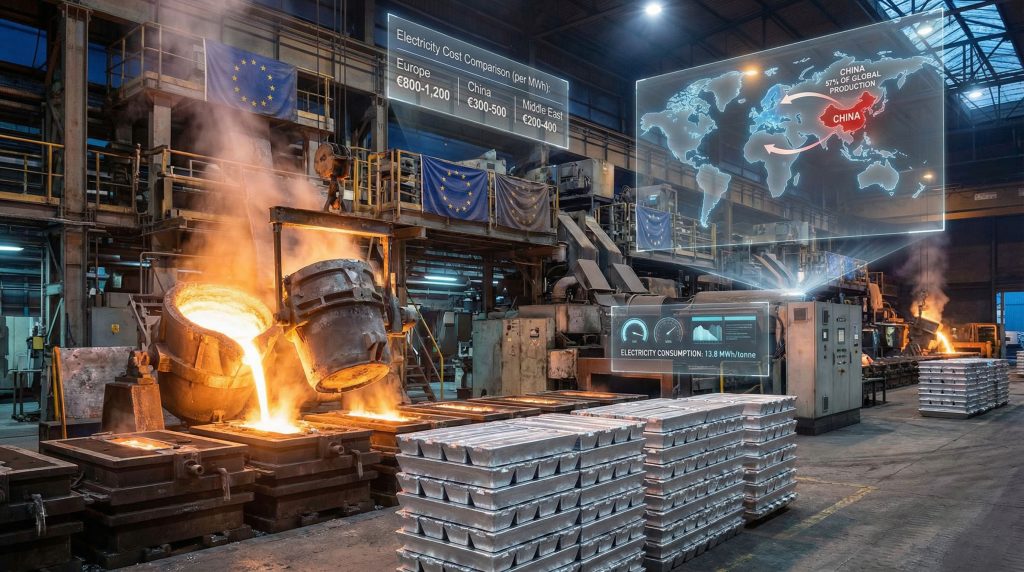
Aluminium production represents one of the most energy-intensive industrial processes, requiring 13-15 megawatt-hours (MWh) of electricity per tonne of primary metal produced. This energy intensity makes electricity costs the single largest variable expense in smelting operations, typically accounting for 35-40% of total production costs.
European electricity prices have consistently exceeded global competitors by substantial margins. Current comparative analysis reveals:
| Region | Average Industrial Electricity Price (€/MWh) | Annual Cost per Tonne Al (€) |
|---|---|---|
| Europe | 80-120 | 1,040-1,800 |
| China | 25-45 | 325-675 |
| Middle East | 15-35 | 195-525 |
| North America | 35-65 | 455-975 |
These cost differentials create insurmountable competitive disadvantages for European producers, particularly when energy represents such a significant portion of total production costs. The situation has worsened since 2022, when natural gas price volatility created additional uncertainty for industrial planning.
European Energy Price Volatility and Industrial Planning
Smelting operations require continuous power supply to maintain electrolysis cell temperatures above 950°C. Interruptions or significant fluctuations can damage equipment permanently, making reliable energy supply essential for operational viability. European grid instability, partly driven by renewable energy intermittency, has complicated industrial planning for energy-intensive manufacturers.
Moreover, the energy transition challenges facing developed economies have created additional complexity for long-term industrial planning. Many smelters now operate under spot market exposure, creating unsustainable financial volatility during periods of high energy prices.
What Role Does Global Supply Chain Reconfiguration Play?
China's Dominant Position in Global Aluminium Markets
Chinese primary aluminium production capacity now accounts for approximately 57% of global output, representing a dramatic shift from the distributed production geography of previous decades. This concentration has created pricing power for Chinese producers and established China as the marginal cost producer for global markets.
Chinese export patterns have evolved strategically, focusing on high-value semi-fabricated products rather than primary ingot to maximise value addition. This approach allows China to capture greater shares of the aluminium value chain while maintaining domestic primary production for strategic industries like automotive and aerospace.
Export volume analysis reveals:
- Primary aluminium exports: Deliberately limited to support domestic processing
- Semi-fabricated products: Aggressive expansion in automotive and construction segments
- Technology transfer: Partnerships with overseas smelters to influence global capacity allocation
Middle Eastern Capacity Expansion and Cost Advantages
Gulf Cooperation Council countries have invested heavily in aluminium smelting capacity, leveraging abundant natural gas resources and government subsidies. The UAE's Emirates Global Aluminium and Saudi Arabia's Ma'aden have commissioned modern, efficient facilities designed to serve export markets.
These investments benefit from:
- Subsidised energy costs: Government pricing below market rates
- Modern technology: Latest smelting technology with improved efficiency
- Strategic positioning: Access to Asian and European markets through established shipping routes
- Vertical integration: Combined alumina refining and primary smelting operations
Technology transfer from European and North American aluminum companies has enabled rapid capability development in the Middle East, often involving partnerships that provide operational expertise in exchange for market access.
Secondary Aluminium Market Dynamics and Scrap Availability
European scrap aluminium markets face increasing competition from international buyers, particularly in Asia where recycling capacity has expanded rapidly. Scrap prices have risen 35-40% since 2020 as global competition intensifies, making European recycling operations less economically attractive.
Scrap export patterns show concerning trends for European secondary production:
- Asian demand growth: China and India increasing scrap import volumes
- Price escalation: International buyers offering premium rates for quality scrap
- Collection efficiency: Improved European scrap collection systems paradoxically supporting exports
- Circular economy challenges: Domestic scrap leaving the regional market despite policy objectives
How Do Carbon Pricing Mechanisms Affect Industrial Competitiveness?
EU Emissions Trading System Impact on Aluminium Production
The European Union Emissions Trading System (EU ETS) creates direct costs for aluminium producers through carbon allocation and indirect costs through electricity pricing. Primary smelting operations generate approximately 1.5-2.0 tonnes of CO2 equivalent per tonne of aluminium produced, primarily from electricity consumption.
Current carbon pricing mechanisms affect European producers through:
- Direct emissions: Process-related CO2 from carbon anodes and fuel combustion
- Indirect emissions: Power generation carbon content reflected in electricity pricing
- Free allocation phase-out: Gradual reduction in free carbon allowances
- Benchmark adjustments: Performance standards that disadvantage older facilities
Carbon costs add an estimated €30-60 per tonne to European aluminium production, depending on the carbon price and facility efficiency. With EU ETS prices fluctuating between €80-100 per tonne CO2 in recent periods, these costs represent significant competitive disadvantage versus non-EU producers.
Carbon Border Adjustment Mechanism (CBAM) Implementation Effects
The Carbon Border Adjustment Mechanism, which entered its transitional phase in 2023 and implements financial obligations from 2026, theoretically protects European producers by imposing carbon costs on imports. However, practical implementation faces substantial challenges.
CBAM coverage for aluminium includes:
- Primary aluminium: Direct carbon intensity assessment required
- Some downstream products: Coverage expanding gradually
- Default values: Penalty rates for unverified emissions data
- Administrative complexity: Significant compliance costs for importers
Default carbon intensity values under CBAM range from 4.7 tonnes CO2/tonne for India to over 9 tonnes CO2/tonne for Indonesia, compared to EU benchmarks around 1.37 tonnes CO2/tonne. However, verified data from efficient overseas producers may significantly reduce these obligations.
Early CBAM implementation reveals that verified emissions data from major exporting countries often falls well below default values, limiting the mechanism's protective effect for European producers while adding administrative complexity to trade flows.
Which Automotive Sector Changes Accelerate Aluminium Demand Shifts?
European Automotive Manufacturing Transformation
European automotive production has declined substantially from pre-pandemic levels, falling more than 6% in 2024 compared to the previous year. This contraction reflects multiple pressures including Chinese electric vehicle competition, high production costs, and shifting consumer preferences.
Production statistics reveal concerning trends:
- 2019 baseline: 18.5 million vehicles produced across Europe
- 2024 performance: Approximately 16.2 million vehicles
- 2025 projection: Further decline to 15.8 million vehicles expected
The automotive transformation affects aluminium demand through multiple channels. Electric vehicles typically contain 20-30% more aluminium than internal combustion engine vehicles due to battery housing requirements and lightweighting needs. However, reduced overall production volumes offset increased aluminium intensity per vehicle.
Chinese Electric Vehicle Export Growth and European Market Share
Chinese automotive manufacturers have rapidly expanded European market presence, particularly in electric vehicle segments. Companies like BYD, NIO, and Geely have established European operations while maintaining primary manufacturing in China, creating different supply chain dynamics for aluminium consumption.
This shift impacts European aluminium demand through:
- Import substitution: Chinese vehicles replacing European production
- Supply chain relocation: Component manufacturing following final assembly
- Technology leadership: Chinese EVs often incorporating advanced lightweight aluminum designs
- Price competition: Lower-cost Chinese vehicles pressuring European manufacturers
Industry analysis indicates that approximately 30% of aluminium content in vehicles sold in Europe may now be processed outside the region, compared to roughly 15% a decade ago.
Internal Combustion Engine Technology Export Decline
Historical European automotive technology leadership created substantial aluminium demand through engine blocks, transmission components, and export vehicle production. As global automotive technology leadership shifts toward electric powertrains, European competitive advantages in traditional automotive manufacturing have diminished.
Technology transition impacts include:
- Engine component demand reduction: ICE-specific aluminium applications declining
- Export market losses: Reduced European vehicle exports to global markets
- Value chain disruption: Traditional aluminium processing relationships changing
- Investment redirection: R&D focus shifting to battery and electric drivetrain technologies
What Are the Investment and Capital Allocation Implications?
Smelter Closure Economics and Asset Stranding
Aluminium smelting facilities represent substantial capital investments with typical construction costs of €2,500-3,500 per tonne of annual capacity. When facilities close permanently, these assets often become stranded with minimal recovery value due to specialised infrastructure requirements.
Financial analysis of closure decisions involves:
- Mothballing costs: €50-100 per tonne of capacity annually for preservation
- Restart expenses: €200-500 per tonne for facility recommissioning
- Demolition costs: €100-200 per tonne for site clearance
- Site remediation: Additional environmental restoration expenses
Major European closures since 2020 include facilities in Germany, France, and the Netherlands, with combined capacity reductions exceeding 800,000 tonnes annually. Asset write-downs from these closures have totaled several billion euros across the industry.
Downstream Processing Industry Resilience
Semi-fabrication and downstream aluminium processing operations demonstrate greater resilience than primary smelting, benefiting from lower energy intensity and proximity to end-use markets. Rolling, extrusion, and casting operations typically consume 0.5-1.5 MWh per tonne of processed aluminium, significantly below primary production requirements.
European downstream processing maintains competitiveness through:
- Technical expertise: Advanced alloy development and specialised applications
- Customer relationships: Established partnerships with automotive and aerospace manufacturers
- Logistical advantages: Proximity to major consumption centres
- Quality standards: High-specification products for demanding applications
Investment patterns show continued commitment to European downstream operations, with several major expansion projects announced for recycling and specialised processing capabilities.
Alternative Industrial Uses for Former Aluminium Production Sites
Former smelter sites often possess valuable infrastructure including electrical grid connections, transportation access, and industrial zoning approvals. These characteristics make them attractive for alternative industrial applications, particularly those requiring substantial power supply capabilities.
Repurposing strategies include:
- Data centers: High power availability and grid connectivity
- Battery manufacturing: Industrial infrastructure suitable for electric vehicle supply chains
- Green hydrogen production: Electrolysis operations utilising existing electrical infrastructure
- Grid-scale energy storage: Location advantages for power system stabilisation
The next major ASX story will hit our subscribers first
How Do Geopolitical Factors Influence European Aluminium Markets?
Trade Policy and Tariff Structure Evolution
Global trade policy shifts significantly impact aluminium markets through tariff impositions, trade defense measures, and bilateral agreements. Recent US tariff policies on aluminium imports have redirected global trade flows, affecting European market dynamics indirectly.
European trade defense measures include:
- Safeguard quotas: Temporary restrictions on specific product categories
- Anti-dumping duties: Country-specific tariffs on unfairly priced imports
- Anti-subsidy measures: Countervailing duties on government-subsidised exports
However, the effectiveness of these measures has been limited by circumvention through transshipment and product classification adjustments by exporters. In addition, tariffs impact on investments has created uncertainty across global supply chains.
Strategic Material Security and Supply Chain Resilience
The European Critical Raw Materials Act identifies aluminium as strategically important, though not critical, due to abundant global supply sources. Nevertheless, supply chain concentration risks have prompted policy discussions about industrial resilience and strategic autonomy.
Security considerations include:
- Geographic concentration: Over-reliance on Chinese and Middle Eastern production
- Supply route vulnerability: Shipping lane disruptions affecting imports
- Technology dependence: Reliance on foreign smelting expertise and equipment
- Strategic stockpiling: Limited European government reserves compared to other regions
Alliance-building efforts focus on partnerships with reliable suppliers, particularly in North America and friendly developing countries with aluminium production capabilities.
Russia-Ukraine Conflict Impact on European Industrial Strategy
The conflict has disrupted traditional aluminium supply relationships and accelerated European industrial policy reforms. Russian aluminium producer UC Rusal historically supplied approximately 20% of European aluminium imports, creating substantial market disruption when sanctions limited trade relationships.
Conflict-related impacts include:
- Supply source diversification: Accelerated procurement from alternative suppliers
- Energy security prioritisation: Reduced dependence on Russian natural gas affecting electricity markets
- Strategic autonomy emphasis: Policy focus on reducing critical supply dependencies
- Industrial competitiveness concerns: Recognition that energy security and industrial competitiveness require coordinated policies
What Policy Responses Could Address Structural Challenges?
Industrial Electricity Pricing Reform Options
European policymakers have explored various mechanisms to address industrial electricity pricing disadvantages while maintaining environmental objectives. Proposed reforms include targeted pricing for energy-intensive industries and compensation for providing grid flexibility services.
Reform proposals encompass:
- Industrial electricity contracts: Long-term pricing arrangements below market rates
- Grid service compensation: Payment for demand response and load balancing capabilities
- Renewable energy certificates: Direct procurement arrangements with green power generators
- Interruptible supply contracts: Reduced rates in exchange for demand flexibility
Implementation challenges include state aid compliance, competitive distortion concerns, and coordination with EU energy market regulations.
Research and Development Investment in Next-Generation Technologies
Technological advancement offers potential pathways for European aluminium industry competitiveness recovery. Inert anode technology development could reduce electricity consumption by 15-20% compared to conventional smelting, while improving environmental performance.
Innovation priorities include:
- Process efficiency improvements: Advanced cell technology reducing energy requirements
- Recycling technology: Enhanced sorting and processing for secondary aluminium
- Digital manufacturing: Industry 4.0 applications optimising production efficiency
- Alternative feedstock: Development of non-bauxite aluminium production methods
European research programmes have allocated significant funding for aluminium technology development, though commercialisation timelines extend beyond immediate industry needs. Consequently, the aluminium industry structural decline Europe experiences requires both immediate policy support and long-term technological innovation.
European Green Deal Alignment and Industrial Competitiveness
The European Green Deal creates both challenges and opportunities for aluminium industry transformation. Net-zero transition requirements necessitate substantial process changes while potentially creating market opportunities for low-carbon aluminium products.
Green Deal alignment strategies include:
- Renewable energy integration: Direct procurement from solar and wind facilities
- Circular economy emphasis: Increased focus on recycling and waste reduction
- Product differentiation: Premium markets for sustainably produced aluminium
- Technology export: European expertise in clean production technologies
Green premium markets may provide revenue opportunities for European producers willing to invest in environmental performance improvements. However, the decarbonisation benefits must be balanced against scale limitations that restrict their impact on overall industry economics.
What Does the Future Hold for European Aluminium Manufacturing?
Scenario Analysis: Recovery Versus Permanent Restructuring
Recovery scenarios for European primary aluminium production require fundamental changes in energy economics or trade protection effectiveness. Analysis suggests that electricity costs would need to decline by 40-50% to restore competitiveness with global producers, an unlikely development given European energy transition policies.
Scenario probabilities indicate:
- Full capacity restoration: Less than 15% probability over 10-year horizon
- Partial recovery: 25-30% probability with targeted policy intervention
- Continued decline: 45-50% probability under current trends
- Stable at current levels: 15-20% probability with effective policy support
These projections reflect structural rather than cyclical challenges, suggesting that industry transformation rather than recovery represents the most likely outcome.
Regional Specialisation and Competitive Positioning
European aluminium industry advantages concentrate in high-value applications requiring technical expertise, quality standards, and customer proximity. Aerospace, automotive premium segments, and specialised industrial applications offer potential growth areas despite overall capacity decline.
Competitive positioning strategies include:
- Premium product focus: High-specification alloys for demanding applications
- Technical services: Engineering support and product development capabilities
- Recycling expertise: Advanced secondary production technologies
- Sustainability leadership: Low-carbon product certification and environmental performance
These approaches emphasise value over volume, acknowledging that European operations cannot compete on cost alone with global commodity producers. Furthermore, industry transformation trends suggest that technological advancement and specialisation represent viable pathways for maintaining European competitiveness.
Global Market Share Projections and Strategic Positioning
European aluminium production is projected to decline from approximately 6% of global primary production currently to potentially 3-4% by 2035, assuming no major policy interventions or technological breakthroughs. However, European consumption may remain stable, increasing import dependency substantially.
Strategic positioning for 2030-2035 emphasises:
- Technology leadership: Innovation in recycling and efficiency technologies
- Quality differentiation: Premium market segments requiring superior products
- Supply chain integration: Close relationships with automotive and aerospace customers
- Sustainability positioning: Environmental performance as competitive advantage
Alliance strategies with North American and friendly developing country producers may provide supply security while maintaining some domestic capability for strategic applications. Moreover, the European aluminium industry outlook increasingly focuses on high-value market segments where geographical proximity and technical expertise provide sustainable competitive advantages.
The aluminium industry structural decline Europe experiences reflects fundamental shifts in global economic geography that extend beyond cyclical market forces. Success requires strategic adaptation rather than resistance to these transformative changes, focusing on high-value market segments where European capabilities remain competitive despite cost disadvantages.
Disclaimer: This analysis contains forward-looking assessments based on current market conditions and policy frameworks. Actual industry developments may vary significantly from projections due to technological breakthroughs, policy changes, or unexpected economic developments. Investment and business decisions should incorporate additional research and professional advice.
Looking to Capitalise on the Next Major Aluminium Discovery?
While Europe's aluminium industry faces structural challenges, savvy investors are turning their attention to emerging opportunities in the global mining sector. Discovery Alert's proprietary Discovery IQ model delivers real-time alerts on significant ASX mineral discoveries, including critical metals like aluminium, instantly empowering subscribers to identify actionable opportunities ahead of the broader market and position themselves for the next major breakthrough.