July 27, 2026
The Metallurgical Trade-Off Reshaping Electric Vehicle Design
For most of the twentieth century, copper held an unchallenged position as the conductor of choice across virtually every electrical application. Its combination of high conductivity, ductility, and corrosion resistance made it the default material for engineers designing anything that needed to move electricity reliably. Yet material dominance rarely survives indefinitely when economics shift violently enough, and the conditions now emerging across global metals markets are forcing automotive engineers to revisit assumptions that have governed vehicle wiring design for decades.
The accelerating pace of aluminium wiring adoption in electric vehicles represents one of the most consequential material substitution cycles in modern automotive history. Understanding why it is happening, where it is succeeding, and where it faces genuine limitations requires looking simultaneously at physics, pricing, vehicle architecture, and the competitive dynamics of the global EV market.
When big ASX news breaks, our subscribers know first
Conductivity, Density, and the Physics Behind the Switch
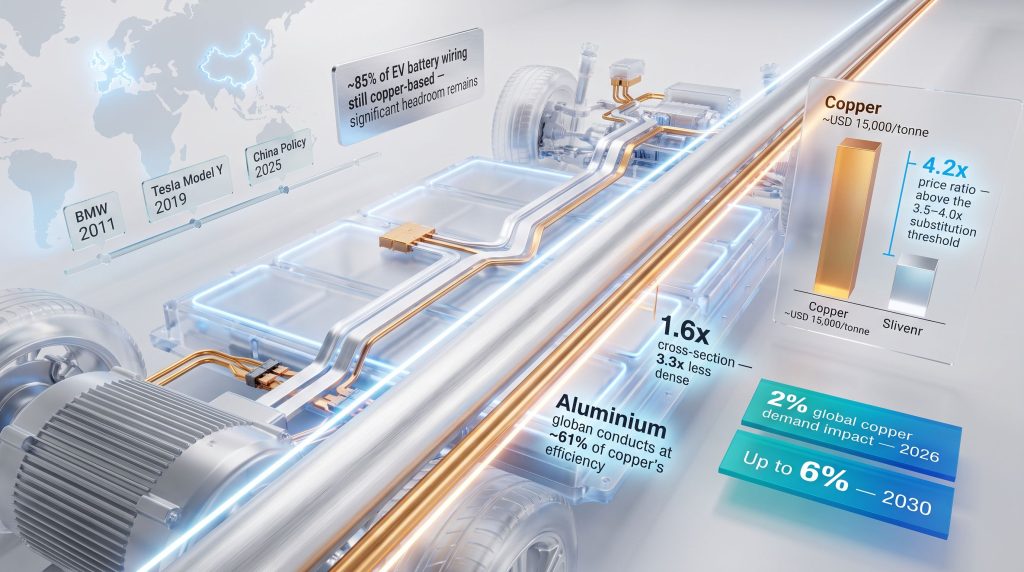
The fundamental trade-off is straightforward to quantify but nuanced in its engineering implications. Aluminium conducts electricity at approximately 61% of copper's efficiency, which means that an aluminium conductor must be roughly 1.6 times larger in cross-section to carry an equivalent current load. On the surface, this sounds like a significant penalty, particularly in space-constrained environments.
However, aluminium is approximately 3.3 times less dense than copper by volume. When you apply the 1.6x cross-section penalty against the 3.3x density advantage, the net outcome in terms of mass still strongly favours aluminium for high-current, longer-run cable applications. This is precisely the profile of the wiring that connects an EV's battery pack to its drive systems, making these routes the primary substitution zone where aluminium delivers meaningful weight reductions without unacceptable engineering compromises.
The weight saved is not a trivial consideration in battery-electric vehicles. Every kilogram removed from a vehicle's structure and systems reduces the energy required to accelerate and maintain speed, which directly translates into extended driving range on a fixed battery capacity. In a market where range anxiety remains a persistent concern among potential buyers, wiring mass is no longer an afterthought for vehicle programme engineers.
When Economics Force Engineering Decisions: The Price Ratio Trigger
Material substitution in industrial supply chains rarely happens for purely technical reasons. Economics typically provide the decisive push, and the copper-to-aluminium price ratio has become the key variable that procurement teams and engineers monitor when evaluating substitution feasibility. Furthermore, the copper price growth drivers at play in current markets have made this evaluation more urgent than ever.
Industry sources suggest that serious substitution consideration typically begins when the copper-to-aluminium price ratio climbs to somewhere between 3.5 and 4.0 times. The table below shows how dramatically current market conditions have exceeded that threshold:
| Metric | Value |
|---|---|
| Copper price peak (early 2026) | ~USD 15,000/tonne |
| Copper-to-aluminium price ratio at peak | 4.3x |
| Current copper-to-aluminium price ratio | ~4.2x |
| Industry substitution trigger threshold | 3.5 to 4.0x |
| Aluminium's approximate price relative to copper | ~25% of copper's price |
With aluminium trading at roughly a quarter of copper's price and the ratio remaining well above the substitution trigger level, the economic case for switching has rarely been stronger. Copper's surge to nearly USD 15,000 per tonne in late January 2026 reflected a combination of supply constraints and intensifying demand from the green energy transition and the data centre build-out, two structural forces that show no sign of reversing.
What is particularly significant is that substitution cycles tend to be self-reinforcing once price ratios breach key thresholds. As more manufacturers switch, supplier ecosystems scale up aluminium wiring capacity, tooling costs fall, engineering knowledge spreads across the industry, and the perceived risk of switching diminishes. The cycle then accelerates independently of the price ratio that initially triggered it.
How Leading Automakers Are Deploying Aluminium Wiring
The adoption curve spans manufacturers across multiple continents, but each has arrived at aluminium wiring through a slightly different path:
BMW was among the earliest systematic adopters, first integrating aluminium conductors in its 1 Series in 2011. Over the following decade, it steadily expanded their use across hybrid and battery-electric platforms. Since launching its sixth-generation eDrive technology, BMW has extended aluminium cable use extensively across both high- and low-voltage systems, demonstrating that long-run adoption is technically viable at scale.
Ferrari provides one of the most carefully documented examples of what aluminium wiring can achieve in terms of measurable outcomes. After introducing aluminium power cables in its 296 hybrid sports car, the company expanded their use across additional models, including the Luce, its first fully electric vehicle. When combined with optimised cable cross-section design, the transition produced total wiring weight reductions of between 15% and 20%. Notably, Ferrari's engineering leadership attributed the decision primarily to technical and weight objectives rather than cost savings alone, which underscores that the benefits extend well beyond procurement economics.
Tesla established the benchmark that much of the subsequent industry has followed. Its integration of aluminium wiring in the Model Y from 2019 onward, later extended to the Cybertruck, created a design template that Chinese EV manufacturers studied carefully and replicated across their own platforms. This benchmarking dynamic has proven to be one of the most powerful accelerants of broader aluminium adoption across the global EV supply chain.
Chinese EV manufacturers including AVATR, XPeng, and Xiaomi have all adopted aluminium wiring in their vehicles. In China's intensely price-competitive EV market, where manufacturers have been locked in a sustained margin-compressing price war, the cost savings from aluminium wiring carry particular strategic weight. Consequently, electric vehicles transforming mining and broader supply chains are reshaping how raw materials are sourced and prioritised globally.
Stellantis has also been reported to be replacing copper wiring with aluminium across its vehicle programmes, indicating that the trend has reached mainstream European mass-market manufacturing.
Where Aluminium Works and Where Copper Remains Essential
Aluminium wiring adoption in electric vehicles is deliberately selective rather than wholesale. Understanding which applications have switched and which have not reveals a great deal about the material's genuine limitations:
| Application Type | Preferred Material | Primary Reason |
|---|---|---|
| High-voltage power cables | Aluminium (growing) | Weight savings, cost efficiency on long runs |
| Battery-to-system busbars | Aluminium (growing) | High current capacity, extended cable lengths |
| Low-voltage signal wiring | Copper (dominant) | Compactness, connection reliability |
| High-flex harness zones | Copper (dominant) | Fatigue resistance under repeated cycling |
| Compact connector areas | Copper (dominant) | Space constraints, robust termination |
A critical data point that reveals just how much headroom remains in this transition: approximately 85% of the electrical wiring and busbars connecting an EV's battery to its systems are still copper-based. This is not a market nearing saturation. It is one in the early stages of structural change, with the bulk of potential substitution still ahead.
The Engineering Challenges That Prevent a Simple Swap
Aluminium wiring is not a plug-and-play replacement for copper across all vehicle electrical systems. It requires purpose-engineered termination hardware, material coatings to manage oxidation at connection points, and system-level redesign. Successful deployment demands that engineers approach it as a new architecture, not a material swap.
The technical limitations of aluminium in vehicle wiring applications are real and deserve clear explanation:
- Oxidation at connection points: Aluminium forms an oxide layer on its surface naturally, which can increase electrical resistance at terminals over time if connections are not specifically engineered to prevent it.
- Vibration fatigue: Aluminium is less resistant to the kind of repeated mechanical stress experienced in flex cycles and vibration-heavy vehicle environments, making it poorly suited to applications where cables experience constant movement.
- Termination complexity: Standard copper termination hardware is not directly compatible with aluminium conductors, requiring purpose-designed connectors and often bi-metallic transition sleeves to prevent galvanic corrosion where the two metals meet.
- Space requirements: The 1.6x cross-section penalty creates packaging challenges in compact areas of the vehicle where routing space is tightly constrained.
These realities explain why the industry has settled on a hybrid wiring architecture, strategically deploying aluminium where it delivers the greatest net benefit while retaining copper where its superior properties remain necessary. For further technical context, resources covering high-voltage cable materials detail the engineering considerations that inform these decisions.
The next major ASX story will hit our subscribers first
Supply Chain Scaling and Market Share Dynamics
The supplier ecosystem has responded to rising OEM demand with measurable capacity and revenue mix shifts:
| Supply Chain Indicator | Data Point |
|---|---|
| Chinese supplier aluminium wiring share of sales (2026) | ~30% |
| Chinese supplier aluminium wiring share of sales (2023) | ~20% |
| Estimated copper components replaceable by aluminium by 2030 in China | 25 to 30% by metal volume |
| Sectors targeted by China's 2025 substitution guidance | Power, automotive, home appliances |
Chinese supplier JONVER's experience illustrates the pace of change, with aluminium wiring products growing from approximately 20% of its sales in 2023 to roughly 30% in 2026. Norwegian aluminium producer Hydro has also reported rising demand for automotive substitution products and anticipates continued market share growth.
In early 2025, China's government issued policy guidance encouraging industrial sectors to accelerate the shift from copper to aluminium components across power, automotive, and home-appliance categories. Consultancy Zhuochuang estimates that between 25% and 30% of copper components across these sectors could be displaced by aluminium by volume before 2030. It is important to note that this represents a broad policy framework rather than project-specific support for any individual manufacturer.
The Broader Copper Substitution Megatrend
The EV sector is not the only arena where aluminium is displacing copper at scale. The trend extends across multiple industries simultaneously, and the ongoing copper supply crunch is accelerating the urgency of these transitions across global industries:
- Power grid infrastructure: Global electricity grid investment is projected to reach approximately USD 11.4 trillion by 2030, according to Nexans. Aluminium is claiming a growing share of this investment, particularly in distribution network applications. Prysmian, the world's largest cable manufacturer, now uses aluminium for roughly 40% of its materials by weight, up from about 37% five years ago.
- HVAC equipment: Daikin, the world's largest air conditioning manufacturer, has been actively substituting copper with aluminium to reduce manufacturing costs. Lennox International and Carrier Global have both introduced aluminium coil technology in air conditioning and heat pump products.
- Demand impact modelling: Analysts at JPMorgan estimate that the substitution shift will affect around 2% of global copper demand in 2026, a figure that could rise to as much as 6% by 2030 under one scenario.
| Timeframe | Estimated Copper Demand Impact From Substitution |
|---|---|
| 2026 | ~2% of global copper demand |
| 2030 (projected scenario) | Up to 6% of global copper demand |
In addition, the evolving battery raw materials market is closely intertwined with these substitution dynamics, as manufacturers reassess which metals deliver the best combination of performance, cost, and availability. Meanwhile, advances in Chinese battery recycling are also influencing how raw material strategies are structured across the broader EV supply chain.
Frequently Asked Questions: Aluminium Wiring in Electric Vehicles
Is aluminium wiring safe in electric vehicles?
Yes, when correctly engineered. The key is purpose-designed termination hardware, anti-oxidation coatings, and system-level design that accounts for aluminium's specific mechanical and chemical properties. Major manufacturers including BMW, Ferrari, and Tesla have validated its safety across production vehicles.
Why don't all EVs use aluminium wiring if it is cheaper and lighter?
Aluminium is not suitable for all wiring applications. In compact connectors, high-flex zones, and signal wiring, copper's superior properties remain necessary. EVs use a hybrid approach, deploying aluminium where the trade-offs work and retaining copper where they do not.
Which EV brands currently use aluminium wiring?
BMW, Ferrari, Tesla, AVATR, XPeng, Xiaomi, and reportedly Stellantis have all integrated aluminium wiring to varying degrees across their EV platforms. For additional context, industry reporting on this shift provides a useful overview of how leading manufacturers are responding to cost pressures.
Will aluminium wiring become the industry standard for EVs?
It is becoming standard for specific high-voltage, long-run applications. Given that around 85% of EV battery wiring and busbars are still copper-based, significant further penetration is plausible as engineering solutions mature and supplier ecosystems scale.
How does aluminium wiring affect EV range and efficiency?
By reducing total vehicle mass, aluminium wiring contributes to lower energy consumption per kilometre, extending driving range on a fixed battery charge. Ferrari documented wiring weight reductions of 15% to 20% from its aluminium cable transition.
What is the difference between aluminium and copper wiring in terms of conductivity?
Aluminium conducts electricity at approximately 61% of copper's efficiency, requiring a conductor about 1.6 times larger in cross-section to carry the same current. Despite this size penalty, aluminium's much lower density means the overall wiring system is still lighter in mass for high-current, longer-run applications.
What Comes Next as Material Science and Market Dynamics Evolve
The trajectory of aluminium wiring adoption in electric vehicles points clearly toward broader integration, though the pace will be governed by three distinct factors:
- Engineering maturity: Advances in termination technology, anti-oxidation surface treatments, and alloy formulations will gradually extend the range of applications where aluminium performs reliably.
- Price ratio persistence: If the copper-to-aluminium price ratio remains above the 3.5 to 4.0 substitution trigger threshold for an extended period, the economic incentive to invest in aluminium-compatible engineering infrastructure will remain compelling.
- Supply chain confidence: As more manufacturers validate aluminium wiring across production volumes, the perceived engineering risk diminishes and adoption accelerates through normal industry benchmarking processes.
Copper will not disappear from EV wiring architectures. Its properties in signal-level applications, compact connectors, and high-flex zones are simply better suited than aluminium's, and no current substitution pressure is likely to change that in the near term. What is changing is the balance, with aluminium steadily claiming the high-current, longer-run routes where its mass advantage is decisive and its connection challenges are manageable through deliberate engineering.
This article contains forward-looking statements and market projections derived from third-party analyst estimates. These represent scenarios based on current data and assumptions, and actual outcomes may differ materially. Readers should not treat any projections as investment advice or guaranteed forecasts.
Want to Capitalise on the Next Major ASX Mineral Discovery Before the Broader Market?
Discovery Alert's proprietary Discovery IQ model scans ASX announcements in real time, instantly identifying significant mineral discoveries across copper, aluminium, and more than 30 other commodities — delivering actionable insights to subscribers before the wider market reacts. Explore historic examples of transformative discovery returns and begin your 14-day free trial today to position yourself at the forefront of the next major find.