
August 5, 2026
When the Ground Gives Way: The Hidden Human Cost of Africa's Artisanal Mining Economy
Across sub-Saharan Africa, a quiet and largely invisible economy operates beneath the surface of official mining statistics. Millions of workers, most of them rural, most of them young, descend daily into unshored pits and hand-dug shafts in pursuit of gold, diamonds, and coltan. No geological survey has assessed the ground beneath their feet. No engineer has calculated the load-bearing capacity of the pit walls around them. No emergency protocol exists to guide a rescue if the earth suddenly shifts. For most of these workers, the absence of formal employment leaves no viable alternative. The risk is not unknown to them. It is simply the price of survival.
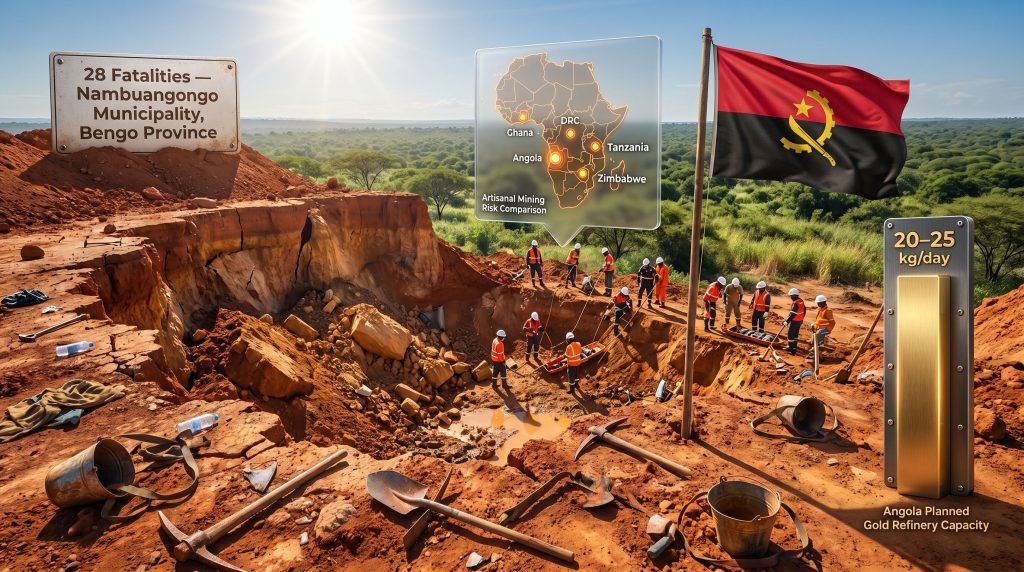
The Angola gold mine collapse in Bengo province, which killed at least 28 people in Nambuangongo Municipality during May 2026, is the latest and one of the most devastating events to expose this reality. But to understand why this happened, and why it will continue to happen without structural change, it is necessary to look well beyond the immediate incident.
When big ASX news breaks, our subscribers know first
A Collapse That Became a Family Catastrophe
The details emerging from Bengo province transform what might otherwise be catalogued as an industrial statistic into something far more visceral. Of the 28 confirmed fatalities, 13 belonged to a single family unit. Four survivors were recovered from the debris during active rescue operations, and at least three injured individuals were treated at Bengo Central Hospital in stable condition. Two people remained unaccounted for after primary search efforts concluded.
The victims ranged in age from their mid-teens to their mid-forties, a profile entirely consistent with the working-age demographic that artisanal and small-scale mining (ASM) draws upon across the continent. However, the concentration of 13 deaths within one household does something that aggregate fatality figures rarely achieve: it makes the systemic failure personal.
When a single family accounts for nearly half the fatalities at an illegal mining site, it reveals that economic precarity does not just push individuals into dangerous work. It pulls entire households into the same hazard simultaneously, because the household has no other income stream to fall back on.
This pattern, where multiple family members participate in the same informal extraction activity at the same location, is not unusual across Africa's artisanal mining communities. It reflects the near-total absence of formal employment alternatives in many rural mineral-bearing areas, and the way that unregulated mining becomes a household survival strategy rather than an individual occupational choice. Furthermore, reporting from the Anadolu Agency confirms the scale of devastation at the Bengo site, underscoring how rapidly conditions can turn fatal without any safety infrastructure in place.
Why Unregulated Gold Mining Is Spreading in Angola
Angola's relationship with informal extraction has historically centred on diamonds. The country is one of Africa's significant diamond producers, and artisanal diamond mining has long generated both economic activity and governance challenges across its eastern and northeastern provinces. However, the centre of gravity within Angola's informal mining economy is shifting.
Gold has become a more compelling target for artisanal operators as commodity price dynamics evolve. Central bank accumulation, safe-haven investor demand, and constrained mine supply from major producing jurisdictions have kept gold prices elevated, making even low-grade, unsophisticated extraction commercially viable at small scales. This is a pattern that repeats itself across the continent whenever gold prices rise: informal sector activity expands, new unregistered sites open, and the population of workers operating without safety infrastructure grows.
Angola's regulatory architecture has not kept pace with this shift. The country's formal minerals governance framework is oriented primarily toward licensed, large-scale operations capable of attracting foreign direct investment. The regulatory infrastructure for artisanal and small-scale mining, including accessible licensing pathways, technical assistance programmes, and safety oversight mechanisms, remains underdeveloped relative to the actual scale of informal activity on the ground. Understanding mining permits explained helps illustrate just how significant the gap is between formal sector requirements and the complete absence of oversight at illegal sites.
The practical consequences of this gap are well illustrated by the conditions that typically prevail at unregistered sites:
| Risk Factor | Formal Licensed Operations | Illegal Artisanal Sites |
|---|---|---|
| Geological stability assessment | Mandatory prior to development | Rarely or never conducted |
| Engineered ground support | Regulatory requirement | Absent in most cases |
| Emergency response protocols | Legally required | Non-existent |
| Personal protective equipment | Enforced by regulation | Typically unavailable |
| Permit and licensing status | Required for operation | Operating illegally |
| Worker identification systems | Maintained by operators | No accountability mechanism |
The Geology of Collapse: Why Pit Walls Fail Without Warning
One detail that receives insufficient attention in coverage of artisanal mining disasters is the specific geological and engineering mechanism that makes these events so lethal. At informal gold sites, miners typically excavate using one of two methods: shallow open pits or narrow vertical shafts. Neither method, when executed without engineering input, accounts for the dynamic forces acting on pit wall stability.
Several factors combine to create collapse conditions:
- Slope angle and cohesion: Artisanal miners routinely excavate pit walls at angles that exceed the natural angle of repose for the local geology, particularly in weathered laterite or alluvial material where gold is often concentrated near the surface in African settings
- Groundwater infiltration: Seasonal rainfall saturates soil and regolith, increasing pore water pressure within pit walls and dramatically reducing the shear strength of material that appeared stable during dry conditions
- Stress redistribution: The removal of load-bearing material from the base of a pit face shifts stress onto the remaining wall mass, which may fail suddenly rather than progressively
- Absence of monitoring: Licensed operations use slope monitoring equipment, inclinometers, and regular geotechnical inspections to detect early movement. Informal sites have none of these systems, meaning the first indication of failure is the collapse itself
This combination of factors explains why landslide events at unregulated sites produce such high casualties. Workers receive no warning, cannot evacuate, and are typically clustered together within a confined excavation.
Angola's Gold Ambitions: The Formal Sector Story
The Bengo disaster does not occur in isolation from Angola's broader mineral economy trajectory. The country is in the process of constructing a genuine gold sector alongside its established petroleum and diamond industries.
Angola is advancing toward the operationalisation of its first domestic gold refinery, a facility designed to process raw ore within the country rather than exporting unrefined material to foreign refiners. The facility is projected to operate at a daily processing capacity of approximately 20 to 25 kilogrammes once fully operational. This is a strategically significant development because it positions Angola to capture downstream processing margins that have historically accrued to refining centres in Europe, the Middle East, and East Asia.
The continental logic behind this type of investment is increasingly well understood. African resource-producing nations are recognising that exporting raw ore or concentrate captures only a fraction of the total value embedded in their geological endowment. In addition, processing capacity is the mechanism through which resource ownership is converted into genuine economic value. Conducting definitive feasibility studies at proposed refinery sites is a critical step in translating these ambitions into credible, bankable projects.
Gold's rising strategic importance to Luanda is also connected to structural pressures within the diamond market. Angola holds a reported interest in acquiring a 20% to 30% equity stake in De Beers, the world's most prominent diamond producer by value, as part of a broader effort to defend African interests in the natural diamond industry. Anglo American has been working to divest De Beers following a period in which declining natural diamond prices, partly driven by the growing market penetration of laboratory-grown diamonds, weakened the unit's financial performance.
Laboratory-grown diamonds have fundamentally altered the competitive dynamics of the gem-quality diamond market. Technological improvements in chemical vapour deposition (CVD) and high-pressure high-temperature (HPHT) synthesis have reduced production costs substantially, allowing synthetic stones to undercut natural diamond prices at the consumer level. This has consequently compressed margins across the natural diamond value chain and forced producing nations including Angola to reassess their reliance on diamond revenue.
Africa's Artisanal Mining Crisis: A Continent-Wide Pattern
The Angola gold mine collapse in Bengo province is not an isolated event. It belongs to a well-documented pattern of preventable fatalities at artisanal sites across sub-Saharan Africa.
| Country | Primary ASM Commodity | Regulatory Context |
|---|---|---|
| Angola | Gold, Diamonds | Informal sector governance underdeveloped |
| Democratic Republic of Congo | Gold, Coltan, Cassiterite | Ongoing enforcement challenges; multiple annual fatalities |
| Ghana | Gold | Partial formalisation programme underway; recurring pit collapses |
| Zimbabwe | Gold | Annual artisanal fatalities documented; mixed enforcement record |
| Tanzania | Gold | Licensing reform in progress; historical collapse events recorded |
What unites these cases is not simply the absence of safety equipment. It is the absence of any institutional relationship between the state and the people doing the mining. When miners operate entirely outside the regulatory system, they receive no training, no technical support, no warning systems, and no emergency response when something goes wrong. They are economically present in the mining sector but institutionally invisible to it. The mining claims framework applied in more regulated jurisdictions offers a useful contrast, demonstrating how formal recognition of small-scale operators can reduce exposure to exactly these kinds of preventable disasters.
The next major ASX story will hit our subscribers first
Formalisation as a Safety Strategy, Not Just a Revenue Strategy
The conventional policy response to artisanal mining disasters tends to focus on enforcement: closing illegal sites, prosecuting operators, and deploying security forces to prevent re-entry. The evidence from comparable situations across Africa consistently shows that enforcement-only approaches produce short-term site closures followed by rapid resumption of illegal activity at new, often more remote and less accessible locations.
Effective responses require a different design logic. Three interventions have demonstrated meaningful impact in other African jurisdictions:
- Simplified licensing and site registration programmes that reduce the administrative and financial barriers preventing small-scale operators from entering the formal system. In jurisdictions where licensing costs and bureaucratic complexity are high, illegality becomes the rational default.
- Community-based geological hazard education focused specifically on slope stability, seasonal flooding risk, and basic evacuation protocols. These programmes do not require sophisticated technology. They require information to reach workers before a collapse occurs rather than after.
- Integrated social protection coupling enforcement action with livelihood alternatives. Crackdowns on dangerous sites that leave workers with no income simply redistribute the population of informal miners to new unregistered locations. Durable safety improvements require that displaced workers have somewhere viable to go.
Enforcement without formalisation is displacement, not reform. The sites close, the workers move, and the next collapse happens somewhere with even less visibility and even fewer witnesses.
Furthermore, mine reclamation importance extends beyond environmental restoration. In the context of artisanal sites, formalisation and post-closure responsibility must become part of any credible governance framework if the cycle of disaster is to be broken.
What This Means for Investors in Angola's Mining Sector
For institutional investors, strategic partners, and project developers evaluating Angola's minerals pipeline, the Bengo disaster introduces considerations that belong in any serious risk assessment framework.
The coexistence of a credible formal sector development agenda with an uncontrolled informal sector creates several specific risks for licensed operators:
- Reputational proximity risk: Disasters at illegal sites in the same country and commodity sector affect the reputational environment in which all mining activity is assessed by international stakeholders, even when licensed operators bear no operational responsibility
- Regulatory response risk: High-profile disasters typically generate political pressure for broad regulatory intervention, which can affect permitting timelines, inspection regimes, and community relations across both formal and informal operations
- Social licence complexity: Communities that have experienced the loss of family members at unregulated sites may become more resistant to engagement with formal sector operators, complicating stakeholder processes
- Governance premium pricing: Sophisticated investors increasingly price governance quality into their Angola exposure assessments, recognising that the institutional gap between formal sector ambition and artisanal sector reality is a material variable, not a background condition
Angola's fundamental resource story remains genuinely compelling. The country has verifiable mineral endowment across gold, diamonds, copper, and iron ore. Its refinery ambitions reflect sound strategic thinking about value chain positioning. Considering natural capital in mining as part of this strategic calculus would further strengthen Angola's positioning as a responsible mineral producer on the world stage.
Its interest in De Beers signals an understanding of where African nations need to position themselves in global commodity markets. However, the Bengo collapse is a precise illustration of the gap between macro-level resource strategy and ground-level institutional reality. That gap has a human cost, and it also has an investment cost. Bridging it is not a secondary policy consideration. It is a prerequisite for Angola's mining sector to fulfil its potential without leaving the most economically vulnerable members of its mining communities to absorb risks that should never have been theirs to bear.
Frequently Asked Questions: Angola Gold Mine Collapse in Bengo Province
How many people died in the Angola gold mine collapse in Bengo province?
At least 28 people were confirmed dead following the landslide at an illegal gold mining site in Nambuangongo Municipality, Bengo Province. Two individuals remained missing after primary search operations concluded, and at least three survivors received treatment at Bengo Central Hospital.
Where exactly did the Angola mine collapse occur?
The collapse occurred at an unregistered artisanal gold mining site in Nambuangongo Municipality, within Bengo Province, located northwest of Angola's capital city, Luanda.
Was the mine operating legally?
No. The site was an illegal, unregistered operation with no formal permits, safety infrastructure, geological assessments, or regulatory oversight in place at the time of the collapse.
Why were 13 members of one family at the same site?
The presence of 13 family members reflects how limited formal employment opportunities in rural Angolan communities lead entire households to depend on the same informal livelihood activity, concentrating economic risk and physical danger within single family units.
What is Angola doing to develop its gold sector formally?
Angola is working toward the opening of its first domestic gold refinery, projected to process approximately 20 to 25 kilogrammes of gold per day at operational capacity. The country is also diversifying its minerals economy beyond oil and diamonds into gold and copper as part of its long-term economic strategy.
How does laboratory-grown diamond technology affect Angola's mining priorities?
Advances in synthetic diamond production using CVD and HPHT technologies have eroded natural diamond price premiums, compressing margins across the natural diamond value chain and consequently accelerating Angola's strategic pivot toward gold and other minerals as complementary revenue sources.
This article contains references to forward-looking developments including refinery projections and policy proposals. These represent current reported plans and publicly available information and should not be interpreted as guarantees of outcomes. Mineral sector investments carry inherent risks including regulatory, operational, and market variables that can affect actual results.
Want to Stay Ahead of Significant ASM Discoveries on the ASX?
Discovery Alert's proprietary Discovery IQ model scans ASX announcements in real time, instantly identifying high-potential mineral discoveries across gold and beyond — turning complex data into actionable insights for investors at every level. Explore historic discoveries and the returns they generated, then begin your 14-day free trial to position yourself ahead of the broader market.