EV Resources Ltd
EV Resources Antimony Recovery at Tecomatlán Processing Plant in Mexico
EV Resources Ltd (ASX: EVR) has reported independent metallurgical test work showing that a bulk flotation flowsheet can recover 81.1% of contained antimony from Chinantla ore, compared with 29.25% recovery from gravity concentration alone. According to the ASX announcement, these results have led EV Resources antimony recovery at Tecomatlán processing plant in Mexico to pivot from a staged gravity‑first development plan to a single‑phase, integrated gravity and flotation upgrade, targeting first operations in approximately 10 to 12 months.
"These comparative results are a significant technical milestone for our Tecomatlán third-party strategy, providing us real confidence in optimal processing and optimal implementation strategy for ore processing. Achieving around 81% antimony recovery and confirming we can produce a commercial-grade concentrate, with a possible optimisation path to 60% antimony, from third-party ore using conventional, well-understood flotation technology gives us real confidence in the hub-and-spoke model. Importantly, we expect to be able to execute this plan with minimal additional CAPEX and additional time relative to the Phase 1 budget and timeline," said Mike Brown, Managing Director of EV Resources Ltd.
When big ASX news breaks, our subscribers know first
Comparative Test Work: The Data Behind the Processing Decision
According to the ASX announcement, EV Resources Ltd commissioned independent comparative test work on ore from the Chinantla antimony project, a third‑party feedstock source covered by a non‑binding Memorandum of Understanding (MOU). Three processing routes were evaluated to identify the preferred flowsheet for Tecomatlán.
| Processing route | Feed grade (% Sb) | Concentrate grade (% Sb) | Sb recovery (%) |
|---|---|---|---|
| Gravity concentration only | 16.44 | 20.54 (combined) | 29.25 |
| Gravity + flotation of tailings | 16.44 | 35.54 (flotation conc.) | 74.04 (overall) |
| Bulk flotation (base case) | 13.36 | 42.40 | 81.1 |
The bulk flotation route recorded the highest recovery and the best concentrate grade of the three options:
- 81.1% Sb recovery at a 42.4% Sb concentrate grade from 13.36% Sb feed.
- Gravity‑only treatment recovered 29.25% Sb at 20.54% Sb concentrate grade from 16.44% Sb feed.
- Gravity followed by flotation of tailings achieved 74.04% overall recovery with a flotation concentrate of 35.54% Sb.
Subsequent upgrading test work on the flotation concentrate confirmed the ability to generate a high‑grade product of 62.9% Sb, which the company reports exceeds typical commercial smelter specifications.
For investors, this set of results is important because it directly informs the design of the Tecomatlán flowsheet, affects anticipated metal output per tonne of ore, and consequently influences the likely economic performance of the processing hub.
Educational Focus: Understanding Flotation and Recovery in Simple Terms
What Is Flotation in Mineral Processing?
Flotation is a commonly used processing method for sulphide minerals such as stibnite, the main antimony sulphide mineral. The process involves several steps:
- Ore is crushed and ground to a fine size so that mineral grains are freed from the surrounding rock.
- Water and reagents (specialised chemicals) are added to form a slurry.
- Air is introduced into the slurry, producing bubbles.
- Target minerals are made water‑repellent by reagents and attach to the bubbles.
- The bubbles rise to the surface and form a froth that is skimmed off as concentrate.
In the Chinantla test work, effective antimony recovery was achieved by:
- Activating stibnite with lead nitrate.
- Using potassium amyl xanthate (PAX) and supplementary collectors.
- Operating at neutral pH.
- Grinding to around 87% passing 200 mesh (about 87% passing 74 microns) to liberate the mineral.
This is described as a conventional sulphide flotation approach, which is widely applied across the mining industry.
Why Is Recovery Rate Important to Investors?
Recovery rate is the percentage of the valuable metal in the feed that is captured into the saleable concentrate. For instance, if a tonne of ore contains 10 kg of antimony and the process recovers 8 kg, the recovery is 80%.
Higher recovery means:
- More payable metal from the same feed tonnage.
- Better utilisation of feedstock.
- Potentially stronger project economics, provided costs remain controlled.
A shift from 29.25% to 81.1% recovery, as reported between gravity and bulk flotation routes, represents a major change in how much antimony can be produced from each tonne of ore processed.
Key Technical Terms Explained
- Stibnite (Sb₂S₃): The main antimony sulphide mineral, which is the principal economic target at Tecomatlán.
- Concentrate grade (% Sb): The percentage of antimony in the final product shipped to smelters. Higher grades typically attract better commercial terms.
- Head grade: The antimony content of the ore before processing, such as 13.36% Sb or 16.44% Sb in the test work.
- Smelter specification: The minimum quality standard required by smelters to accept concentrate. EV Resources Ltd reports that its 62.9% Sb test concentrate exceeds typical requirements.
- MOU (Memorandum of Understanding): A non‑binding agreement outlining intention to supply ore, not yet a final supply contract.
Strong Flotation Performance and Recommended Flowsheet
The ASX announcement details several performance indicators for the bulk flotation base case on Chinantla ore:
- 81.1% antimony recovery.
- 42.4% Sb concentrate grade.
- 28.4% concentrate weight yield.
- Concentration ratio of approximately 3.5.
- Approximately 88% silica gangue rejection.
These results were achieved using a multi‑stage flotation circuit and conventional reagents. Furthermore, the company reports that the preferred processing route is:
- Rougher flotation.
- Scavenger flotation.
- Cleaner flotation, with potential re‑cleaner stages if required.
Gravity upgrading of the flotation concentrate using a shaking table was tested and technically produced a commercial‑grade product (approximately 62.5% Sb), but with low recoveries attributed to fine particle size. For this reason, EV Resources Ltd indicates that an optimised cleaner flotation circuit is being advanced as the primary path to increase concentrate grade while maintaining strong recoveries.
This approach suggests that further incremental improvements in concentrate grade may be achievable without sacrificing the recovery rates that underpin the revised development strategy.
Strategic Pivot: Direct Integration of Flotation at Tecomatlán
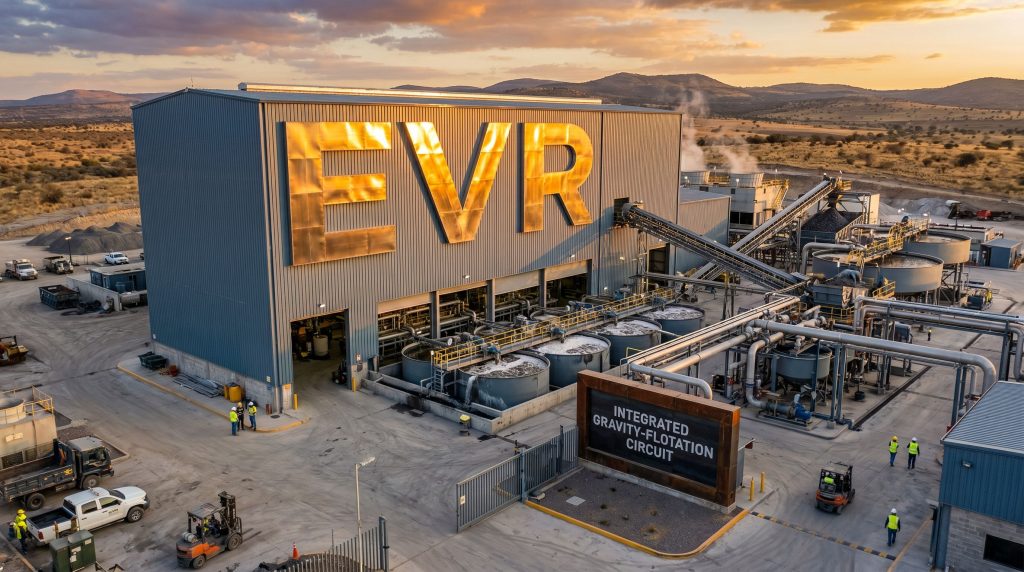
On the back of the test work, EV Resources Ltd is reported to be changing its Tecomatlán implementation plan. Instead of a two‑phase roll‑out with an initial gravity‑only plant followed by a later flotation addition, the company now intends to proceed directly to an integrated circuit.
Key elements of this pivot include:
- Use of existing flotation cells: The Tecomatlán Plant already has flotation equipment installed that has not yet been used. These units will be integrated into the new flowsheet.
- Incremental capital additions: New high‑efficiency rougher, scavenger and cleaner tank cells will be added. According to internal preliminary assessment referenced in the announcement, this incremental capital expenditure is estimated to be a fraction of the cost of constructing a completely new gravity and flotation plant.
- Retention and upgrade of gravity circuit: The existing gravity circuit is being kept and upgraded, not as a standalone phase, but as part of the integrated plant. This is intended to provide operating flexibility for different ore types and for bulk sample pilot work on Los Lirios mineralisation.
From an investment perspective, this direct‑to‑flotation approach is presented by the Board as providing a better outcome for shareholders, based on:
- Higher reported recoveries from flotation (approximately 81.1% versus 29.25% from gravity alone).
- A compressed development timeline by avoiding a sequential phase structure.
- Reduced incremental capital needs by leveraging existing infrastructure.
Hub‑and‑Spoke Model: Tecomatlán as a Regional Processing Hub
The Tecomatlán Processing Plant is intended to serve as a processing centre for multiple third‑party antimony ore sources within the region, consistent with a hub‑and‑spoke model.
According to the announcement:
- Chinantla ore, subject to an executed non‑binding MOU, is expected by the company to cover at least 50% of plant nameplate capacity.
- Other MOUs are in place for additional regional feedstock, as outlined in prior ASX releases.
- Shared mineralogical characteristics have been observed across several feed sources, particularly vein‑hosted quartz‑sulphide (stibnite) mineralisation, which suggests, but does not guarantee, comparable flotation behaviour. Each source remains subject to its own confirmatory test work.
Direct shipping ore from local underground mining operations is currently trucked around 800 km to smelters at San Luis de Potosí. EV Resources Ltd states that Tecomatlán can provide a closer processing option, which could lower transport distances for regional miners and enable processing of material that might be uneconomic as direct shipping ore due to lower grade.
Previous test work on mixed‑state Los Lirios mineralisation, reported in December 2025, delivered gravity recoveries of up to 90.8%. Combined with the upgraded flotation circuit, this suggests that Tecomatlán may be able to handle a range of ore types, subject to ongoing metallurgical characterisation.
For investors, this hub‑and‑spoke framework is central to the EV Resources Ltd business plan, as it focuses on creating processing capacity rather than relying solely on company‑owned mines.
Permitting and Implementation Timeline to First Production
EV Resources Ltd reports that its environmental consultant has commenced preparation of the Informe Preventivo (IP), a Preventive Environmental Report required as a precursor to submitting a Manifestación de Impacto Ambiental (MIA) for the flotation circuit.
The indicative timeline provided in the announcement is summarised below.
| Activity | Estimated duration | Indicative timing |
|---|---|---|
| Present IP | 10 days | Month 0 |
| IP granted | +30 days | Around Month 1 |
| Prepare MIA for integrated plant | 7 weeks | Month 0 to ~1.5 (parallel with IP) |
| Submit MIA | 1 month | ~Month 1.5 to 2.5 |
| MIA approval | +6 months | ~Month 8 to 9 |
| Upgrade, refurbishment and circuit integration | 6–7 months | ~Month 3 to 7 (not contingent on MIA) |
| Commissioning | Not specified | ~Month 9 to 10 (after MIA approval) |
| Operation (first production) | Not specified | From approximately Month 10 to 12 |
Several points are highlighted in the ASX announcement:
- Baseline environmental work has reportedly not identified environmental issues to date.
- EV Resources Ltd's consultant has advised that Federal Environmental Agency (SEMARNAT) review and approval of the MIA is expected within about 6 months of submission.
- Construction, upgrade and integration works are not contingent on MIA approval and can proceed once the IP is granted, which is targeted 4–6 weeks after submission.
Taken together, this integrated pathway is estimated by the company to result in 10–12 months to first production, with permitting and construction activities proceeding largely in parallel.
Next Steps and Planned Workstreams
The ASX announcement outlines several immediate and medium‑term work items:
- Cleaner flotation optimisation: Additional test work to refine the cleaner circuit to maximise concentrate grade while preserving recovery.
- Permitting progression: Advancement of the Preventive Environmental Report and subsequent MIA for operating the flotation circuit.
- Confirmatory test work on other MOU sources: Metallurgical testing on other third‑party feedstock covered by MOUs to validate process performance across the feed portfolio.
- Supply arrangements: Movement from non‑binding MOUs towards definitive supply agreements with regional third‑party miners.
- Offtake and financing discussions: Engagement with potential concentrate buyers and financiers.
For investors tracking EV Resources antimony recovery at Tecomatlán processing plant in Mexico, the execution of these steps is likely to be central to validating the planned hub‑and‑spoke model and the timing of the projected production start.
The next major ASX story will hit our subscribers first
Why This Development Matters in the Antimony Market Context
EV Resources Ltd describes itself as a critical minerals exploration and development company focused on contributing to the North American antimony supply chain. Antimony is listed as a critical mineral by the United States, European Union, and Australia, with uses that include:
- Energy storage and some battery technologies.
- Flame‑retardant materials.
- Defence and other high‑tech applications.
The company notes that supply to Western countries is currently very limited, while demand from defence and related sectors has increased. Within that context, Tecomatlán is presented as one of few new antimony production pathways in North America that is being actively progressed.
From an investor standpoint, the flotation test work and associated processing decision are relevant because they:
- Address a key technical question: can third‑party ore be processed using conventional technology to produce a commercial‑grade antimony concentrate at competitive recoveries?
- Provide a clearer development path: a defined 10–12 month integrated implementation schedule that aligns permitting and construction.
- Indicate potential capital efficiency: by using existing on‑site flotation infrastructure and limiting incremental CAPEX to additional tank cells and integration works.
- Support the regional processing concept: with Chinantla ore expected to cover at least 50% of plant nameplate capacity under the current MOU framework, subject to final agreements.
As with all development‑stage projects, the outcomes remain subject to permitting, financing, successful construction, confirmation of feedstock supply, and the ability to translate bench‑scale test work to commercial operations. However, the ASX announcement indicates that EV Resources antimony recovery at Tecomatlán processing plant in Mexico represents a material step forward in clarifying both the technical route and the indicative timeline for proposed antimony processing operations.
Ready to Learn More About EV Resources' Tecomatlán Antimony Processing Hub?
EV Resources Ltd (ASX: EVR) is advancing a compelling hub-and-spoke antimony processing strategy in Mexico, underpinned by independent test work confirming 81.1% antimony recovery using conventional flotation technology. With an integrated plant upgrade targeting first production in approximately 10 to 12 months and existing on-site infrastructure already in place, EVR is positioning itself as a key player in the North American critical minerals supply chain. To explore the full scope of the Tecomatlán project and what this development could mean for investors, visit the EV Resources website.