Saudi Arabia's energy landscape is undergoing unprecedented transformation as the Aramco Jafurah gas project emerges as the world's largest unconventional gas development outside North America. This massive undertaking, representing a $100 billion investment commitment, fundamentally reshapes Middle Eastern energy security while addressing growing global demand for cleaner-burning natural gas. Furthermore, the project demonstrates how Saudi exploration impact extends beyond traditional oil production into sophisticated unconventional resource development, positioning the kingdom as a leader in next-generation energy technologies.
What Makes Jafurah the World's Most Strategic Unconventional Gas Development?
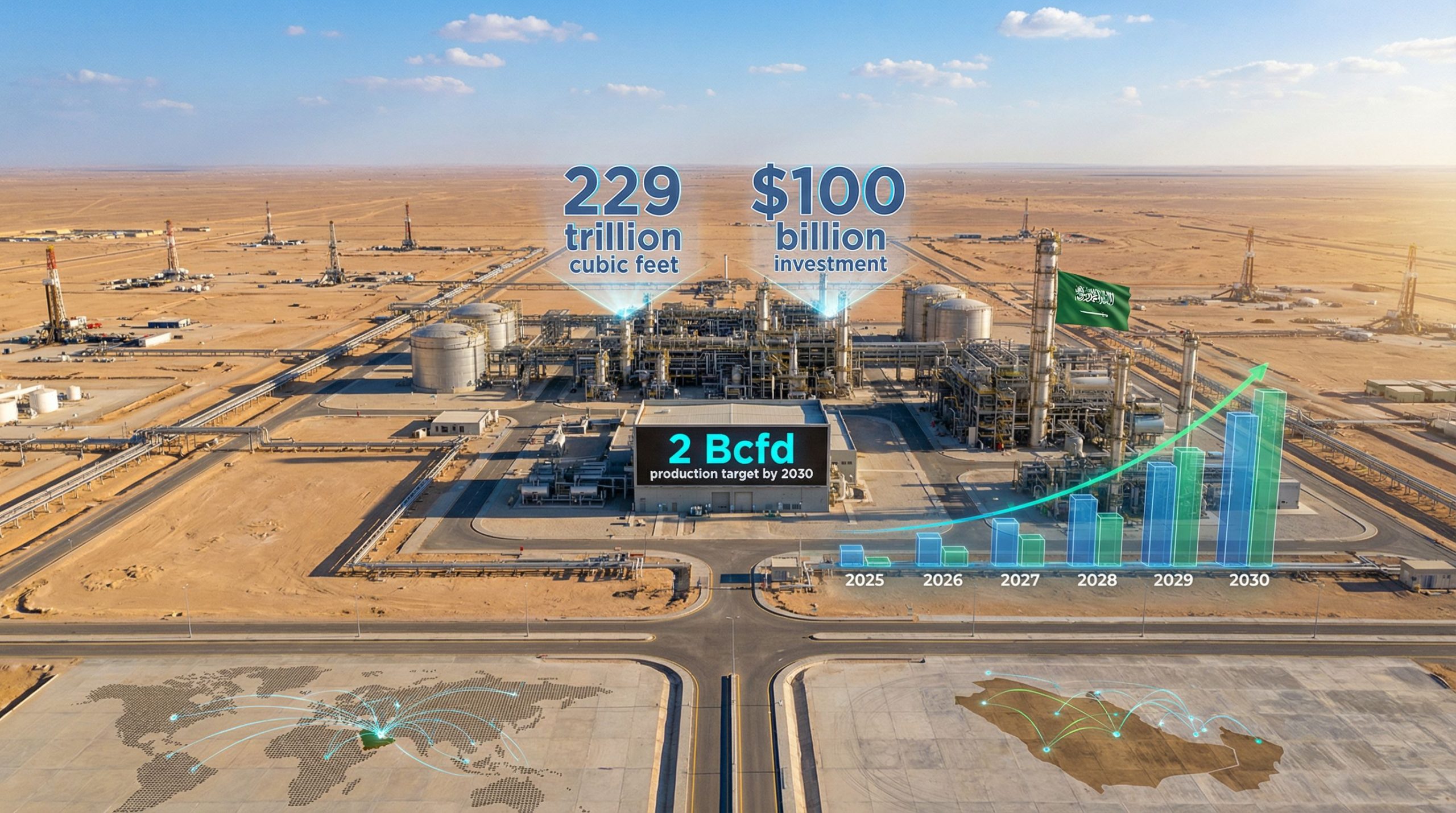
The Aramco Jafurah gas project fundamentally redefines unconventional resource development outside North America through sheer scale and technological sophistication. This massive undertaking encompasses 229 trillion cubic feet of raw gas resources distributed across 17,000 square kilometers of shale formations in eastern Saudi Arabia, establishing it as the largest unconventional gas project beyond U.S. borders.
The Scale Revolution: Understanding Resource Foundation Metrics
Jafurah's resource base dwarfs many established global gas developments through concentrated reserves and advanced recovery potential. The project's 229 Tcf of raw gas represents approximately 0.2% of global natural gas production when fully operational, yet its regional impact proves far more significant within Middle Eastern energy markets.
Current production capabilities demonstrate rapid scaling potential, with Phase-one operations delivering 450 million cubic feet per day (MMcfd) as of late 2025. This initial output establishes the foundation for aggressive expansion toward the 2 billion cubic feet per day (Bcfd) target by 2030, representing a 4.4x production increase over five years.
The project's 17,000 km² field area provides crucial context when compared to major North American precedents:
- Eagle Ford Shale: Approximately 21,700 km² with established production
- Bakken Formation: Roughly 200,000 km² but lower resource density
- Permian Basin: Approximately 310,000 km² across multiple formations
- Jafurah: 17,000 km² representing highly concentrated, prospective acreage
This geographic concentration enables optimized drilling programs, shared infrastructure development, and streamlined operational management compared to more dispersed unconventional plays. Additionally, the project benefits from digital drilling innovations that enhance operational efficiency and reduce environmental impact.
Beyond North American Precedents: Technological Adaptation Challenges
The Aramco Jafurah gas project requires fundamental adaptations of proven North American shale technologies to Middle Eastern geological conditions. Unlike the Permian's relatively uniform shale characteristics, Jafurah's Jurassic-age formations exhibit different mineralogical compositions, pressure regimes, and fluid properties requiring customized completion designs.
Key Technical Differentiators:
- Geological Complexity: Jurassic shales with varying mineral content compared to Permian's Wolfcamp formations
- Pressure Maintenance: Reservoir pressure management adapted to regional geological structures
- Completion Technologies: Hydraulic fracturing programs calibrated for specific formation characteristics
- Production Optimization: Digital monitoring systems designed for extended lateral wells in challenging environments
The presence of significant liquid hydrocarbon components within Jafurah's gas streams adds operational complexity while enhancing project economics. These condensate-rich zones require sophisticated separation and processing systems, but generate premium revenue streams beyond standard dry gas production.
Resource Density and Production Economics Analysis
Comparative productivity metrics reveal Jafurah's potential competitiveness against established unconventional benchmarks. While Permian Basin Wolfcamp wells average 2-3 MMcfd per well with 1-1.5 billion cubic feet (Bcf) cumulative recovery, Jafurah's 450 MMcfd Phase-one output from newly developed facilities suggests comparable or superior well productivity.
Production Efficiency Indicators:
| Metric | Jafurah | Permian Comparison | Eagle Ford Comparison |
|---|---|---|---|
| Initial Production Rate | 450 MMcfd (Phase-one) | Variable by operator | Variable by operator |
| Resource Density | High (229 Tcf / 17,000 km²) | Moderate | Moderate |
| Liquid Component | Condensate-rich | Oil-associated gas | Oil-associated gas |
| Development Timeline | 2025-2030 | Mature/declining | Mature/declining |
This production profile demonstrates successful technology transfer and adaptation, indicating that Middle Eastern unconventional development can achieve North American-level efficiency with appropriate engineering modifications.
Why Does Jafurah Matter for Saudi Arabia's Economic Transformation?
Saudi Arabia's economic diversification strategy depends critically on optimizing domestic energy consumption patterns while maximizing export revenue generation. The Aramco Jafurah gas project addresses a fundamental structural constraint: the kingdom's historical reliance on crude oil combustion for electricity generation, which reduces available export volumes and creates energy security vulnerabilities. Moreover, this development aligns with broader energy transition security objectives across the Middle East.
Domestic Energy Security Equation Transformation
Jafurah's production enables fuel switching at unprecedented scale, potentially displacing 500,000 barrels of oil equivalent per day (bopd) currently consumed for power generation. This displacement strategy generates multiple economic benefits simultaneously:
Direct Revenue Enhancement:
- Additional Export Capacity: 500,000 bopd freed for international markets
- Premium Pricing Capture: Crude oil commands $80-100/barrel vs. domestic gas at $3-5/MMBtu equivalent
- Foreign Exchange Generation: $14-18 billion additional annual revenue at full production
- Fiscal Balance Improvement: Enhanced government revenues supporting Vision 2030 initiatives
Energy Security Strengthening:
- Supply Diversification: Reducing dependence on single energy sources for critical infrastructure
- Strategic Reserve Optimization: Maintaining crude oil inventories for export market timing
- Industrial Feedstock Security: Reliable natural gas supply for petrochemical sector expansion
Vision 2030 Alignment and Industrial Development Support
The Aramco Jafurah gas project directly supports Saudi Arabia's National Industrial Development and Logistics Program (NIDLP) through competitively priced domestic natural gas supplies. This enablement proves crucial for petrochemical sector expansion and manufacturing competitiveness.
Petrochemical Industry Enhancement:
- SABIC Operations Support: Natural gas as both energy source and chemical feedstock
- Downstream Complex Development: Supporting new methanol, ammonia, and polyethylene facilities
- Import Substitution: Reducing reliance on international LNG supplies for industrial applications
- Value Chain Integration: Connecting upstream gas production to downstream manufacturing
Current gas production metrics demonstrate rapid expansion toward these strategic objectives. Aramco's total gas output reached 12.6 Bcfd by September 2024, representing 5% year-over-year growth from the previous year's 12 Bcfd. The company's revised target of 80% growth above 2021 levels would position total production at approximately 15.3 Bcfd, with Jafurah contributing substantially to this achievement.
Regional Energy Independence Strategy
Jafurah development reduces Middle Eastern dependence on external gas suppliers, particularly addressing vulnerabilities demonstrated during regional tensions between 2017-2021. Qatar's dominance of regional LNG supply at approximately 77 million tonnes per annum (Mtpa) created strategic dependencies that Jafurah helps mitigate.
Geopolitical Security Benefits:
- Supply Chain Resilience: Domestic production insulates against regional supply disruptions
- Negotiating Power Enhancement: Alternative supply sources strengthen bargaining positions
- Infrastructure Investment Attraction: Reliable gas supplies attract international industrial partnerships
- Energy Diplomacy Options: Potential for cross-border pipeline developments with neighboring states
How Does the $100 Billion Investment Strategy Drive Long-Term Returns?
The Aramco Jafurah gas project's massive $100 billion capital commitment represents one of the energy industry's largest single-project investments, distributed across multiple development phases from 2025-2030. This investment strategy employs sophisticated financial engineering approaches that balance capital efficiency with operational control retention, utilizing advanced capital raising strategies common in major energy developments.
Capital Deployment Framework and Phased Development
Jafurah's capital allocation follows a systematic phase-gate approach enabling risk management and return optimization throughout the development timeline. The $100 billion total investment implies annual capital expenditure of approximately $16-20 billion during peak development periods.
Phase-Based Capital Distribution:
| Development Phase | Timeline | Estimated Investment | Production Target |
|---|---|---|---|
| Phase-One | 2025-2026 | $20-25 billion | 450 MMcfd |
| Phase-Two | 2027-2028 | $35-40 billion | 1.2 Bcfd cumulative |
| Phase-Three | 2029-2030 | $35-40 billion | 2.0 Bcfd target |
This phased approach enables continuous optimization based on reservoir performance, technology improvements, and market conditions, while providing flexibility to adjust development pace according to capital availability and economic returns.
Infrastructure Financing Innovation Through Asset Monetization
Aramco's $11 billion lease-and-leaseback agreement with Global Infrastructure Partners (BlackRock subsidiary) demonstrates sophisticated capital structure optimization. This transaction monetizes approximately 11% of total project capital requirements while maintaining operational control and production capture rights.
Financial Engineering Advantages:
- Capital Efficiency: Converting fixed infrastructure assets into revenue-generating contracts
- Balance Sheet Optimization: Reducing debt requirements without equity dilution
- Risk Sharing: Distributing infrastructure risks with institutional investment partners
- Operational Control Retention: Maintaining management authority over production operations
Similar models employed by Equinor in Norwegian infrastructure sales and ADNOC's LNG infrastructure monetization demonstrate proven precedent for this approach across major energy companies globally.
Cash Flow Generation and Return Profile Analysis
Jafurah's revenue generation potential scales dramatically across development phases, with initial 450 MMcfd production generating approximately $500M-$800M annual gross revenue at regional gas prices of $3-5/MMBtu. Full 2 Bcfd capacity would generate $2.5-4 billion annually excluding condensate premium revenues.
Return Profile Scenarios:
- Low Case ($2.50/MMBtu): 12-14% IRR over project lifecycle
- Base Case ($4.00/MMBtu): 15-18% IRR with stable production profile
- High Case ($6.00/MMBtu LNG parity): 20-25% IRR with export market access
These return expectations align with industry benchmarks for large-scale unconventional developments, while Jafurah's scale economies and established technology base support upper-range achievement potential.
Infrastructure Technical Specifications and Capacity Planning
Phase-one infrastructure delivers 450 MMcfd processing capability through approximately 4-5 gas processing trains with individual capacities of 100-150 MMcfd each. These facilities incorporate advanced separation, dehydration, compression, and sulfur removal technologies specifically designed for high-sulfur gas streams characteristic of Middle Eastern deposits.
Processing System Architecture:
- Primary Separation: High-pressure gas/liquid separation systems
- Dehydration Units: Molecular sieve or glycol-based water removal
- Sulfur Processing: Amine treating and sulfur recovery units for environmental compliance
- Compression Facilities: Three-stage compression delivering 600 MMcfd combined capacity
The 1,500 km specialized pipeline network connects production facilities to end-use markets including power plants, petrochemical complexes, and potential export terminals. Pipeline specifications accommodate varying gas quality parameters and pressure requirements for different market segments.
What Are the Global Market Implications of Jafurah's Production Ramp?
The Aramco Jafurah gas project introduces significant supply-side dynamics into global natural gas markets, particularly affecting regional Middle Eastern energy flows and potential LNG export development. While Jafurah's full 2 Bcfd production represents approximately 0.2% of global supply (4,000 Bcf annually), its strategic positioning and timing create disproportionate market impacts. These developments align with global natural gas price trends that reflect evolving supply-demand dynamics.
LNG Market Dynamics and Export Potential Analysis
Global LNG trade exceeds 400 million tonnes per annum (Mtpa) with Asian markets (Japan, South Korea, China, India) collectively importing approximately 220 Mtpa annually. Should Saudi Arabia develop LNG export capabilities, Jafurah's 2 Bcfd output could support approximately 22 Mtpa of liquefaction capacity, representing 10% of typical annual Asian import growth.
Pricing Arbitrage Opportunities:
| Market Segment | Typical Pricing | Price Range | Netback Potential |
|---|---|---|---|
| Middle Eastern Pipeline | Domestic rates | $2-4/MMBtu | Base pricing |
| Asian LNG Spot | Premium pricing | $10-15/MMBtu | 250-375% premium |
| European LNG | Variable | $8-12/MMBtu | 200-300% premium |
This pricing differential creates substantial incentive for export infrastructure development, potentially positioning Saudi Arabia alongside traditional LNG exporters including Qatar (77 Mtpa), Australia (85 Mtpa), and the United States (75+ Mtpa).
Regional Energy Security and Supply Chain Transformation
Jafurah development fundamentally alters Middle Eastern gas supply dependencies, reducing regional reliance on Qatari LNG dominance and Iranian pipeline gas. Historical tensions during the 2017-2021 blockade demonstrated vulnerability of single-supplier dependence, making Saudi gas development strategically significant for regional energy security.
Regional Supply Rebalancing Effects:
- Qatar Market Share: Potential reduction in regional LNG market dominance
- Iranian Competition: Alternative supply source for neighboring Gulf states
- Pipeline Development: Enabling cross-border infrastructure projects with UAE, Kuwait, Bahrain
- Strategic Reserve Building: Enhanced regional emergency supply capabilities
Middle Eastern gas production currently totals approximately 550 Bcf annually, with Jafurah's 730 Bcf annual capacity representing a 130% increase in regional supply availability when fully operational.
Competitive Positioning Against Established Producers
Jafurah's market entry timing coincides with global supply tightening and increasing demand from energy transition policies requiring natural gas as a "bridge fuel" during renewable energy scaling. This timing provides strategic advantages for market penetration and premium pricing capture.
Global Competition Analysis:
- U.S. Shale Production: Mature development with declining growth rates
- Russian Gas Exports: Disrupted by geopolitical sanctions and infrastructure constraints
- Australian LNG: High-cost production with limited expansion potential
- Qatari Expansion: North Field development competing for Asian market share
Jafurah's competitive advantages include lower production costs compared to Australian LNG, geographic proximity to high-demand Asian markets, and integrated development within Aramco's established infrastructure network.
Industrial Integration and Value Chain Development
Beyond export potential, Jafurah enables downstream industry expansion through reliable, competitively priced feedstock supplies. Saudi Arabia's petrochemical sector can expand production without competing for international LNG supplies, supporting Saudi Basic Industries Corporation (SABIC) operations and attracting international partnerships.
Value-Added Processing Opportunities:
- Blue Hydrogen Production: Natural gas reformation with carbon capture
- Methanol Manufacturing: Chemical feedstock for international markets
- Ammonia Production: Supporting global fertilizer supply chains
- Polyethylene Expansion: Integrated petrochemical value chains
Which Technologies Enable Jafurah's Unconventional Success?
The Aramco Jafurah gas project represents sophisticated adaptation of North American unconventional technologies to Middle Eastern geological conditions, requiring fundamental modifications of proven shale development techniques. This technological transfer involves complex engineering solutions addressing unique reservoir characteristics, environmental conditions, and operational challenges distinct from U.S. precedents.
Shale Development Technical Specifications and Adaptations
Jafurah's Jurassic-age shale formations exhibit markedly different characteristics compared to prolific North American plays, necessitating customized drilling and completion programs. Unlike the Permian's Wolfcamp formations or Eagle Ford's relatively uniform geology, Jafurah requires specialized approaches addressing higher complexity factors.
Geological Adaptation Requirements:
- Mineralogical Differences: Varying clay content and brittleness compared to U.S. shales
- Pressure Regime Management: Different reservoir pressures requiring adapted completion designs
- Fluid Property Variations: High-sulfur content and condensate-rich streams demanding specialized processing
- Structural Geology: Regional fault systems and depositional environments affecting well placement
Drilling Program Specifications:
| Technical Element | Jafurah Application | Adaptation Requirements |
|---|---|---|
| Horizontal Drilling | Extended reach laterals | Heat-resistant equipment for regional temperatures |
| Completion Design | Multi-stage hydraulic fracturing | Customized proppant and fluid systems |
| Well Density | Optimized spacing patterns | Reservoir simulation for Middle Eastern geology |
| Production Monitoring | Digital surveillance systems | Real-time optimization for complex fluid streams |
Hydraulic Fracturing Technology Customization
Successful unconventional development requires hydraulic fracturing programs specifically calibrated for Jafurah's formation characteristics. Standard North American fracturing designs require modifications addressing regional geological properties, environmental considerations, and operational constraints.
Fracturing System Adaptations:
- Proppant Selection: Engineered materials suitable for formation pressure and temperature conditions
- Fluid Chemistry: Customized fracturing fluids addressing high-temperature wellbore conditions
- Completion Sequencing: Optimized stage spacing and fracturing intensity based on reservoir modeling
- Environmental Compliance: Water sourcing, recycling, and disposal systems meeting regional regulations
The integration of digital monitoring technologies enables real-time optimization during fracturing operations, providing continuous feedback on fracture propagation, pressure response, and production enhancement effectiveness.
Gas Processing and Infrastructure Engineering Solutions
Jafurah's production streams require sophisticated processing systems addressing high-sulfur content, condensate separation, and gas quality specifications for different market applications. The project's three processing facilities delivering 600 MMcfd combined capacity incorporate advanced separation and purification technologies.
Processing Facility Technical Components:
- High-Pressure Separation: Primary gas/liquid separation handling diverse fluid compositions
- Sulfur Recovery Systems: Amine treating and sulfur recovery units achieving environmental compliance standards
- Condensate Processing: Stabilization and pipeline specification systems for liquid hydrocarbon streams
- Compression Architecture: Multi-stage compression maintaining pipeline transportation pressures
The 1,500 km specialized pipeline network employs advanced materials and monitoring systems accommodating varying gas compositions, pressure requirements, and destination market specifications. Pipeline infrastructure includes:
Transportation System Features:
- Corrosion-Resistant Materials: Specialized steel grades handling high-sulfur gas streams
- Pressure Management: Automated compression and regulation systems
- Quality Monitoring: Continuous gas composition analysis ensuring market specifications
- Emergency Response: Integrated safety and leak detection throughout the network
Digital Transformation and Production Optimization Systems
Advanced digital technologies enable integrated monitoring, optimization, and maintenance across Jafurah's complex development program. These systems provide real-time data integration supporting operational efficiency and production maximization.
Digital Platform Capabilities:
- Reservoir Monitoring: Continuous pressure, temperature, and production rate analysis
- Predictive Maintenance: Equipment health monitoring preventing unplanned downtime
- Production Optimization: Automated well performance adjustments maximizing output
- Environmental Monitoring: Air quality, water usage, and emission tracking systems
Integration with Aramco's existing digital infrastructure enables centralized monitoring and control, supporting operational efficiency across the company's broader production portfolio.
How Does Jafurah Accelerate Saudi Arabia's Energy Transition Strategy?
The Aramco Jafurah gas project serves as a cornerstone enabling Saudi Arabia's gradual energy transition while maintaining hydrocarbon sector leadership. Natural gas development provides essential bridge fuel capabilities supporting renewable energy integration, industrial decarbonization, and economic diversification objectives aligned with Vision 2030 goals.
Carbon Intensity Reduction Through Fuel Switching
Jafurah's production enables systematic carbon intensity reduction across Saudi Arabia's power generation and industrial sectors through strategic fuel substitution. Natural gas combustion produces approximately 45-50% fewer carbon emissions per unit of energy compared to crude oil burning, while eliminating particulate emissions and improving air quality metrics.
Emissions Reduction Pathways:
| Application Sector | Current Fuel | Gas Substitution | Carbon Reduction |
|---|---|---|---|
| Power Generation | Crude oil/diesel | Natural gas | 45-50% per MWh |
| Industrial Process Heat | Heavy fuel oil | Natural gas | 40-45% per BTU |
| Petrochemical Feedstock | Mixed hydrocarbons | Natural gas | 30-35% per unit |
The displacement of 500,000 bopd equivalent in domestic fuel consumption generates substantial environmental benefits while freeing premium crude oil for export markets at higher economic returns.
Blue Hydrogen Production and Clean Energy Development
Natural gas from Jafurah provides essential feedstock for blue hydrogen production through steam methane reformation combined with carbon capture and storage (CCS) systems. This pathway enables Saudi Arabia's participation in emerging global hydrogen markets while maintaining hydrocarbon sector integration.
Hydrogen Value Chain Development:
- Production Capacity: Natural gas reformation supporting large-scale hydrogen generation
- Carbon Management: CCS integration reducing lifecycle emissions intensity
- Export Market Access: Positioning Saudi Arabia in Asian and European hydrogen demand growth
- Industrial Applications: Supporting domestic steel, cement, and chemical sector decarbonization
Blue hydrogen development from Jafurah gas could support NEOM's renewable energy initiatives and broader Saudi Green Initiative objectives while providing economic returns from international hydrogen trade.
Industrial Decarbonization and Manufacturing Competitiveness
Reliable natural gas supplies from Jafurah enable industrial sector decarbonization without compromising manufacturing competitiveness. Lower-carbon feedstocks support petrochemical expansion, steel production optimization, and cement industry emission reductions.
Industrial Integration Benefits:
- SABIC Operations Enhancement: Lower-emission feedstocks for chemical production
- Steel Industry Support: Natural gas-based direct reduction replacing coke-based processes
- Cement Production: Alternative fuel reducing carbon intensity per tonne of production
- Manufacturing Attraction: Competitive energy costs attracting international industrial investment
This industrial integration supports National Industrial Development and Logistics Program (NIDLP) objectives while building domestic supply chain capabilities and technology transfer opportunities.
Economic Diversification Through Energy Security
Energy security from domestic gas production enables broader economic diversification by reducing vulnerability to energy price volatility and supply chain disruptions. Stable, competitively priced energy supports non-oil sector development and private sector investment attraction.
Diversification Impact Mechanisms:
- Energy Cost Stability: Predictable industrial input costs supporting business planning
- Supply Chain Resilience: Reduced dependence on international energy imports
- Investment Climate Enhancement: Energy security attracting foreign direct investment
- Technology Development: Building domestic expertise in unconventional resource development
Job creation multipliers from upstream and midstream operations, combined with downstream manufacturing expansion, support Vision 2030's employment and economic diversification targets.
What Risks and Challenges Could Impact Jafurah's Success Timeline?
The Aramco Jafurah gas project faces multiple risk categories that could affect development timeline, production targets, and economic returns. Comprehensive risk assessment encompasses technical uncertainties, operational challenges, market volatility, and regulatory evolution affecting long-term project success.
Technical and Operational Risk Assessment
Unconventional resource development involves inherent reservoir performance uncertainties that may impact production forecasts and recovery factors. Jafurah's adaptation of North American technologies to Middle Eastern geological conditions introduces additional technical complexities requiring continuous monitoring and optimization.
Primary Technical Risk Categories:
- Production Decline Curves: Uncertain long-term well performance and EUR (Estimated Ultimate Recovery) realization
- Reservoir Heterogeneity: Varying formation characteristics affecting completion effectiveness across the field
- Water Management: Disposal and recycling challenges for hydraulic fracturing operations in arid environments
- Equipment Reliability: Specialized unconventional technology performance under regional operating conditions
Operational Constraint Factors:
| Risk Category | Specific Challenges | Mitigation Strategies |
|---|---|---|
| Supply Chain | Specialized equipment availability | Long-term service contracts |
| Skilled Labor | Technical expertise requirements | International partnerships and training |
| Environmental Compliance | Water usage and waste management | Advanced recycling and treatment systems |
| Infrastructure Integration | Pipeline and processing coordination | Phased development with flexibility |
Market and Economic Volatility Scenarios
Global natural gas price volatility significantly impacts Jafurah's project economics and investment returns. Price fluctuations affect break-even calculations, development pace decisions, and long-term strategic positioning within Aramco's portfolio.
Price Sensitivity Analysis:
- Low Price Environment ($2.00-3.00/MMBtu): Reduced IRR requiring operational optimization and cost management
- Moderate Pricing ($4.00-5.00/MMBtu): Base case economics supporting sustained development
- High Price Scenarios ($6.00+/MMBtu): Enhanced returns enabling accelerated development and export options
Regional pricing dynamics, LNG market development, and competing supply sources (Qatar North Field expansion, U.S. LNG exports) influence long-term price expectations and project profitability.
Environmental and Regulatory Evolution
Changing environmental regulations and compliance requirements could affect operational procedures, capital costs, and development timeline. Saudi Arabia's increasing focus on environmental sustainability and carbon emissions reduction may introduce additional compliance obligations.
Regulatory Risk Factors:
- Environmental Standards: Evolving air quality, water usage, and waste management requirements
- Carbon Pricing: Potential future carbon tax or emission trading system implementation
- Water Resources: Restrictions on freshwater usage for hydraulic fracturing operations
- Local Content Requirements: Mandated use of domestic suppliers and contractors
Climate Policy Integration: Saudi Arabia's Saudi Green Initiative and Middle East Green Initiative commitments may influence operational requirements, technology selection, and reporting obligations for major energy projects.
Geopolitical Stability and Regional Security Considerations
Regional geopolitical dynamics affect operational security, infrastructure protection, and market access for Jafurah production. Historical tensions in the Middle East demonstrate potential impacts on major energy infrastructure projects.
Security Risk Assessment:
- Infrastructure Protection: Safeguarding processing facilities, pipelines, and transportation networks
- Operational Continuity: Maintaining production during regional political tensions
- Market Access: Ensuring reliable transportation and export infrastructure functionality
- International Partnerships: Managing relationships with technology providers and service companies
Risk mitigation strategies include diversified supply chains, enhanced security measures, insurance coverage, and contingency planning for various scenario outcomes.
When Will Jafurah's Full Impact Become Visible in Energy Markets?
The Aramco Jafurah gas project's market impact will emerge progressively across multiple development phases, with initial effects already visible through Phase-one production commencement in 2025. Full strategic implications become apparent as production scales toward the 2 Bcfd target by 2030, fundamentally altering regional energy dynamics and global supply chains.
Production Milestone Timeline and Market Integration
Jafurah's development follows a systematic scaling approach enabling continuous market integration while building operational expertise and infrastructure capacity. Current 450 MMcfd Phase-one production establishes the foundation for dramatic expansion over the project timeline.
Development Phase Progression:
| Timeline | Production Target | Market Impact | Strategic Milestones |
|---|---|---|---|
| 2025-2026 | 450 MMcfd (achieved) | Domestic fuel switching begins | Phase-one operational, initial export displacement |
| 2027-2028 | 1.0-1.2 Bcfd | Regional supply rebalancing | Middle Eastern market share shifts |
| 2029-2030 | 2.0 Bcfd (target) | Global LNG market integration | Full strategic impact realization |
Near-term Market Effects (2025-2027):
- Domestic Energy Security Enhancement: Reduced crude oil consumption for power generation
- Export Revenue Optimization: Additional 200,000-300,000 bopd available for international markets
- Regional Gas Pricing: Potential moderation of Middle Eastern gas prices through increased supply
- Industrial Feedstock Availability: Support for petrochemical sector expansion and manufacturing attraction
Long-term Strategic Outcomes and Global Integration
By 2030, Jafurah's full production capacity positions Saudi Arabia as a significant player in global gas markets, with potential impacts extending beyond regional supply dynamics to influence international LNG trade flows and pricing structures.
Decade-Plus Development Horizons:
2030-2035 Strategic Positioning:
- Regional Energy Leadership: Saudi Arabia emerges as Middle Eastern gas hub
- LNG Export Development: Potential entry into global LNG markets with 15-25 Mtpa capacity
- Industrial Integration: Fully developed downstream value chains supporting economic diversification
- Technology Leadership: Established expertise in Middle Eastern unconventional resource development
Supply Chain Integration Pathways:
- Pipeline Infrastructure: Cross-border connections with UAE, Kuwait, and other Gulf states
- LNG Liquefaction: Potential Red Sea or Persian Gulf export terminals serving Asian and European markets
- Blue Hydrogen Production: Integration with renewable energy projects and carbon management systems
- Petrochemical Expansion: World-scale chemical complexes utilizing Jafurah feedstocks
Global Energy Market Transformation Implications
Jafurah's full impact extends beyond Saudi Arabia's domestic objectives to influence global energy security, supply diversification, and transition fuel availability. These broader implications become increasingly significant as international energy policies emphasise natural gas as a "bridge fuel" during renewable energy scaling.
Global Strategic Implications:
- Supply Security Enhancement: Reduced global dependence on Russian gas exports and Iranian supplies
- Asian Market Competition: Alternative supply source competing with Australian LNG and Qatari expansion
- Energy Transition Support: Natural gas availability supporting renewable energy integration globally
- Geopolitical Rebalancing: Enhanced Middle Eastern energy independence and strategic autonomy
Timeline for Maximum Global Impact:
Full global market integration occurs throughout the 2030s as Jafurah production reaches sustained capacity, regional infrastructure development completes, and potential LNG export capabilities become operational. This timeline aligns with global energy transition requirements and Asian LNG demand growth projections, as Aramco's shale gas project demonstrates the successful implementation of advanced extraction technologies in the Middle East.
Market Visibility Indicators:
- 2026-2027: Regional gas price moderation and Saudi crude oil export increases
- 2028-2029: Middle Eastern LNG import reductions and supply chain rebalancing
- 2030+: Global LNG market share shifts and pricing dynamic changes
- 2032-2035: Full strategic integration with international energy networks
The Aramco Jafurah gas project represents a transformation of unprecedented scale in Middle Eastern energy development, with implications extending far beyond regional supply dynamics to influence global energy security, economic diversification strategies, and energy transition pathways worldwide.
Looking to Capitalise on Major Energy Discoveries?
Discovery Alert's proprietary Discovery IQ model delivers real-time alerts on significant ASX mineral discoveries, instantly empowering subscribers to identify actionable opportunities ahead of the broader market. Understand why historic discoveries can generate substantial returns by exploring our dedicated discoveries page showcasing exceptional market outcomes.