August 9, 2026
The High-Stakes Gamble Reshaping Global Lithium Supply Chains
Decades of boom-and-bust resource cycles have taught one enduring lesson: the countries that attract capital during structural inflection points tend to define the next generation of commodity supply. Right now, Argentina is positioned at precisely such a juncture. With global demand for battery-grade lithium accelerating alongside the electrification of transport and energy storage, the competitive race to develop new supply has intensified across the so-called "Lithium Triangle" — the region spanning Argentina, Bolivia, and Chile that holds the majority of the world's known lithium brine resources.
Yet Argentina has historically underperformed its geological potential. Decades of currency controls, unpredictable regulatory shifts, and periodic state intervention created a chilling effect on the long-cycle capital commitments that large-scale mining demands. That dynamic is now being deliberately dismantled through a suite of Argentina lithium mine expansion incentives anchored by a policy framework unlike anything previously attempted in the country.
When big ASX news breaks, our subscribers know first
What Is RIGI and Why Does It Represent a Structural Break from Argentina's Past
Understanding the significance of RIGI requires appreciating just how scarred institutional memory runs among investors who have previously committed capital to Argentine resource projects. The framework, formally known as the Incentive Regime for Large Investments, was introduced in 2024 under President Javier Milei as a direct response to this entrenched scepticism.
Its architecture is designed to eliminate the categories of risk that have historically deterred capital allocation into Argentina:
| RIGI Feature | Detail |
|---|---|
| Minimum project threshold | USD $200 million |
| Legal stability guarantee | Up to 30 years |
| Tax relief | VAT exemptions, import and export duty relief |
| Currency protections | Foreign exchange stability provisions |
| Dispute resolution | Access to international arbitration |
| Current application deadline | July 8, 2027 |
The 30-year legal stability clause is arguably the most structurally significant element. In practical terms, it creates a contractual firewall between approved projects and future policy reversals — meaning a subsequent Argentine government cannot unilaterally revoke the incentives granted to projects that entered the programme under current rules.
"The RIGI framework is attempting to solve a fundamental credibility problem. Argentina has extraordinary mineral endowments but a political history that has repeatedly punished foreign investors who committed capital based on prevailing rules that were later changed."
The programme specifically targets projects above the USD $200 million threshold, ensuring it captures the large-scale, multi-decade infrastructure that defines the mining sector rather than smaller exploratory ventures. The combination of legal guarantees, tax relief, and hard currency protections addresses the trifecta of concerns — sovereign risk, fiscal unpredictability, and foreign exchange access — that have historically made Argentina a difficult jurisdiction for resource investment.
The Capital Mobilisation Story So Far
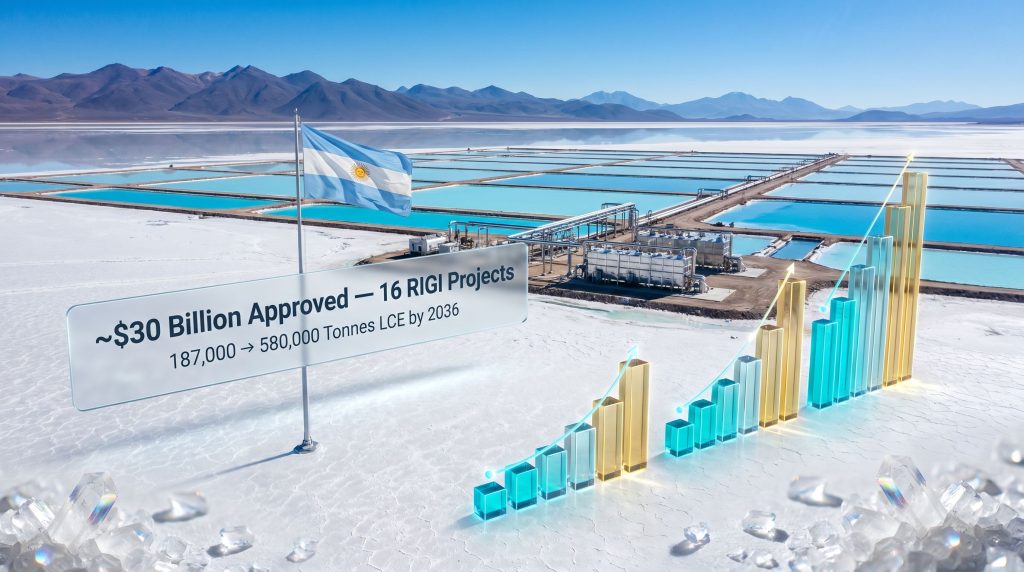
The early pipeline data suggests the RIGI framework is generating genuine traction. As of May 2026, Argentina had approved 16 projects through the programme, with total committed investment across approved projects reaching approximately $30 billion. A further 20-plus proposals remain under active evaluation.
The breadth of sectors represented in the pipeline extends well beyond lithium. Copper, gold, silver, steel infrastructure, and energy projects are all present in the RIGI queue, reflecting the programme's design as a broad-based investment attraction mechanism rather than a lithium-specific initiative. However, lithium and copper dominate the headline capital commitments given the scale of individual project valuations.
Two approvals confirmed in May 2026 illustrate both the scale and diversity of projects entering the framework:
- The Jujuy lithium expansion, structured as a joint venture, representing a $1.24 billion committed investment
- PSJ Cobre Mendocino (formerly known as San Jorge), the first large-scale metal mine approved for the winemaking province of Mendoza, valued at approximately $891 million
Together, these two projects alone are projected to generate over 8,000 direct and indirect jobs, with Economy Minister Luis Caputo confirming the figures publicly. The combined value of these two approvals — roughly $2.1 billion — represents a single day's contribution to what is becoming a formidable national investment queue.
The Jujuy Lithium JV: Geopolitical Complexity Meets Economic Pragmatism
The approval of the Jujuy lithium expansion carries significance that extends well beyond the project's financial metrics. The joint venture involves three distinct stakeholders:
- Ganfeng Lithium Group (China): The largest single shareholder, holding a 47% ownership stake in the project
- Lithium Argentina AG: A US-listed co-investor and project partner
- JEMSE: The state-owned entity representing Jujuy province's resource interests
The project focuses on the Pozuelos-Pastos Grandes (PPG) lithium brine system in Jujuy province, and the $1.24 billion investment is directed toward expanding existing operations rather than greenfield development, which carries meaningful implications for timeline and execution risk.
What makes this approval analytically interesting is its geopolitical context. The Milei administration had previously restricted Chinese state-linked entities from involvement in Argentine resource projects, a posture widely interpreted as diplomatic alignment with the Trump administration — a relationship that reportedly included a $20 billion financial commitment extended to Argentina. The decision to approve a project with Ganfeng as its controlling shareholder therefore represents a notable recalibration.
"The Jujuy approval illustrates a tension that many resource-rich emerging economies are navigating: the desire to align geopolitically with Western partners while still accessing the deep capital pools and processing expertise that Chinese firms bring to critical minerals development."
Significantly, Economy Minister Caputo's announcement on social media made no direct reference to the companies involved, suggesting a deliberate effort to minimise the optics of Chinese capital entering a sector the administration had previously sought to ring-fence. This kind of strategic ambiguity is itself informative for investors: it signals that economic imperatives — specifically the hard-currency generation that successful mining exports represent — are increasingly overriding ideological filters in investment screening decisions.
Why Brine Extraction Gives Argentina a Structural Cost Advantage
To understand why capital is flowing into Argentine lithium specifically rather than competing jurisdictions, it is worth understanding the geological distinction between lithium brine extraction and hard rock lithium mining, which is the dominant methodology in Australia, the world's largest lithium producer by volume.
Brine deposits consist of lithium-rich saltwater trapped beneath the surface of salt flats, known locally as salares. Extraction involves pumping brine to the surface and allowing solar evaporation to concentrate the lithium over several months before chemical processing. The capital and operating cost profile of brine extraction is structurally lower than hard rock mining, which requires crushing, grinding, and flotation of spodumene ore before hydrometallurgical conversion.
Argentina's high-altitude salares in provinces such as Jujuy, Salta, and Catamarca benefit from intense solar radiation and low rainfall — ideal conditions for evaporative concentration. Furthermore, this creates a natural competitive advantage that no amount of policy engineering can replicate in other jurisdictions. The RIGI framework is essentially layering financial incentives on top of an already compelling geological cost structure. In addition, Argentina lithium brines are increasingly recognised as among the most cost-competitive sources of battery-grade lithium globally.
Argentina's Production Trajectory: Scaling Toward a New Supply Tier
Argentina currently produces roughly 187,000 metric tonnes of lithium carbonate equivalent (LCE) annually. The country's planned expansion trajectory, if executed as projected, would represent one of the most aggressive single-country production ramp-ups in the critical minerals sector:
| Timeframe | Projected LCE Output |
|---|---|
| Current baseline | ~187,000 metric tonnes/year |
| 2030 target | ~409,000 metric tonnes/year |
| 2036 long-term target | ~580,000 metric tonnes/year |
Achieving the 2030 target would require bringing multiple greenfield brine operations into production within a compressed four-year window. Several projects are positioned along this timeline, including Rio Tinto's Rincón and Sal de Vida projects, Galán Lithium's Hombre Muerto West operation, and the PPG project now backed by the Ganfeng joint venture. Notably, Argentina is set to start 8 new lithium projects by 2030, further reinforcing the scale of this production ambition.
The combined capital commitment across the pipeline of new brine projects targeting commissioning by 2030 is estimated at approximately $14 billion — making this arguably one of the largest single-country critical minerals construction programmes currently underway anywhere in the world.
It is important to note that these production projections are forward-looking estimates subject to material execution risk. Capital cost overruns, permitting delays, commodity price movements, and political cycle variability in Argentina could all affect the pace and ultimate scale of production growth. Consequently, investors should treat these targets as indicative planning scenarios rather than confirmed outcomes.
The Corporate Landscape: Who Is Committing Capital to Argentina
The diversity of companies participating in Argentina's mining expansion reflects the programme's broad appeal across commodity types and corporate scales:
| Company | Project | Commodity Focus |
|---|---|---|
| Rio Tinto | Rincón, Sal de Vida | Lithium |
| Ganfeng Lithium | PPG (Jujuy JV) | Lithium |
| Galán Lithium | Hombre Muerto West | Lithium |
| Lake Resources | Kachi | Lithium |
| Lithium Chile | Arizaro | Lithium |
| BHP / Lundin Mining | Vicuña | Copper |
| McEwen Copper | Los Azules | Copper |
| Glencore | Multiple assets | Diversified |
The presence of Rio Tinto and BHP alongside Chinese majors like Ganfeng signals that Argentina's RIGI regime is attracting capital from competing geopolitical blocs simultaneously. This creates an unusual dynamic: the same investment framework is hosting Western mining majors and Chinese resource companies side by side, with the Argentine government effectively operating as a neutral facilitator focused on hard-currency generation rather than supply chain alignment with any single downstream consumer bloc.
Beyond lithium, the copper pipeline deserves specific attention. The PSJ Cobre Mendocino approval — the first large metal mine in the historically agricultural province of Mendoza — signals a geographic expansion of Argentina's mining footprint into provinces not previously associated with large-scale extraction. This diversification reduces concentration risk across the portfolio and opens new provincial economies to mining-related infrastructure investment.
The next major ASX story will hit our subscribers first
Long-Term Economic Targets: The Numbers Behind the Strategy
The Milei administration has framed Argentina's mining expansion in explicitly macroeconomic terms. The country faces a structural shortage of hard currency, a legacy of decades of current account deficits and restricted access to international capital markets. Mining exports, denominated in US dollars, represent one of the most direct mechanisms for addressing this constraint.
The government's stated long-term targets are ambitious:
| Economic Target | Projected Figure | Timeframe |
|---|---|---|
| Annual copper and lithium exports | $32.7 billion | By 2036 |
| Energy and mining trade surplus | $75 billion | By 2035 |
| Annual copper production target | 1.6 million tonnes | By 2036 |
| RIGI-approved investment (as of May 2026) | ~$30 billion | Confirmed |
| Jobs from two most recent approvals | 8,000 (direct + indirect) | Near-term |
These are long-dated projections that carry inherent uncertainty and should be understood as policy ambitions rather than guaranteed outcomes. However, the direction of travel is credible given the scale of committed capital now entering the system.
How RIGI Compares to Competing Investment Frameworks
Argentina's RIGI framework does not exist in a vacuum. It competes directly for global mining capital against Chile and Australia, both of which offer different but significant advantages:
| Dimension | Argentina (RIGI) | Chile | Australia |
|---|---|---|---|
| Legal stability guarantee | Up to 30 years | Project-specific | Standard regulatory framework |
| State ownership requirements | No mandatory nationalisation | CODELCO model in copper | None |
| Foreign exchange protections | Yes (RIGI-specific) | Limited | Full convertibility |
| Environmental approval complexity | Moderate (improving) | High | High |
| Sovereign risk profile | Elevated (improving) | Low-Moderate | Low |
| Current lithium production rank | 4th globally | 2nd globally | 1st globally |
Chile's lithium sector operates under a framework that reserves a significant state role through CODELCO and mandates partnership with government entities for new project development. Australia offers sovereign stability and full currency convertibility but lacks the large-scale brine deposits that give Argentine operations their structural cost advantage. Argentina's RIGI, by contrast, offers the most explicit and legally binding incentive package currently available in any major lithium jurisdiction. Furthermore, among countries with the largest lithium reserves, Argentina's combination of geological endowment and improved policy settings is increasingly distinguishing it from regional peers.
Key Risks Every Investor Must Evaluate
No assessment of Argentina's investment opportunity is complete without a rigorous treatment of the risks that remain, even within the RIGI framework.
Political continuity risk: RIGI's 30-year stability clause is only as durable as the legal system and institutional framework that underpins it. A future Argentine government that chose to test or challenge the programme's legal architecture could create years of uncertainty regardless of contractual protections.
Capital controls history: Argentina has a well-documented pattern of imposing currency controls during periods of balance-of-payments stress. While RIGI provides specific foreign exchange protections, the practical operation of repatriation mechanisms during a future currency crisis remains untested.
Provincial variability: Mining approvals in Argentina require coordination between federal and provincial governments. Provincial-level regulatory environments vary significantly, and projects in provinces with less established mining sectors face additional permitting uncertainty.
Environmental regulation: The glacier protection framework applicable to certain high-altitude operations in northern Argentina creates regulatory complexity for projects located near protected zones. Investors in projects at elevation in Jujuy, Salta, and Catamarca provinces should assess compliance requirements carefully.
RIGI deadline pressure: The current application window closes July 8, 2027. Industry bodies, including the president of Argentina's Chamber of Mining Companies (CAEM), have publicly advocated for extending the deadline and broadening eligibility to smaller-scale projects. Moreover, the Argentina Mining Chamber urges an extension to investment incentives as a matter of priority. If no extension is granted, projects that fail to secure approval before the deadline will not access the same incentive architecture.
"The structural tension in Argentina's investment story is this: RIGI is sophisticated enough to address most of the historic deterrents to long-cycle capital, but Argentina's institutional track record means investors must still price in a risk premium that comparable jurisdictions simply do not carry."
The "Super RIGI" Question: What the Next Reform Phase Could Mean
Speculation within mining investment circles has grown around a potential enhanced iteration of the programme, informally referenced as a "Super RIGI." President Milei has signalled interest in expanding the investment incentive architecture, potentially broadening sectoral coverage, lowering the minimum project threshold to capture a wider range of resource development opportunities, and extending the application timeline.
The CAEM's formal recommendations to government have focused on precisely these dimensions: expanding eligibility criteria, extending the application deadline, and creating a pathway for smaller-scale projects to access legal stability provisions without meeting the $200 million project size threshold. Whether these recommendations translate into enacted policy changes before the current deadline remains to be seen.
For investors, the possibility of an enhanced framework creates an interesting option value dynamic. Projects currently in development that fall below the $200 million threshold could become eligible under revised rules, potentially expanding the universe of investable assets that carry RIGI-grade legal protections. Direct lithium extraction technologies, in particular, could benefit from a broader eligibility framework given their potential to accelerate project timelines at lower capital thresholds.
Frequently Asked Questions: Argentina Lithium Mine Expansion Incentives
What is the RIGI programme in Argentina?
RIGI is Argentina's flagship investment incentive framework, offering up to 30 years of legal stability, tax exemptions, and foreign exchange protections to mining and energy projects valued above $200 million. It was introduced in 2024 under President Javier Milei as part of a broader economic reform agenda designed to attract large-scale foreign direct investment into the country's resource sector.
How much has Argentina approved through RIGI so far?
As of May 2026, Argentina has approved 16 projects through RIGI representing approximately $30 billion in committed investment, with a further 20-plus proposals currently under evaluation.
Which companies are involved in the Jujuy lithium expansion?
The Jujuy lithium joint venture approved in May 2026 involves Ganfeng Lithium Group as the largest shareholder with a 47% ownership stake, Lithium Argentina AG as a US-listed co-investor, and JEMSE as Jujuy's provincial state entity. Total committed investment stands at $1.24 billion.
What is Argentina's lithium production target by 2030?
Argentina is targeting annual lithium carbonate equivalent output of approximately 409,000 metric tonnes by 2030, more than double its current production baseline of around 187,000 metric tonnes per year.
What are the main risks of investing in Argentine lithium projects?
Key risks include Argentina's historical pattern of policy reversals, the practical operation of capital repatriation mechanisms during currency stress, provincial-level regulatory variability, environmental compliance requirements near glacier protection zones, and the political cycle risk associated with a reform programme anchored to the current administration.
When does the RIGI application window close?
The current RIGI application deadline has been extended to July 8, 2027. Industry bodies are actively advocating for a further extension and scope expansion, though no formal decision on this had been confirmed as of May 2026.
A Structural Turning Point, With Conditions
Argentina's Argentina lithium mine expansion incentives represent the most ambitious attempt in the country's modern history to convert geological endowment into sustained export revenue. The combination of brine-based extraction economics, a 30-year legal stability framework, and a government that has explicitly staked its economic credibility on mining-sector performance creates a convergence of factors that serious capital allocators cannot ignore.
The approval of the Jujuy lithium expansion, with a Chinese major as controlling shareholder, alongside the opening of a new mining province in Mendoza through PSJ Cobre Mendocino, demonstrates that RIGI is generating real approvals at meaningful scale rather than merely attracting speculative interest.
Three conditions will ultimately determine whether Argentina delivers on its mining ambitions: whether the legal stability framework survives beyond the current political cycle; whether provincial governments develop the regulatory capacity to process the incoming pipeline of approvals efficiently; and whether commodity markets sustain the price levels that make the capital-intensive brine expansion projects economically viable throughout their ramp-up phases.
Investors who understand the distinction between policy ambition and executed capacity will find Argentina's lithium story among the most consequential resource investment narratives currently unfolding. The risk is real, but so is the scale of the potential if the structural reforms hold.
This article contains forward-looking statements and projections regarding production targets, investment commitments, and economic outcomes. These represent planning scenarios and policy ambitions rather than guaranteed results. Commodity prices, political developments, regulatory changes, and project execution risks could materially affect actual outcomes. This article is intended for informational purposes and does not constitute financial or investment advice.
Want to Track the Next Major Mineral Discovery Before the Broader Market Does?
Discovery Alert's proprietary Discovery IQ model delivers real-time alerts on significant ASX mineral discoveries — cutting through complexity across 30-plus commodities to surface actionable opportunities the moment they are announced. Explore how historic discoveries have generated extraordinary returns on Discovery Alert's dedicated discoveries page, and begin your 14-day free trial today to position yourself ahead of the market.