
August 21, 2026
The Long Game: Why Forward-Thinking Capital Is Quietly Repositioning Around 2027
Investor behaviour rarely shifts in straight lines. More often, it moves in layered cycles where surface-level anxiety and deep-horizon conviction exist simultaneously. Right now, Australian equity markets are experiencing exactly that kind of tension. Headline-level discourse remains dominated by inflation concerns, geopolitical friction, and questions about whether equity valuations have stretched too far. Yet beneath that noise, a different story is developing inside the boardrooms and capital allocation committees of Australia's most influential listed companies.
That story is about 2027, and the quiet but decisive way corporate Australia bets on 2027 as a genuine inflection point for earnings, cost structures, and demand cycles. Understanding this dynamic requires looking past the backward-facing lens of reporting season results and examining the forward signals embedded within them.
When big ASX news breaks, our subscribers know first
The Macro Paradox Driving Long-Horizon Capital Decisions
At first glance, the macroeconomic backdrop appears uninspiring. Deloitte has trimmed Australia's real GDP growth forecast for 2026-27 to just 1.3%, a figure that would normally prompt defensive capital positioning rather than bold forward bets. Yet that is precisely what makes the current moment analytically interesting.
When near-term growth expectations are subdued, capital with genuine conviction tends to compress its deployment windows. Companies that believe in structural demand shifts cannot afford to wait for perfect macroeconomic conditions before committing capital. The cost of delayed positioning in supply-constrained commodity cycles, for instance, can be significant and largely irreversible.
This counterintuitive dynamic explains why some of Australia's largest companies are spending billions on long-horizon asset classes even as economists trim their near-term growth outlooks. Slow growth now does not necessarily mean slow growth later, particularly when the structural drivers of demand are technological, not cyclical. The ASX market performance through this period underscores just how nuanced the current environment truly is.
How Australia's Mining Giants Are Rewiring Their Earnings Architecture
BHP's Copper Pivot and What It Reveals About the Commodity Super-Cycle Thesis
The most symbolically significant development from this reporting season is that copper has overtaken iron ore as BHP's primary earnings contributor. For a company long synonymous with Australia's iron ore dominance, this is not a minor footnote. It represents a fundamental restructuring of the earnings architecture underpinning the country's largest miner.
Copper's ascent within BHP's portfolio reflects a calculated response to the electrification mega-trend. Every electric vehicle requires roughly two to four times more copper than a conventional internal combustion engine vehicle. Grid-scale energy storage, transmission infrastructure for renewable energy, and data centre buildout for artificial intelligence workloads all carry elevated copper intensity. Exploring copper investment strategies at this stage reveals just how compelling the long-term demand thesis has become for BHP's repositioning.
Rio Tinto's Productivity-First Playbook
Rio Tinto has taken a somewhat different but complementary approach. Rather than simply acquiring new commodity exposure, the company has generated $870 million in productivity benefits and deployed that efficiency dividend into expanding its copper, aluminium, and lithium presence simultaneously. This internally funded diversification strategy carries a lower execution risk profile than debt-funded acquisition-led growth and signals management confidence in sustained operational performance.
The breadth of Rio's commodity pivot is worth examining in structured terms:
| Commodity | Strategic Driver | Key ASX Exposure |
|---|---|---|
| Copper | Electrification and grid infrastructure | BHP, RIO |
| Lithium | EV battery supply chain | MIN, RIO |
| Aluminium | Green manufacturing transition | RIO, S32 |
| Rare Earths | Defence and tech supply chain diversification | Sector-wide |
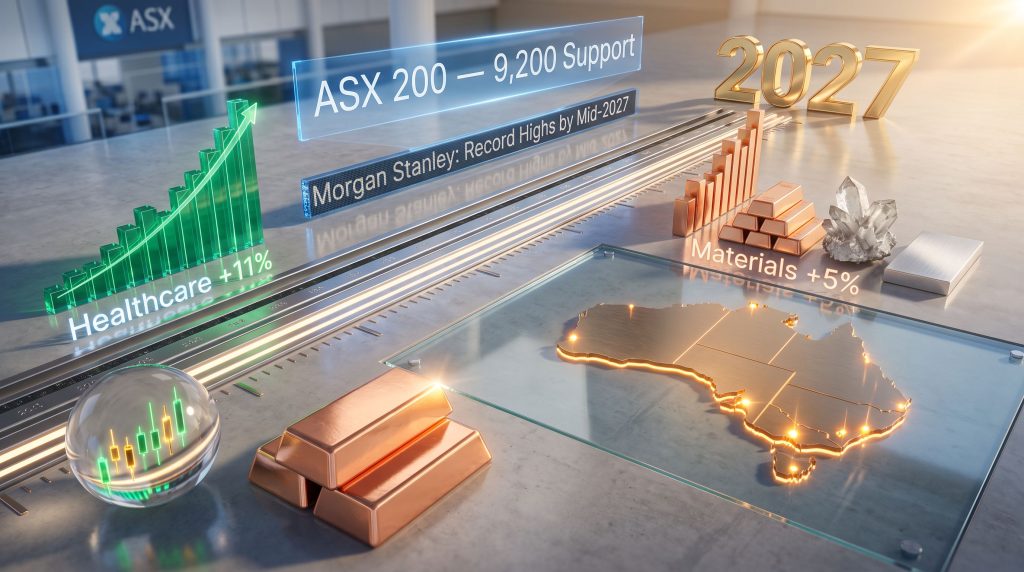
Morgan Stanley has projected that the ASX 200 could revisit record highs by mid-2027, with resource and mining stocks identified as the primary performance catalyst in that scenario. If that projection proves accurate, the commodity pivots currently underway at BHP and Rio Tinto will have been foundational.
The Critical Minerals Dimension: Rare Earths and the Defence Supply Chain
One dimension of the critical minerals demand thesis that receives insufficient attention is the defence and advanced manufacturing angle. Rare earth elements are not simply relevant to electric vehicles. They are essential inputs for guided munitions, radar systems, and advanced communication hardware.
As Western governments seek to reduce dependence on single-source supply chains for these materials, Australian producers are positioned within a structural demand environment that has both commercial and strategic dimensions. This dual-demand profile, simultaneously serving the energy transition and the defence modernisation cycle, is a relatively uncommon investment characteristic that elevates the long-term demand floor for Australian rare earth exposure.
Healthcare and Energy: The Non-Mining Sectors Building Quietly for 2027
CSL and the Margin Discipline Signal
The healthcare sector's performance this reporting season delivered one of the most instructive signals of the entire period. CSL Limited surged more than 25% following its FY26 result, dragging the broader healthcare sector up by more than 11% in a single week. The catalyst was not simply a strong result but rather the market's enthusiastic reception of CSL's major restructuring plans, which are designed to deliver underlying profit growth in FY27 despite broadly flat revenue expectations.
The analytical significance of this cannot be overstated. A company forecasting profit growth against flat revenue is explicitly communicating margin expansion through cost discipline, not volume growth. In a slow-GDP environment, that is exactly the kind of earnings architecture that institutional capital rewards.
Pro Medicus provided a complementary data point, rising more than 15% on another consistently strong FY26 result. Pro Medicus operates in the medical imaging software space and has demonstrated the compounding power of a high-conviction, scalable business model with recurring revenue characteristics. Its sustained premium valuation reflects institutional confidence that the earnings growth trajectory remains structurally intact.
Energy's Dual Catalyst Structure
The energy sector gained more than 3% during the reporting week, supported by two distinct forces. First, AGL's forward earnings guidance points to stronger margins in FY27, driven by a combination of lower operating costs and expanding battery storage capacity. Second, ongoing geopolitical instability, particularly surrounding the Iran conflict, has maintained elevated oil prices, providing a revenue tailwind for ASX-listed energy producers.
The battery storage element of AGL's outlook deserves particular attention. Battery portfolios sit at the intersection of the energy transition and grid reliability economics. As renewable penetration increases, grid-balancing assets like large-scale batteries become structurally more valuable, independent of commodity price cycles. This creates a more resilient earnings foundation than traditional generation assets alone.
Interest Rates, Refinancing, and the Compounding Effect
CBA's Rate Cut Forecast and Its Earnings Implications
Commonwealth Bank is forecasting two interest rate reductions in 2027, a projection that, if accurate, would arrive at a particularly fortuitous moment for companies that have simultaneously been reducing their cost bases through restructuring. The combination of lower financing costs meeting improved operational efficiency creates what might be described as a compounding earnings effect.
Companies demonstrating falling cost structures, improving earnings visibility, and capital deployed into structurally growing demand categories represent the clearest expression of what forward-positioning looks like in the current environment.
For capital-intensive businesses in mining, healthcare infrastructure, and energy, the refinancing cycle carries additional relevance. Debt facilities entered at peak rate conditions over the past two to three years will roll into a lower-rate environment, reducing interest expense and improving free cash flow simultaneously with operating improvements. This timing alignment is not accidental for companies that have managed their balance sheets deliberately.
The RBA's stated expectation that inflation will gradually return toward its target band provides the macro prerequisite for this rate reduction scenario. While no rate forecast should be treated as certainty, the directional alignment between monetary policy trajectory and corporate cost reduction programs creates a plausible dual-tailwind environment for 2027.
Policy Architecture Reshaping the 2027 Business Environment
Beyond monetary policy, a series of fiscal and regulatory measures are scheduled to take effect that will materially alter the investment calculus for specific ASX sectors.
| Policy Measure | Effective Date | Primary Beneficiary |
|---|---|---|
| Expanded venture capital incentives | 1 July 2027 | Growth-stage companies |
| Instant asset write-off (permanent) | Ongoing | SMEs and capital-intensive businesses |
| Loss carry-back provisions | 2026-27 Budget | Companies with cyclical earnings |
| CGT setting changes | 2027 | Investors and M&A activity |
The permanent legislating of the instant asset write-off is particularly relevant for capital-intensive businesses across mining, agriculture, and manufacturing. Previously a temporary measure subject to annual budget renewal uncertainty, its permanent status reduces investment timing anxiety for companies planning multi-year capital expenditure programs.
A separate but significant regulatory deadline arrives in January 2027: the implementation of gambling advertising reforms. This structural change carries real implications for media companies and consumer discretionary businesses with material revenue exposure to gambling marketing. Companies with diversified revenue streams will be insulated; those with concentrated dependency on gambling advertising will face earnings recalibration. Furthermore, analysts note that the broader regulatory landscape signals a sustained shift in how governments view gambling-adjacent revenue, adding longer-term uncertainty for affected sectors.
The next major ASX story will hit our subscribers first
Reading the ASX 200's Technical Structure
The 9,200 Level as a Market Confidence Barometer
The All Ordinaries Index closed the most recent week down just 0.16%, a figure that appears unremarkable in isolation. However, the intraweek price action carries substantially more analytical weight than the headline number suggests.
On Thursday, the market tested the 9,200 level before buyers stepped in and drove a recovery. That buyer response at a defined technical support level is a signal about institutional conviction, not retail momentum. When institutional capital defends a technical level with visible buying pressure, it typically indicates that forward expectations are strong enough to justify adding exposure at that price point.
The scenario framework from here is relatively binary:
- If 9,200 holds: The market structure remains consistent with a broader bullish trajectory, with potential for a year-end rally and a constructive setup entering 2027.
- If 9,200 fails: The next meaningful structural support falls at 9,000, a level that would require reassessment of the near-term directional thesis.
The sector rotation patterns visible through reporting season reinforce the bullish interpretation. Healthcare advancing +11% and Materials gaining +5% while Financials fell -5% and Consumer Discretionary dropped -4% reflects institutional capital rotating toward forward earnings quality and away from rate-sensitive or consumption-dependent businesses.
FY26 Reporting Season: The Standout Movers
Top Performers
- CSL Limited: +25% driven by restructuring plans targeting margin expansion in FY27 despite flat revenue
- Pro Medicus: +15% on sustained execution and confirmation that its structural growth narrative remains intact
- Evolution Mining: +14% underpinned by a record FY26 result and continued gold price outlook strength
Underperformers
- JB Hi-Fi: -14% despite posting record FY26 sales; investor concern shifted entirely to FY27 trading conditions and what weaker forward guidance implies for growth
- Aurizon Holdings: -13% where expectations of declining coal earnings in FY27 overwhelmed an otherwise credible result
- HUB24: -12% illustrating the valuation compression risk when strong earnings growth is already substantially embedded in the share price
The HUB24 outcome is a useful reminder that earnings quality and stock performance are not the same thing. A business can deliver genuinely impressive results and still disappoint the market if expectations were already priced at a premium. This distinction matters enormously when evaluating forward-positioned ASX companies heading into 2027.
A Three-Factor Framework for Identifying 2027-Ready Companies
For investors seeking to apply the forward-positioning thesis in a disciplined way, three factors warrant systematic evaluation:
- Cost Trajectory: Is the business structurally reducing its operating cost base, or are cost improvements one-off and non-repeatable? Genuine cost reduction creates permanent margin improvement; temporary savings simply delay the problem.
- Earnings Momentum: Does the FY27 guidance reflect operational improvement derived from internal execution, rather than purely commodity price or macro tailwinds? Companies that can grow earnings in a slow-GDP environment demonstrate business model resilience.
- Demand Alignment: Is capital being deployed into sectors with multi-year structural demand tailwinds, such as electrification commodities, healthcare technology, or grid-scale energy storage? Demand alignment determines how sustainable the earnings improvement is likely to be.
Companies demonstrating all three characteristics simultaneously represent the clearest expression of what corporate Australia bets on 2027 actually looks like from an investment perspective.
Frequently Asked Questions: Corporate Australia and the 2027 Outlook
Why Is 2027 Considered a Potential Inflection Year for Australian Markets?
Multiple catalysts are expected to converge around 2027, including potential interest rate reductions, policy changes taking effect from July 2027, the completion of corporate restructuring programs currently underway, and maturing capital investment in high-demand commodity sectors. No single factor is decisive, but their simultaneous arrival creates a potentially supportive environment.
Which ASX Sectors Are Most Exposed to Positive 2027 Catalysts?
Materials and mining, particularly copper and critical minerals; healthcare, driven by margin expansion from restructuring; and energy, benefiting from battery portfolio expansion and sustained oil price elevation.
How Do Forecast Interest Rate Cuts Affect ASX Company Earnings?
Lower rates reduce financing costs on variable-rate debt, improve refinancing economics on maturing facilities, and can stimulate consumer activity in rate-sensitive sectors. For companies that have simultaneously been reducing their operating costs, falling rates create an additive rather than a standalone earnings improvement.
Is the Shift Away from Iron Ore a Permanent Strategic Change for Australian Mining Giants?
The diversification away from iron ore dependence appears structural rather than tactical. The energy transition creates multi-decade demand for copper, lithium, and aluminium at a scale that iron ore, facing structural headwinds from Chinese steel demand normalisation, cannot replicate. The pivot reflects genuine demand signal reading, not opportunistic repositioning.
What Does the All Ordinaries Support Level at 9,200 Mean for Near-Term Market Direction?
The 9,200 level represents a technical reference point where buyer activity has been observed. Its significance lies in what it reveals about institutional sentiment. Sustained defence of this level would strengthen the case for continued market stability and potential upside toward year-end.
This article is intended for informational purposes only and does not constitute financial advice. All forecasts, price targets, and analyst projections referenced are subject to change and should not be relied upon as guarantees of future performance. Readers should consult a licensed financial adviser before making investment decisions. Past performance is not indicative of future results.
For ongoing coverage of ASX market strategy, reporting season analysis, and sector-level insights, visit The Market Online.
Want to Catch the Next Major ASX Mineral Discovery Before the Broader Market Does?
Discovery Alert's proprietary Discovery IQ model delivers real-time alerts on significant ASX mineral discoveries, instantly transforming complex mineral data into actionable insights for both short-term traders and long-horizon investors — exactly the kind of edge that matters when structural demand cycles in copper, critical minerals, and energy are accelerating toward a 2027 inflection point. Explore Discovery Alert's discoveries page to understand how historic mineral discoveries have generated substantial market returns, and begin your 14-day free trial today to position yourself ahead of the next major find.