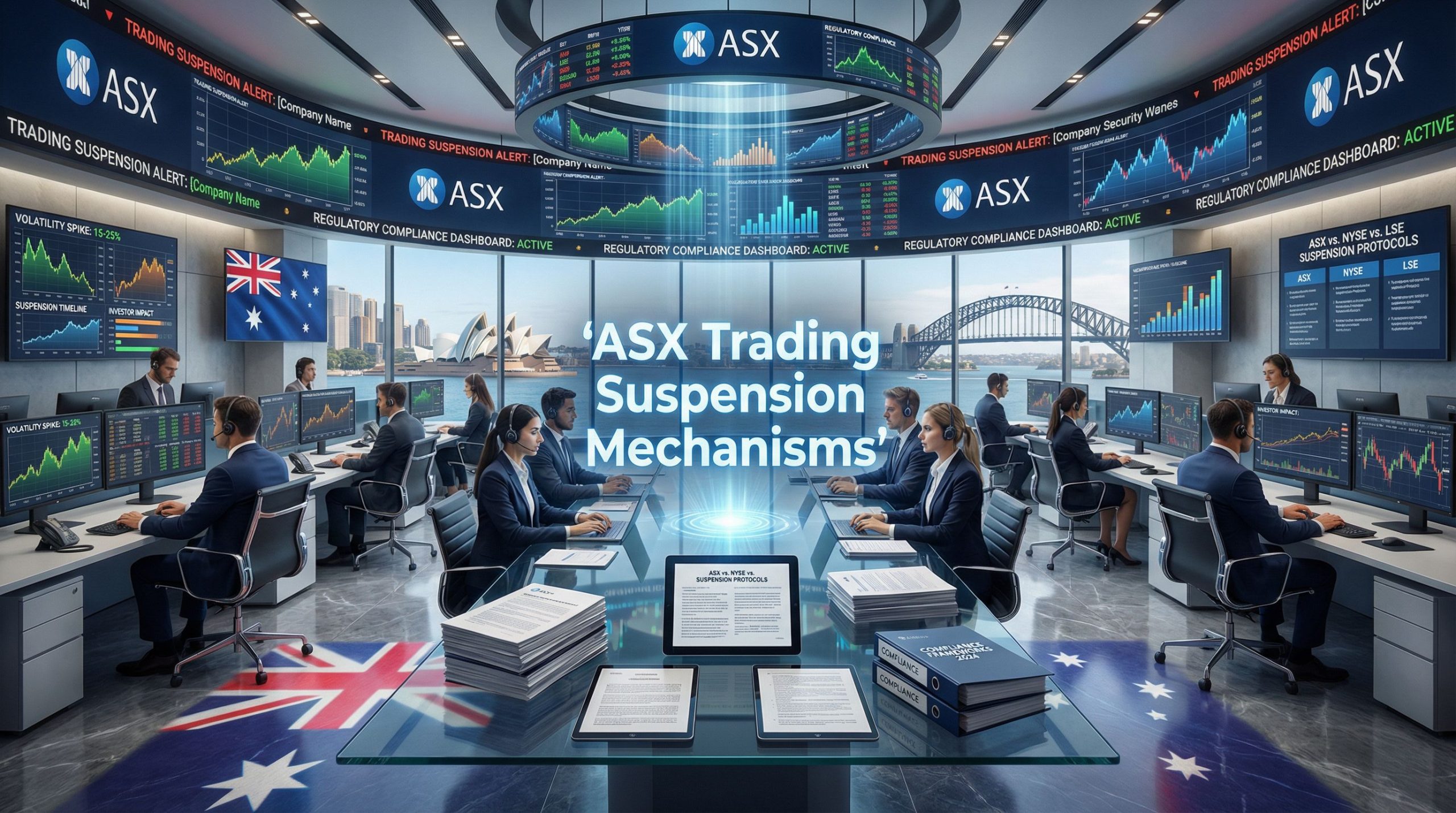
Understanding ASX Trading Suspension Mechanisms Through Regulatory Framework Analysis
Market surveillance systems within Australia's regulatory architecture operate through sophisticated monitoring protocols that detect anomalies in trading patterns, disclosure obligations, and corporate governance compliance. These mechanisms form the backbone of investor protection frameworks, yet many market participants lack comprehensive understanding of how suspension triggers actually function in practice.
The Australian Securities Exchange operates under a dual regulatory model where ASIC maintains statutory oversight while ASX Limited exercises self-regulatory authority through market operating rules. This structure creates multiple intervention points when companies fail to meet continuous disclosure requirements or when technical infrastructure disruptions threaten market integrity.
Recent ASX trading suspension news has highlighted systemic vulnerabilities within electronic trading platforms, particularly following technical outages that affected approximately 80 companies during December 2024. Such incidents underscore the critical importance of understanding suspension categories and their differential impacts on various investor classes.
What Triggers ASX Trading Suspensions Under Current Market Rules?
Market Surveillance and Compliance Triggers
ASX Market Rule 17.1 establishes the foundation for suspension decisions, empowering the exchange to halt trading when securities fail to meet listing requirements or when information asymmetries create unfair market conditions. The continuous disclosure regime under Listing Rule 3.1 mandates immediate announcement of price-sensitive information, with breaches triggering automatic surveillance alerts.
• Price query protocols activate when share prices move beyond statistically normal ranges without corresponding announcements
• Volume spike investigations commence when trading activity exceeds predetermined thresholds relative to historical patterns
• Corporate action monitoring tracks merger activity, capital restructures, and director dealings for compliance verification
• Third-party information verification cross-references media reports, analyst communications, and regulatory filings
Technical Infrastructure Failure Protocols
The December 2024 ASX outage deepened investors' concerns and demonstrated how technical failures can cascade into widespread trading suspensions. ASX's Trade Acceptance Service (TAS) and integrated trading system dependencies create single points of failure that affect multiple securities simultaneously.
System resilience testing occurs quarterly, yet real-world disruptions often exceed stress-test parameters. Circuit breaker mechanisms automatically engage when message processing delays exceed 500 milliseconds, protecting market integrity at the cost of liquidity provision.
How Do ASX Suspension Categories Affect Different Investor Classes?
Voluntary vs. Mandatory Suspension Classifications
| Suspension Type | Duration Range | Primary Trigger | Investor Impact | Resolution Timeline |
|---|---|---|---|---|
| Technical Outage | 2-6 hours | System failure | Universal liquidity freeze | Infrastructure restoration |
| Price Query | 1-2 days | Unexplained volatility | Information seeking | Company response |
| Disclosure Breach | 3-10 days | Material omission | Compliance investigation | Rectification filing |
| Regulatory Inquiry | 2-12 weeks | Conduct concerns | Extended uncertainty | ASIC determination |
Institutional vs. Retail Investor Exposure Differentials
Professional investment managers typically maintain superior information networks and risk management protocols that provide defensive positioning advantages before suspensions occur. Institutional investors often receive early warnings through direct corporate relationships and sophisticated monitoring systems that detect potential compliance issues.
Retail investors face structural disadvantages during suspension periods, lacking access to alternative liquidity sources and professional advisory services. Understanding share trading basics becomes crucial for navigating these challenging periods.
High-frequency trading algorithms automatically halt engagement when suspension triggers activate, removing algorithmic liquidity provision that retail participants depend upon. Options markets experience immediate volatility expansion when underlying securities face suspension, with implied volatility premiums increasing 200-400% during extended halts.
This creates asymmetric risk exposure for retail options traders who may lack sophisticated hedging capabilities. Furthermore, effective market volatility hedging strategies become essential during these periods.
What Are the Financial Consequences of Extended Trading Suspensions?
Direct Market Capitalisation Impact Metrics
Statistical analysis of ASX suspension events over the past five years reveals average price volatility increases of 23% during the first trading session following suspension lifting. Market makers typically widen bid-ask spreads by 150-300% immediately after resumption, reflecting increased uncertainty and reduced liquidity provision.
Extended trading suspensions create compounding liquidity constraints that can permanently damage small-cap stock tradability and institutional investor confidence.
Index inclusion consequences represent another significant financial impact, with suspended securities facing automatic exclusion from major indices after 20 consecutive trading days of inactivity. This triggers forced selling by passive index funds, amplifying downward pressure when trading resumes.
Operational Cost Implications for Listed Entities
Companies experiencing trading suspensions incur substantial additional costs beyond direct market impacts. Legal compliance expenditure typically increases 300-500% during suspension periods due to regulatory investigation responses and enhanced disclosure requirements.
• External legal advisory fees averaging $50,000-200,000 per month during extended suspensions
• Investor relations consultancy costs for stakeholder communication and reputation management
• Audit and compliance reviews requiring independent verification of systems and procedures
• Credit facility renegotiation expenses as lenders reassess counterparty risk profiles
Which Regulatory Bodies Oversee ASX Suspension Decisions?
ASIC Enforcement Framework Integration
The Australian Securities and Investments Commission operates sophisticated surveillance technology through its Market Analysis and Intelligence system, which processes approximately 50 billion data points daily from ASX trading activity. This system employs machine learning algorithms to identify potential market misconduct patterns that may warrant suspension intervention.
ASIC's enforcement powers under Section 794D of the Corporations Act enable direct suspension orders when market integrity concerns arise. However, the regulator maintains concurrent jurisdiction with ASX Limited, creating potential conflicts when suspension decisions involve both technical rule breaches and broader conduct issues.
ASX Limited Self-Regulatory Authority Scope
ASX operates under Australian Market Licence conditions that require maintenance of fair, orderly, and transparent markets. The exchange's Market Supervision department employs real-time monitoring systems that analyse trading patterns, corporate announcements, and price movements simultaneously.
Decision-making protocols within ASX follow escalating authority levels, with routine suspensions handled by senior market supervisors while complex cases requiring legal interpretation involve executive management consultation. Appeal mechanisms exist through ASX's Disciplinary Tribunal system, though successful challenges remain statistically rare.
How Do International Markets Handle Similar Suspension Scenarios?
NYSE/NASDAQ Circuit Breaker Systems
United States equity markets employ percentage-based automatic halt triggers that differ significantly from ASX's discretionary approach. Individual stock circuit breakers activate at 10% price movements within five-minute periods, with cooling-off periods ranging from five to ten minutes depending on time of day.
Market-wide circuit breakers engage at 7%, 13%, and 20% S&P 500 declines, with trading halts lasting 15 minutes for the first two levels and continuing until the next trading day for the 20% trigger after 3:25 PM EST.
LSE Regulatory Halt Procedures
London Stock Exchange suspension protocols operate under Financial Conduct Authority oversight, with emphasis on maintaining orderly markets during periods of extreme volatility or information uncertainty. The exchange employs auction call periods rather than complete trading halts for minor disruptions.
Brexit-related regulatory changes have created additional complexity in cross-border suspension coordination, particularly for securities with dual listings across EU and UK venues. Alternative Trading System providers now maintain independent suspension decision-making authority, potentially creating market fragmentation during crisis periods.
What Risk Management Strategies Protect Investors During Suspensions?
Portfolio Diversification Defence Mechanisms
Sophisticated portfolio construction principles can mitigate suspension-related risks through strategic asset allocation across multiple dimensions. Sector concentration limits of 5-10% for individual industries reduce exposure to systematic suspension risks affecting entire market segments.
Geographic diversification across ASX, international developed markets, and emerging market exposures provides protection against Australia-specific regulatory or technical disruptions. For instance, examining Australian share market insights helps investors understand these risks better.
Market capitalisation tier balancing between large, mid, and small-cap securities creates different liquidity risk profiles with varying suspension probabilities. Additionally, monitoring the ASX alerts curve provides early warning signals for potential issues.
Professional Risk Mitigation Tools
Derivatives-based hedging strategies can provide limited protection during suspension periods, though options markets typically suspend trading simultaneously with underlying securities. Cross-listing arbitrage opportunities exist for companies trading on multiple exchanges, though retail investors rarely possess the infrastructure to exploit these differentials.
• Credit facility pre-arrangement for operational liquidity during prolonged suspensions
• Over-the-counter trading relationships with institutional counterparties
• Alternative investment platform access for continued market participation
• Professional portfolio management services with sophisticated risk monitoring capabilities
How Has ASX Suspension Policy Evolved Since Major Market Disruptions?
Post-GFC Regulatory Enhancement Timeline
The Global Financial Crisis prompted comprehensive reviews of market surveillance and suspension procedures, resulting in significant technological and procedural upgrades implemented between 2010-2015. Enhanced real-time monitoring capabilities now process market data with sub-second latency, enabling faster detection of anomalous trading patterns.
• 2010: Implementation of enhanced continuous disclosure monitoring systems
• 2012: Introduction of circuit breaker mechanisms for individual securities
• 2015: Deployment of machine learning-based surveillance algorithms
• 2018: Integration of social media monitoring for sentiment analysis
• 2020: COVID-19 emergency trading protocols and volatility management procedures
• 2024: Post-outage infrastructure resilience improvements and redundancy systems
Technology Infrastructure Resilience Improvements
ASX's Technology Roadmap 2025 encompasses distributed ledger technology integration, quantum-resistant security protocols, and enhanced cybersecurity frameworks. Cloud-based backup systems now provide failover capabilities within 15 minutes of primary system failures, significantly reducing suspension durations for technical issues.
Artificial intelligence surveillance systems scheduled for 2025 implementation will analyse patterns across multiple data sources simultaneously, potentially reducing false positive suspension triggers while improving detection accuracy for genuine compliance breaches.
What Should Investors Monitor During Active Suspension Periods?
Information Gathering Priority Framework
Effective information management during suspension periods requires systematic monitoring of multiple communication channels and regulatory databases. Consequently, the ASX Market Announcements Platform provides real-time updates on company filings, while ASIC's public database tracks enforcement actions and investigation developments.
Professional investors employ dedicated information services that aggregate regulatory filings, media coverage, and industry analyst communications. These systems provide automated alerts when suspended companies release material information or when regulatory developments affect suspension status.
Communication Channel Optimisation
Direct engagement with company investor relations departments often provides additional context beyond public announcements, though companies face strict limitations on selective disclosure during suspension periods. Professional advisory services can offer valuable interpretation of complex regulatory developments and potential timeline estimates.
• Company announcement monitoring through ASX platforms and direct subscriptions
• Regulatory filing surveillance via ASIC databases and professional services
• Industry peer analysis for comparative context and market sentiment assessment
• Professional advisory consultation for complex regulatory interpretation
How Do Suspension Events Impact Long-Term Investment Strategies?
Fundamental Analysis Recalibration Requirements
Trading suspensions often reveal previously unknown information about corporate governance practices, financial reporting quality, or operational risks that require comprehensive reassessment of investment thesis assumptions. In addition, discounted cash flow models may require significant adjustment of risk-free rate assumptions and terminal value calculations.
Management credibility assessments become critically important following suspension events, as governance failures frequently indicate broader cultural or operational deficiencies. Board composition analysis and executive track record evaluation provide insights into likelihood of successful resolution and future performance potential.
Technical Analysis Disruption Management
Price chart analysis faces significant limitations during and after suspension periods due to trading volume distortions and artificial price gaps. Moving average calculations require recalibration to account for suspension-period data exclusions, while support and resistance levels may require complete recalculation based on post-suspension price action.
Volume-based technical indicators become unreliable for extended periods following suspension lifting, as initial trading sessions often exhibit abnormal activity patterns that distort historical relationships. Technical analysts typically require 3-6 weeks of normal trading activity before resuming standard analytical approaches.
What Legal Protections Exist for Shareholders During Suspensions?
Shareholder Rights Preservation Mechanisms
Class action litigation frameworks provide potential recourse for shareholders who suffer losses due to disclosure breaches or corporate governance failures that trigger suspensions. Australian courts have established precedents for recovery in cases where companies fail to meet continuous disclosure obligations under Corporations Act Section 674.
Minority shareholder protection provisions under oppressive conduct legislation enable legal challenges when suspension-related events disproportionately impact smaller shareholders. These protections have proven particularly relevant in cases involving management buyout attempts or restructuring proposals announced during suspension periods.
Corporate Governance Accountability Standards
Director fiduciary duty enforcement has strengthened significantly following high-profile suspension cases, with personal liability extending beyond traditional corporate veil protections. Executive compensation clawback provisions now feature in most major corporation remuneration policies, providing recovery mechanisms for performance-based payments during periods of governance failure.
Independent audit requirements maintain continuity during suspension periods, ensuring ongoing financial reporting oversight and stakeholder protection. Whistleblower protection programs provide additional safeguards for internal disclosure of compliance breaches that may contribute to suspension events.
Trading suspensions represent critical inflection points where regulatory frameworks, market structure limitations, and investor protection mechanisms converge to determine long-term market confidence and capital allocation efficiency.
The complexity of ASX trading suspension news requires sophisticated understanding of regulatory frameworks, market microstructure dynamics, and risk management principles. Furthermore, comprehensive ASX market performance analysis provides valuable context for these suspension events. Investors who develop comprehensive knowledge of these systems position themselves advantageously for navigating suspension events while protecting portfolio values during periods of market disruption.
Looking for Early Warning Signals Before Market Disruptions?
Discovery Alert's proprietary Discovery IQ model delivers real-time alerts on significant ASX mineral discoveries and market developments, empowering subscribers to identify potential opportunities and risks before they impact broader market sentiment. Start your 30-day free trial today at Discovery Alert and gain the market intelligence needed to navigate complex trading environments with confidence.