June 1, 2026
The Uranium Supply Gap That Frontier Africa Is Now Positioned to Fill
Nuclear energy's structural comeback as a low-carbon baseload power source has created a supply equation that existing producers are struggling to balance. Global uranium demand is climbing steadily as reactor restarts accelerate across Asia, Europe, and North America, while the pipeline of new mines capable of meeting that demand remains critically thin. The uranium supply deficit is becoming increasingly pronounced, with the World Nuclear Association projecting that uranium requirements from operating reactors could reach approximately 130,000 tonnes of uranium per year by the mid-2030s — a figure that current committed production cannot comfortably satisfy.
Against this backdrop, the Aura Energy Tiris uranium mine FID has emerged as one of the most closely watched capital deployment decisions in the junior uranium development space. Located in Mauritania, West Africa, Tiris represents not just a single project milestone but a broader test of whether frontier African uranium assets can be advanced through the full development cycle within commercially competitive timeframes.
When big ASX news breaks, our subscribers know first
What the Tiris Project Looks Like at the Development Threshold
Core Project Parameters at a Glance
Before examining what the FID process means in practice, it is worth grounding the analysis in the project's physical and financial fundamentals. The Tiris uranium project presents a compelling set of parameters that distinguish it from many frontier peers.
| Parameter | Detail |
|---|---|
| Location | Mauritania, West Africa |
| Operator | Aura Energy (ASX and AIM dual-listed) |
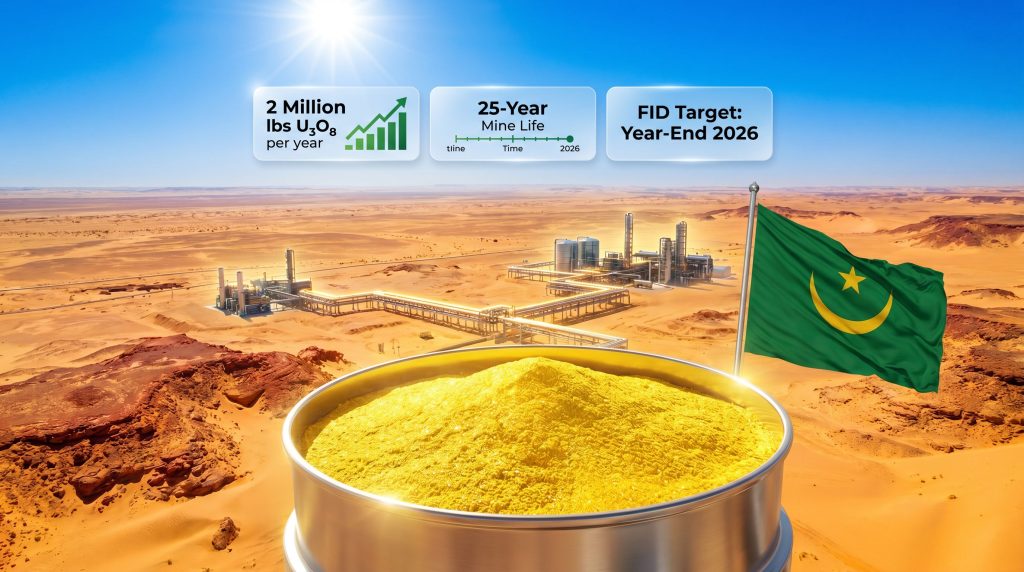
| Base Production Target | 2 million lbs U₃O₈ per year |
| Expansion Scenario Under BFS Review | 3.5 million lbs U₃O₈ per year |
| Projected Mine Life | 25 years |
| Tailings Processing Throughput | 750,000 tonnes per year |
| BFS Completion Target | September 2026 |
| FID Target Window | Year-end 2026 |
Tiris would be Mauritania's first uranium mine and, notably, the country's first new mine of any kind in approximately 20 years. That context matters because it places Tiris in the category of genuine nation-building infrastructure rather than incremental capacity expansion — a distinction that carries weight in international development finance conversations.
Why Jurisdiction Matters as Much as Geology
Mauritania occupies a relatively stable political position compared with several of its immediate Sahel neighbours, where recent instability has complicated mining investment. Its Atlantic-facing geography also offers logistical advantages that are frequently underappreciated in uranium project comparisons. Landlocked uranium jurisdictions in central and southern Africa face significant transport cost disadvantages in getting product to port, a friction that Mauritania's coastal positioning substantially reduces.
Full regulatory licensing has been achieved at Tiris, covering the exploitation permit, environmental clearance, and production authorisation. For context, securing this trifecta of approvals in a frontier jurisdiction without prior modern mining history is a genuinely rare outcome. Most comparable projects at similar stages are still navigating permit queues that can extend two to five years beyond initial application.
Furthermore, the broader uranium market dynamics in 2025 continue to favour projects that have already cleared regulatory hurdles, as financiers increasingly prioritise de-risked assets when deploying capital into the sector.
The Processing Flowsheet: Why Technical Certainty Drives Capital Confidence
How the Tiris Plant Circuit Actually Works
One of the most significant — and least widely discussed — developments in the Tiris advancement story is the full validation of its processing flowsheet across the complete range of ore types present at the deposit. This is not a trivial distinction. Many uranium projects at BFS stage have validated their processing approach against representative ore samples but retain uncertainty about how the circuit performs across mineralogical variation within the ore body. Tiris has eliminated this category of risk.
The processing circuit integrates two distinct technological systems:
-
Pre-leach centrifuge separation: Gangue material is removed ahead of the leach circuit, reducing reagent consumption and improving overall leach efficiency. The technology applied here draws on established industrial applications rather than experimental or pilot-scale systems.
-
Post-leach polymer dewatering (ATA system): Developed and owned by ASX-listed Clean TeQ Water, the ATA polymer-based dewatering system operates in combination with horizontal vacuum belt filtration. Clean TeQ Water has been awarded a design-and-construct contract for a full-scale ATA plant capable of processing 750,000 tonnes per year of tailings.
The combination of centrifuge pre-separation and polymer dewatering is considered an efficient and cost-effective pairing that avoids the capital and operational complexity of conventional counter-current decantation circuits used in older uranium processing facilities.
The Bankability Dimension of Flowsheet Validation
In uranium project finance, processing risk sits alongside resource uncertainty and uranium price exposure as the three primary underwriting variables examined by senior debt providers. A flowsheet validated exclusively on partial ore type coverage introduces contingency provisions into project cost models that can materially inflate estimated capital requirements and reduce debt serviceability metrics.
By confirming performance across all ore types at Tiris, the technical foundation now satisfies a core bankability criterion ahead of the BFS. This matters because it removes the need for a separate pilot plant construction phase that, in comparable projects, has historically added between 12 and 24 months and tens of millions of dollars to development timelines before FID could be contemplated.
"The completion of a fully validated processing flowsheet covering all ore types is arguably the single most consequential technical de-risking milestone a uranium project can achieve before entering the formal BFS phase. It converts processing from a financial contingency into a costed certainty."
The Capital Structure Strategy Behind the Tiris FID Pathway
A Multi-Source Funding Architecture Designed for Resilience
Aura Energy has structured the Tiris funding pathway across three complementary tranches rather than pursuing a single financing source. This architecture is deliberate and reflects hard lessons learned across the junior uranium development sector, where single-counterparty financing dependency has derailed projects at late stages. In addition, the nuclear growth investments landscape has increasingly rewarded projects that present diversified funding structures to institutional counterparties.
Tranche 1: Strategic Cornerstone Equity via MoU
An MoU has been signed with a major international nuclear power company covering potential equity investment, uranium offtake, and technical collaboration. The structure of this arrangement is notable for two reasons. First, a nuclear power company acting simultaneously as equity investor and offtake counterparty eliminates the need to separately negotiate production contracts in a spot or term market, reducing one of the most time-consuming elements of uranium project commercialisation. Second, the MoU is structured to preserve competitive tension with other funding channels rather than granting exclusivity, maintaining negotiating leverage for Aura across the full capital raise process.
Tranche 2: Senior Project Debt via DFC and Quasi-Equity Instruments
The US International Development Finance Corporation has been identified as a potential senior project debt provider. DFC participation in critical mineral and nuclear fuel supply chain projects reflects US policy objectives around supply chain diversification away from Russian and Central Asian uranium sources, though it is important to note that DFC engagement does not constitute confirmed project-specific funding or government backing at this stage. Royalty structures are also under consideration as quasi-equity instruments alongside senior debt, providing an additional layer of capital structure flexibility.
Tranche 3: US Investment Fund Proposal
A non-binding, fully funded proposal has been received from a major US investment fund. This tranche operates as either an alternative or supplementary capital source independent of the DFC debt pathway, further insulating the project from single-counterparty withdrawal risk.
| Funding Tranche | Counterparty Type | Stage | Instrument |
|---|---|---|---|
| Strategic Cornerstone | International nuclear power company | MoU signed | Equity + Offtake |
| Senior Project Debt | US DFC (potential) | Under engagement | Debt + Royalties |
| US Investment Fund | Major US fund | Non-binding proposal | Full project funding |
Three Scenarios for Whether FID Is Achieved by Year-End 2026
Scenario Modelling Across the Key Variable Set
The Aura Energy Tiris uranium mine FID outcome by year-end 2026 is not binary. Three credible pathways exist, each driven by a distinct combination of uranium price dynamics, BFS outcomes, and strategic investor decision-making timelines.
Scenario A: Base Case FID on Schedule
The BFS completes in September 2026 confirming commercially robust economics at the 2 million lbs per year production rate. The MoU counterparty converts to a binding equity and offtake commitment following BFS publication. DFC term sheet is executed in Q4 2026, and FID is announced before December 31, 2026. This scenario is supported by uranium spot price stability above approximately $65 per pound, which maintains offtake negotiation momentum without triggering capex model reassessment.
Scenario B: Delayed FID Driven by Expansion Economics
BFS analysis concludes that the 3.5 million lbs per year expansion scenario generates materially superior economics relative to the base case 2 million lbs configuration. Capital structure renegotiation to accommodate higher project capex pushes FID into Q1 or Q2 2027. This is not necessarily a negative outcome for long-term project value but does extend the timeline. A stronger uranium price environment above $80 per pound would likely accelerate strategic investor appetite for the expanded configuration.
Scenario C: Accelerated FID Ahead of BFS
The MoU nuclear power company counterparty, motivated by supply security urgency, accelerates binding commitments before formal BFS completion. Early equity anchoring enables parallel debt financing negotiations, and FID is achieved ahead of BFS publication, with the study then used for construction planning rather than as a financing trigger. This scenario is driven by geopolitical urgency rather than project-level factors.
How Tiris Stacks Up Against the Broader African Uranium Development Pipeline
Competitive Positioning Compared to Frontier Peers
| Project Attribute | Tiris (Mauritania) | Typical Frontier Uranium Project |
|---|---|---|
| Full Licensing Status | Achieved | Often 2-5 years away |
| Validated Flowsheet (All Ore Types) | Confirmed | Frequently at pilot stage |
| Strategic Investor MoU | Signed | Rare at pre-FID stage |
| DFC Financing Engagement | Active | Uncommon at this scale |
| BFS Stage | Q3 2026 target | Variable |
| Dual Exchange Listing | ASX and AIM | Less common |
| Mine Life | 25 years | Varies widely |
The 25-year mine life is particularly significant from a utility procurement perspective. Nuclear power operators manage reactor lifecycles of 40 to 60 years and prefer to source uranium from long-duration assets that reduce the frequency of supply renegotiations. At the base case production rate, Tiris would generate approximately 50 million pounds of cumulative U₃O₈ over its mine life. At the expanded 3.5 million lbs per year rate, cumulative output would approach 87.5 million pounds — a volume that is material relative to annual global uranium production of roughly 130 to 150 million pounds per year.
The next major ASX story will hit our subscribers first
Key Risks That Investors and Market Observers Should Monitor
Risk Variables Between Now and FID
No pre-FID uranium project is without risk, and Tiris carries a specific set of variables worth tracking across the remainder of 2026. The broader uranium supply-demand outlook will also play a significant role in shaping investor appetite and offtake pricing negotiations between now and year-end.
-
Uranium price sensitivity: Project economics are modelled against long-term contract prices rather than spot market fluctuations. However, a sustained spot price decline below approximately $55 per pound could affect offtake counterparty willingness to commit at target pricing.
-
BFS cost escalation: Global mining construction costs have risen significantly since 2020 driven by supply chain inflation across steel, concrete, and skilled labour. A capital cost outcome in the BFS that exceeds preliminary estimates could require capital structure adjustments before lenders will proceed.
-
Expansion scenario complexity: Evaluating both the 2 million lbs and 3.5 million lbs configurations simultaneously introduces analytical complexity into the BFS. A strong preference for the larger configuration could require additional financing discussions that compress the year-end 2026 FID window.
-
Regional security context: Mauritania has maintained greater political stability than several neighbouring Sahel nations. However, the regional security environment in West Africa remains a monitoring variable for international financiers conducting sovereign risk assessments, particularly for DFC facility approvals.
-
Regulatory continuity: Full project licensing has been secured, materially reducing near-term regulatory risk. Ongoing compliance with environmental permit conditions during the construction phase will nonetheless require active management.
Disclaimer: This article contains forward-looking statements and scenario projections based on publicly available information. Nothing in this article constitutes financial advice. Investors should conduct their own independent due diligence before making any investment decisions related to Aura Energy or uranium sector equities.
Frequently Asked Questions: Aura Energy Tiris Uranium Mine FID
What does FID mean for the Tiris uranium project?
A Final Investment Decision is the formal commitment by a company and its financing partners to deploy capital into full project construction. For Tiris, reaching FID marks the transition from feasibility study completion and capital formation into active construction contracting and mine development. The critical minerals demand surge further underscores why this decision carries broad significance beyond the project itself.
When is the BFS expected, and what does it cover?
The Bankable Feasibility Study is targeted for completion in September 2026. It will evaluate economics for both the 2 million lbs per year base case and the potential expansion to 3.5 million lbs per year, forming the primary technical and financial document used to finalise lender and investor commitments ahead of the Aura Energy Tiris uranium mine FID.
What role does Clean TeQ Water play in the Tiris processing circuit?
Clean TeQ Water, listed on the ASX, owns the ATA polymer-based dewatering system that forms the post-leach dewatering stage of the Tiris processing circuit. The company has been awarded a design-and-construct contract for a full-scale ATA plant with a tailings processing throughput of 750,000 tonnes per year.
Has any offtake agreement been signed for Tiris uranium production?
An MoU covering potential investment, offtake, and technical collaboration has been signed with a major international nuclear power company. This MoU is not yet a binding offtake agreement but establishes a structured pathway toward one and demonstrates serious commercial interest from an end-user capable of anchoring the project's capital structure.
What is the significance of Wood Group's engineering engagement?
Wood Group's engineering services for the Tiris project support execution-phase engineering readiness and position the site for construction mobilisation following FID. This type of early engineering services engagement by a major contractor is typically a prerequisite for detailed construction scheduling and cost certainty at the lender level. Furthermore, the final permit issued for the Mauritanian uranium mine reinforces that Tiris has cleared the critical regulatory milestones that many comparable frontier projects have yet to achieve.
Ready to Track the Next Major Uranium Discovery Before the Market Does?
Discovery Alert's proprietary Discovery IQ model scans ASX announcements in real time, delivering instant alerts on significant mineral discoveries — including uranium projects at critical development milestones like Tiris — so subscribers can act ahead of the broader market. Explore Discovery Alert's discoveries page to see how historic mineral discoveries have generated substantial returns, and begin your 14-day free trial today to secure a genuine market-leading edge.