
July 20, 2026
The Illusion of Stability: Why Aurizon's Future Is a Coal Question First
Utility-like infrastructure businesses have long attracted a specific category of investor: those who prize earnings predictability over growth optionality. Regulated asset bases, monopoly network positions, and government-sanctioned return frameworks create the appearance of permanence. Yet history repeatedly demonstrates that infrastructure built to serve a single commodity is only as permanent as that commodity's demand curve. When the underlying resource enters a structural rather than cyclical decline, the regulatory moat that once protected investors becomes a slowly draining reservoir.
This is precisely the analytical tension at the centre of any serious long-term assessment of Aurizon (ASX: AZJ). The company controls the Central Queensland Coal Network (CQCN), a 2,670-kilometre regulated rail corridor linking Queensland's coal production basins to export terminals. That network generates revenue through access charges governed by the Queensland Competition Authority (QCA), operating under a Regulated Asset Base (RAB) model that provides capital returns largely independent of short-term volume fluctuations. On paper, it resembles a toll road. In practice, it is a coal-specific asset operating in a world accelerating away from coal.
The purpose of this analysis is not to assess Aurizon's near-term performance, which remains solid. It is to stress-test the company's survivability across distinctly different coal decline trajectories, and to interrogate whether the regulatory protections investors rely on today will survive the structural pressures of the next two decades.
When big ASX news breaks, our subscribers know first
How Aurizon's Revenue Architecture Actually Works
The Two-Engine Model and Its Hidden Asymmetry
Aurizon generates earnings through two fundamentally different mechanisms, and understanding the distinction between them is essential before any scenario modelling can begin.
Engine One is the CQCN itself. Access charges collected from coal producers using the network are set by the QCA under a periodic regulatory determination process. The RAB framework means Aurizon earns a regulated return on its capital investment regardless of whether actual volumes meet the regulatory assumption. When throughput falls below the assumed level, the revenue shortfall is not lost permanently. Instead, it accumulates as a future revenue cap entitlement, recoverable in subsequent regulatory periods. This mechanism transforms what would otherwise be a volume-sensitive business into something closer to a quasi-utility in the short to medium term.
Engine Two is coal haulage, and it operates under no such protection. Haulage revenue is directly tied to the volume of coal moved, which in turn depends on mine production levels, prevailing export prices, and the operational decisions of individual mine operators. When coal prices weaken and marginal producers curtail output or close entirely, haulage volumes decline and the associated earnings are permanently lost. There is no regulatory backstop and no deferred recovery mechanism.
The following table illustrates the structural differences between these two revenue streams:
| Revenue Stream | Regulatory Protection | Volume Sensitivity | Collapse Risk Horizon |
|---|---|---|---|
| CQCN Network Access Charges | High (QCA-regulated RAB) | Low in short term | Medium to long term |
| Coal Haulage | None | High | High under structural decline |
| Bulk Freight | None | Medium | Low to medium |
| Containerised Freight | None | Low to medium | Low |
The Current Operating Picture
Aurizon's trading data for the ten months to 30 April 2026 provides the baseline against which any decline scenario must be measured. Furthermore, understanding these figures is essential to appreciating how exposed the business is to broader coal market transformation:
- Network volumes reached 173.5 million tonnes, up 2.6% year-on-year
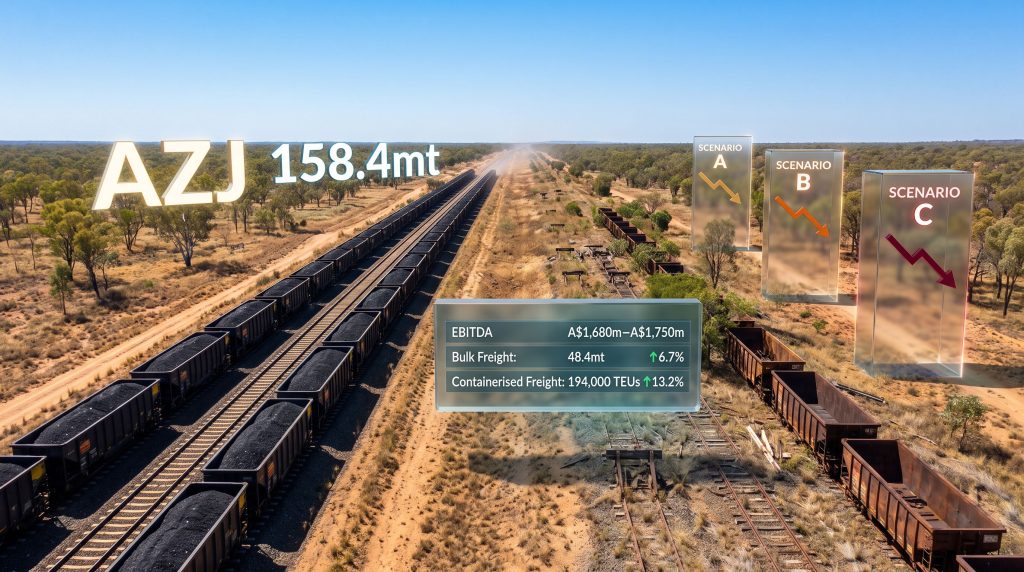
- Coal volumes within that figure totalled 158.4 million tonnes, up 0.8% despite weather-related disruptions in March 2026
- Bulk freight volumes expanded 6.7% to 48.4 million tonnes, supported by grain haulage and the commencement of BHP's South Australian copper contract
- Containerised freight grew 13.2% to 194,000 TEUs, driven by new customer additions
- FY2026 underlying EBITDA guidance was reaffirmed at A$1,680m to A$1,750m
- A temporary fuel cost timing difference is expected to reduce FY2026 EBITDA by approximately A$10 million, with recovery anticipated in subsequent periods
- Shares on issue: 1,683.3 million
One critical detail embedded in these numbers deserves close attention. The FY2026 regulatory volume assumption for the CQCN is 221 million tonnes. Actual full-year volumes are tracking materially below this figure. Yet Aurizon has confirmed it will recognise the full allowable revenue entitlement, including the estimated future revenue cap, within FY2026 earnings. This is the RAB model functioning exactly as designed.
The deeper implication, however, is that coal volumes representing more than 91% of total network throughput (158.4mt out of 173.5mt) demonstrate just how embryonic Aurizon's diversification story remains in volume terms. The growth rates in bulk and containerised freight are encouraging, but the absolute tonnage gap between coal and everything else is vast.
Defining the Scenarios: What Coal Collapse Actually Means
Three Distinct Trajectories, Three Different Risk Profiles
The phrase "coal industry collapse" is analytically imprecise. It conflates commodities with different demand drivers, different replacement technology timelines, and different policy exposure profiles. A rigorous stress-test requires three separate scenarios.
Scenario A: Thermal Coal Structural Decline (Gradual, Policy-Driven)
Thermal coal, used predominantly in power generation, faces an unambiguous structural trajectory. Renewable energy combined with grid-scale storage is now cost-competitive with new coal-fired power in virtually every major market. Japan has committed to phasing out unabated coal-fired power by 2030 under its revised energy plan, while South Korea has set a 2040 phase-out target. These are confirmed policy positions from Queensland's two largest thermal coal export customers. The volume erosion is slow and somewhat predictable, playing out over fifteen to twenty years rather than collapsing suddenly.
For Aurizon, this scenario is painful but manageable. The regulated revenue cap mechanism provides a meaningful buffer during the transition, and the extended timeline creates space for capital reallocation toward bulk and containerised freight. EBITDA impact is gradual, dividend sustainability is likely maintained, and the credit profile remains broadly stable.
Scenario B: Metallurgical Coal Partial Disruption (Slower But Structurally Significant)
Metallurgical coal, used in blast furnace steelmaking, currently enjoys a fundamentally different demand outlook because no commercially scalable substitute exists at the volumes required by global steel production. Green steel market dynamics, however, are advancing rapidly, with producers including SSAB, ArcelorMittal, and POSCO progressing pilot and commercial-scale projects. However, green hydrogen supply chains remain expensive, and full displacement of coal-based steelmaking at global scale is unlikely before the mid-2030s at the earliest.
A partial demand reduction of 20 to 30% in metallurgical coal volumes would strip an estimated A$150 million or more from annual EBITDA through haulage revenue alone. Unlike regulated network shortfalls, haulage losses are permanent. This scenario puts dividends under pressure and elevates credit rating risk. The RAB valuation would face downward pressure as regulators reassess long-term volume assumptions underpinning allowable returns.
Scenario C: Total Coal Industry Collapse (Rapid, Simultaneous)
The most extreme scenario assumes both thermal and metallurgical coal demand collapse within a compressed ten to fifteen year window. This is a low-probability outcome in the near term, but it is not negligible across a twenty-year investment horizon given the pace of decarbonisation policy globally.
Under this trajectory:
- Combined coal revenue loss would represent an estimated A$500 million to A$700 million in annual EBITDA destruction
- The CQCN transitions from a regulated utility to a stranded asset, with maintenance costs exceeding recoverable revenue
- Shareholder returns including dividends and buybacks would be eliminated
- Credit rating downgrades across multiple notches would constrain capital market access
- Asset disposal at distressed valuations becomes the most likely endgame for the network itself
The critical asymmetry here is that the RAB model protects Aurizon from cyclical volume downturns, not structural ones. If coal volumes decline permanently and materially below regulatory assumptions over multiple consecutive periods, the QCA will eventually be compelled to reset allowable revenue, lower RAB growth projections, and shorten the assumed economic life of network assets. The very mechanism that currently provides Aurizon's earnings floor becomes a ceiling that declines over time.
What Analyst Consensus Pricing Implies About Market Risk Perception
Current sell-side consensus forecasts embed Scenario A assumptions almost exclusively, with no material probability weight assigned to Scenario B or C outcomes. Consequently, this creates a valuation disconnect that warrants careful scrutiny when assessing commodity price impacts on miners over the medium term.
| Metric | FY2026E | FY2027E | FY2028E | FY2029E | FY2030E |
|---|---|---|---|---|---|
| Revenue (A$bn) | ~4.15 | ~4.28 | Flat | Flat | Slight decline |
| EBITDA (A$bn) | ~1.72 | ~1.79 | ~1.73-1.74 | ~1.73-1.74 | ~1.73 |
| EPS (cents) | 24¢ | 26¢ | 26¢ | 26¢ | 26¢ |
| Net Profit (A$m) | ~404 | ~438 | ~438 | ~438 | ~438 |
These forecasts describe a business that is stable, slightly growing, and largely flat: revenue edges up through FY2027 before plateauing, EBITDA oscillates within a narrow band, and earnings per share improve modestly before holding. The implicit message is that analysts are pricing in regulatory durability and thermal coal's gradual rather than abrupt exit, with metallurgical coal remaining a stable volume contributor through the decade.
This creates a valuation gap that investors should treat as a live risk. If metallurgical coal disruption from green steel technologies accelerates faster than the consensus timeline implies, earnings deterioration will exceed current market pricing, and the downward re-rating could be sharp rather than gradual.
The Diversification Gap: Can Bulk and Containerised Freight Fill the Void?
Pillar One: Bulk Freight's Strategic Promise and Physical Limitations
The BHP South Australian copper haulage contract represents Aurizon's most strategically significant non-coal win in recent years. It demonstrates that the company can successfully compete for critical mineral haulage on a commercial basis, a trend reinforced by the growing importance of critical minerals in the energy transition. Bulk freight volumes of 48.4 million tonnes over ten months, up 6.7%, show genuine momentum.
However, the arithmetic is sobering. Replacing coal's earnings contribution at scale would require Aurizon to replicate contracts of BHP-equivalent scope dozens of times over. Critical mineral haulage volumes in Australia, while growing, are not remotely comparable to coal throughput on a ten to twenty year horizon. Bulk freight margins are also structurally lower than regulated network returns, meaning the replacement earnings density is inferior even if the volumes materialise.
Pillar Two: Containerised Freight's Role as a Stabiliser, Not a Saviour
Containerised freight grew 13.2% to 194,000 TEUs in the ten-month period, and the growth rate is genuinely impressive. Intermodal rail is structurally well-positioned against road freight on long-haul routes where fuel efficiency advantages are most pronounced. However, this segment operates in a competitive market against road transport operators and other rail logistics providers, with margin profiles considerably below the CQCN's regulated returns.
The role of containerised freight in Aurizon's portfolio is best understood as a stabiliser that reduces earnings volatility rather than a structural growth engine capable of replacing coal's economics.
Pillar Three: Capital Discipline as a Defensive Posture
Aurizon has deliberately moderated capital expenditure on coal-specific infrastructure, preserving cash flow for reallocation rather than over-investing in assets with declining long-term utility. This is rational capital management, but it is a defensive strategy that protects margins in a contracting market rather than driving the earnings growth needed to offset coal's structural decline.
To illustrate the scale of the diversification challenge: if coal EBITDA were to decline by A$500 million over a decade, Aurizon's bulk and containerised freight divisions would need to grow their combined earnings contribution by approximately three to four times from current levels to maintain group stability. At prevailing growth rates, achieving that threshold would require fifteen to twenty years of uninterrupted expansion, a timeline that may not align with the pace of coal's structural exit.
The Regulatory Variable: Aurizon's Most Underappreciated Long-Term Risk
How QCA Regulatory Resets Could Erode the Network's Financial Moat
The CQCN regulatory framework is simultaneously Aurizon's most powerful near-term protection and its most complex long-term vulnerability. The QCA's determination process sets allowable revenue based on long-term volume assumptions, capital return parameters, and network asset life estimates. These inputs are calibrated to the expectation that the CQCN will continue operating as a high-throughput coal export corridor for decades to come.
If coal volumes decline structurally and persistently, the QCA faces growing pressure from access seekers and potentially from Queensland's own policy environment to revise these assumptions downward. A regulatory reset would reduce allowable revenue, lower RAB growth projections, and shorten assumed asset life, progressively eroding the earnings floor that currently insulates Aurizon from volume risk.
Three distinct regulatory trajectories become plausible across the scenario framework:
-
Regulatory Continuity applies while coal volumes remain above a critical throughput threshold. The revenue cap mechanism functions as designed, and Aurizon's earnings remain largely protected. This is the base case for Scenario A.
-
Regulatory Adjustment occurs when the QCA revises long-term volume assumptions downward following sustained structural decline. Allowable revenue decreases gradually but remains positive. This becomes applicable under moderate Scenario B conditions.
-
Regulatory Restructuring involves a fundamental reassessment of the CQCN's economic life and capital return framework. This outcome, possible under Scenario C or an accelerated Scenario B, would materially erode the regulated earnings contribution and fundamentally alter Aurizon's investment thesis.
It is worth noting that Queensland's state government has deep economic interests in maintaining coal export infrastructure, given its role in supporting regional employment and royalty revenue streams. This political dimension may slow regulatory adjustment but cannot indefinitely prevent it if structural coal volume destruction becomes the dominant market reality. Indeed, Aurizon's Australian coal network railings have already shown signs of stress in recent reporting periods, suggesting the regulatory buffer is already being tested.
The next major ASX story will hit our subscribers first
Thermal vs. Metallurgical Coal: The Distinction That Defines Aurizon's Survivability Timeline
Why These Two Commodities Cannot Be Treated as One Risk
The single most important distinction in any Aurizon scenario analysis is the separation of thermal and metallurgical coal risk profiles. Investors who treat coal as a monolithic commodity misunderstand the company's actual exposure timeline. In addition, shifts in China's steel and iron ore market add further complexity to metallurgical coal demand projections.
| Coal Type | Demand Trajectory | Replacement Technology Status | Aurizon Timeline Risk | Regulatory Sensitivity |
|---|---|---|---|---|
| Thermal Coal | Structural decline confirmed | Renewables commercially deployed | High within 15 years | High |
| Metallurgical Coal | Resilient near-term | Green DRI emerging, not at scale | Medium within 20 years | Medium |
| Combined Collapse | Scenario C only | Both at scale simultaneously | Low near-term, elevated long-term | Very High |
Metallurgical coal's defence rests on a physical reality: the thermochemical process by which coke derived from metallurgical coal reduces iron ore to iron within a blast furnace has no commercially equivalent substitute at global steel production volumes today. Green hydrogen DRI requires both affordable green hydrogen and a completely different furnace infrastructure. The capital intensity and supply chain complexity of this transition means metallurgical coal retains a plausible fifteen to twenty year demand runway in volume terms, even as individual producers begin decarbonisation pilots.
Thermal coal faces a categorically different situation. The technology replacing it — utility-scale solar, onshore and offshore wind, and increasingly grid-scale battery storage — is already cost-competitive and rapidly scaling. The replacement is not theoretical. It is commercially deployed and accelerating. Japan's and South Korea's coal phase-out commitments represent confirmed demand destruction with visible policy timelines, not speculative projections.
Understanding this distinction allows investors to frame Aurizon's survivability question with much greater precision. The company likely has fifteen to twenty years of defensible metallurgical coal revenue if green steel technologies develop on their current trajectory. The thermal coal exposure is the near-term structural risk, and the metallurgical coal exposure is the medium-term one. Whether Aurizon's diversification can mature within those windows is the central investment question. For further context, Australian coal's growth outlook over the coming decade remains a subject of active debate among industry analysts.
The Long-Term Investment Verdict: Four Forces, One Commodity
Aurizon's trajectory over the next two decades will ultimately be shaped by four interlocking variables:
- The pace of global coal demand destruction, differentiated by coal type and geography, particularly across Japan, South Korea, China, and India
- The durability of the QCA regulatory framework as structural coal volume decline tests the assumptions underpinning allowable revenue determinations
- The scalability of non-coal freight revenue across bulk commodities, critical minerals, and containerised freight, each carrying lower earnings density than the regulated network
- The viability of Queensland's operating coal mines over a twenty-year horizon, which determines whether haulage revenue erodes gradually or collapses abruptly
The near-term operating picture remains stable. FY2026 EBITDA guidance of A$1,680m to A$1,750m reflects a business generating strong, predictable cash flows. Consensus forecasts project net profit of approximately A$438 million by FY2027, maintained through FY2030. These numbers describe a company that is not in crisis.
However, the long-term question of the Aurizon future if the coal industry collapses is not about near-term performance. It is about whether a 2,670-kilometre network built for a single commodity can reinvent its economic identity before that commodity's global relevance is structurally diminished. The regulatory model buys time. It does not buy transformation. That work falls to management, market conditions, and the pace of a global energy transition that no single company controls.
This article is general in nature and does not constitute financial advice. All forecasts, scenarios, and financial projections discussed are analytical estimates based on publicly available information and are inherently uncertain. Investors should conduct their own research and seek independent financial advice before making investment decisions.
Want To Track The Next Major ASX Mineral Discovery Before The Market Moves?
While Aurizon navigates the structural pressures of coal's long-term decline, the broader commodities landscape is generating significant opportunities in critical minerals and emerging resources — and Discovery Alert's proprietary Discovery IQ model instantly identifies significant ASX mineral discoveries the moment they are announced, delivering real-time, actionable alerts to subscribers. Explore how historic discoveries have generated extraordinary returns and begin your 14-day free trial today to position yourself ahead of the market.