Ausquest Ltd
- ASX Code: AQD
- Market Cap: $76,690,088
AusQuest Drills Into World-Class IOCG Territory at Coober Pedy
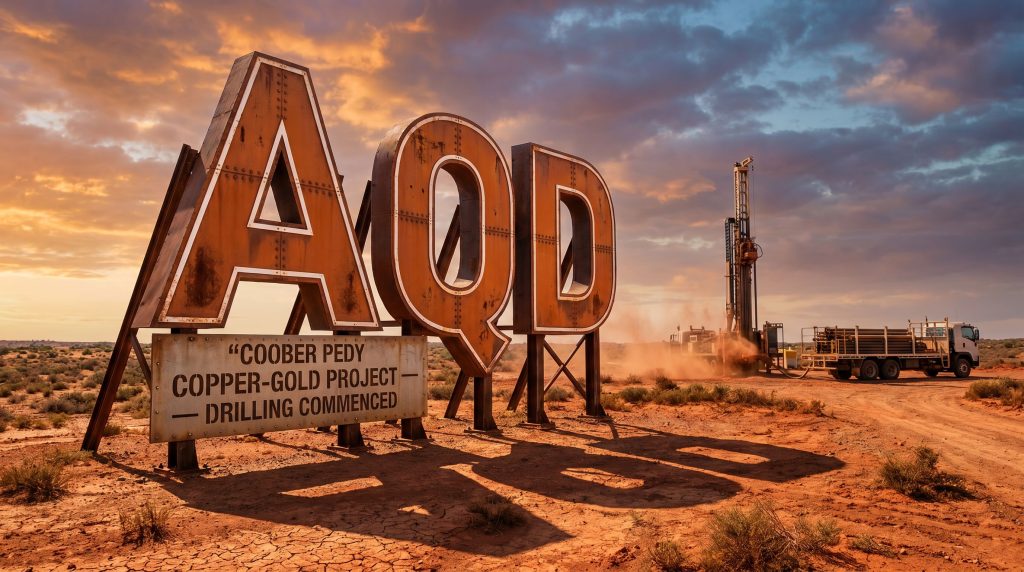
AusQuest Limited (ASX: AQD) has commenced a Reverse Circulation (RC) drilling program at its Coober Pedy Iron-Oxide Copper-Gold (IOCG) Project in South Australia. The AusQuest Coober Pedy IOCG drilling program in South Australia sits at the northern end of the Olympic Dam IOCG Province, home to three world-class copper-gold deposits. With drilling now underway and assay results expected within approximately eight weeks, this marks a pivotal moment for the company as it advances its exploration pipeline in partnership with a major global miner.
When big ASX news breaks, our subscribers know first
A Premier Address in Australian Exploration
Location matters enormously in mineral exploration, and the Coober Pedy Project occupies what many explorers spend decades searching for: a position within a proven, world-class mineral system.
The project sits at the northern end of the Olympic Dam IOCG Province in South Australia, the same geological corridor that hosts three of the most significant copper-gold deposits globally:
- Olympic Dam — the world's largest known uranium deposit and a major copper-gold producer
- Carrapateena — a significant IOCG deposit operated by OZ Minerals (now BHP)
- Prominent Hill — a producing copper-gold mine operated by OZ Minerals (now BHP)
Being positioned within this province gives the Coober Pedy Project a geological pedigree that few early-stage exploration assets can claim. Furthermore, AusQuest is now moving beyond target generation and into active drilling — the moment when geological theory meets ground truth.
What's Happening on the Ground
AusQuest has mobilised an experienced South Australian drilling contractor to the site, located just 10 kilometres from the opal mining township of Coober Pedy. The RC rig is already on site, drilling into priority targets that have been carefully assembled from multiple data sets.
Key Operational Details of the Current Program
| Parameter | Detail |
|---|---|
| Drilling Method | Reverse Circulation (RC) |
| Planned Drill Holes | 10 to 15 vertical holes |
| Planned Depth | Up to 350 metres per hole |
| Sedimentary Cover | 50m to 150m (relatively thin) |
| Target Depth (Mineralisation) | ~250m to 500m |
| Distance from Coober Pedy | 10 kilometres |
| Drilling Duration (Estimate) | Approximately 4 weeks |
| Assay Results Expected | Approximately 4 weeks post-drilling |
One of the more compelling aspects of this project is the cover thickness advantage. Many IOCG targets across Australia are buried beneath more than 500 metres of sedimentary cover, making them expensive and technically challenging to test.
At Coober Pedy, however, the cover sequence sits at a far more manageable 50m to 150m, which meaningfully reduces drilling costs and technical risk at this early-stage exploration phase.
The Target — Built From Multiple Data Layers
The drill targets are not speculative. They have been assembled through a systematic, multi-disciplinary approach combining historical drilling data with modern geophysical surveys — a process that significantly improves the quality of drill targeting.
How Were the Targets Developed?
Target development has drawn from three key data sources:
-
Historical Vale drilling — Two wide-spaced diamond drill holes previously completed by Vale (one of the world's largest mining companies) intersected strong potassic alteration within the eastern-most hole (GAW_RC01). Potassic alteration is a recognised pathfinder for IOCG-style mineralisation.
-
Induced Polarisation (IP) Survey (2025) — Designed specifically to test large-scale, semi-coincident gravity and magnetic anomalies. The survey identified two IP targets with weak to moderate chargeabilities and associated low apparent resistivities, suggesting the presence of disseminated sulphide source rocks at depths of approximately 250m to 500m.
-
Gravity and Magnetic Data — Modelling indicates that the IP targets are semi-coincident with discrete gravity highs of approximately 2 milligals, occurring adjacent to the interpreted Elizabeth Creek Fault zone, a structural corridor considered an important control on IOCG mineralisation in the region.
The combination of these three independent data sources converging on the same area consequently strengthens the geological case for drilling considerably.
Managing Director Graeme Drew on the significance of the moment:
"The Coober Pedy Project has a great address — being located at the northern end of a world-class IOCG Province which hosts the world-class Olympic Dam, Carrapateena and Prominent Hill deposits. We are now in the testing phase to advance these highly prospective targets and look forward to reporting on results when they become available."
Understanding IOCG Deposits — Why Do They Matter to Investors?
What Is an IOCG Deposit?
Iron-Oxide Copper-Gold (IOCG) deposits are a class of mineral system characterised by large volumes of iron oxide minerals (magnetite and hematite) combined with economically significant concentrations of copper, gold, and often uranium, cobalt, and rare earth elements.
They are among the most valuable deposit types in the world because:
- They tend to be very large in scale — often containing billions of tonnes of mineralisation
- They are typically polymetallic, meaning multiple commodities can be recovered, improving project economics
- Olympic Dam, the defining example of the deposit type, contains the world's largest known uranium resource and one of the largest copper deposits on Earth
Why Does Geological Setting Matter?
IOCG deposits are not randomly distributed. They cluster within specific crustal-scale fault systems and geological provinces. The Olympic Dam IOCG Province is one of the most fertile of these globally.
The presence of multiple world-class deposits within the same province suggests a large-scale, sustained mineralising system that may have produced additional deposits not yet discovered at depth or beneath cover.
Key Glossary Terms
| Term | Definition |
|---|---|
| IOCG | Iron-Oxide Copper-Gold — a deposit type characterised by iron oxide minerals with copper and gold |
| RC Drilling | Reverse Circulation drilling — a cost-effective method using compressed air to return rock chips to surface |
| Induced Polarisation (IP) | A geophysical technique that measures how rocks store and release electrical charge, useful for detecting sulphide minerals |
| Potassic Alteration | A chemical change in host rocks involving enrichment of potassium — a common indicator of IOCG-style mineralising systems |
| Gravity Anomaly | A localised variation in the Earth's gravitational field, often caused by dense rocks such as iron oxides at depth |
| Milligal (mGal) | A unit of gravitational acceleration used in geophysical surveys |
| SAA (Strategic Alliance Agreement) | A formal partnership arrangement between AusQuest and a South32 subsidiary for the Coober Pedy Project |
The South32 Strategic Alliance — A Significant Endorsement
The Coober Pedy Project is not being advanced by AusQuest alone. The project is subject to a Strategic Alliance Agreement (SAA) with a wholly-owned subsidiary of South32 Ltd, one of the world's largest diversified mining companies with a market capitalisation measured in the tens of billions of dollars.
Strategic Alliance Agreements of this nature, involving major mining companies, typically reflect a genuine assessment of exploration prospectivity by an organisation with significant technical and geological resources. In addition, the involvement of a South32 subsidiary adds a layer of credibility to the exploration thesis, signalling that the targets being drilled today have been assessed at a level beyond what a junior explorer could typically achieve independently.
What Comes Next — Timeline to Results
The timeline from here is relatively tight, giving investors a near-term catalyst to monitor.
| Milestone | Estimated Timing |
|---|---|
| Drilling Program Completion | ~4 weeks from commencement |
| Final Assay Results | ~4 weeks after drilling completion |
| Results Announcement to ASX | Following receipt and review of assays |
The program of 10 to 15 holes to 350 metres depth represents a meaningful first pass across the highest-priority targets. Importantly, the modelling suggests mineralised source rocks at depths of 250m to 500m, which is well within the planned drill depth range.
This means the current program is genuinely designed to test the core of the target, not just its margins.
The next major ASX story will hit our subscribers first
Why Investors Should Keep a Close Eye on AusQuest
Several factors combine to make this announcement worth tracking for investors with an interest in copper and gold exploration:
World-class province address. The Olympic Dam IOCG Province has already produced multiple globally significant deposits. Exploration within this corridor carries genuine geological merit.
Thin cover advantage. At 50m to 150m of cover, the Coober Pedy targets are comparatively shallow and low-cost to test relative to many IOCG opportunities in Australia, reducing upfront capital intensity at the drill-test stage.
Multi-dataset target quality. The convergence of IP geophysics, gravity anomalies, magnetic data, and historical drilling results from a company of Vale's calibre represents a well-constructed exploration case rather than speculative target generation.
Major mining company partnership. The involvement of a South32 subsidiary through the Strategic Alliance Agreement reflects institutional-level assessment of the project's prospectivity.
Near-term newsflow. With assay results expected approximately eight weeks from commencement, this is an exploration story with a defined, near-term catalyst window.
Key Takeaway:
The AusQuest Coober Pedy IOCG drilling program in South Australia has positioned the company as an active explorer in one of Australia's most celebrated IOCG provinces, with drill bits now turning on targets supported by multiple independent geophysical and geochemical data sets. With assay results anticipated within approximately eight weeks, and a Strategic Alliance Agreement with a South32 subsidiary underpinning the project, the Coober Pedy IOCG Project represents a compelling near-term catalyst for investors monitoring the junior copper-gold exploration space.
Ready to Dig Deeper Into AusQuest's Coober Pedy IOCG Project?
With drilling now underway in one of Australia's most celebrated copper-gold provinces, and assay results expected within approximately eight weeks, AusQuest Limited (ASX: AQD) represents a compelling near-term exploration story backed by world-class geology and a Strategic Alliance Agreement with a South32 subsidiary. Investors looking to learn more about AusQuest's projects and exploration pipeline can visit the company's official website at www.ausquest.com.au.