Austral Gold Ltd
Austral Gold Reports Surface Silver-Gold Results at Juncal as Maiden Drilling Approaches
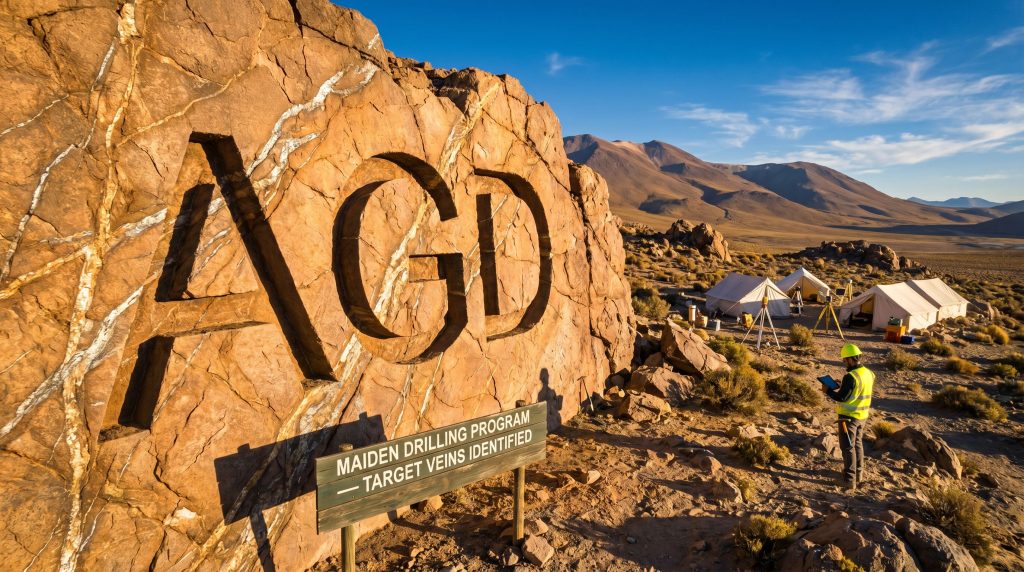
Austral Gold Limited (ASX: AGD) has reported broad surface confirmation of silver-gold mineralisation at its 100%-owned Juncal Silver-Gold Project in northern Chile, with seven of eleven mapped veins returning mineralised channel results in Phase 1 exploration. According to the ASX announcement, the update moves the Juncal silver-gold project closer to its first known drill test, with Phase 2 induced polarisation (IP) surveys underway and a planned 10,000-metre Reverse Circulation (RC) drilling program scheduled for Q3 2026.
For investors, the central point is clear. Juncal is an undrilled epithermal vein project within Austral Gold's Chilean portfolio, and the surface work reported in the release has provided the first systematic dataset to rank targets ahead of drilling.
When big ASX news breaks, our subscribers know first
Phase 1 Results Point to Multiple Mineralised Veins
In the announcement, Austral Gold said Phase 1 was completed during March to April 2026 and included detailed mapping, more than 1,000 metres of channel sampling across trenches, drone-supported magnetic surveying, and multispectral satellite imagery interpretation. The trenching program generated 602 samples from 53 trenches, with assays covering gold, silver, copper, lead, zinc and antimony.
The headline outcome was the confirmation of continuous surface mineralisation across seven veins, with the Javiera, Sofia and Koda veins identified as the main initial priorities.
| Vein | Strike length | Average grade | Average width | AgEq accumulation | Channels sampled |
|---|---|---|---|---|---|
| Javiera | ~1,400 m | 183 g/t AgEq | 0.7 m | 128 g/t·m | 25 |
| Sofia | ~500 m | 68 g/t AgEq | 1.8 m | 122 g/t·m | 15 |
| Koda | ~500 m | 71 g/t AgEq | 1.8 m | 128 g/t·m | 7 |
Austral Gold noted that these are channel widths, not true widths, and true widths are interpreted to be lower. That distinction matters because channel sampling provides a surface indication of grade and continuity, but drilling is needed to confirm geometry at depth.
Javiera was the standout structure in the report. The company described continuous mineralisation over about 1,400 metres of strike, with individual channel results ranging from 40 g/t to 392 g/t silver equivalent (AgEq) across mineralised channel widths of 0.4 metres to 1.5 metres.
Selected Javiera Highlights
Selected Javiera highlights from the ASX release included:
- TR-JAV021: 392.5 g/t AgEq over 0.58 m
- TR-JAV012: 385.0 g/t AgEq over 0.53 m
- TR-JAV016: 305.6 g/t AgEq over 0.46 m
- TR-JAV025: 296.2 g/t AgEq over 0.55 m
- TR-JAV030: 295.5 g/t AgEq over 0.67 m
The broader dataset also showed mineralised intervals on the Romané, Carolina, Mia and Edith veins. That wider spread is important because it suggests the Juncal silver-gold project is not a single-target project at surface.
Results Across Additional Veins
Selected examples from other veins include:
- Romané: TR-ROM004 returned 146.1 g/t AgEq over 1.2 m
- Carolina: TR-CP001 returned 87.4 g/t AgEq over 7.22 m, including 179.0 g/t AgEq over 1.52 m
- Sofia: TR-SOF003 returned 100.9 g/t AgEq over 2.91 m, including 149.9 g/t AgEq over 0.90 m
CEO Commentary Highlights the Undrilled Nature of the Project
Austral Gold framed Juncal as an early-stage but technically promising target within the Paleocene belt of northern Chile.
"Juncal is an underexplored silver-gold project at the Paleocene belt within our northern Chile portfolio. Phase 1 has identified silver-gold mineralisation at surface across multiple veins and provides a basis for drill targeting. To date, and despite the presence of mapped mineralised structures and historical workings, the Project has not been drill tested."
— Stabro Kasaneva, CEO, Austral Gold Limited
That final point is one of the most important parts of the announcement. According to the company, no historical or modern drilling is known to have been undertaken at Juncal, meaning the planned campaign would be the first systematic test of subsurface continuity.
Structural Interpretation Has Sharpened Target Selection
The ASX update also outlined an updated structural model for the project area. Austral Gold now interprets three main vein trend systems across the district.
| Structural system | Trend | Example veins | Interpretation |
|---|---|---|---|
| NW-trend | Dominant and oldest | Gloria | Primary structural corridor |
| NE-trend | Secondary | Barreales, Romané, Sofia, Carolina, Mia, Isidora | Offsets Gloria through dextral displacement |
| ENE-trend | Later conjugate set | Javiera, Koda, Edith | Associated with a later deformation event |
Why does this matter? In epithermal vein systems, intersections between major structures can act as channels for mineral-rich fluids. According to the company, the intersection of the Gloria and Romané systems in the north-western part of Juncal coincides with a broad hydrothermal alteration zone and has been identified as a priority target.
In practical terms, that means future drilling is not expected to test only surface grades. It is also expected to test whether structural intersections focused fluid flow and led to stronger mineral deposition at depth.
Furthermore, Austral Gold also reported tourmaline breccia bodies in the eastern part of the project, mainly within intrusive rocks. In simpler terms, these are broken-rock zones altered by hot mineral-bearing fluids. Their presence may indicate a more complex hydrothermal system than surface sampling alone would suggest.
What Is an Intermediate Sulfidation Epithermal Deposit?
Juncal is described in the release as an Intermediate Sulfidation (IS) epithermal deposit. For investors who do not follow geology closely, understanding that deposit style helps explain why Austral Gold is prioritising the project.
An epithermal deposit forms when hot fluids move upward through cracks in the Earth's crust and deposit metals such as gold and silver at relatively shallow depths. These deposits often form veins and breccias, which are broken-rock zones filled with minerals.
How Does Intermediate Sulfidation Fit In?
Intermediate sulfidation systems sit between the better-known high-sulfidation and low-sulfidation styles. They are commonly associated with:
- Quartz-carbonate veins controlled by faults and fractures
- Sulfide minerals such as sphalerite, galena, stibnite and chalcopyrite
- Vein textures that suggest repeated pulses of fluid movement
- Economic potential for both gold and silver
At Juncal, the company reported that mineralisation occurs mainly in structurally controlled quartz-carbonate-base metal sulfide veins, hydrothermal breccias and associated stockworks. This matches the characteristics of an intermediate sulfidation system.
For investors, the relevance is that this deposit style is already known in the Paleocene metallogenic belt of northern Chile, where Austral Gold also operates Amancaya and Guanaco. That does not confirm economic outcomes at Juncal, but it does provide geological context for why the company considers the project prospective.
Glossary of Key Terms
- AgEq: Silver equivalent, a way of combining gold and silver grades into a single silver-based number using assumed metal prices.
- Channel sampling: A surface sampling method where rock is cut along a line to measure grade and width.
- Strike length: The horizontal distance along which a vein or mineralised zone can be traced.
- IP survey: A geophysical method used to detect underground chargeable materials, often linked to sulfide minerals.
- RC drilling: Reverse Circulation drilling, a common and relatively cost-effective drilling method used in early exploration.
- NSR: Net Smelter Return royalty, a percentage of future metal sales payable to a royalty holder.
QA/QC Detail Strengthens Confidence in the Reported Data
A notable feature of the ASX release was the amount of detail provided on quality assurance and quality control, or QA/QC. For exploration-stage projects, the quality of assay data can materially affect how investors assess technical credibility.
Austral Gold stated that its QA/QC program included:
- 31 field duplicates inserted at roughly a 5% rate
- Standards and blank samples inserted through the sample stream
- Primary assays conducted at Guanaco Compañía Minera SpA
- 20 representative samples sent to external laboratory Cotecna-AGS for independent verification
- A reported R² of 0.9884 for silver after updating the internal silver digestion method to a 4-acid digestion
- Analytical duplicate repeatability of R² = 0.9998 for gold and R² = 0.9997 for silver
- Blank results remaining below five times the lower detection limit
- Certified reference materials performing within accepted control limits
One of the more relevant technical disclosures was the company's handling of silver assays. The original internal protocol used aqua regia digestion, but comparison with the external laboratory showed that a 4-acid digestion was more appropriate for silver recovery in this dataset.
Austral Gold then stated that 100% of trench and chip-channel samples were re-analysed under the updated method to ensure a consistent database. That kind of adjustment does not change the early-stage nature of the project, but it does suggest the company took steps to improve analytical consistency before presenting the final results.
Next Steps: Geophysics Now, Drilling in Q3 2026
The next phases of the Juncal program are already laid out in the announcement.
| Phase | Timing | Activity | Purpose |
|---|---|---|---|
| Phase 1 | March to April 2026 | Mapping, trench channel sampling, magnetic survey, satellite interpretation | Surface confirmation and target ranking |
| Phase 2 | June to August 2026 | IP survey | Refine drill targets and assess sulfide distribution |
| Phase 3 | September to November 2026 | ~10,000 m RC drilling | Test down-dip continuity and subsurface mineralisation |
According to the company, the drilling is planned to use company-owned equipment operated by DV Drilling. The holes are intended to test down-dip extensions of mapped structures and mineralisation potential below surface, including in areas with no direct outcrop exposure.
For the market, the key catalyst remains the same: the first drill campaign into an undrilled vein system that has already returned numerous mineralised surface channels.
The next major ASX story will hit our subscribers first
Why Juncal Matters Within Austral Gold's Wider Portfolio
The Juncal silver-gold project update is relevant not only because of the grades reported, but because of where the project sits within Austral Gold's asset base. The company said Juncal covers about 2,100 hectares and is located roughly 70 km south of Guanaco and 35 km east of Amancaya, both within its Chilean operations and exploration portfolio. Juncal is also subject to a 1% NSR royalty held by Elemental Royalty Corporation.
From an investor perspective, several points stand out:
- Undrilled status: Juncal remains a first-test exploration story rather than a follow-up drilling story.
- Multiple target areas: Seven mineralised veins provide more than one target for follow-up.
- Near-term catalysts: IP results and maiden drilling are both scheduled within 2026.
- District context: The project sits within a belt known for epithermal gold-silver systems.
- Operating company exposure: Austral Gold is an established producer, which may support in-country technical and operational capacity.
None of these points confirms a commercial outcome. However, the Phase 1 results reported to the ASX indicate that Juncal has moved beyond reconnaissance and into a more defined targeting stage.
For investors tracking ASX gold and silver exploration stories, that shift matters. Surface channel results alone do not establish a resource, but they can identify which structures merit first-pass drilling. At the Juncal silver-gold project, Austral Gold's latest report suggests several such targets are now lined up for testing.
Want to Be First to Know When the Next Major Silver-Gold Discovery Hits the ASX?
Discovery Alert's proprietary Discovery IQ model scans ASX announcements in real time, instantly identifying significant mineral discoveries like emerging silver-gold exploration stories and converting complex data across 30+ commodities into clear, actionable insights — explore historic discovery returns on Discovery Alert's dedicated discoveries page to understand what early positioning can mean, then begin your 14-day free trial to stay ahead of the market.