Global Mining Sector Transformation Through Strategic Resource Control
The modern commodity landscape has witnessed unprecedented shifts in global supply chain dynamics, driven by technological disruption and evolving industrial demands. This transformation becomes particularly evident when examining how specific nations leverage their geological advantages to establish market dominance across critical mineral sectors. Furthermore, understanding these strategic positioning frameworks provides essential insights for investors, policymakers, and industry stakeholders navigating an increasingly complex resource environment, particularly regarding australia lithium exports.
Australia's Lithium Export Infrastructure and Strategic Market Position
Australia has systematically developed one of the world's most sophisticated lithium export networks, establishing itself as the dominant global supplier through strategic infrastructure investment and geological advantages. The country's australia lithium exports operations span multiple specialised port facilities, each optimised for bulk mineral handling and international distribution.
The infrastructure network centres on several key export hubs that facilitate efficient movement from mine sites to global markets. Bunbury Port serves as the primary export gateway, handling approximately 155,700 tonnes in November 2024 alone, representing a 21% monthly increase. This facility primarily serves operations from the Greenbushes complex, which ranks among the world's oldest and most productive lithium mining sites.
Port Hedland, traditionally known for iron ore exports, has expanded its capabilities to accommodate lithium shipments, processing 122,000 tonnes in November 2024. The port's strategic location in Western Australia's Pilbara region provides direct access to multiple mining operations, creating logistical efficiencies that reduce transportation costs and improve supply chain reliability.
Regional Export Distribution:
- Esperance Port: 61,400 tonnes (87% monthly growth)
- Geraldton Port: 44,500 tonnes (stable performance)
- Fremantle Port: 18,600 tonnes (emerging capacity)
The geographic concentration of these facilities within Western Australia creates significant competitive advantages through reduced inland transportation requirements and specialised handling capabilities. This infrastructure investment represents decades of strategic planning and capital deployment, creating substantial barriers to entry for potential competitors. Moreover, these developments are closely aligned with broader australia lithium industry innovations that continue to enhance operational efficiency.
Mining Operations and Production Capacity Analysis
Australia's lithium production landscape encompasses multiple world-class operations, each contributing to the country's overall export capacity. The Greenbushes Complex stands as the cornerstone facility, operating as the world's oldest commercial lithium extraction site with premium-grade deposits that consistently deliver high-quality spodumene concentrate.
The Pilgangoora Hub represents large-scale extraction capabilities designed for maximum throughput efficiency. Located in the established Pilbara mining region, this facility benefits from existing infrastructure networks and skilled workforce availability. Production operations utilise advanced processing technologies to achieve optimal recovery rates from the underlying pegmatite formations.
Mt Marion Joint Venture demonstrates the international partnership model increasingly common in Australian lithium development. This facility operates under a strategic alliance structure that combines local operational expertise with international capital and market access. The operation sends processed spodumene to Esperance Port for global distribution, primarily targeting Chinese processing facilities.
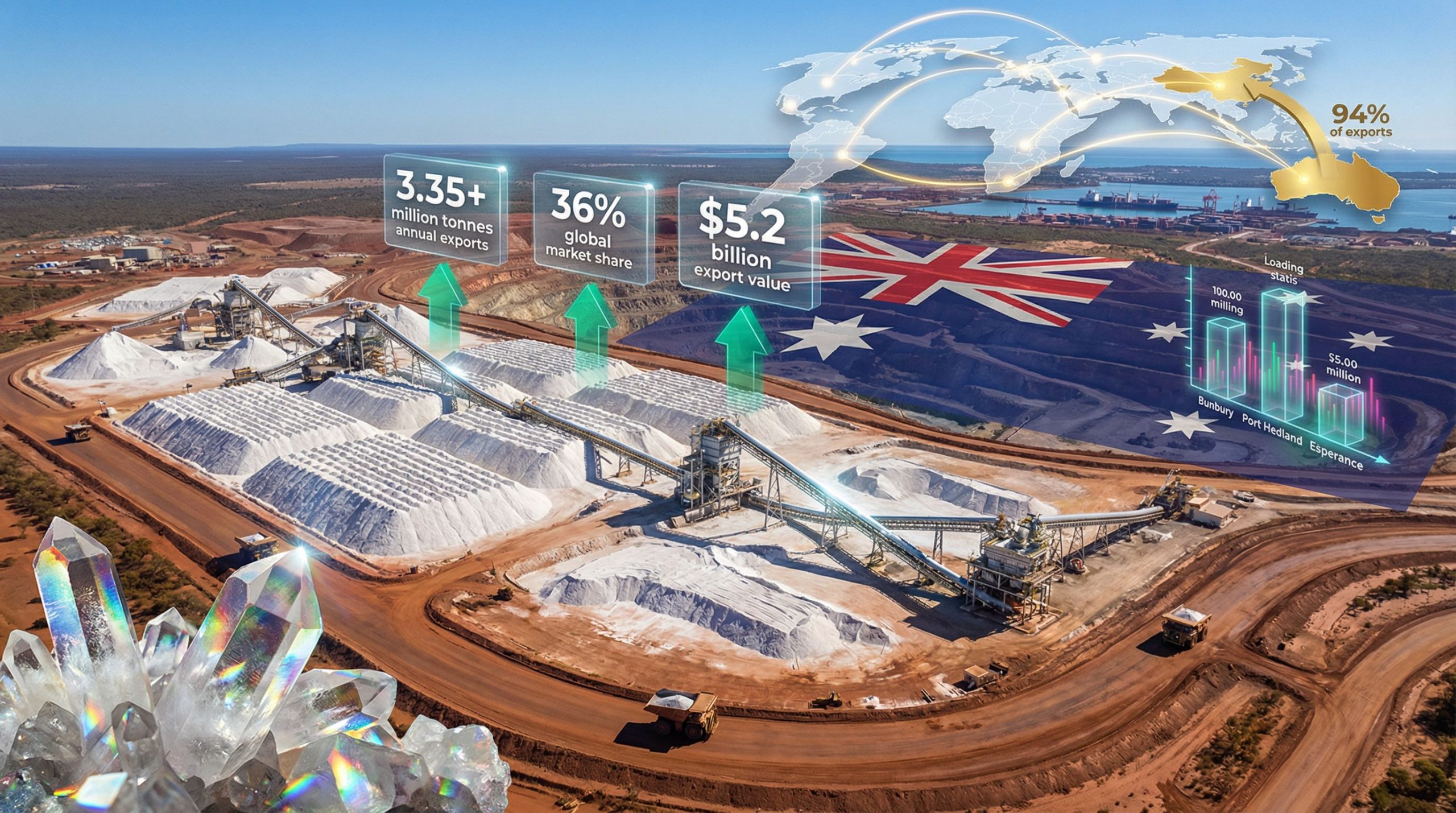
Additional production centres include the Wodgina Operations, Mt Holland Development, and Kathleen Valley Project, each representing different phases of industry expansion. These facilities collectively contribute to Australia's annual spodumene concentrate exports of 3.35+ million tonnes, supporting the country's 36% global market share.
Production Quality Metrics:
- Average spodumene concentrate grade: 6% lithium oxide content
- Recovery rates: 75-85% from raw ore processing
- Processing capacity: Expanding toward 4.5 million tonnes annually
- Quality consistency: Meeting international battery-grade specifications
Industry professionals regularly gather to discuss these developments at the wa mining conference 2025, where key stakeholders share insights and strategies for continued growth.
Export Destination Markets and Trade Flow Analysis
China dominates australia lithium exports with overwhelming market concentration, absorbing 94% of total spodumene shipments during the first half of 2025. This bilateral trade relationship involves 1.86 million tonnes of the 1.98 million total exports, highlighting the strategic importance of Chinese processing capacity in global lithium supply chains.
The concentration risk inherent in this trade relationship has prompted efforts toward market diversification, though alternative destinations remain relatively small by comparison. Indonesia has emerged as the second-largest importer, increasing purchases by 165% year-over-year to reach 66,678 tonnes in the first half of 2025. This growth reflects Indonesia's aggressive battery materials processing ambitions and desire to capture greater value-added manufacturing.
South Korea presents an interesting countertrend, with imports declining 33% year-over-year to approximately 45,000 tonnes. This reduction indicates successful domestic refining capacity development and strategic efforts to reduce dependence on Chinese processing infrastructure. Consequently, South Korean battery manufacturers are investing heavily in direct lithium processing capabilities to secure supply chain independence.
Japan maintains stable import levels at approximately 15,000 tonnes, representing consistent industrial demand from established battery manufacturers. The United States accounts for roughly 10,000 tonnes with growing trend momentum, reflecting domestic battery production expansion and strategic supply chain diversification initiatives.
| Destination Market | Volume (tonnes) | Market Share | Strategic Importance |
|---|---|---|---|
| China | 1,860,000 | 94% | Primary processing hub |
| Indonesia | 66,678 | 3.4% | Emerging manufacturing center |
| South Korea | 45,000 | 2.3% | Technology integration focus |
| Japan | 15,000 | 0.8% | Established industrial demand |
| United States | 10,000 | 0.5% | Strategic supply diversification |
However, global recycling initiatives, particularly the chinese battery recycling breakthrough, may influence future demand patterns for raw lithium materials.
Geological Advantages and Resource Quality Assessment
Western Australia's lithium deposits benefit from exceptional geological formations developed over billions of years of tectonic activity. The region's pegmatite formations contain some of the world's highest-grade lithium concentrations, creating natural competitive advantages that competitors struggle to replicate through technological advancement alone.
These ancient rock formations concentrate lithium-bearing minerals through specific geological processes that occurred during the Archean and Proterozoic eras. The Yilgarn Craton and surrounding geological structures provide multiple deposit types, including hard-rock spodumene and lepidolite formations that yield consistent mineral grades suitable for commercial extraction.
Geological Characteristics:
- Deposit Age: 2.5-3.8 billion years (Archean period)
- Formation Type: Pegmatite intrusions with high-grade concentrations
- Mineral Composition: Primarily spodumene with accessory lepidolite and petalite
- Grade Distribution: 1.2-2.5% lithium oxide content in raw ore
- Resource Continuity: Consistent mineralisation over extensive strike lengths
The technical processing characteristics of Australian spodumene provide additional competitive advantages. The mineral's crystalline structure responds well to conventional processing methodologies, achieving high recovery rates through flotation and magnetic separation techniques. This processing efficiency translates to lower operational costs and higher-quality final products.
Furthermore, Australia's geological advantages become more significant when compared to emerging competitors like thacker pass lithium production in the United States, which faces different geological challenges and processing requirements.
Price Dynamics and Market Valuation Trends
Australian australia lithium exports demonstrate remarkable volatility patterns that reflect both supply-demand fundamentals and speculative market dynamics. Recent pricing recovery shows 6% grade spodumene concentrate advancing from $920-980 per tonne in November 2024 to $1,170-1,235 per tonne by December 2024, representing a 25-30% price appreciation within a single month.
This pricing recovery reflects several underlying market factors, including strategic inventory building by Chinese processors preparing for first-quarter 2026 production schedules. Chinese salt plants have demonstrated increased urgency in securing sufficient feedstock supplies, creating upward pressure on spot market pricing despite previous oversupply conditions.
Revenue Trajectory Analysis:
- Current Export Value: $5.2 billion (FY2025 forecast)
- Projected Peak Value: $8.2 billion (FY2030)
- Real Terms Growth: 58% increase over five-year period
- Share of Total Resources: 3% of Australia's resource exports (growing)
The sector's economic contribution extends beyond raw tonnage figures to encompass employment generation, infrastructure development, and technological advancement. According to official Australian Bureau of Statistics data, Australian lithium exploration expenditure has increased dramatically from US$1.4 million in 2015 to US$298 million in 2024, representing 27% of global exploration investment and indicating sustained confidence in resource expansion potential.
Market Psychology Factors:
- Inventory Cycles: Chinese processors rebuilding strategic stockpiles
- Supply Chain Security: Increasing focus on diversified sourcing
- Price Discovery: Transition from spot markets to contract-based pricing
- Investment Sentiment: Growing institutional interest in battery materials
Additionally, broader macroeconomic factors such as us–china trade impact continue to influence pricing dynamics and strategic decision-making across the lithium supply chain.
Technical Processing and Quality Specifications
Australian spodumene concentrate meets stringent international specifications required for battery-grade lithium production. The processing methodology involves multiple stages designed to achieve consistent quality parameters while maximising recovery rates from the underlying ore bodies.
Primary Processing Stages:
- Crushing and Grinding: Reducing ore size to optimal liberation specifications
- Flotation Separation: Concentrating spodumene through selective flotation chemistry
- Magnetic Separation: Removing iron-bearing contaminants
- Final Concentration: Achieving target grade specifications through multiple cleaning cycles
The technical specifications achieved through this processing approach consistently meet battery manufacturer requirements for lithium carbonate and lithium hydroxide production. 6% grade concentrate represents the industry standard, though some operations achieve higher concentrations depending on ore characteristics and processing optimisation.
Quality Control Metrics:
- Lithium Oxide Content: 6.0-6.2% (battery-grade standard)
- Iron Content: <0.5% (critical for processing efficiency)
- Moisture Content: <10% (shipping and handling requirements)
- Particle Size Distribution: Optimised for downstream processing
Competitive Positioning and Strategic Advantages
Australia maintains multiple reinforcing competitive advantages that create substantial barriers to entry for potential competitors in global lithium markets. These advantages span geological endowment, infrastructure development, regulatory stability, and technical expertise accumulated over decades of mining experience.
The geological endowment represents the fundamental competitive moat, as the unique pegmatite formations cannot be replicated through technological advancement or capital investment. This natural advantage provides sustainable competitive positioning that competitors must overcome through alternative approaches or significantly higher cost structures.
Infrastructure integration creates operational efficiencies through dedicated transportation networks, specialised port facilities, and optimised supply chain coordination. The decades of capital investment in these systems represent substantial sunk costs that new entrants would need to duplicate to achieve comparable cost structures.
Regulatory stability provides predictable investment environments with clear property rights and consistent policy frameworks. This stability enables long-term capital planning and reduces political risk premiums that affect project financing costs and investment decision-making.
Core Competitive Factors:
- Resource Quality: Premium-grade deposits with consistent mineralisation
- Processing Efficiency: Optimised extraction and concentration methodologies
- Logistical Integration: Seamless mine-to-port transportation networks
- Market Access: Established relationships with international processors
- Capital Availability: Access to project financing and expansion capital
Recent Export Finance Australia reports confirm that strong mine output continues to support Australia's dominant position in global lithium markets.
Market Challenges and Strategic Risk Assessment
Current market dynamics present both opportunities and challenges for Australia's lithium export sector. The extreme concentration of exports to China creates vulnerability to demand fluctuations, policy changes, and bilateral trade tensions that could significantly impact revenue generation and market access.
Price volatility remains a persistent challenge, with commodity cycles impacting revenue predictability and long-term investment planning. The recent price recovery demonstrates potential upside opportunities, but historical patterns suggest continued volatility as supply-demand dynamics evolve with global electric vehicle adoption rates.
Competition emergence from North American and African projects threatens long-term market share retention. These alternative supply sources benefit from government support, strategic partnerships with battery manufacturers, and proximity to key consumption markets that may reduce dependence on Australian supplies.
Processing dependency limits value capture opportunities, as most australia lithium exports consist of raw concentrate requiring further processing to produce battery-grade chemicals. This structural limitation reduces profit margins and creates dependence on Chinese processing infrastructure for market access.
Strategic Risk Categories:
- Market Concentration: Over-reliance on Chinese demand
- Commodity Cycles: Revenue volatility from price fluctuations
- Competitive Pressure: Emerging alternative supply sources
- Value Chain Position: Limited domestic processing capability
- Regulatory Changes: Potential export restrictions or taxes
Future Market Evolution and Strategic Outlook
Australia's lithium export trajectory appears sustainable through 2030, supported by continued exploration success, infrastructure investment, and growing global battery demand. However, maintaining market leadership will require strategic adaptation to changing competitive dynamics and evolving customer requirements.
Global lithium extraction is forecast to grow at nearly 10% annually through 2030, driven primarily by European Union and Chinese electric vehicle adoption policies. This demand growth provides market expansion opportunities, though increased competition may pressure market share and pricing power.
The sector's evolution toward higher value-added processing represents both opportunity and necessity for maintaining competitive positioning. Government incentives for domestic processing development could enable Australian companies to capture greater value creation while reducing dependence on Chinese refining capacity.
Market diversification strategies become increasingly important as alternative buyers develop processing capabilities and seek supply chain security. Growing demand from non-Chinese battery manufacturers creates opportunities for long-term supply agreements and premium pricing arrangements.
Strategic Success Factors:
- Processing Capacity Development: Domestic lithium chemical production
- Technology Innovation: Advanced extraction and processing methodologies
- Market Diversification: Reducing dependence on single-destination exports
- Strategic Partnerships: Joint ventures with international manufacturers
- Infrastructure Optimisation: Continued efficiency improvements and capacity expansion
The long-term sustainability of Australia's lithium export dominance depends on successfully navigating these strategic challenges while leveraging inherent geological advantages and established market positions. Companies and investors that adapt quickly to changing market dynamics will be best positioned to capitalise on the continuing global transition toward battery-powered transportation and energy storage systems.
Ready to Capitalise on Australia's Lithium Export Dominance?
Discovery Alert's proprietary Discovery IQ model delivers instant notifications on significant ASX mineral discoveries, including lithium opportunities that could benefit from Australia's strategic market positioning. Explore Discovery Alert's dedicated discoveries page to understand how major mineral discoveries have generated substantial returns, then begin your 30-day free trial today to position yourself ahead of the market.