August 21, 2026
Australia's lithium processing landscape has reached a critical inflection point, with domestic hydroxide production capabilities becoming essential for national supply chain security. The traditional model of raw material export to overseas refineries is giving way to integrated operations that capture higher-margin downstream value within Australian borders. This transformation represents more than operational efficiency – it signals a fundamental shift toward securing strategic mineral processing capacity amid global supply chain uncertainties, particularly as the Australia lithium industry evolves to meet growing domestic and international demand.
Vertical Integration Redefines Australian Lithium Processing Architecture
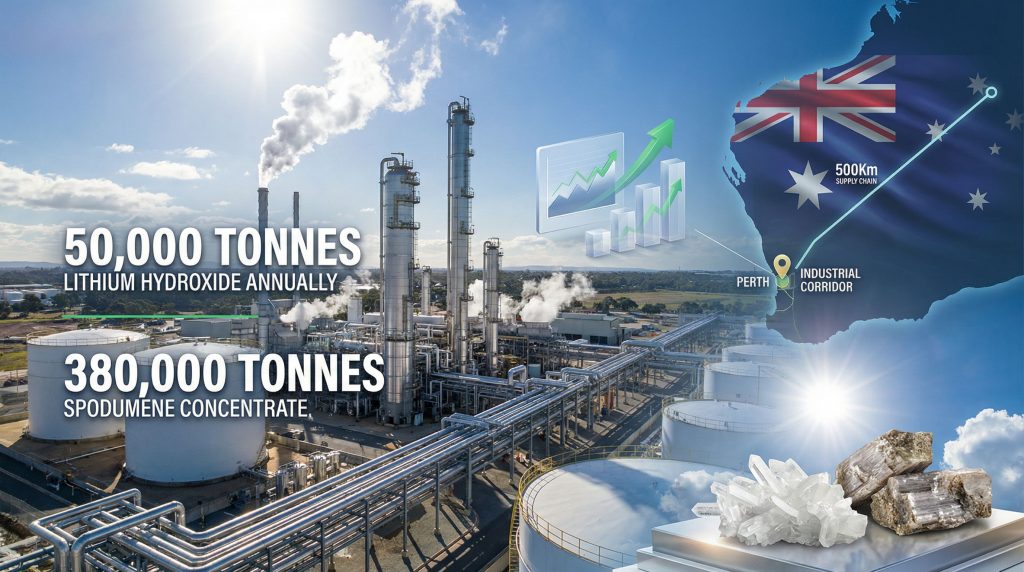
The Mt Holland-Kwinana operation exemplifies how vertical integration can revolutionise Australia's position in the global lithium value chain. This integrated model spans 500 kilometres from mine to refinery, connecting spodumene concentrate production at Mt Holland with battery-grade lithium hydroxide conversion at the Kwinana facility, strategically positioned 42 kilometres south of Perth's established industrial corridor.
Strategic Supply Chain Integration Across Western Australia
The Covalent Lithium joint venture operates on a scale designed to supply battery materials for approximately 1 million electric vehicles annually through its target production capacity of 50,000 tonnes of lithium hydroxide. This output requires processing approximately 380,000 tonnes of spodumene concentrate annually from the Mt Holland mine, establishing one of the world's most significant integrated lithium processing operations.
Traditional Australian lithium operations, including established facilities like Greenbushes, have historically focused on spodumene concentrate production for export to international refineries, particularly in China. The Mt Holland-Kwinana integration breaks this pattern by establishing complete domestic processing capability, enabling Australian producers to capture downstream processing margins while reducing dependency on overseas conversion capacity.
Processing Technology and Conversion Efficiency
The technical specifications of the integration demonstrate sophisticated mineral processing capabilities. Furthermore, these specifications align with global standards for battery-grade lithium refinery operations worldwide.
- Spodumene concentrate grade: 5.8-6.0% Li₂O through flotation and magnetic separation
- Conversion ratio: 5.5-6.0 tonnes of concentrate required per tonne of lithium hydroxide
- Processing methodology: Sulfuric acid leaching, purification stages, and crystallisation to battery-grade specifications
This conversion process positions the operation to serve Asia-Pacific EV battery manufacturers requiring lithium hydroxide meeting strict quality specifications, including ≥56.5% Li₂O equivalent with minimal iron (<10 ppm) and sodium (<20 ppm) impurities.
When big ASX news breaks, our subscribers know first
Mt Holland Kwinana Ramp-Up Demonstrates Operational Resilience
The commissioning timeline for the Kwinana refinery has progressed through several critical milestones, with major construction completion achieved in July 2025 below initial cost estimates. First battery-grade lithium hydroxide production commenced during the same month, marking the transition from construction to operational phases. However, the Mt Holland Kwinana ramp-up has faced some technical challenges that demonstrate the complexity of modern lithium processing operations.
Production Performance During Scale-Up Phase
Operational metrics from the first half of fiscal year 2026 demonstrate steady progress during the ramp-up period:
| Performance Metric | H1 FY2026 Results |
|---|---|
| Wesfarmers' share of spodumene concentrate | 98,000 tonnes |
| Lithium business earnings contribution | $6 million |
| Performance trend | Improving throughout period |
| Revenue recognition status | Costs capitalised during ramp-up |
The production performance showed consistent improvement throughout the reporting period, with interim spodumene concentrate sales generating positive cash flows while refinery optimisation continued. This dual-revenue approach – concentrate sales during ramp-up and planned hydroxide production at scale – provides operational flexibility and cash flow stability.
Accounting Treatment and Commercial Production Criteria
Under International Financial Reporting Standards, costs incurred during the ramp-up phase continue to be capitalised to the refinery asset until commercial production achievement. This accounting treatment indicates that as of December 2025, the joint venture partners had not yet classified operations as having reached full commercial production status.
Commercial production determination typically requires several key criteria to be met consistently:
- Throughput achievement: Processing facility reaching approximately 80%+ of design capacity
- Product quality consistency: Battery-grade specifications maintained across production runs
- Operational stability: Management assessment of transition from optimisation to revenue-generating production
Engineering Solutions Address Operational Optimisation Challenges
The extended Mt Holland Kwinana ramp-up timeline primarily results from intermittent odour management issues identified during commissioning phases. Engineering works initiated in August 2025 target resolution by mid-2026, representing a 9-12 month optimisation period beyond initial commissioning.
Technical Analysis of Processing Facility Emissions
Odour emissions from lithium hydroxide refinery operations typically originate from several processing stages. In addition, these emissions can affect both operational efficiency and community relations around industrial facilities.
- Acid leaching operations: Sulfuric acid digestion can generate hydrogen sulfide if sulfur-containing mineral impurities are present
- Impurity removal processes: Iron removal stages may produce chlorine-based compounds from precipitation agents
- Crystallisation systems: Evaporative processes can release volatile organic compounds from process water
- Thermal management: Cooling and condensation systems may concentrate volatile emissions
Engineering Solutions Framework
Industry-standard remediation approaches for similar processing facilities include comprehensive emission control systems. For instance, the operational update from Covalent Lithium provides additional details on recent progress.
- Installation of caustic or biological scrubbing systems
- Process air stripping with activated carbon filtration
- Enhanced condensation recovery to minimise volatile release
- Alternative precipitation chemistry to reduce emission sources
- Upgraded ventilation and air handling capacity
The targeted mid-2026 completion timeline suggests engineering solutions have been identified and are implementable without fundamental process redesign. This timeframe aligns with industry precedents for similar optimisation challenges at complex mineral processing facilities.
Strategic Joint Venture Structure Leverages Complementary Expertise
The Covalent Lithium partnership combines SQM's global lithium market expertise with WesCEF's Australian industrial infrastructure capabilities through a 50:50 ownership structure. This joint venture model enables both partners to contribute specialised knowledge while sharing operational risks and capital requirements.
SQM's Global Market Integration
Sociedad Química y Minera de Chile contributes decades of lithium production experience from operations in Chile's Atacama region, where the company produces over 700,000 tonnes of lithium carbonate equivalent annually. SQM's contribution includes:
- Advanced processing technology developed through 25+ years of large-scale operations
- Established relationships with major battery manufacturers including Tesla, CATL, LG Energy Solution, and Samsung SDI
- Capital and working capital management expertise across commodity price cycles
- International market intelligence and offtake contract negotiation capabilities
WesCEF's Australian Infrastructure Advantage
Wesfarmers Chemicals, Energy & Fertilisers brings critical local infrastructure and operational expertise to the partnership. Consequently, this local knowledge proves invaluable for navigating Australian regulatory requirements and industrial operations.
- Established industrial operations within Western Australia's Kwinana precinct
- Government relations and regulatory navigation capabilities
- Access to port facilities and established logistics networks
- Experienced workforce and supply chain management systems
- Domestic market relationships and EV battery manufacturer connections
Governance Structure and Decision-Making Framework
The 50:50 ownership structure requires joint decision-making on major operational and strategic initiatives, ensuring both partners maintain equal influence over:
- Production planning and capacity allocation decisions
- Capital expenditure approvals and facility expansion timing
- Marketing strategy and long-term offtake agreement negotiations
- Technology upgrades and process optimisation investments
Market Dynamics Support Integrated Processing Strategy
The lithium pricing environment experienced significant improvement during the second half of 2025, with spodumene concentrate prices showing inflection beginning in November 2025. This recovery supports the economic viability of the Mt Holland Kwinana ramp-up during a critical operational phase.
Pricing Recovery and Market Positioning
The pricing improvement came after extended market weakness during 2023-2024, when oversupply conditions pressured both concentrate and hydroxide pricing. Current market dynamics indicate strong recovery trends that benefit integrated operations.
- Spodumene concentrate pricing: Recovery from November 2025 lows, reaching $12,000-$14,000/tonne
- Lithium hydroxide equivalent: Premium pricing of $18,000-$20,000/tonne basis during same period
- Value capture advantage: Integrated operations can access higher-margin hydroxide pricing versus concentrate export
This pricing differential demonstrates the strategic value of downstream processing capabilities, enabling value capture across the entire production chain rather than dependence on concentrate sales alone.
Competitive Landscape Shifts
Market consolidation within Australia's lithium processing sector has created opportunities for remaining integrated operations. Albemarle's decision to place its Kemerton lithium hydroxide facility into care and maintenance removes significant processing capacity from the Australian market, potentially improving supply-demand dynamics for continuing operations.
The Kemerton shutdown affects over 250 jobs and removes substantial hydroxide production capacity, highlighting the operational challenges facing lithium processors during market volatility. This consolidation may benefit integrated operations like Mt Holland Kwinana through:
- Reduced domestic processing competition
- Enhanced bargaining power with battery manufacturers
- Greater market share opportunities in Australian and Asian markets
- Improved facility utilisation rates during market recovery
What Are The Commercial Production Timeline and Scaling Expectations?
The progression toward full commercial production at the Kwinana refinery follows a structured timeline designed to optimise throughput while maintaining product quality standards. Current projections indicate material volume increases expected during the second half of fiscal year 2027, aligning with broader mining evolution trends across the sector.
Production Optimisation Milestones
Key performance targets for the transition to commercial operations include several critical benchmarks that must be achieved sequentially:
- Engineering works completion: Mid-2026 for odour management solutions
- Capacity utilisation scaling: Progressive increases from current levels toward design capacity
- Product quality verification: Consistent achievement of battery-grade specifications
- Process optimisation: Efficiency improvements to reduce conversion costs per tonne
The ramp-up strategy allows for gradual throughput increases while maintaining operational flexibility to address technical challenges as they arise. This approach reduces the risk of production disruptions that could affect long-term offtake relationships.
Long-Term Expansion Potential
The Mt Holland mine and concentrator operation has been designed with expansion capabilities that could support doubled production capacity. Feasibility studies for additional refining capacity consider multiple expansion scenarios:
- Mine life extension through resource expansion drilling
- Concentrator throughput increases to support additional hydroxide production
- Infrastructure sharing opportunities within the Kwinana industrial precinct
- Integration with broader Australian critical minerals strategy initiatives
The next major ASX story will hit our subscribers first
Investment Implications and Financial Performance Framework
The Mt Holland Kwinana ramp-up represents significant capital deployment in Australian critical minerals processing infrastructure. Financial performance indicators suggest the project is tracking within expected parameters despite extended commissioning timelines. Moreover, successful completion could enhance Australia's critical minerals reserve capabilities significantly.
Capital Efficiency and Cost Management
Construction completion below initial cost estimates indicates effective project management and engineering execution. This performance compares favourably with industry benchmarks for first-of-a-kind lithium processing facilities, where cost overruns are common during commissioning phases.
The accounting treatment of ramp-up costs – capitalisation until commercial production – protects short-term earnings while building asset value. This approach aligns with standard practice for mining and processing operations transitioning from development to production phases.
Revenue Recognition and Cash Flow Development
The interim revenue generation from spodumene concentrate sales provides cash flow during the ramp-up period, reducing working capital pressure on joint venture partners. This dual-product strategy offers several advantages:
- Immediate revenue recognition: Concentrate sales provide current cash flows
- Market timing flexibility: Hydroxide production can be optimised for favourable pricing periods
- Risk diversification: Multiple revenue streams reduce dependence on single product success
How Does This Impact Australia's Critical Minerals Processing Capacity?
The Mt Holland Kwinana operation demonstrates the viability of large-scale integrated lithium processing within Australia's established industrial infrastructure. This precedent could influence future critical minerals processing investments and policy frameworks across the nation.
Demonstration Effect for Industry Development
Successful completion of the ramp-up phase would validate the integrated processing model for other Australian lithium projects, potentially encouraging widespread adoption. Furthermore, recent contract wins at Mount Holland demonstrate growing industry confidence in the operation.
- Additional domestic hydroxide processing capacity development
- Technology transfer and knowledge sharing across the industry
- Workforce development in specialised lithium processing skills
- Supply chain optimisation for battery materials production
Infrastructure Synergies and Knowledge Development
The Kwinana location within Western Australia's established petrochemical corridor provides access to comprehensive industrial support systems:
- Existing utility infrastructure (power, water, industrial gases)
- Specialised workforce with relevant processing experience
- Port facilities optimised for bulk chemical exports
- Research and development capabilities through nearby institutions
These infrastructure advantages could support additional critical minerals processing projects, creating a specialised industrial cluster focused on battery materials production.
Long-Term Supply Security Implications
Australian domestic lithium hydroxide production reduces dependency on Chinese processing capacity, which currently controls approximately 60% of global conversion capability. This supply chain diversification offers strategic benefits:
- Enhanced supply security for domestic battery manufacturing development
- Reduced exposure to international trade tensions affecting critical materials
- Premium pricing potential for ESG-compliant battery materials
- Regional supply chain resilience for Asia-Pacific EV manufacturers
The successful Mt Holland Kwinana ramp-up positions Australia as a reliable supplier of battery-grade lithium materials, supporting the nation's critical minerals strategy and energy transition objectives. As engineering challenges are resolved and commercial production achieved, this integrated operation could serve as a template for future critical minerals processing investments across Australia's resource sector.
Disclaimer: This analysis is based on publicly available information and company disclosures. Lithium market dynamics are subject to significant volatility, and project timelines may be affected by technical, regulatory, or market factors beyond company control. Investors should conduct independent research and consider professional advice before making investment decisions.
Ready to Capitalise on Australia's Critical Minerals Revolution?
Discovery Alert's proprietary Discovery IQ model delivers real-time notifications on significant ASX mineral discoveries, instantly empowering subscribers to identify actionable opportunities ahead of the broader market. Understand why historic discoveries can generate substantial returns by exploring Discovery Alert's dedicated discoveries page and begin your 14-day free trial today to position yourself ahead of the market.