
August 22, 2026
The Counterparty Question Most Bullion Buyers Ask Too Late
Physical gold ownership is often treated as a simple transaction: you pay spot price plus a premium, you receive metal, and the relationship ends there. That framing misses one of the most consequential variables in long-term bullion ownership, specifically, who stands behind the product you hold, and what legal mechanism governs that relationship if something goes wrong. The Australian Gold Kangaroo coin, however, offers a structurally distinct answer to this question.
Most sovereign mint products carry an implicit government association that is reputational rather than statutory. The institution may be state-adjacent, nationally recognised, or officially sanctioned, but the actual guarantee protecting your metal typically runs to a corporate balance sheet. If that entity encounters financial difficulty, your recourse is determined by commercial law, not by an Act of Parliament.
The Australian Gold Kangaroo coin occupies a structurally different position in this landscape, and understanding why requires starting not with its artwork or specifications, but with the legal architecture beneath it.
When big ASX news breaks, our subscribers know first
The Legislative Foundation Behind the Australian Gold Kangaroo Coin
Gold Corporation, the statutory body that operates under the Perth Mint trading name, is wholly owned by the Government of Western Australia. This is not a branding relationship or a licensing arrangement. Gold Corporation exists under the Gold Corporation Act 1987 (WA), and Section 22 of that Act commits the Treasurer of Western Australia, acting on behalf of the Crown, to guarantee all amounts of gold owed, payable, and deliverable by Gold Corporation to its customers.
This is a legislative commitment enforceable under state law. The full text of the Act is publicly available through the Parliament of Western Australia, which means investors can verify the guarantee independently rather than relying on institutional assurances alone.
This distinction reframes the entire evaluation process for long-term holders. Furthermore, when you acquire an Australian Gold Kangaroo, your counterparty risk does not terminate at a corporate balance sheet. It runs to a state treasury, codified in legislation that predates the coin series itself.
The LBMA Referee Appointment: An Independent Quality Signal
Statutory backing addresses counterparty risk. A separate question is quality credibility, and here the Perth Mint's position is equally notable. Understanding the LBMA gold market structure provides essential context for appreciating why this appointment matters so significantly.
In March 2025, the London Bullion Market Association appointed Gold Corporation as one of its Good Delivery Programme Referees, expanding the panel from five to seven members. Referees occupy the apex of the LBMA's quality assurance structure. They conduct assays on samples submitted for monitoring and supply the reference materials against which other refiners are benchmarked globally.
This appointment means the Perth Mint does not merely comply with the world's most widely recognised gold quality standard. It actively administers and validates that standard for other participants in the market. For investors evaluating the Australian Gold Kangaroo against competing bullion products, this context is rarely included in standard product descriptions.
Technical Specifications: 2026 Australian Gold Kangaroo (1 oz)
The flagship one-ounce issue carries the following verified parameters for the 2026 series:
| Specification | Detail |
|---|---|
| Gold Purity | 99.99% (24 karat / .9999 fine) |
| Fine Gold Content | 1.000 troy ounce |
| Gross Weight | 31.107 grams (minimum) |
| Diameter | 32.60 mm (maximum) |
| Thickness | 2.95 mm (maximum) |
| Legal Tender Face Value | AUD 100.00 |
| Mintage Cap | Unlimited (bullion issue) |
| Obverse Design | Dan Thorne effigy of King Charles III |
| Issuing Authority | Gold Corporation / The Perth Mint (WA) |
One figure in that table deserves close attention. The coin's minimum gross weight and its fine gold content are effectively the same number: 31.107 grams. At 99.99% purity, the gap between total weight and gold weight is analytically negligible. Investors calculating portfolio exposure do not need to apply an alloy discount.
This simplicity carries genuine operational value for institutional buyers, vault operators, and anyone managing physical gold positions with precision. You can purchase the 2026 1oz Australian Kangaroo directly through the Perth Mint's official online store.
From Gold Nuggets to Kangaroos: The Series History
The Perth Mint itself was established in 1899 as a branch of Britain's Royal Mint, built specifically to process the output of the Kalgoorlie goldfields into coinage. That founding purpose remains largely intact: the refinery processed 225.4 tonnes of gold during the 2024-25 financial year, representing approximately 71% of Australia's total newly mined gold output for the period. Australia consistently ranks among the world's three largest gold-producing nations, so these throughput figures carry global rather than merely regional significance.
The coin series launched in 1986-87 under the name Australian Gold Nugget, with reverse designs depicting famous nuggets recovered during the colonial-era gold rush. Kangaroo imagery was progressively introduced from 1989 onward, with the transition to kangaroo designs on bullion coins completed with the 1990-dated issues. The series was subsequently rebranded to reflect the new reverse, and the Australian Gold Kangaroo name has defined the product line ever since.
In 1991, the Mint expanded the range to include 2 oz, 10 oz, and 1 kilogram formats. Of those additions, only the kilogram coin remains in the current standard bullion lineup.
The Annual Design Rotation: What It Means for Investors and Collectors
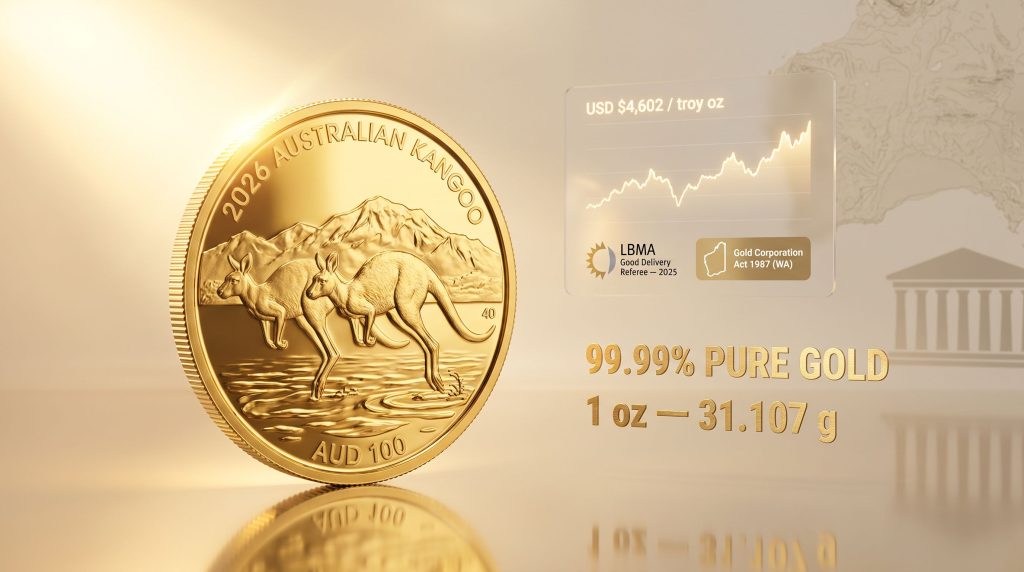
The reverse design on the one-ounce and fractional coins is updated each calendar year while all technical specifications remain constant. The 2026 reverse, created by artist Neil Hollis, depicts two kangaroos moving across a water surface with a mountain range in the background. A privy mark reading "40" appears on this issue, marking the series' fortieth anniversary.
Each coin also incorporates a micro-laser engraved authentication letter, visible only under magnification. This is a production-level anti-counterfeiting measure embedded during the striking process, not an aftermarket addition.
Does Annual Design Change Create Artificial Scarcity?
No, and this point is frequently misunderstood. The bullion issue carries an unlimited mintage, meaning production volume is determined by market demand rather than an administratively imposed ceiling. No calendar year's issue is artificially capped.
Coins with genuinely limited mintages can attract premiums substantially above metal value when collector demand is elevated. Those premiums can compress sharply when sentiment shifts. Unlimited mintage bullion coins price off metal content, which removes a significant variable for long-term holders focused on capital preservation rather than numismatic appreciation.
Annual design variation gives collectors a reason to follow the series without exposing investors to the premium volatility that scarcity engineering produces. The gold content, purity, and legislative backing are identical across every year of issue.
Full Size Range: From Entry-Level Fractional to Monumental
| Denomination | Face Value (AUD) | Notes |
|---|---|---|
| 1/20 oz | AUD 5 | Entry-level fractional |
| 1/10 oz | AUD 10-15 | Current bullion lineup |
| 1/4 oz | AUD 25 | Current bullion lineup |
| 1/2 oz | AUD 50 | Current bullion lineup |
| 1 oz | AUD 100 | Flagship issue |
| 1 kg | AUD 3,000 | Current large-format issue |
| 1 tonne | AUD 1,000,000 | Guinness World Record display piece |
The one-tonne coin at the base of that table warrants its own discussion. Cast in 2011, the Australian Kangaroo One Tonne Gold Coin contains 1,012 kilograms of 99.99% pure gold. It measures approximately 80 centimetres in diameter and 12 centimetres in depth, carries an official legal tender face value of AUD 1,000,000, and was certified by Guinness World Records as the world's largest gold coin in 2012. It remains permanently on display at The Perth Mint facility in Perth, Western Australia.
Comparing the Australian Gold Kangaroo to Major Global Bullion Coins
Fineness is where the world's leading bullion coins genuinely diverge, and that divergence has measurable consequences for weight, accounting, and tax treatment.
| Coin | Country | Fineness | Gold Content (1 oz) | Gross Weight | Alloy |
|---|---|---|---|---|---|
| Australian Gold Kangaroo | Australia | 99.99% | 1.000 oz | ~31.107 g | None |
| Canadian Gold Maple Leaf | Canada | 99.99% | 1.000 oz | ~31.107 g | None |
| Austrian Gold Philharmonic | Austria | 99.99% | 1.000 oz | ~31.107 g | None |
| American Gold Eagle | USA | 91.67% (22 kt) | 1.000 oz | ~33.931 g | Copper + Silver |
| South African Krugerrand | South Africa | 91.67% (22 kt) | 1.000 oz | ~33.931 g | Copper only |
The American Gold Eagle and South African Krugerrand each weigh approximately 33.931 grams for a one-ounce coin, roughly 2.8 grams heavier than the Kangaroo. That additional mass is entirely alloy. Both 22-karat coins deliver a full troy ounce of fine gold; the alloy addition improves surface hardness and scratch resistance, which has practical benefits for coins intended to circulate or change hands frequently.
The 24-karat approach used by the Kangaroo, Maple Leaf, and Philharmonic keeps gold content and gross weight aligned, simplifying verification and portfolio valuation. Neither approach is inherently superior for every investor. The practical question is whether hardness or accounting simplicity matters more for your specific use case.
Security Features: A Less Discussed Differentiator
The Kangaroo's micro-laser engraved authentication letter is embedded at the production stage. The Canadian Maple Leaf uses a different approach, combining a radial line security field across the entire surface with a laser-engraved micro-text maple leaf as its primary authentication layer. The American Gold Eagle relies on design complexity and reeded edges but does not incorporate a dedicated micro-engraved authentication element in its standard bullion format.
For investors concerned about counterfeiting risk, particularly when acquiring coins through secondary market channels, understanding these authentication features is more useful than comparing surface designs. In addition, investors weighing up physical gold vs ETFs should note that authentication concerns apply exclusively to physical metal holdings.
The next major ASX story will hit our subscribers first
IRA Eligibility: The Legal Mechanism Explained Precisely
The Australian Gold Kangaroo qualifies for inclusion in a U.S. self-directed Individual Retirement Account. The governing provision is Section 408(m)(3)(B) of the Internal Revenue Code, which exempts certain bullion from collectible classification inside retirement accounts.
The mechanism requires precise description because it is widely misquoted. The Code does not specify 99.99% as a requirement. Instead, it exempts bullion whose fineness meets or exceeds the minimum standard that a regulated futures contract market requires for delivery. For gold, that minimum is 0.995 fineness. At 0.9999 fineness, the Australian Gold Kangaroo clears this threshold by a substantial margin.
The Krugerrand situation illustrates why fineness alone does not determine IRA eligibility across all coins:
| Coin | Fineness | IRA Eligible | Legal Basis |
|---|---|---|---|
| Australian Gold Kangaroo | 99.99% | Yes | Meets fineness threshold under §408(m)(3)(B) |
| Canadian Gold Maple Leaf | 99.99% | Yes | Meets fineness threshold under §408(m)(3)(B) |
| Austrian Gold Philharmonic | 99.99% | Yes | Meets fineness threshold under §408(m)(3)(B) |
| American Gold Eagle | 91.67% | Yes | Statutory carve-out under §408(m)(3)(A)(i) |
| South African Krugerrand | 91.67% | No | Below threshold; no statutory exemption |
The American Gold Eagle falls below the 0.995 fineness threshold but qualifies regardless because Congress granted it a specific statutory exemption under Section 408(m)(3)(A)(i). No equivalent carve-out exists for the Krugerrand, leaving it ineligible for IRA inclusion despite being one of the most widely traded bullion coins in history.
This distinction carries real consequences for investors consolidating physical gold within tax-advantaged accounts. A coin that is perfectly sound as a direct holding may be structurally unsuitable for retirement account inclusion based entirely on its fineness and statutory treatment rather than its underlying metal quality.
A qualified IRA custodian must hold any IRA-eligible bullion. Home storage of IRA-held precious metals is not permitted under IRS rules, regardless of the coin's eligibility status.
Premium Structure and Long-Term Holding Implications
Unlimited mintage directly shapes the premium an investor pays and the risk that premium carries over time. Because production volume is anchored to demand rather than an administrative cap, the coin's market price stays connected to its metal content plus a fabrication and distribution premium. Collector scarcity dynamics do not enter the equation.
| Characteristic | Unlimited Mintage Bullion | Capped or Proof Issues |
|---|---|---|
| Primary price driver | Spot gold plus fabrication premium | Spot gold plus collector demand premium |
| Premium stability | High, anchored to metal content | Variable, sentiment-dependent |
| Liquidity | Broad dealer and secondary market | Narrower specialist market |
| Long-term premium compression risk | Structurally lower | Structurally higher |
| Condition grading requirement | Not applicable | Required for numismatic valuation |
For an investor with a multi-year or multi-decade holding horizon, the unlimited mintage structure removes a meaningful variable. The premium paid above spot price at acquisition does not face compression when collector interest fades, because collector interest was never the mechanism pricing the coin in the first place.
Macroeconomic Context: The Structural Case for Physical Gold Ownership
With gold trading near USD $4,602 per troy ounce as of August 21, 2026, the metal content of a one-ounce Kangaroo represents a substantial store of value relative to its AUD 100 legal tender face value. That face value functions as a legal classification conferring official currency status under Australian law. It is not a price signal. Actual market value at any point is determined entirely by the prevailing gold price plus applicable dealer premiums.
Several structural factors underpin the long-term investment rationale for physical gold in this format. Furthermore, gold as a safe haven continues to attract institutional interest across precisely these kinds of macroeconomic conditions.
- Global gold mine supply has grown at under 1% annually across the past decade, a structural constraint that distinguishes gold from assets whose supply expands in response to price signals.
- Central bank money supply expansion, undertaken to service sovereign debt obligations, continues to erode the real purchasing power of cash savings over extended holding periods.
- Nominal interest rates on savings instruments have frequently failed to keep pace with inflation across major economies, producing negative real returns for cash holders in multiple rate environments.
- The U.S. national debt crossed $40 trillion in August 2026, with the interval between successive trillion-dollar milestones compressing, a fiscal dynamic that institutional analysts have begun explicitly connecting to gold demand.
Consequently, central bank gold demand has accelerated meaningfully in this environment, reinforcing the broader structural case for physical metal allocation. In addition, the scale of central bank gold reserves globally signals institutional confidence that extends well beyond retail investor sentiment.
These conditions do not guarantee any particular price outcome. They describe the structural environment in which investors are choosing to allocate a portion of savings to physical metal with verifiable purity, legislative backing, and established secondary market liquidity.
Frequently Asked Questions
Is the Australian Gold Nugget the same coin as the Australian Gold Kangaroo?
Yes. The series launched in 1986-87 under the Gold Nugget name, with reverse designs depicting famous Australian gold nuggets. Kangaroo imagery was introduced progressively from 1989, with the transition to kangaroo designs on bullion coins completed with the 1990-dated issues, after which the series was rebranded accordingly. You can find further historical background on the Australian Gold Nugget via Wikipedia's dedicated entry.
What sizes are currently available in the Gold Kangaroo bullion series?
The current Perth Mint bullion lineup includes 1/10 oz, 1/4 oz, 1/2 oz, and 1 oz, alongside a 1 kilogram format. Larger sizes including 2 oz and 10 oz were introduced in 1991 but are not part of the current standard bullion offering.
Does the AUD 100 face value have any practical significance?
The face value confers legal tender status in Australia, confirming the coin's official government-issued character. It theoretically allows the coin to be tendered as currency at face value, though doing so would represent a significant economic loss relative to its gold market value.
How do I authenticate a Gold Kangaroo coin?
The 2026 issue includes a micro-laser engraved authentication letter visible under magnification. Additional verification methods include weight testing (minimum 31.107 grams for the 1 oz issue), dimensional measurement against published tolerances, and acid or electronic assay testing available through accredited dealers and assay offices.
What is the largest Australian Gold Kangaroo ever produced?
The Australian Kangaroo One Tonne Gold Coin, cast in 2011, holds 1,012 kilograms of 99.99% pure gold, measures approximately 80 centimetres across and 12 centimetres in depth, and carries an AUD 1,000,000 face value. Guinness World Records certified it as the world's largest gold coin in 2012. It remains on permanent display at The Perth Mint.
This article is for informational purposes only and does not constitute investment advice or a solicitation to buy or sell any financial product. Past performance is not indicative of future results. All investments, including physical precious metals, involve risk and may result in partial or total loss. Investors should consult a qualified financial adviser before making any investment decision.
Want to Capitalise on the Next Major Mineral Discovery Before the Broader Market?
Discovery Alert's proprietary Discovery IQ model delivers real-time alerts on significant ASX mineral discoveries, transforming complex geological data into actionable investment insights for both new and experienced investors — explore historic examples of exceptional discovery returns and begin your 14-day free trial today to secure a market-leading advantage.