
May 17, 2026
Australia's energy infrastructure operates under mounting pressures that extend far beyond traditional market forces. Global supply chain disruptions, aging refinery assets, and mounting geopolitical tensions have fundamentally altered how developed nations approach fuel security planning. These macro-economic trends create cascading vulnerabilities that can transform localized industrial incidents into national strategic concerns, particularly in economies with concentrated energy production assets.
Understanding Australia's Critical Fuel Infrastructure Vulnerability
The Strategic Importance of Domestic Refining Capacity
Australia's fuel production landscape reveals a concerning concentration risk that mirrors broader infrastructure vulnerabilities across developed economies. The nation operates with just two major domestic refineries carrying the entire burden of local fuel production, creating what energy analysts describe as a binary supply structure with minimal redundancy.
The Geelong refinery fire impact demonstrates how quickly this concentrated system can shift from stability to crisis. When operational capacity at one facility drops significantly, the remaining infrastructure must absorb unprecedented demand whilst maintaining safety standards and operational efficiency. This binary structure differs markedly from countries like the United States or Germany, where dozens of refineries provide geographic and operational diversification.
Historical data reveals Australia's refining sector has contracted substantially over the past two decades. Multiple facility closures, including major installations previously operated by Shell and Caltex, have progressively concentrated production into fewer hands. Each closure transferred greater systemic risk to the surviving facilities, creating the current situation where single-point failures can trigger national supply concerns.
Furthermore, Australia faces additional challenges with energy exports challenges affecting the broader energy sector. These pressures compound the vulnerability created by concentrated domestic refining capacity.
Geelong's Role in National Energy Security
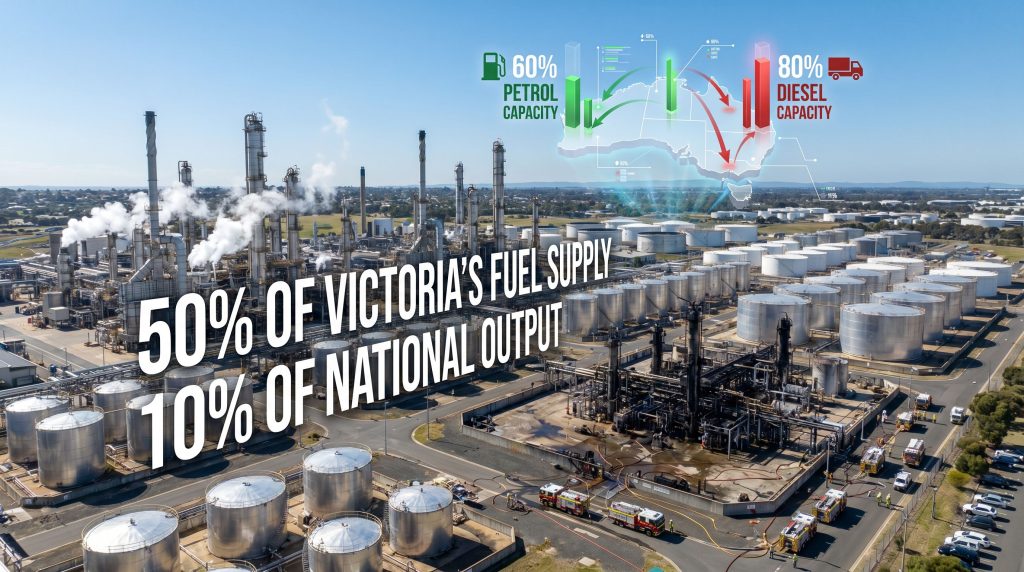
The scale of Geelong's contribution to Australia's fuel ecosystem cannot be understated. The facility supplies approximately 50% of Victoria's total fuel requirements and represents roughly 10% of national fuel output. This concentration means that disruptions at the Corio site immediately affect millions of consumers across southeastern Australia.
Geographic distribution challenges compound these vulnerabilities. Victoria and Tasmania's fuel supply chains depend heavily on Geelong's output, with limited alternative domestic sources available during supply disruptions. The nearest major refining facility operates from Brisbane, approximately 1,700 kilometres away, creating logistical challenges for emergency supply redistribution.
Current operational status following equipment failures highlights the interconnected nature of modern refining operations. The damaged MOGAS (Motor Gasoline) unit has reduced the facility to 60% of normal petrol production, 80% of diesel output, and 80% of aviation fuel capacity. These figures, confirmed by Prime Minister Anthony Albanese during an April 19, 2026 site visit, illustrate how single-unit failures cascade across multiple product lines within integrated refining operations.
When big ASX news breaks, our subscribers know first
How Will Production Disruptions Reshape Australia's Fuel Market Dynamics?
Immediate Supply Chain Reconfiguration
Emergency response mechanisms have activated across multiple levels of government and industry. Australian authorities secured 100 million litres of fuel imports from Brunei and Korea within days of the incident, demonstrating the speed required to maintain supply continuity. BP's involvement in Export Finance Australia arrangements highlights how quickly international partnerships must mobilise during domestic supply crises.
This import arrangement reveals crucial details about Australia's emergency fuel procurement capabilities. The ability to secure significant volumes from Southeast Asian and Northeast Asian suppliers within a 72-hour window suggests pre-existing contingency agreements and established trade relationships. However, these emergency imports operate under different economic parameters than domestic production.
In addition, global market dynamics play a crucial role in these scenarios. Recent oil price rally insights suggest that international pricing pressures could affect import costs during extended supply disruptions.
Key supply chain adjustments include:
- Immediate activation of international fuel procurement agreements
- Redistribution of domestic supply priorities across state boundaries
- Enhanced coordination between private operators and government agencies
- Accelerated customs and port processing for emergency fuel imports
Regional Price Volatility and Consumer Impact Analysis
The economic implications of production disruptions extend beyond simple supply arithmetic. Imported fuel typically operates under thinner profit margins compared to domestic production, creating earnings pressure for operators whilst potentially affecting consumer pricing structures. This margin compression occurs due to additional transportation costs, international market price exposure, and supply chain complexity.
Victoria and Tasmania face heightened price volatility risks given their dependence on Geelong's output. Historical analysis of previous supply disruptions suggests that regionalised shortages can create price premiums that persist even after supply restoration. The timeline for recovery becomes crucial in determining whether these effects remain localised or spread nationally.
Moreover, global oil futures trends indicate that international market volatility could compound domestic pricing pressures during recovery periods.
Recovery scenarios present distinctly different outcomes:
| Timeline | Supply Impact | Economic Effect | Price Implications |
|---|---|---|---|
| 3-week recovery | Minimal disruption | Insurance coverage adequate | Limited price volatility |
| 3-month recovery | Significant shortfall | Earnings compression | Sustained price premiums |
| Extended delay | Critical shortage | Import dependency | Market restructuring |
Why Is Ampol Positioned to Dominate Australia's Refining Landscape?
Strategic Market Positioning Through Operational Timing
Ampol's competitive advantage emerged through a combination of strategic planning and fortunate timing. The company's decision to defer Lytton refinery maintenance from early June to early August 2026 now appears prescient, providing maximum production capacity during Geelong's recovery period. This maintenance deferral, announced on March 20, 2026, will deliver approximately 300 million litres of additional domestic fuel production during the critical June-July window.
The Brisbane-based Lytton facility now operates as Australia's only domestic refinery running at full capacity. This near-monopoly position in domestic production creates opportunities for margin expansion and market share consolidation. Industry analysts note that tighter domestic supply typically supports higher refining margins, particularly when import costs set price ceilings.
Market recognition of Ampol's strengthened position has been immediate and substantial. The company's shares achieved 52-week highs on April 18, 2026, settling around A$33.06 and representing approximately 60% annual growth. This performance reflects investor confidence in Ampol's ability to capitalise on constrained domestic supply conditions.
Consequently, Ampol benefits from broader market trends, including concerns about US oil production decline affecting global supply dynamics and supporting domestic production advantages.
Financial Performance Indicators and Investment Implications
Ampol's strategic positioning extends beyond simple production arithmetic. The company's ability to maximise output during a competitor's downtime creates multiple revenue enhancement opportunities:
- Enhanced refining margins due to reduced domestic competition
- Increased demand across distribution networks as customers prioritise domestic supply
- Premium pricing opportunities supported by import cost benchmarks
- Market share gains in commercial and industrial segments
However, this advantageous position carries inherent risks. Operating as Australia's primary domestic fuel producer creates substantial regulatory and political scrutiny. Single-point-of-failure risks that previously applied to Geelong now partially transfer to Lytton, potentially triggering government intervention measures or enhanced oversight requirements.
The concentration of production capability raises questions about sustainable competitive advantages versus temporary market dislocations. Ampol's ability to maintain enhanced margins depends largely on Geelong's recovery timeline and the broader industry's capacity expansion plans.
What Are the Long-term Economic Consequences for Energy Sector Investment?
Insurance and Business Continuity Framework Analysis
Industrial insurance structures face severe testing during major facility disruptions. Business interruption coverage for refining operations typically addresses lost production revenue, but policy terms vary significantly regarding coverage duration, exclusions, and valuation methodologies. The adequacy of insurance arrangements becomes crucial in determining whether facility operators can maintain financial stability during extended outages.
Critical insurance considerations include:
- Coverage duration limits that may not match actual repair timelines
- Policy exclusions for certain types of equipment failure or force majeure events
- Valuation disputes over lost revenue calculations and margin assumptions
- Deductible structures that affect initial cash flow during recovery periods
Risk management strategies for critical infrastructure operators require reassessment following major incidents. Traditional approaches focusing on individual facility protection may prove inadequate when systemic vulnerabilities emerge. Comprehensive business continuity planning must address supply chain alternatives, emergency procurement capabilities, and stakeholder coordination protocols.
Furthermore, industry experts note that the Grattan Institute's analysis provides valuable insights into the long-term implications of refinery disruptions on Australia's fuel security framework.
Government Policy Response and Industry Support Mechanisms
The concentration of refining capacity into two major facilities creates substantial political economy implications. Government authorities face pressure to ensure fuel security whilst balancing market competition and private sector autonomy. This tension typically manifests through policy interventions designed to support critical infrastructure operators without creating market distortions.
Potential government support mechanisms include:
- Strategic reserve expansion to provide buffer capacity during supply disruptions
- Infrastructure investment incentives for refining capacity maintenance and expansion
- Regulatory streamlining for emergency fuel imports and distribution
- Public-private partnerships for fuel security enhancement projects
The political dynamics surrounding fuel security often transcend traditional market mechanisms. When critical infrastructure affects millions of consumers and essential economic functions, governments typically prioritise supply continuity over pure market outcomes. This creates opportunities for enhanced industry support but also increases regulatory oversight and compliance requirements.
How Should Investors Navigate Energy Sector Opportunities and Risks?
Viva Energy Investment Risk Assessment Framework
Investment decision-making during industrial crises requires careful scenario analysis and risk-adjusted return calculations. Viva Energy's share price remained frozen at A$2.53 during the four-day trading halt, having gained more than 20% year-to-date prior to the incident. This valuation must now incorporate recovery timeline uncertainty and earnings impact estimates.
Key investment variables include:
- Recovery timeline probability distributions affecting earnings projections
- Insurance settlement adequacy influencing cash flow stability
- Market share retention capacity during extended outages
- Regulatory response implications for future operational requirements
The diversification within Viva Energy's business model provides some earnings protection during refining disruptions. Commercial and industrial operations, alongside retail and convenience networks, contribute more substantially to group earnings than refining activities. This diversification reduces but does not eliminate the financial impact of production outages.
Risk assessment frameworks must account for recovery timeline uncertainty. Analysis suggests that restart delays represent the primary risk factor for existing shareholders. If repairs extend beyond six weeks, portfolio risk management may warrant position adjustments to account for prolonged earnings impacts.
Additionally, oil price movements analysis suggests that broader market volatility could amplify company-specific risks during the recovery period.
Portfolio Diversification Strategies for Energy Exposure
Energy sector investment strategies require careful consideration of operational concentration risks and supply chain vulnerabilities. The Geelong refinery fire impact illustrates how quickly individual facility problems can create systemic industry effects. Portfolio construction should account for these interconnected risks whilst identifying opportunities emerging from market dislocations.
Diversification considerations include:
- Geographic distribution of energy assets to reduce regional concentration risk
- Operational segment balance between upstream, midstream, and downstream activities
- Supply chain position variety to benefit from different market dynamics
- Regulatory risk hedging through exposure to multiple policy frameworks
The current situation creates potential opportunities for investors with appropriate risk tolerance and capital deployment timing. Ampol's strengthened market position demonstrates how supply disruptions can benefit surviving operators, whilst Viva Energy's depressed valuation may offer value opportunities for patient capital with adequate risk management.
What Does This Incident Reveal About Australia's Energy Resilience?
Structural Weaknesses in National Fuel Security Architecture
Australia's energy resilience framework reveals significant structural vulnerabilities when subjected to stress testing through real-world disruptions. The binary refining structure creates cascading risks that extend beyond simple production arithmetic to encompass supply chain coordination, emergency response capabilities, and international trade dependencies.
Comparative analysis with international strategic reserve standards suggests Australia operates with minimal buffer capacity relative to consumption requirements. Countries like the United States maintain strategic petroleum reserves equivalent to multiple months of import requirements, whilst Australia's emergency provisions rely primarily on commercial stockpiles and short-term import arrangements.
The speed of government response in securing 100 million litres of emergency imports demonstrates existing contingency planning capabilities. However, this reactive approach differs from proactive strategic reserve management employed by other developed economies facing similar geographic isolation and supply concentration challenges.
For instance, BBC's coverage of the incident highlights international perspectives on Australia's fuel security vulnerabilities and potential lessons from other nations' approaches.
Future-Proofing Strategies for Energy Independence
Long-term energy security planning requires substantial infrastructure investment and policy coordination across multiple government levels. The transition toward renewable energy sources adds complexity to traditional fuel security planning, as transportation fuels remain predominantly petroleum-based whilst electricity generation increasingly relies on renewable sources.
Strategic planning priorities include:
- Additional refining capacity development to reduce concentration risks
- Enhanced strategic reserve capabilities for emergency supply management
- Supply chain diversification through multiple international partnerships
- Infrastructure redundancy improvements across production and distribution networks
Investment requirements for meaningful capacity expansion typically exceed private sector capabilities without government support. Public-private partnerships may provide mechanisms for sharing investment risks whilst maintaining competitive market structures. However, these arrangements require careful design to avoid market distortions or competitive disadvantages.
The next major ASX story will hit our subscribers first
Frequently Asked Questions About the Geelong Refinery Impact
Will fuel prices increase significantly across Australia?
Regional price impacts will likely exceed national effects due to geographic distribution patterns. Victoria and Tasmania face higher exposure to price volatility given their dependence on Geelong's output, whilst other regions may experience minimal immediate effects. Government intervention mechanisms, including import arrangements and strategic reserve releases, aim to moderate price increases.
Historical precedents from previous supply disruptions suggest that localised shortages can create temporary price premiums lasting several weeks or months. However, Australia's integration with international fuel markets provides alternative supply sources that typically prevent sustained price spikes beyond transportation cost differentials.
How long will the recovery process realistically take?
Recovery timelines depend heavily on the extent of damage to the MOGAS unit and the availability of specialised replacement equipment. Modern refining equipment often requires custom manufacturing with lead times extending several months. Regulatory approval processes for restart operations add additional time requirements for safety inspections and compliance verification.
Industry experts suggest that three-week recovery scenarios require minimal equipment replacement, whilst three-month timelines indicate more substantial reconstruction requirements. Extended delays beyond three months typically involve major equipment replacement or facility redesign, creating much more significant economic and strategic implications.
What investment opportunities emerge from this crisis?
Energy infrastructure investment themes gain prominence during supply security crises. Companies with strategic positioning in fuel distribution, storage, or alternative supply arrangements may benefit from increased demand for redundancy and resilience. Technology solutions addressing supply chain optimisation and emergency response coordination also present potential opportunities.
However, crisis-driven investment decisions require careful risk assessment and timeline consideration. Short-term market dislocations may not provide sustainable competitive advantages, whilst genuine structural improvements typically require substantial capital commitments and extended development periods.
Redefining Australia's Energy Security Strategy
Key Takeaways for Investors and Policymakers
The Geelong refinery fire impact serves as a critical stress test for Australia's energy infrastructure resilience and policy frameworks. The incident demonstrates how concentrated production assets create systemic vulnerabilities that extend beyond individual company risks to encompass national security considerations.
For investors, the situation illustrates both the risks and opportunities inherent in critical infrastructure investments. Companies with strategic positioning can benefit substantially from supply disruptions, whilst those directly affected face potentially severe earnings impacts depending on recovery timelines and insurance adequacy.
Policymakers must address fundamental questions about acceptable risk levels in critical infrastructure sectors. The balance between market efficiency and strategic redundancy requires careful consideration of economic costs versus security benefits. Future energy security planning must incorporate lessons learned from real-world stress testing of current systems.
The path forward requires enhanced coordination between private sector operators, government agencies, and international partners. Investment in redundancy, strategic reserves, and emergency response capabilities represents essential components of a resilient energy security framework capable of weathering future disruptions whilst maintaining economic efficiency.
This analysis is based on publicly available information and should not be considered financial advice. Investors should conduct their own research and consider their risk tolerance before making investment decisions. The events described involve future scenarios that may not materialise as projected.
Ready to Capitalise on Energy Sector Investment Opportunities?
Australia's fuel supply disruptions highlight the critical importance of identifying market-moving developments before they impact broader markets. Discovery Alert's proprietary Discovery IQ model delivers real-time notifications on significant ASX mineral discoveries, empowering subscribers to recognise actionable opportunities in the energy and resources sectors ahead of traditional market analysis. Start your 14-day free trial today and gain the market-leading advantage that comes from instant access to discovery-driven investment insights.