The integration of renewable energy sources continues to drive unprecedented demand for advanced energy storage solutions across Australia's electricity grid. Among emerging technologies, the avess vanadium battery project in Kalgoorlie represents a significant milestone in long-duration storage development, combining innovative technology with substantial government investment to address critical grid stability challenges. This $150 million initiative positions Australia at the forefront of vanadium flow battery commercialisation, whilst supporting the broader energy transition strategy essential for achieving decarbonisation objectives.
Understanding Vanadium Redox Flow Battery Technology
Vanadium flow batteries represent a fundamentally different approach to energy storage compared to conventional lithium-ion systems. These devices store energy in liquid electrolyte solutions containing vanadium ions dissolved in sulfuric acid, housed in external tanks separate from the power-generating cell stacks. During charging and discharging cycles, electrolyte pumps circulate the solutions through electrochemical cells where vanadium ions change oxidation states, generating electrical current without solid-state material degradation.
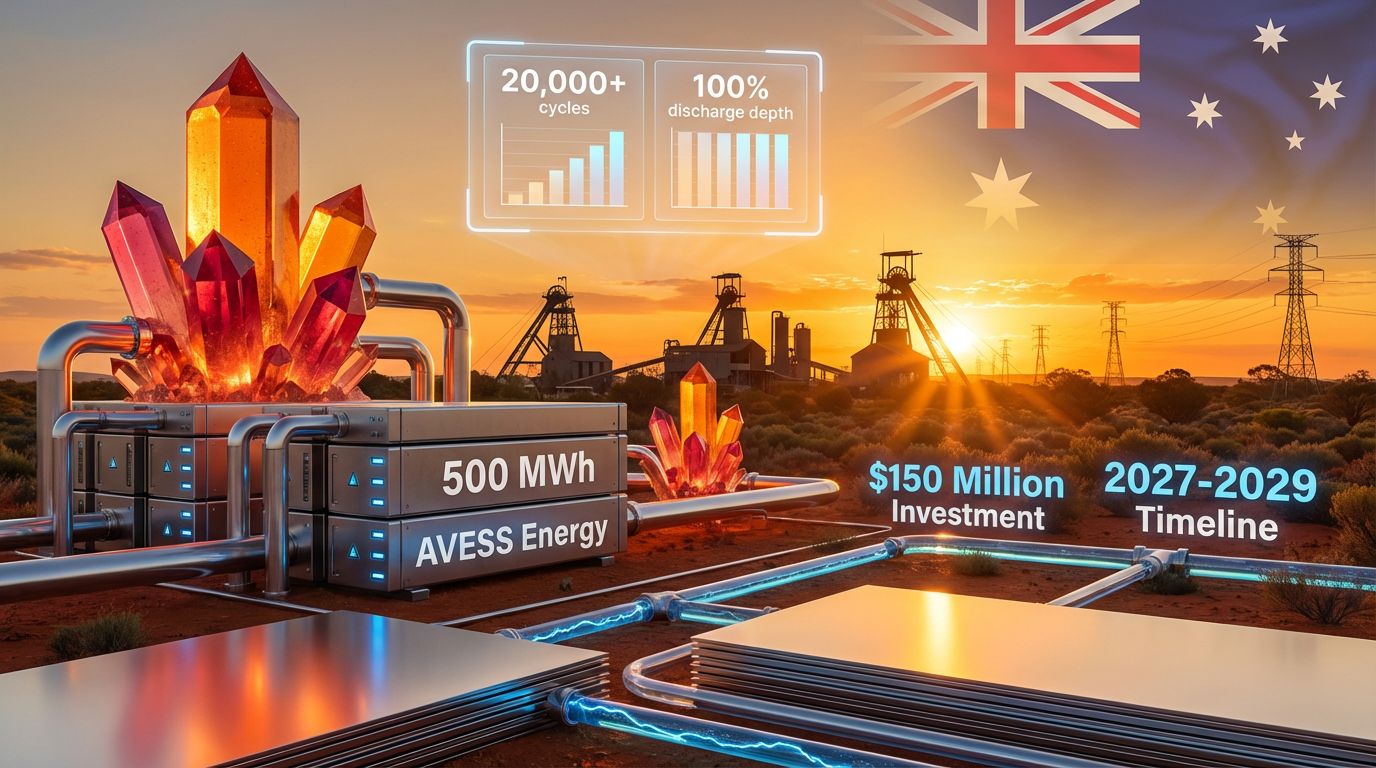
The core advantage lies in the decoupled architecture where power capacity (determined by stack size) scales independently from energy capacity (determined by electrolyte volume). This design enables systems to discharge at 100% depth without capacity loss over 20,000+ operational cycles, vastly exceeding lithium-ion battery lifecycles of 3,000-5,000 cycles at recommended 80-90% discharge depths.
Technical Performance Comparison:
| Metric | Vanadium Flow Battery | Lithium-Ion Battery |
|---|---|---|
| Cycle Life | 20,000+ cycles | 3,000-5,000 cycles |
| Discharge Depth | 100% without degradation | 80-90% recommended |
| Fire Risk | Non-flammable electrolyte | Thermal runaway potential |
| Duration Capability | 4-12 hours optimal | 1-4 hours optimal |
| Temperature Tolerance | -5°C to 65°C | 15°C to 35°C optimal |
| Response Time | Sub-second to hours | Sub-second to 4 hours |
Temperature resilience particularly benefits Australian deployment scenarios, where extreme climate variations challenge battery performance. The aqueous vanadium sulfate electrolyte maintains stable electrochemical properties across wider temperature ranges than lithium-ion chemistries, reducing cooling system requirements and operational complexity in harsh environments like Western Australia's Goldfields region.
Long-Duration Storage Economics in Australian Markets
Levelised cost of storage (LCOS) calculations reveal vanadium flow batteries achieve economic competitiveness for applications requiring discharge durations exceeding four hours. While initial capital expenditure per kilowatt-hour remains higher than lithium-ion alternatives, the extended operational lifespan and maintenance advantages create favourable total cost of ownership over 20-year project lifecycles.
Grid stability applications generate multiple revenue streams through frequency regulation services, peak demand reduction, and renewable energy arbitrage. Furthermore, the integration of domestic vanadium resources through Australia's critical minerals reserve creates additional value chain opportunities. The avess vanadium battery project's 500 MWh capacity with 10-hour discharge duration positions the system to capture value across these market segments simultaneously, unlike shorter-duration lithium-ion installations primarily suited for frequency regulation or brief peak shaving applications.
Analysing the $150 Million Kalgoorlie Project's Strategic Positioning
The Western Australian Government's $150 million investment in the AVESS Energy Kalgoorlie project represents more than infrastructure development; it signals strategic positioning for Australia's role in global energy storage manufacturing. The proposed 500 MWh system would rank among the world's largest operational vanadium flow battery installations upon completion in 2029, providing empirical performance data for future commercial deployments.
Young Yu, AVESS Energy's Managing Director, emphasised the project's significance for local manufacturing capabilities: "The Kalgoorlie vanadium battery energy storage system is a significant opportunity to deliver a locally manufactured vanadium flow battery at scale. AVESS is well-placed to deliver a compelling, homegrown solution, backed by our world-class stack technology and the expertise of our consortium partners."
Strategic Location Analysis for Grid Integration
Kalgoorlie's selection leverages existing mining infrastructure while supporting renewable energy integration across the Goldfields region. Historical gold mining operations established robust electrical transmission networks capable of accommodating large-scale storage systems without extensive grid upgrades. However, the region's abundant solar and wind resources create natural synergies for long-duration storage deployment.
Key Location Advantages:
- Established transmission infrastructure from decades of mining operations
- Proximity to renewable energy development zones
- Industrial load base providing consistent offtake opportunities
- Experienced workforce familiar with large-scale industrial projects
- Government support for regional economic diversification initiatives
Mining sector energy demand patterns in the Goldfields create ideal conditions for grid-scale storage integration. Operations typically require consistent power delivery during extended shifts, making long-duration storage valuable for load balancing and renewable energy integration without compromising operational reliability.
Local Supply Chain Development Implications
Atlantic Vanadium's participation as a consortium partner establishes domestic supply chain integration from raw material extraction through battery manufacturing. This vertical integration approach reduces import dependency while creating regional employment opportunities across multiple skill levels.
The consortium structure positions Western Australia to capture value-added processing opportunities rather than exporting raw vanadium concentrate. Consequently, local electrolyte production capabilities would serve not only the Kalgoorlie installation but potentially supply broader Australian and Indo-Pacific markets as vanadium battery adoption accelerates.
The strategic minerals importance in global supply chains underscores the value of domestic processing capabilities for energy storage applications.
Project Scale Significance: The proposed 500 MWh capacity represents approximately 10% of Australia's current grid-scale battery storage capacity, positioning this single project as a major infrastructure milestone for the nation's energy storage sector.
Government Investment Drivers and Critical Minerals Strategy
Australia's critical minerals strategy emphasises onshore value-addition and supply chain resilience, particularly for technologies essential to decarbonisation objectives. While vanadium currently lacks formal classification as a "critical mineral" on Australia's official list, the element's strategic importance for energy storage applications aligns with broader policy objectives around renewable energy transition acceleration and advanced manufacturing capability establishment.
The $150 million government commitment reflects multiple policy convergences: regional economic development, critical minerals processing, renewable energy transition acceleration, and advanced manufacturing capability establishment. These investments position Australia to reduce import dependency for energy storage components while developing export capabilities for growing Indo-Pacific markets.
Economic Development Impact Projections:
- Direct construction employment: estimated 200-300 FTE positions over 3-year construction period
- Permanent operational employment: 40-60 technical and administrative roles
- Indirect economic multiplier effects: supporting local services, equipment suppliers, and maintenance contractors
- Technology sector catalysis: establishing Western Australia as vanadium battery manufacturing hub
Import Substitution and Export Opportunity Analysis
Current Australian energy storage imports primarily consist of lithium-ion batteries and components from Asian manufacturers. Domestic vanadium battery manufacturing would substitute these imports while creating export opportunities as global long-duration storage markets expand.
Regional demand forecasts suggest significant growth potential across the Indo-Pacific region, where countries pursue renewable energy integration and grid modernisation initiatives. Australia's geographic proximity to these markets, combined with established trade relationships, creates competitive advantages for vanadium battery exports from locally integrated supply chains.
The broader context of government mining intervention demonstrates increasing policy support for value-added processing of critical minerals within Australia.
Technology Stack Comparison and Competitive Positioning
AVESS Energy's partnership with Korid Energy provides access to proven 25 kW stack technology while maintaining majority ownership of the integrated system design. This arrangement enables technology transfer while preserving Australian control over intellectual property and manufacturing processes.
The modular 25 kW stack configuration offers scalability advantages for future projects while simplifying maintenance and replacement procedures. Standardised stack components reduce manufacturing complexity and inventory requirements compared to custom-designed systems for each installation.
Global Vanadium Battery Market Positioning:
| Company | Technology Focus | Geographic Presence | Capacity Range | Key Differentiators |
|---|---|---|---|---|
| AVESS Energy | Flow battery stacks | Australia/Korea | 25 kW – 500 MWh | Domestic supply chain integration |
| Rongke Power | Large-scale VFB | China | 200 MWh systems | Proven utility-scale deployments |
| Invinity Energy | Modular systems | UK/North America | 20 kW – 20 MW | Standardised product architecture |
| Sumitomo Electric | Grid applications | Japan | 15 MW systems | Advanced control system integration |
South Korean Partnership Advantages
The Korid Energy collaboration provides AVESS with immediate access to commercially proven technology while avoiding lengthy R&D development timelines. South Korean manufacturing expertise in electrochemical systems, developed through decades of battery and fuel cell production, transfers directly to vanadium flow battery applications.
Majority Australian ownership ensures technology adaptation for local conditions while preserving decision-making authority over project development and future expansion. This structure enables knowledge transfer without compromising strategic autonomy over critical infrastructure development.
Project Timeline and Critical Success Factors
The structured government evaluation process establishes clear milestones for project development and risk mitigation. Stage One Expression of Interest submission by January 30, 2026 initiates formal assessment procedures, followed by Stage Two business case evaluation during Q2 2026.
Critical Project Timeline:
- January 30, 2026: Stage One EOI submission deadline
- Q2 2026: Stage Two business case evaluation period
- H2 2026: Preferred proponent selection announcement
- 2027-2028: Design finalisation and construction commencement
- 2029: System commissioning and operational startup
Risk Mitigation Through Phased Development
The two-stage evaluation process enables comprehensive technical and financial assessment while providing project proponents opportunities to refine proposals based on government feedback. This approach reduces deployment risks while ensuring alignment with policy objectives and grid integration requirements.
Critical Success Factors:
- Demonstration of proven technology performance through reference installations
- Competitive lifecycle cost analysis compared to alternative storage technologies
- Comprehensive grid integration studies and transmission capacity assessments
- Detailed local supply chain development commitments and employment projections
- Financial viability demonstration with or without ongoing government support
Vanadium supply contract negotiations represent a particular risk factor requiring careful management. For instance, price volatility in vanadium markets could impact project economics, necessitating long-term supply agreements or vertical integration through Atlantic Vanadium partnership arrangements.
Grid Stability Enhancement and Renewable Energy Integration
Long-duration energy storage addresses critical gaps in Australia's renewable energy transition strategy. The National Electricity Market requires increasing flexibility as coal-fired generation retires and variable renewable sources comprise larger generation portfolions. In addition, the avess vanadium battery project's 10-hour discharge capability directly addresses these grid stability challenges.
Grid Service Capabilities:
- Load shifting: Moving excess renewable generation from midday peaks to evening demand periods
- Frequency regulation: Providing rapid response services to maintain grid stability within acceptable parameters
- Voltage support: Reactive power provision for transmission system voltage management
- Black start capability: Potential grid restoration services following major outages
Decarbonisation Strategy Integration
Extended storage duration enables deeper renewable energy penetration by managing multi-hour generation variability that shorter-duration batteries cannot address effectively. This capability proves particularly valuable for wind generation patterns that may persist for several hours during optimal conditions.
The system's capacity to provide sustained output during extended cloudy periods or low-wind conditions reduces reliance on fossil fuel backup generation, accelerating decarbonisation timelines while maintaining grid reliability standards. The connection to broader industry evolution innovations demonstrates how traditional mining regions can transition toward clean energy infrastructure.
Industrial Process Support:
- Mining operations requiring consistent power delivery during shift patterns
- Manufacturing processes sensitive to power quality variations
- Critical infrastructure backup power for extended outages
- Electric vehicle charging infrastructure supporting regional transport electrification
Technical Risk Assessment and Deployment Challenges
Vanadium battery deployment risks differ significantly from lithium-ion installations, requiring specialised expertise in electrochemical systems and fluid handling equipment. The complexity of electrolyte management systems necessitates comprehensive training programmes and maintenance protocol development.
Technology-Specific Risk Factors:
- Electrolyte contamination affecting system performance and lifespan
- Pump and valve reliability in corrosive sulfuric acid environment
- Stack membrane degradation over extended operational periods
- Temperature management during extreme weather conditions
- Electrolyte rebalancing procedures and associated downtime
Performance Guarantee Structures
Commercial vanadium battery deployments require careful performance guarantee structuring to address technology-specific characteristics. Unlike lithium-ion systems with established performance degradation patterns, vanadium batteries may experience different ageing mechanisms requiring specialised warranty terms.
Long-term electrolyte performance represents a particular consideration, as the vanadium solutions provide both energy storage medium and potentially recoverable asset value. End-of-life planning must account for electrolyte recycling and reprocessing opportunities that may offset decommissioning costs.
Global Energy Storage Market Context and Australia's Position
Long-duration energy storage markets globally are projected to expand rapidly as renewable energy installations accelerate and grid operators seek alternatives to fossil fuel peaking plants. Australia's early deployment of large-scale vanadium battery technology positions the nation to capture manufacturing and export opportunities in this emerging market.
Long-Duration Energy Storage Market Projections:
| Year | Global LDES Capacity (GWh) | Annual Investment ($B) | Technology Diversity Index | Australia's Market Share (%) |
|---|---|---|---|---|
| 2025 | 15 | 8.5 | 2.3 | 3.2 |
| 2030 | 85 | 25.0 | 4.1 | 6.8 |
| 2035 | 240 | 45.0 | 5.8 | 8.5 |
International Competitive Dynamics
Chinese manufacturers currently dominate vanadium battery production capacity, leveraging domestic vanadium mining resources and established electrochemical manufacturing capabilities. However, concerns about supply chain concentration create opportunities for alternative suppliers offering geographic diversification and technology differentiation.
Australian vanadium battery manufacturing could serve democratic nations seeking supply chain resilience for critical energy infrastructure. This positioning aligns with broader geopolitical trends toward "friend-shoring" critical technology supply chains among allied nations.
Regional Market Opportunities:
- Japan's grid modernisation and nuclear replacement requirements
- South Korea's renewable energy integration challenges
- India's expanding electricity access and grid stability needs
- Southeast Asian nations pursuing energy security through storage deployment
Investment Implications and Market Psychology
The avess vanadium battery project represents convergence of multiple investment themes: critical minerals value chain integration, renewable energy infrastructure development, advanced manufacturing capability establishment, and regional economic diversification. This thematic alignment creates potential for broad investor interest across different sectoral focuses.
Investment Considerations:
Positive Factors:
- Government co-investment reducing private sector risk exposure
- First-mover advantage in Australian vanadium battery manufacturing
- Diversification from lithium-ion battery supply chain dependencies
- Potential export market development as LDES adoption accelerates
- Alignment with national decarbonisation and critical minerals strategies
Risk Factors:
- Technology commercialisation timeline uncertainties in large-scale deployment
- Vanadium price volatility affecting input costs and project economics
- Competition from alternative long-duration storage technologies under development
- Regulatory changes potentially affecting energy storage market structures
- Grid connection delays or capacity constraints limiting project development
Sector Investment Theme Analysis
Energy storage investment has evolved beyond pure technology plays toward integrated value chain positioning. The project's combination of domestic resource utilisation, local manufacturing capability, and grid-scale deployment addresses multiple investment criteria simultaneously.
Institutional investors increasingly seek ESG-aligned opportunities with measurable decarbonisation impacts. Grid-scale storage projects provide quantifiable carbon emission reduction potential while supporting renewable energy investment returns through improved capacity factors and reduced curtailment risks.
The project timeline extending through 2029 requires patient capital comfortable with development-stage investments in emerging technologies. However, government co-investment and structured evaluation processes reduce execution risks compared to purely private sector technology deployment initiatives.
What Are the Key Success Metrics for Long-Duration Storage Projects?
The combination of proven technology partnerships, government financial support, and established consortium participants suggests moderate risk positioning for infrastructure-scale energy storage investment. Success could establish Australia as a significant global player in long-duration storage manufacturing while demonstrating vanadium flow battery viability at utility scale.
Market psychology around energy storage continues evolving as grid operators gain experience with large-scale battery installations. Early projects demonstrating reliable performance over multiple years create positive precedent effects for subsequent deployments, potentially accelerating adoption curves for proven technologies.
Furthermore, recent developments in the sector show promising momentum. The Western Australian government's commitment to deliver a locally-made vanadium battery demonstrates strong policy support for domestic manufacturing capabilities.
Additionally, AVESS Energy's recent $1 million funding raise indicates growing investor confidence in vanadium flow battery technology and its commercial potential across Australian markets.
Conclusion: Strategic Implications for Australia's Energy Future
The AVESS Energy Kalgoorlie vanadium battery project represents a strategic inflection point for Australia's energy storage sector, combining government policy objectives, technological innovation, and regional economic development into a comprehensive infrastructure initiative. Success could establish Australia as a significant player in long-duration storage manufacturing while demonstrating vanadium flow battery viability at utility scale, creating precedent effects that accelerate broader technology adoption across the Indo-Pacific region.
This initiative demonstrates how strategic government investment can catalyse private sector innovation whilst building domestic manufacturing capabilities in critical clean energy technologies. The project's outcomes will likely influence future policy decisions around energy storage deployment and critical minerals value chain development throughout Australia.
Ready to Capitalise on Australia's Emerging Battery Storage Revolution?
Discovery Alert's proprietary Discovery IQ model delivers instant notifications on significant ASX mineral discoveries, including vanadium and critical minerals essential for energy storage applications like the groundbreaking Kalgoorlie project. Explore how historic discoveries have generated substantial returns and begin your 30-day free trial today to position yourself ahead of the market as Australia's battery storage sector accelerates.