
May 11, 2026
Why Tailings Storage Has Quietly Become the Most Critical Variable in Long-Life Gold Mining
Across the global gold mining industry, a structural reality is reshaping how major producers plan for the future. While ore grade, metallurgical recovery, and commodity pricing dominate investor conversations, the practical ceiling on production at high-throughput open-pit operations is increasingly set by something far less discussed: the physical capacity to store processed waste material. Tailings storage infrastructure, once treated as a background engineering consideration, has moved to the centre of mine planning strategy at some of the world's largest gold operations.
Nowhere is this dynamic more visible than at Pueblo Viejo in the Dominican Republic, where the Barrick Pueblo Viejo tailings infrastructure program represents one of the most consequential capital deployments in Caribbean mining history. At stake is not merely the continuation of current production, but the potential to extend one of Latin America's most significant gold operations by more than two decades.
When big ASX news breaks, our subscribers know first
The Engineering Ceiling That Ore Grade Cannot Solve
A common misconception in mining investment analysis is that ore reserve depletion defines operational longevity. In reality, at large open-pit gold mines processing tens of millions of tonnes of material annually, tailings storage capacity can impose a binding constraint that cuts mine life well short of what the reserve base would otherwise support.
The relationship between processing throughput and tailings accumulation is direct and mathematically unavoidable. For every tonne of ore processed, a proportional volume of slurried waste material must be safely contained. At operations running at the scale of Pueblo Viejo, currently processing approximately 8.76 million tonnes per annum (Mtpa), the rate at which tailings accumulate makes storage facility lifespan a primary operational planning horizon.
When a mine reaches this threshold, the operational calculus becomes binary. Furthermore, the consequences of inaction are well understood across the industry:
- Invest in substantial new tailings containment infrastructure to unlock continued production and potentially increased throughput.
- Accept the physical limit imposed by existing storage capacity and manage toward an accelerated closure timeline.
This is not a speculative risk. It is an engineering constraint that, when left unaddressed, has historically forced profitable mines into premature closure despite substantial remaining mineral reserves. Effective mining waste management is, consequently, as strategically important as ore discovery itself.
Two Aging Dams and a Closing Window
Pueblo Viejo's tailings infrastructure situation reflects a convergence of lifecycle pressures across its existing containment facilities. The El Llagal Dam, which currently manages the bulk of the operation's tailings storage, is approaching the projected end of its optimal operational lifespan, with engineering assessments pointing to 2027 as a critical horizon. Simultaneously, the Mejita Dam has begun its transition toward environmental closure, marking the end of its active operational role in the mine's waste management system.
The concurrence of these two infrastructure events is not incidental. It reflects the natural consequence of building a large mining operation in stages, where original tailings facilities were sized for a particular production profile that has since evolved. What this convergence creates is a defined window within which new infrastructure must be permitted, designed, constructed, and commissioned — or production continuity cannot be maintained.
The Pueblo Viejo joint venture, operated by Barrick Gold (60% interest) and Newmont Corporation (40% interest) and located approximately 100 kilometres northwest of Santo Domingo, currently produces in excess of 800,000 ounces of gold annually. The economic weight of that production stream makes the infrastructure investment case straightforward in concept, even if its execution is technically and socially complex.
El Naranjo: Technical Specifications of a Landmark Structure
The proposed El Naranjo Tailings Storage Facility represents the operational solution to Pueblo Viejo's storage capacity challenge. Its technical parameters position it among the most significant tailings structures in the Latin American mining landscape.
Core Engineering Parameters
| Specification | El Naranjo Design Parameter |
|---|---|
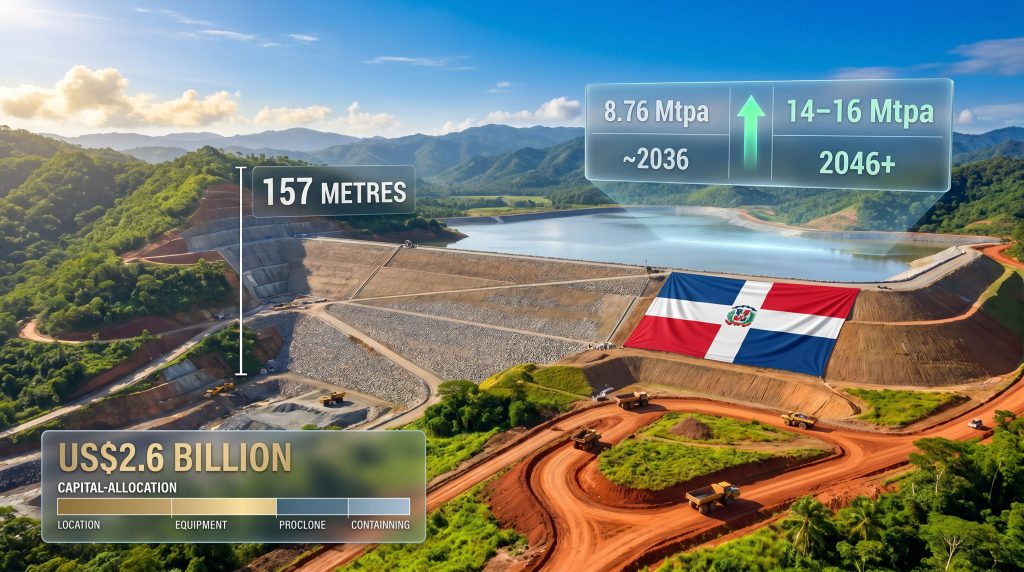
| Proposed Dam Height | 157 metres |
| Total Storage Capacity | 278 million cubic metres |
| Combined Tailings and WTS Volume | 344.7 million metric tonnes |
| PAG Waste Rock Co-disposal | 452.7 million metric tonnes |
| Processing Rate Target (post-expansion) | 14 to 16 Mtpa |
| Current Processing Rate | 8.76 Mtpa |
| Mine Life Extension Target | Beyond 2040 (20+ additional years) |
At 157 metres, El Naranjo would rank among the tallest tailings dam structures in the Caribbean and Latin America. This is not simply an engineering superlative; height is directly correlated with consequence classification under modern tailings management standards, which in turn determines the stringency of design requirements, monitoring obligations, and independent review processes that must be applied throughout the facility's operational life.
What the Throughput Uplift Actually Means
The capacity jump from 8.76 Mtpa to a target range of 14 to 16 Mtpa represents a potential increase of roughly 60 to 80 percent in ore processing volume. This is not achievable through equipment upgrades alone. Processing plant capacity expansions require that tailings containment infrastructure keeps pace, making El Naranjo's construction the enabling condition for any throughput growth, not merely a supporting element.
The mine life extension mathematics are equally significant. Without new tailings capacity, Pueblo Viejo's operational horizon converges toward approximately 2036 based on current infrastructure constraints. With El Naranjo operational, that horizon extends to 2046 and beyond, representing more than two additional decades of gold production from a known, permitted, operating asset.
Capital Deployment Strategy: Holding the Envelope While Resequencing the Work
The total capital expenditure commitment for the Pueblo Viejo expansion remains fixed at US$2.6 billion, a figure that has not changed despite a meaningful evolution in how that capital is being deployed. What has shifted is the internal sequencing of construction activity, with emphasis moving from processing plant upgrades toward tailings infrastructure build-out as the primary workstream. Barrick's project has maintained this capital envelope even as priorities within it have evolved.
This resequencing reflects standard mine expansion logic that experienced project managers will recognise. Increasing processing throughput before adequate tailings storage is available creates a compounding operational risk, because additional ore processed generates additional waste that has nowhere to go. Infrastructure-first capital phasing avoids this trap.
Implications for Near-Term Cost Profiles
Infrastructure-heavy capital phases typically affect short-term cost metrics in predictable ways:
- All-in sustaining costs (AISC) tend to rise during major infrastructure construction phases as capital expenditure intensity increases without corresponding production uplift.
- Near-term free cash flow is constrained by elevated capital deployment.
- Long-term reserve conversion economics improve substantially as new tailings capacity unlocks access to ore tonnes that would otherwise be stranded.
For investors evaluating Barrick's project economics, the current capital-intensive phase represents an investment cycle typical of mature mine life extension projects, where front-loaded infrastructure expenditure precedes extended production cashflow streams at higher throughput rates. A thorough definitive feasibility study is, consequently, essential for understanding these long-horizon cost trade-offs.
The GISTM Framework: Why Engineering Standards Have Permanently Changed
The catastrophic failure of the Brumadinho tailings dam in Brazil in January 2019, which caused the deaths of 270 people, fundamentally altered the global regulatory and industry standard landscape for tailings dam engineering. The Global Industry Standard on Tailings Management (GISTM), developed through collaboration between the International Council on Mining and Metals (ICMM), the United Nations Environment Programme (UNEP), and the Principles for Responsible Investment (PRI), was published in August 2020 with a binding implementation deadline of August 5, 2023 for facilities classified under the highest consequence categories.
As an ICMM member company, Barrick Gold is bound by GISTM requirements across all its operations. Pueblo Viejo's tailings facilities, including the proposed El Naranjo structure, are classified under the "Very High or Extreme" failure consequence category, the most demanding classification tier within the standard.
What This Classification Demands in Practice
| GISTM Requirement Category | Application to Very High or Extreme Structures |
|---|---|
| Independent Tailings Review Board | Mandatory; must include qualified geotechnical engineers |
| Responsible Tailings Facility Engineer (RTFE) | Must be appointed; has accountability for design integrity |
| Design Safety Factor | Must exceed standard stability thresholds |
| Real-time Monitoring | Required throughout construction and operation |
| Emergency Action Plan | Must be current, tested, and shared with affected communities |
| GISTM Compliance Deadline | August 5, 2023 (operational facilities) |
The GISTM framework introduced a concept that has reshaped capital budgeting for tailings infrastructure globally: the requirement that the operator of record, not just contracted engineering firms, maintains ultimate accountability for facility safety. This has driven meaningful increases in engineering design costs and monitoring system capital requirements relative to pre-standard approaches.
The next major ASX story will hit our subscribers first
Foundation Geology and the Technical Complexity of El Naranjo
One of the more technically significant aspects of the El Naranjo design concerns the geological characteristics of the proposed dam foundation. Engineering assessments have identified concerns related to high-permeability foundation materials at the site, which introduce seepage management as a central design challenge.
Seepage through or beneath a tailings dam embankment can, if uncontrolled, destabilise the dam structure and represent a pathway for contaminated water to reach surrounding watercourses and groundwater systems. For a facility of El Naranjo's proposed height and consequence classification, this foundation condition requires:
- Detailed geotechnical investigation to characterise permeability at depth.
- Foundation treatment measures, which may include grouting, cutoff walls, or drainage blanket systems depending on investigation findings.
- Permanent seepage collection and monitoring infrastructure to detect and manage any seepage that occurs during operations.
- Ongoing independent geotechnical review of seepage monitoring data throughout the facility's operational life.
Potentially Acid-Generating Waste Rock: A Distinct Engineering Layer
Beyond conventional tailings management, El Naranjo must also accommodate 452.7 million metric tonnes of potentially acid-generating (PAG) waste rock from the Monte Negro and Moore open pits. PAG material presents a fundamentally different containment challenge from conventional tailings slurry.
When sulphide minerals within PAG waste rock are exposed to oxygen and water, the resulting acid rock drainage (ARD) can mobilise heavy metals and acidic leachate at concentrations capable of causing severe and long-lasting environmental damage. Co-disposal strategies that integrate PAG waste rock with tailings material require careful chemical compatibility assessment, because the interaction between acid-generating rock and alkaline tailings slurry can produce unpredictable geochemical outcomes if not properly engineered.
At Pueblo Viejo specifically, the processing method involves cyanide heap leaching, meaning complete cyanide destruction at on-site treatment plants is a required operational step before tailings material enters the storage facility. The resulting water treatment sludge, which captures cyanide degradation byproducts, must also be incorporated into the facility's total storage volume calculations, contributing to the combined 344.7 million metric tonne tailings and sludge design capacity.
Downstream Risk and the 227-Kilometre Consequence Envelope
Independent environmental impact assessment findings for El Naranjo quantify the downstream risk of a catastrophic dam failure scenario in terms that contextualise why GISTM's extreme-consequence classification is warranted. Tailings dispersal in a worst-case failure event is modelled to extend across a corridor of 227 kilometres, reaching the ecologically sensitive Samaná Bay, located 101 kilometres from the facility.
The communities of Las Lagunas and La Cerca have been identified as falling within the direct impact zone of such a scenario, alongside significant mine infrastructure assets. This consequence profile is precisely what GISTM's highest classification tier was designed to govern, mandating engineering design standards, monitoring systems, and emergency response capabilities that exceed those applied to lower-consequence facilities.
"The 227-kilometre consequence envelope and proximity to Samaná Bay's coastal ecosystem are not worst-case theoretical exercises. Under GISTM, these scenarios are required to be modelled, disclosed, and used as the design basis for engineering safety factors, emergency preparedness, and community risk communication."
Community Resettlement and the Social Licence Challenge
The El Naranjo construction program requires the resettlement of communities within the facility's footprint area. Under international best practice frameworks, including the IFC Performance Standards on Environmental and Social Sustainability, resettlement processes must be conducted in a manner that maintains or improves the livelihoods and living standards of affected people. Broader considerations around natural capital in mining are, furthermore, increasingly factored into how resettlement obligations and environmental offsets are structured.
The engagement model at Pueblo Viejo incorporates multiple stakeholder groups as formal consultation parties: affected community members, Dominican government entities at both national and municipal levels, and the Catholic Church, which holds significant institutional influence in Dominican communities. This multi-party model reflects the complexity of resettlement negotiations in contexts where land tenure documentation may be informal and community relationships with land are both economic and cultural.
Legal complaints filed by local individuals and environmental organisations seeking suspension of construction activities represent an active regulatory and judicial risk dimension that affects contractor mobilisation and capital deployment scheduling. The dual-ministry approval pathway, requiring sign-off from both the Dominican Ministry of Energy and Mines and the Ministry of Environment and Natural Resources (MIMARENA), creates multiple decision points where legal challenges can intersect with regulatory timelines. The regulatory environment governing mining permits has, in addition, become increasingly scrutinised across jurisdictions globally.
From Permitting to Production: How a Major Tailings Facility Reaches Operation
For readers unfamiliar with the infrastructure development pathway for large-scale tailings facilities, the sequence below outlines the key stages that must be completed before El Naranjo can receive its first tonne of material.
- Feasibility and Site Selection — Geotechnical investigation, hydrological modelling, and environmental baseline studies conducted; dual-ministry review pathway initiated with Dominican regulatory authorities.
- Environmental Impact Assessment Submission — Independent agencies prepare EIA documentation incorporating consequence modelling, baseline environmental data, and mitigation frameworks for MIMARENA review.
- Community Consultation and Resettlement Planning — Formal engagement with Las Lagunas, La Cerca, and other affected communities; resettlement framework and compensation structure established consistent with IFC Performance Standards.
- Regulatory Approval — Dual-ministry approval obtained from Ministry of Energy and Mines and MIMARENA; legal challenges resolved or progressed through Dominican judicial processes.
- Engineering Design Finalisation — GISTM-compliant detailed design completed; Independent Tailings Review Board engaged and Responsible Tailings Facility Engineer appointed for extreme-consequence structure oversight.
- Construction Mobilisation — Civil works contractor mobilised; foundation treatment works, drainage systems, and initial embankment construction commence.
- Staged Commissioning — Facility brought into service in phases aligned with mine production requirements; geotechnical and water quality monitoring systems activated.
- Operational Monitoring and Compliance — Continuous monitoring maintained throughout operational life; GISTM compliance reporting submitted to ICMM as required by membership obligations.
What Pueblo Viejo's Infrastructure Pivot Reveals About Modern Gold Mining Economics
The Barrick Pueblo Viejo tailings infrastructure program is not simply a site-specific engineering challenge. It represents a broader structural shift in how the economics of mature gold mining operations are understood and managed. Indeed, mine reclamation evolution across the industry has been driven by precisely the same post-Brumadinho forces reshaping standards at Pueblo Viejo.
The post-Brumadinho regulatory environment has permanently elevated the capital and technical requirements for tailings dam construction globally. Where a pre-2019 operator might have approached tailings infrastructure as a routine sustaining capital line item, the GISTM era demands that extreme-consequence structures be engineered, monitored, and governed at standards that materially increase both upfront capital costs and ongoing operational complexity.
For major producers with the balance sheet capacity to absorb US$2.6 billion capital programmes, this elevated standard is manageable. For mid-tier and junior operators facing similar tailings infrastructure constraints at smaller operations, however, the new standard environment creates a structural barrier to mine life extension that was less pronounced a decade ago.
The Pueblo Viejo case also illustrates the growing premium that investors and regulators place on social licence maintenance at long-life operations in Latin America. The involvement of community resettlement processes, civil society legal challenges, and multi-ministry regulatory approvals introduces timeline risk that cannot be engineered away — only managed through consistent and transparent engagement.
At 800,000+ ounces of annual gold production generating substantial revenue across a potential extended mine life reaching beyond 2046, the economic case for resolving these complexities remains compelling. The infrastructure capital commitment stands. The technical pathway is defined. What remains is execution across one of the most demanding permitting, engineering, and community engagement environments in Latin American mining.
This article contains forward-looking statements regarding capital expenditure, production targets, and mine life projections. These involve known and unknown risks and uncertainties that could cause actual outcomes to differ materially from those expressed. Readers should conduct their own due diligence and consult qualified financial and technical advisers before making investment decisions based on information contained herein.
Want to Know Which ASX Gold Explorers Could Deliver the Next Major Discovery?
While established producers like Barrick navigate billion-dollar tailings infrastructure programmes to extend mine life, the most transformative returns in gold often originate from the moment of discovery — and Discovery Alert's proprietary Discovery IQ model ensures subscribers receive real-time alerts the instant significant ASX mineral discoveries are announced. Explore historic discovery returns on Discovery Alert's dedicated discoveries page and begin your 14-day free trial to position yourself ahead of the broader market.