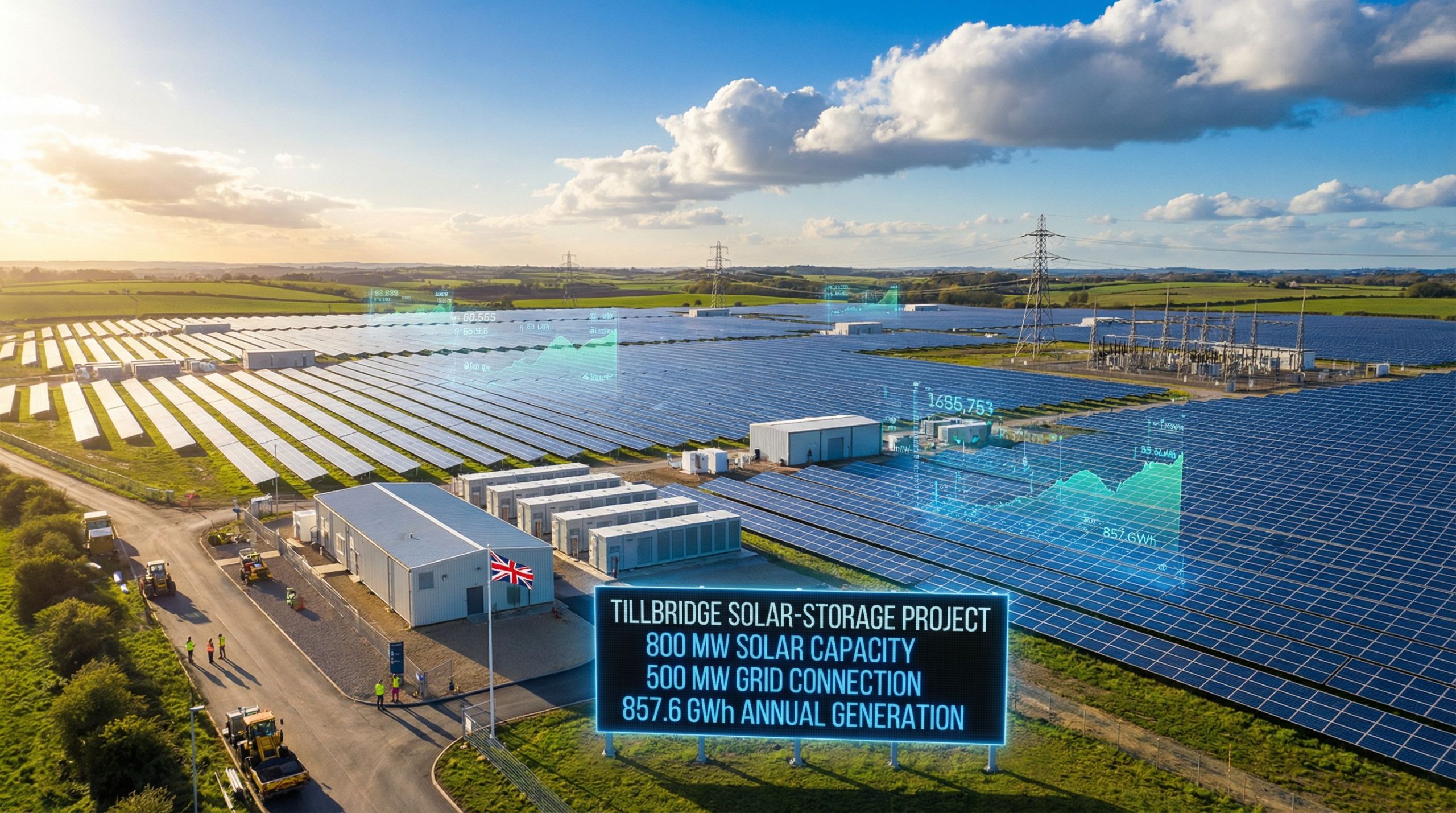
The energy storage landscape is experiencing a fundamental transformation as battery technology costs decline and grid modernisation requirements intensify. This convergence of economic and technical factors has created optimal conditions for hybrid renewable infrastructure deployment, where oversized solar installations paired with grid-scale battery systems deliver enhanced asset utilisation and revenue diversification opportunities. The Recurrent Energy UK solar storage project exemplifies these developments through strategic capacity planning and innovative financing approaches.
Strategic Co-Location Architecture for Grid Connection Optimisation
The Recurrent Energy UK solar storage project represents a sophisticated approach to grid connection economics through strategic capacity overbuild methodology. The Tillbridge Solar Project demonstrates this architecture with 800 MWp of solar capacity connecting through a 500 MW grid export limitation, supported by a 500 MW/1 GWh battery energy storage system.
Grid Export Capacity Maximisation Through Storage Buffering
This configuration enables 60% solar capacity overbuild relative to grid connection constraints, with the battery system providing temporal energy shifting capabilities. During peak solar generation periods, excess production beyond the 500 MW export capacity charges the storage system, which subsequently discharges during evening peak demand periods or when solar generation declines.
The 2-hour storage duration (1 GWh ÷ 500 MW) provides strategic flexibility for daily load balancing while maximising utilisation of the available grid connection infrastructure. This approach addresses the fundamental challenge of grid connection scarcity in the UK renewable energy development pipeline. Furthermore, these renewable energy transformations demonstrate scalable solutions for energy transition challenges.
Revenue Stream Diversification in Hybrid Energy Systems
Co-located solar-storage projects access multiple income streams beyond traditional energy sales:
- Energy arbitrage: Storing low-value solar generation for discharge during high-price periods
- Frequency response services: Fast-responding storage providing grid stability services
- Capacity market participation: Long-term contracts for system adequacy
- Balancing services: Grid operator payments for voltage support and reactive power
The hybrid configuration enables revenue optimisation across these markets while reducing exposure to single-market price volatility. For investors seeking comprehensive investment strategy insights, these diversified revenue models present compelling opportunities.
NSIP Pathway Strategic Advantages for Large-Scale Infrastructure
The UK's Nationally Significant Infrastructure Projects framework provides centralised approval mechanisms for utility-scale renewable developments exceeding specific capacity thresholds. The Tillbridge project secured approval through this pathway in October 2025, demonstrating the strategic advantages of NSIP designation.
Threshold Analysis and Regulatory Timeline
Current NSIP requirements apply to generating stations exceeding 50 MW capacity in England, with this threshold increasing to 100 MW effective December 31, 2025. The Tillbridge project's 800 MW solar capacity significantly exceeds both thresholds, ensuring NSIP pathway eligibility under either regulatory framework.
| Threshold Period | Capacity Requirement | Decision Authority |
|---|---|---|
| Through Dec 30, 2025 | 50 MW | UK Energy Secretary |
| From Dec 31, 2025 | 100 MW | UK Energy Secretary |
The centralised approval process bypasses local planning authority constraints, enabling streamlined development timelines for strategic infrastructure projects. This approach particularly benefits large-scale renewable developments where local planning capacity may be insufficient for complex technical assessments.
Development Consent Order Framework
NSIP approval culminates in a Development Consent Order rather than conventional planning permission. Recurrent Energy CEO Ismael Guerrero confirmed the company secured a DCO for the 800 MW solar and battery storage project, positioning it among the UK's most significant solar and storage developments.
According to industry sources, the project represents a major advancement in supporting the UK's clean energy transition while strengthening grid reliability and delivering community environmental benefits. This strategic positioning aligns with national energy security objectives and net zero policy frameworks.
Investment Performance Metrics for Hybrid Solar-Storage Systems
The economic viability of co-located projects depends on optimised capital deployment across shared infrastructure and diversified revenue generation capabilities. Hybrid systems demonstrate superior asset utilisation compared to standalone solar installations through enhanced grid connection efficiency.
Capacity Utilisation Analysis
Traditional solar installations typically achieve 11-15% capacity factors in the UK climate, limited by seasonal irradiance variations and daily generation cycles. Hybrid configurations with strategically sized storage systems can potentially achieve higher effective utilisation by:
- Capturing curtailed solar generation during low-demand periods
- Shifting energy output to high-value time periods
- Providing continuous grid services capability beyond solar generation hours
- Maximising grid export capacity utilisation throughout daily cycles
Capital Expenditure Optimisation Through Infrastructure Sharing
Co-located developments achieve cost efficiencies through:
- Shared site preparation and civil works: Single construction mobilisation for dual-asset deployment
- Common grid connection infrastructure: Unified transmission equipment serving both solar and storage systems
- Integrated control systems: Centralised monitoring and dispatch capabilities
- Consolidated operations and maintenance: Unified O&M contracts reducing operational complexity
These synergies enable lower levelised cost of electricity compared to separately developed solar and storage projects. Additionally, understanding critical minerals & energy security considerations is essential for sustainable project development.
UK Solar Infrastructure Benchmark Comparison
The Tillbridge project's scale positions it as transformational infrastructure within the UK renewable energy portfolio. With 800 MW solar capacity, it significantly exceeds existing operational benchmark projects.
Scale Analysis Against Operational Assets
Cleve Hill Solar Park, previously the largest operational UK solar installation at 373 MW, provides the current benchmark for utility-scale development. The Tillbridge project's capacity represents 214% of Cleve Hill's size, establishing a new scale paradigm for UK solar infrastructure.
| Project | Capacity (MW) | Technology | Status |
|---|---|---|---|
| Tillbridge Solar | 800 | Solar + 500 MW/1 GWh BESS | Approved Oct 2025 |
| Cleve Hill Solar Park | 373 | Solar only | Operational |
| Scale Ratio | 2.14× | Hybrid vs. Solar | Comparative Analysis |
Strategic Grid Integration Benefits
The Lincolnshire location provides strategic transmission access advantages, though specific grid connection details and regional demand characteristics require additional technical analysis beyond the scope of available project documentation.
The geographic positioning within England's transmission network enables efficient power delivery to demand centres while supporting grid stability through distributed renewable generation capacity.
Joint Venture Partnership Structure in Utility-Scale Development
The Tillbridge project represents a strategic partnership between Recurrent Energy, a subsidiary of Canadian Solar Inc., and UK-based Tribus Clean Energy. This joint venture structure combines international development expertise with local market knowledge.
Global Portfolio Context and Development Experience
Recurrent Energy brings substantial utility-scale development credentials to the partnership:
- 12 GWp global solar development experience
- 5 GWh+ battery storage project portfolio worldwide
- Established financing relationships and technical execution capabilities
This international experience provides technical methodology and financial structuring expertise for GW-scale infrastructure development. Moreover, battery technology investments continue driving innovation in energy storage solutions.
Local Market Integration Strategy
Tribus Clean Energy contributes UK market-specific capabilities including:
- Regulatory navigation expertise within UK planning frameworks
- Stakeholder engagement experience with local communities and authorities
- Grid connection application processes and transmission operator relationships
- Environmental impact assessment coordination within UK regulatory requirements
The partnership structure enables risk distribution while leveraging complementary capabilities essential for successful utility-scale development in complex regulatory environments.
Net Zero Policy Integration and Grid Modernisation
Large-scale solar-storage projects serve dual functions within UK energy policy: direct renewable generation capacity expansion and grid reliability enhancement during the energy transition period.
Strategic Infrastructure Role in Energy Security
The project aligns with UK net zero commitments under the Climate Change Act 2008 framework, contributing to economy-wide decarbonisation targets through:
- Fossil fuel displacement: Direct substitution of renewable generation for conventional thermal capacity
- Grid flexibility enhancement: Storage-enabled renewable integration supporting higher penetration levels
- Energy security strengthening: Domestic renewable capacity reducing import dependency
According to Recurrent Energy's strategic positioning, Tillbridge represents major advancement in supporting the UK's clean energy transition while strengthening grid reliability and delivering community benefits.
Technical Grid Services Integration
The 500 MW/1 GWh storage system provides multiple grid stability services:
- Frequency response: Fast-responding storage capacity for grid frequency regulation
- Voltage support: Reactive power capabilities for transmission system stability
- Peak demand management: Strategic discharge during high-demand periods reducing conventional generation requirements
- Renewable integration support: Storage absorption of excess renewable generation reducing curtailment requirements
These technical capabilities enable higher renewable penetration across the UK electricity system while maintaining grid reliability standards.
Environmental Impact and Community Benefit Framework
Utility-scale renewable projects must demonstrate positive environmental outcomes while providing local community benefits to secure development approvals and social licence for operations.
Biodiversity Net Gain Implementation
UK planning policy requires renewable energy projects to deliver measurable environmental improvements beyond baseline conditions. Biodiversity net gain calculations assess habitat quality enhancements and ecological value creation across project sites.
Solar installations enable land use optimisation through:
- Habitat restoration: Native vegetation establishment between solar arrays
- Agricultural co-benefits: Potential agrivoltaic applications maintaining land productivity
- Wildlife corridor creation: Strategic landscaping connecting existing habitat areas
- Soil quality improvement: Reduced intensive agricultural inputs enabling soil recovery
Local Economic Development Impact
Large-scale infrastructure development generates significant local economic activity through:
- Construction employment: Direct job creation during development phases
- Supply chain integration: Local procurement opportunities for materials and services
- Long-term operational positions: Permanent employment for maintenance and operations
- Community investment: Developer contributions to local infrastructure and services
The scale of GW-level projects creates substantial economic multiplier effects within regional economies.
Market Evolution Scenarios and Technology Integration
The viability of solar-storage projects depends on continued technology cost reductions and supportive market mechanisms for hybrid renewable infrastructure.
Battery Technology Cost Trajectory Analysis
Energy storage deployment economics have improved dramatically through:
- Lithium-ion battery cost declines: Manufacturing scale economies reducing system costs
- Technology performance improvements: Enhanced energy density and cycle life extending asset value
- Manufacturing localisation: Reduced transportation costs and supply chain risks
- Financing market maturation: Lower cost of capital for proven storage technologies
These trends enable economically viable co-location projects at increasing scale.
Grid Services Market Development
The UK electricity system operator continues evolving market mechanisms to support renewable integration:
- Enhanced frequency response markets: Premium pricing for fast-responding storage capacity
- Capacity market evolution: Long-term contracts supporting investment certainty
- Balancing services expansion: Growing revenue opportunities for flexible assets
- Distribution system services: Emerging markets for local grid support services
These market developments support diversified revenue streams for hybrid projects, reducing merchant energy market exposure.
Future Development Pipeline and Scaling Potential
The Tillbridge project establishes precedent for GW-scale hybrid renewable development in the UK market, with implications for subsequent project approvals and investment patterns.
Replication Potential Across UK Markets
Successful hybrid project deployment depends on:
- Grid connection availability: Transmission capacity constraints limiting development locations
- Planning policy consistency: Stable regulatory frameworks supporting investment decisions
- Technology supply chains: Equipment availability and delivery timelines
- Financial market capacity: Available capital for multi-GW development programmes
The NSIP pathway provides scalable approval mechanisms for projects exceeding capacity thresholds, enabling streamlined development processes for strategic infrastructure. Consequently, understanding capital raising strategies becomes crucial for financing these large-scale developments.
Investment Capital Market Evolution
Large-scale renewable infrastructure requires substantial capital deployment supported by:
- Institutional investor interest: Pension funds and infrastructure investors seeking long-term stable returns
- Green finance mechanisms: Climate-focused lending and investment products
- Government policy support: Strategic frameworks supporting renewable energy deployment
- Risk mitigation instruments: Insurance and hedging products reducing project risks
The demonstration of successful GW-scale hybrid development creates market confidence supporting additional project investment.
Disclaimer: This analysis is based on publicly available information as of December 2025. Energy infrastructure development involves significant technical, regulatory, and market risks. Actual project performance may vary from projections due to technology changes, policy modifications, or market evolution. Investment decisions should be based on comprehensive due diligence and professional financial advice.
Looking to Capitalise on Australia's Energy Transition Opportunities?
Discovery Alert's proprietary Discovery IQ model delivers real-time alerts on significant ASX mineral discoveries, including critical battery metals and energy transition commodities that are driving the global shift to renewable energy. With hybrid renewable projects like Tillbridge demonstrating the massive infrastructure investment required for net zero targets, investors can position themselves ahead of the market by accessing Discovery Alert's historic discovery returns data and beginning their 30-day free trial today.