Livium Ltd
- ASX Code: LIT
- Market Cap: $18,576,964
Livium Completes Landmark BESS Recycling Project, Laying the Groundwork for WA Expansion
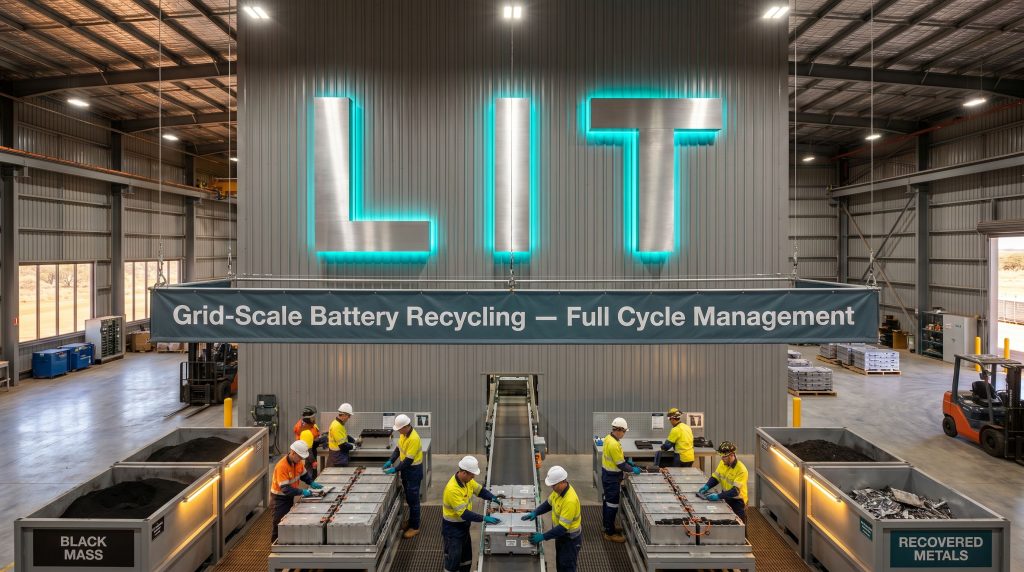
Livium Ltd (ASX: LIT) has announced the successful completion of the Livium completes Alkimos Beach community battery BESS recycling project in Western Australia — a milestone that validates the company's end-to-end operational capability and reinforces its growth ambitions in the state. Executed through wholly owned subsidiary Envirostream Australia Pty Ltd, the project processed 348 lithium-ion battery modules totalling approximately 16.3 tonnes, achieving an overall recycling rate of approximately 71.5% and recovering ~11.6 tonnes of material diverted from landfill.
The project was delivered for Synergy, Western Australia's state-owned electricity generator and retailer, which currently operates 26 generation assets and holds three utility-scale battery energy storage systems in its portfolio. For Livium, the engagement represents far more than a single completed contract — it establishes a commercially replicable model for the growing wave of end-of-life grid storage assets emerging across Australia.
When big ASX news breaks, our subscribers know first
From One Project to a Scalable Platform: What Was Actually Delivered
The Alkimos BESS recycling project was executed across the country, beginning with safe collection of battery modules in Western Australia and concluding with dismantling, processing, and material recovery at Envirostream's Victorian facilities. The end-to-end workflow was structured around compliance with Dangerous Goods transport requirements, controlled discharge protocols, cell-level dismantling, and multi-stream materials separation.
The key outcome metrics from the project are summarised below:
| Metric | Detail |
|---|---|
| Total modules processed | 348 lithium-ion battery modules |
| Total weight processed | ~16.3 tonnes |
| Overall recycling rate | ~71.5% |
| Total material recovered | ~11.6 tonnes |
| Black mass recovered | ~4.6 tonnes |
| Material diverted from landfill | ~11.6 tonnes |
The recovered materials were separated into distinct streams — metals directed to domestic recycling markets, and battery cells processed into mixed metal dust (MMD) for downstream refining. Furthermore, the black mass recovered from the project is currently being planned for shipment to Envirostream's black mass processing partners.
A Closer Look: Where the Recovered Material Goes
One of the more instructive aspects of this project is the detailed breakdown of what was actually recovered. The materials profile reflects both the composition of modern lithium-ion battery systems and the effectiveness of Livium's processing capabilities.
| Material | Weight (kg) | Share of Total | Destination |
|---|---|---|---|
| Steel | 5,935 | 36.4% | Domestic recycling markets |
| Mixed Metal Dust (MMD) | 4,627 | 28.4% | Downstream refining (lithium, nickel, cobalt, manganese, aluminium, copper) |
| Plastic (non-recyclable) | 4,125 | 25.3% | Waste stream |
| Copper | 774 | 4.8% | Domestic recycling markets |
| Other waste (electrolyte losses) | 514 | 3.2% | — |
| Aluminium | 241 | 1.5% | Domestic recycling markets |
| Electrical components (BMS etc.) | 70 | 0.4% | — |
Steel and MMD together account for approximately 64.8% of total recovered material by weight, underscoring the meaningful economic and environmental value embedded in end-of-life battery systems. The MMD stream — containing lithium, nickel, cobalt, manganese, aluminium, and copper — is particularly significant given the strategic importance of these materials in battery manufacturing supply chains.
Understanding Black Mass: A Key Term for Battery Recycling Investors
What Is Black Mass?
Black mass is the powdery residue produced when lithium-ion battery cells are shredded and processed. It contains a concentrated mix of valuable battery minerals — most notably lithium, nickel, cobalt, and manganese — along with carbon from the battery's anode material.
Why Does It Matter?
These are the same critical minerals used to manufacture new battery cells. Recovering them through recycling creates a domestic supply pathway that reduces reliance on primary mining and supports circular supply chains. For Livium, black mass recovery is a core downstream revenue stream, with the material processed at Envirostream's facilities before being sent to refining partners for further extraction of individual metals.
Glossary of Key Terms
- BESS (Battery Energy Storage System): A large-scale installation that stores electrical energy and can release it to the grid or local network on demand.
- Black mass: The processed output from shredded lithium-ion battery cells, containing recoverable critical minerals.
- MMD (Mixed Metal Dust): A processed material stream containing multiple metals derived from battery cell chemistry, destined for downstream refining.
- BMS (Battery Management System): The electronic control system that manages a battery's operation, safety, and performance.
- End-of-life batteries: Batteries that have reached the end of their usable service life and require decommissioning and recycling.
CEO Insight
"This project was an important showcase of Livium's ability to successfully execute a fully integrated, end-to-end recycling solution for large-format battery systems from any location within Australia. The successful delivery of this project not only validates our technical and operational capability but also reinforces the role Livium can play in supporting the lifecycle management of Australian energy storage infrastructure with leading players in the energy market, such as Synergy. Our operating model is built around the principles of traceability, auditability, capability, compliance, and risk management."
— Simon Linge, CEO and Managing Director, Livium Ltd
Why Western Australia Is Central to Livium's Growth Story
Western Australia is explicitly identified by Livium as a key growth region, driven by accelerating electrification across both the energy and mining sectors. Synergy's expanding portfolio — including the country's largest commissioned BESS and a pipeline of additional utility-scale storage assets — represents the kind of customer and contract profile that Livium is positioning to service at scale.
Synergy currently operates three utility-scale battery energy storage systems and has two generation assets under construction, according to its 2025 Annual Report. For a recycling operator, this is precisely the type of end-user base that creates long-tail, recurring volumes as infrastructure cycles through its operational lifespan and reaches end-of-life.
Critically, the Livium completes Alkimos Beach community battery BESS recycling project demonstrates that Livium can execute across state borders — managing logistics, Dangerous Goods compliance, processing, and downstream material placement — all within its own facilities and operational framework. This is not a theoretical capability; it has now been demonstrated on a real, utility-scale asset.
Next Steps: Building on the Foundation
The completion of this project is framed by Livium as the beginning of a broader engagement model rather than a standalone event. Key forward-looking themes from the announcement include:
-
Black mass shipment planning — The ~4.6 tonnes of black mass recovered from the project is being prepared for shipment to Envirostream's black mass processing partners, representing a near-term downstream activity.
-
WA expansion — The project is explicitly described as establishing a foundation for expanding Livium's presence in Western Australia as volumes of end-of-life batteries continue to grow in the state.
-
Utility and infrastructure engagement — The replicable project model provides a pathway for future engagements with energy utilities and infrastructure owners managing grid-scale and distributed energy storage assets.
-
Broader adjacencies — Livium's stated strategy extends beyond lithium-ion battery recycling to include rare earth element recycling, solar panel recycling, and black mass processing, each of which can leverage the operational infrastructure and compliance frameworks demonstrated in this project.
The Investment Case: Why This Milestone Matters
The completion of the Alkimos BESS project is meaningful for the Livium investment thesis across several dimensions.
1. Technical Validation at Scale
Processing 348 modules across 16.3 tonnes of large-format battery systems — with documented outcomes, traceable material flows, and a 71.5% recycling rate — demonstrates that Livium's capabilities extend beyond consumer and small-format batteries into the utility and commercial-scale segment. This is a material step up in complexity and commercial significance.
2. A Tier-One Customer Reference
Synergy is Western Australia's state-owned electricity generator and retailer. Completing a project for this type of customer — and doing so successfully — provides the kind of reference that is difficult to replicate and valuable when engaging other utilities and infrastructure owners.
3. A Replicable Commercial Model
The structured, end-to-end workflow used for Alkimos is described as a replicable model. As grid-scale BESS deployments continue to grow across Australia, the pipeline of future end-of-life projects will expand. Consequently, Livium has now demonstrated it can service this pipeline effectively and efficiently.
4. ESG and Regulatory Alignment
The project's emphasis on traceability, auditability, and compliance directly supports the ESG reporting needs of large energy companies and infrastructure operators — making Livium's services relevant not just as a cost solution but as a risk and compliance partner.
5. Domestic Circular Economy Positioning
Recovering ~4.6 tonnes of black mass containing lithium, nickel, cobalt, and manganese keeps critical mineral value within the Australian supply chain rather than sending end-of-life batteries to landfill or offshore processors.
The next major ASX story will hit our subscribers first
Why Investors Should Keep a Close Eye on Livium
Livium is not positioning itself as a speculative player waiting for future technology — it is a profitable, operating battery recycler that is demonstrating capability in a segment that is only going to grow. The transition away from fossil fuels means more batteries are being deployed today, which means more batteries will reach end-of-life tomorrow.
The Livium completes Alkimos Beach community battery BESS recycling project is a direct proof point for what that future looks like operationally. The company has now:
- Completed a utility-scale BESS recycling project from collection through to material recovery
- Recovered 11.6 tonnes of material from a single project, with downstream refining plans in motion
- Established a working relationship with one of Western Australia's largest energy providers
- Demonstrated cross-state logistics, compliance, and processing capability under a single operational model
Key Takeaway:
"Livium has positioned itself as Australia's leading battery recycler with a proven, end-to-end capability that now extends to utility-scale grid storage systems. With Western Australia identified as a priority growth region and a replicable commercial model validated through the Alkimos BESS project, investors should watch closely as Livium builds on this foundation to capture an expanding pipeline of end-of-life battery volumes across the energy and mining sectors."
Ready to Look Closer at Livium's Battery Recycling Investment Case?
Livium (ASX: LIT) has demonstrated a proven, end-to-end capability in utility-scale battery recycling — completing a landmark project for one of Western Australia's largest energy providers and laying the groundwork for significant regional expansion. With a replicable commercial model, a tier-one customer reference, and a growing pipeline of end-of-life battery volumes across Australia's energy and mining sectors, the investment case is becoming increasingly compelling. To learn more about Livium's projects, strategy, and growth trajectory, visit the Livium investor hub today.