What Drives BHP's Earnings Performance in the Current Market Environment?
Global mining corporations face unprecedented complexity in today's interconnected commodity markets, where supply chain resilience intersects with volatile pricing dynamics across multiple continents. Understanding how major mining companies navigate these challenges requires analyzing the fundamental drivers that separate industry leaders from their competitors during periods of economic uncertainty. The BHP earnings forecast through 2030 reflects these complex market dynamics and operational capabilities.
Commodity Price Dynamics and Market Fundamentals
BHP's profitability engine operates across three interconnected commodity segments, each responding to distinct market forces while contributing to overall revenue stability. Iron ore price trends remain the primary revenue catalyst, with recent realizations of US$84 per wet metric tonne exceeding analyst expectations during the first quarter of fiscal 2026. This pricing strength reflects both product quality premiums and strategic positioning across diversified distribution channels.
The company's exposure spans iron ore, copper, and coal markets, creating natural hedging mechanisms against single-commodity volatility. This diversification proved particularly valuable during Q1 FY26, when operational challenges in iron ore shipments were offset by exceptional performance in copper and coal segments.
UBS analysts recently upgraded their commodity price forecasts for BHP's key products, citing four critical market developments:
- Tightening global copper supply conditions
- Industrial substitution trends affecting aluminum demand relative to copper
- Resilient iron ore fundamentals supporting sustained demand
- Continued momentum in precious metals pricing environments
Production Efficiency and Operational Resilience
The Western Australian Iron Ore division demonstrates enhanced supply chain capabilities, with production capacity excluding maintenance reaching approximately 300 million tonnes annually. This capacity utilization reflects post-pandemic supply chain improvements and operational optimization across mining and port facilities.
Operational execution during Q1 FY26 highlighted BHP's ability to manage complex maintenance schedules while maintaining production targets. The accelerated completion of car dumper maintenance at Port Hedland, originally expected to impact 4.3 million tonnes of volume, finished ahead of schedule and positioned the division for stronger performance throughout the remainder of fiscal 2026.
Escondida Copper Operations Performance Metrics:
- Record concentrator throughput achieved in Q1 FY26
- Enhanced recovery rates exceeding operational guidance
- Operational improvements supporting higher margin realization
- Production consistency despite regional infrastructure challenges
Global Supply-Demand Imbalances
Structural copper supply constraints create favorable pricing environments across multiple end-use applications. Furthermore, the copper supply forecast indicates declining ore grades at existing copper operations, combined with limited new mine development globally, support sustained price premiums for established producers like BHP.
The company's iron ore distribution strategy across "different commercial distribution channels" reduces dependency on single-market exposure, particularly regarding Chinese steel production cycles. This multi-channel approach provides pricing flexibility and market access diversification that smaller competitors cannot replicate.
How Do Analysts Project BHP's Financial Performance Through 2030?
Investment banks are recalibrating their BHP earnings forecast models following stronger-than-expected operational performance and commodity price revisions. UBS analysts project a distinctive earnings trajectory that reflects both near-term operational momentum and long-term structural market changes affecting the global mining sector.
Near-Term Growth Trajectory (FY26-FY27)
FY26 Earnings Outlook
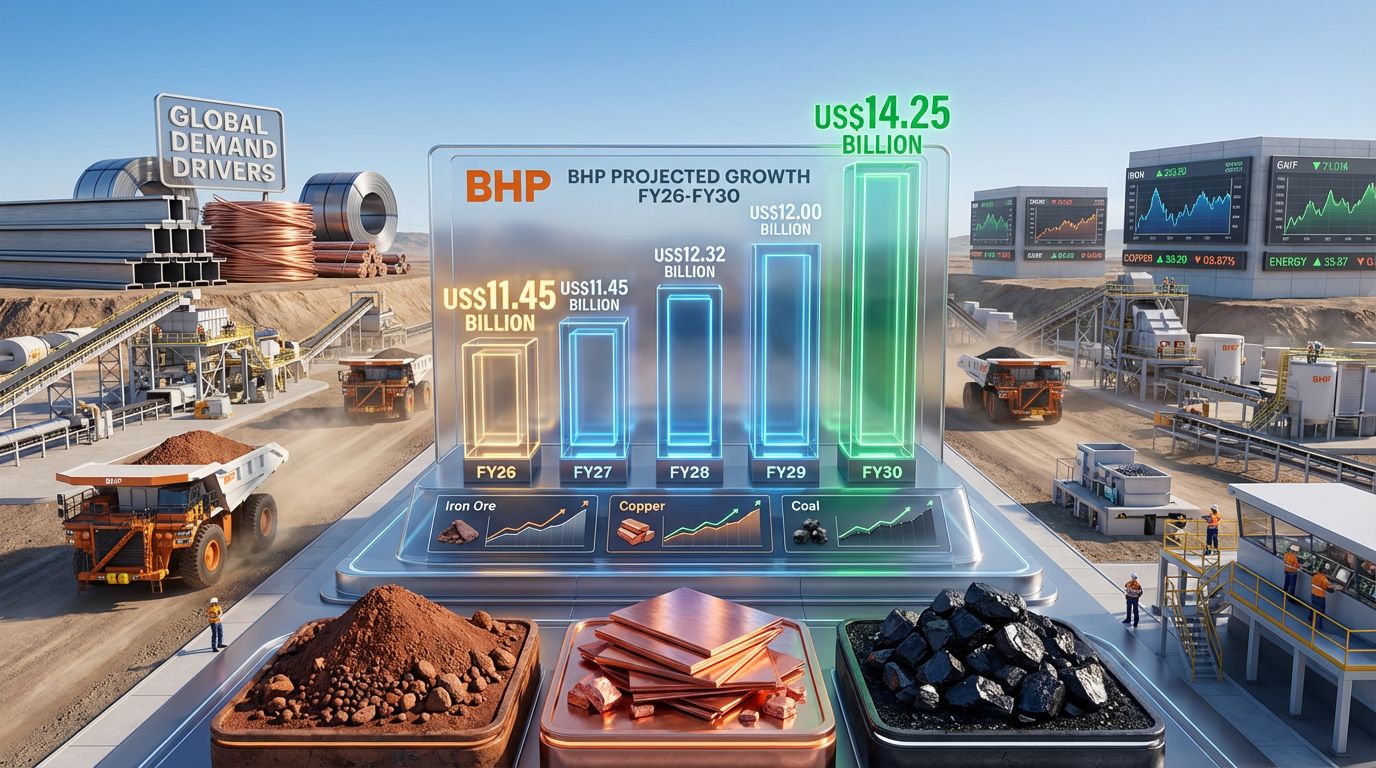
UBS projects net profit growth to US$11.45 billion for fiscal 2026, representing the foundation of a multi-year earnings expansion cycle. This forecast incorporates enhanced copper division performance through record Escondida throughput, coal operations exceeding expectations via optimized project execution, and iron ore shipment challenges offset by stronger pricing realizations.
The FY26 projection reflects what UBS characterizes as a "solid start" to the fiscal year, with first-quarter operational results validating assumptions about production capacity and commodity pricing strength. Escondida's record concentrator performance and BMA project optimization exceeded analyst expectations, while WAIO's maintenance completion ahead of schedule positions the iron ore division for sustained output growth.
FY27 Consolidation Phase
Projected net profit of US$11.38 billion for fiscal 2027 represents a marginal 0.6% decline from FY26 levels, reflecting what analysts characterise as commodity price normalisation following current elevated levels. This relatively flat trajectory indicates market transition from supply-driven to demand-driven earnings environments.
Mid-Term Stability Period (FY28-FY29)
FY28 Performance Metrics
Expected net profit of US$11.32 billion continues the stabilisation theme, with operational efficiency gains maintaining profit margins despite commodity price moderation. This period represents market maturation where competitive advantages become increasingly important for sustained profitability.
FY29 Recovery Indicators
The projected 17.8% increase to US$13.33 billion in net profit marks an inflection point in the earnings trajectory. UBS attributes this acceleration to structural demand improvements supporting higher margins, enhanced production capacity utilisation, and the early contribution from strategic growth projects.
Long-Term Growth Acceleration (FY30)
FY30 Peak Performance
The forecast culminates with US$14.25 billion in net profit, representing a 6.9% increase from FY29 and the strongest performance within the projection period. This peak reflects cumulative operational improvements, full capacity utilisation across all divisions, and favourable long-term commodity market dynamics.
Five-Year Earnings Summary:
| Fiscal Year | Net Profit (US$ billions) | Year-over-Year Change | Key Performance Drivers |
|---|---|---|---|
| FY26 | 11.45 | Baseline | Enhanced copper/coal, iron ore pricing |
| FY27 | 11.38 | -0.6% | Commodity price normalisation |
| FY28 | 11.32 | -0.5% | Operational efficiency focus |
| FY29 | 13.33 | +17.8% | Structural demand recovery |
| FY30 | 14.25 | +6.9% | Peak operational leverage |
The cumulative five-year earnings of US$61.73 billion represents an average annual profit of US$12.35 billion, with total growth of 24.4% from FY26 to FY30 demonstrating sustained value creation potential for shareholders.
What Commodity Market Trends Support BHP's Earnings Forecasts?
Commodity market fundamentals across iron ore, copper, and coal segments demonstrate varying degrees of supply-demand tightness that collectively support BHP's earnings projections through 2030. Each commodity faces distinct structural drivers that create differentiated pricing environments and margin opportunities.
Iron Ore Market Fundamentals
Global steel production patterns continue supporting iron ore demand stability, with BHP's premium product positioning enabling price realizations above benchmark indices. The company's Q1 FY26 achievement of US$84 per wet metric tonne demonstrates this premium capture capability in practice.
BHP's strategic distribution across multiple commercial channels reduces concentration risk compared to competitors heavily dependent on single-market exposure. This diversification proves particularly valuable during periods of Chinese steel sector volatility, as alternative markets provide demand stability and pricing flexibility.
Iron Ore Demand Drivers Through 2030:
- Emerging market urbanisation supporting steel consumption growth
- Infrastructure development in developing economies
- Quality premium trends favouring high-grade iron ore products
- Supply discipline among major producers maintaining price stability
Copper Supply Constraints
Structural copper market dynamics create the most favourable pricing environment among BHP's commodity portfolio. UBS identifies "tightening copper supply" as a primary driver of improved commodity price forecasts, supported by two fundamental constraints affecting global production capacity.
Declining Ore Grade Challenge:
Copper ore grades at existing mines continue deteriorating globally, requiring higher processing volumes to maintain production levels. This grade decline increases operational costs for competitors while advantaging BHP's high-grade operations like Escondida.
Limited New Mine Development:
Capital intensity and extended development timelines for new copper projects limit supply growth potential. Environmental permitting challenges and community opposition further constrain new project advancement, supporting sustained pricing strength for existing producers.
Long-Term Copper Demand Catalysts:
- Industrial electrification across transportation and energy sectors
- Renewable energy infrastructure requiring copper-intensive components
- 5G telecommunications network expansion globally
- Electric vehicle adoption accelerating copper consumption per vehicle
Coal Market Dynamics
Both thermal and metallurgical coal segments benefit from supply chain disruptions affecting competitors globally. BHP's operational continuity advantage, combined with high-quality coal product specifications, enables premium pricing in international markets.
Competitive Advantage Factors:
- Supply chain resilience during geopolitical disruptions
- Premium coal quality commanding higher realisations
- Established customer relationships providing marketing stability
- Operational flexibility enabling responsive production management
Market Structure Benefits:
Metallurgical coal demand remains supported by global steel production requirements, as current steelmaking technology requires coking coal inputs. While environmental pressures affect thermal coal markets, metallurgical coal maintains structural demand support through the steel production process.
How Does BHP's Dividend Policy Align with Earnings Projections?
BHP maintains a disciplined capital allocation framework centred on a 50% dividend payout ratio targeting sustainable shareholder returns across commodity price cycles. This policy structure provides earnings-linked dividend growth potential while preserving capital flexibility for strategic investments and operational requirements.
Payout Ratio Framework
The 50% net profit payout target represents a balanced approach between immediate shareholder returns and long-term capital preservation. UBS analysts expect BHP to maintain this framework through the first half of fiscal 2026, though higher payout ratios remain possible during periods of exceptional cash generation and favourable commodity pricing.
Dividend Sustainability Metrics:
- Consistent 50% payout ratio across commodity cycles
- Strong balance sheet supporting dividend resilience during downturns
- Cash flow generation exceeding dividend requirements by substantial margins
- Flexible payout capability during commodity price strength periods
Projected Dividend Growth Trajectory
Based on UBS earnings forecasts and the 50% payout framework, dividend per share growth mirrors the projected profit trajectory through 2030. According to financial calendar information and consensus estimates, the dividend progression aligns with operational performance expectations.
Estimated Annual Dividend Progression:
- FY26: Enhanced dividends supported by US$11.45 billion earnings
- FY27-FY28: Relatively stable dividends during profit consolidation period
- FY29: Material dividend increase reflecting 17.8% earnings growth
- FY30: Peak dividend levels corresponding to US$14.25 billion profit projection
Enhanced Returns Potential
During periods of exceptional commodity pricing strength, BHP's strong cash position enables opportunistic shareholder returns beyond the base 50% payout ratio. Historical precedent demonstrates the company's willingness to distribute excess cash through special dividends or share buybacks when balance sheet strength permits.
Capital Allocation Priorities:
- Base dividend maintenance: 50% payout ratio sustainability
- Growth capital investment: Strategic project development funding
- Balance sheet optimisation: Debt management and liquidity maintenance
- Excess cash distribution: Special dividends or share buybacks during commodity strength
What Investment Risks and Opportunities Emerge from These Forecasts?
BHP's earnings projections through 2030 incorporate multiple risk variables that could materially alter financial performance outcomes. Understanding these risk factors alongside strategic opportunities provides essential context for investment decision-making in the mining sector.
Macro-Economic Risk Factors
Global Economic Slowdown Impact
Recession risks across major economies pose significant challenges to commodity demand assumptions underlying BHP earnings forecast models. Steel consumption typically correlates strongly with economic growth, making iron ore demand vulnerable to GDP contraction in key markets. However, the US economy tariff impact could create additional volatility in global trade patterns.
Chinese Property Sector Dynamics
China's property development sector represents approximately 30-40% of global steel demand, making iron ore pricing particularly sensitive to Chinese residential and commercial construction activity. Continued weakness in Chinese property markets could pressure iron ore realisations below forecast assumptions.
Currency Fluctuation Effects
BHP reports earnings in US dollars while incurring costs in multiple currencies including Australian dollars. Significant AUD strength relative to USD could compress margins and reduce earnings conversion, particularly affecting Australian-based iron ore operations.
Geopolitical Supply Chain Risks
- Trade relationship deterioration between major economies
- Sanctions affecting commodity trading relationships
- Shipping route disruptions through critical maritime passages
- Resource nationalism in key operating jurisdictions
Operational Risk Considerations
Mine Life Extension Requirements
BHP's major operations require continuous capital investment to maintain production capacity as ore bodies mature. Significant capital expenditure for mine life extensions could reduce cash available for dividends and growth investments.
Environmental Regulatory Compliance
Increasing environmental standards globally require ongoing operational modifications and compliance investments. Carbon pricing mechanisms and emissions reduction requirements may increase operational costs beyond current forecast assumptions.
Labor Market Dynamics
Skilled mining workforce shortages across Australia and Chile create wage inflation pressures. Competition for specialised technical personnel could increase operational costs and affect production consistency during labour negotiations.
Climate Change Operational Impact
- Extreme weather events affecting mine operations and port facilities
- Water availability constraints in arid mining regions
- Temperature increases affecting equipment performance and worker safety
- Regulatory responses to climate change increasing compliance costs
Strategic Growth Opportunities
Copper Market Leadership Expansion
BHP's position in global copper markets provides significant growth potential through brownfield expansions and technological improvements. Copper demand growth from industrial electrification creates multi-decade expansion opportunities for existing operations.
Potash Project Commercialisation
The Canadian potash development project represents diversification into agricultural commodity markets with different demand cycles than traditional mining products. Successful commercialisation could provide earnings stability and growth beyond current forecasts.
Technology Investment Returns
The mining industry evolution demonstrates how automation and digitalisation initiatives across mining operations offer substantial cost reduction potential while improving safety outcomes. These technological investments enhance long-term competitiveness and margin expansion capabilities.
Sustainability Premium Opportunities
ESG-focused investment flows increasingly favour companies demonstrating environmental leadership. BHP's sustainability initiatives could command premium valuations and preferential access to capital markets compared to less sustainable competitors.
How Do Current Market Conditions Support Long-Term Earnings Growth?
Contemporary commodity market dynamics demonstrate several structural trends that support sustained earnings growth for diversified mining companies through 2030. These conditions represent fundamental shifts rather than cyclical fluctuations, providing more reliable foundations for long-term investment analysis.
Structural Demand Drivers
Global Decarbonisation Trends
The transition toward renewable energy infrastructure creates sustained copper demand growth across multiple applications. Solar panels, wind turbines, electric vehicles, and grid modernisation projects require substantially more copper per unit of energy capacity compared to traditional fossil fuel infrastructure.
Emerging Market Urbanisation
Steel demand growth remains supported by continued urbanisation across developing economies, particularly in Asia, Africa, and South America. Urban infrastructure development requires substantial steel inputs for construction, transportation, and utility systems.
Industrial Electrification Acceleration
Manufacturing processes increasingly rely on electricity rather than direct fossil fuel combustion, creating sustained copper demand growth. Electric arc furnace adoption in steelmaking also modifies metallurgical coal demand patterns while maintaining overall steel production requirements.
Supply Side Constraints
Limited New Mine Development
Capital requirements for new mining projects have increased substantially due to environmental compliance costs, community engagement requirements, and infrastructure development needs. These factors constrain new supply additions across all major commodities.
Ore Grade Decline Acceleration
Existing copper mines globally face declining ore grades requiring increased processing volumes to maintain production levels. This trend favours high-grade operations like BHP's Escondida while pressuring competitors with lower-grade resources.
Geopolitical Supply Concentration
Copper production remains concentrated in politically unstable regions including Peru, Chile, and Democratic Republic of Congo. This geographic concentration creates supply security premiums for operations in stable jurisdictions like Australia.
Technological Advancement Benefits
Automation Implementation
BHP's investment in autonomous mining equipment and remote operations capabilities reduces labour costs while improving safety outcomes. These technological advantages compound over time, creating sustainable competitive positioning versus traditional mining approaches.
Digitalisation and Data Analytics
Furthermore, innovative mining operations utilise advanced data analytics to enable optimised mine planning, predictive maintenance, and enhanced recovery rates across processing operations. These improvements increase effective production capacity without requiring proportional capital investment.
Environmental Technology Integration
Carbon capture, renewable energy integration, and waste reduction technologies enhance operational sustainability while potentially reducing regulatory compliance costs over time.
What Does This Mean for BHP Shareholders?
BHP's earnings trajectory through 2030 presents a compelling investment proposition supported by diversified commodity exposure, operational excellence, and favourable long-term market dynamics. The projected growth from US$11.45 billion in FY26 to US$14.25 billion in FY30 reflects both structural market advantages and internal operational improvements.
Investment Thesis Summary
Earnings Resilience Factors:
- Diversified commodity portfolio reducing single-market dependency
- Premium product positioning enabling price realisations above benchmarks
- Operational efficiency improvements supporting margin expansion
- Strategic distribution channels providing market access flexibility
Growth Catalyst Alignment:
The BHP earnings forecast incorporates multiple structural growth drivers including industrial electrification copper demand, emerging market steel consumption, and premium iron ore market positioning. These catalysts operate independently, providing portfolio resilience across different economic scenarios.
Total Return Expectations
Dividend Income Component:
BHP's 50% payout ratio framework provides earnings-linked dividend growth potential throughout the forecast period. Shareholders can expect dividend increases corresponding to the projected 24.4% cumulative earnings growth from FY26 to FY30.
Capital Appreciation Potential:
UBS maintains a neutral rating with A$45 price target, suggesting current valuations adequately reflect the earnings growth trajectory. However, successful execution of growth initiatives and favourable commodity market conditions could support valuation premium expansion.
Risk-Adjusted Returns:
BHP's defensive characteristics during economic downturns, combined with leverage to commodity price upturns, create asymmetric return profiles suitable for risk-conscious investors seeking exposure to global economic growth trends.
Portfolio Positioning Considerations
Diversification Benefits:
Mining sector exposure provides portfolio diversification relative to service sector and technology investments. BHP's commodity mix offers further diversification within the mining sector compared to single-commodity producers.
Inflation Hedge Characteristics:
Commodity investments typically provide inflation protection during periods of monetary expansion. BHP's diversified commodity exposure offers broad-based inflation hedging across multiple economic sectors.
ESG Investment Compatibility
BHP's sustainability initiatives and environmental leadership position the company favourably for ESG-focused investment mandates, potentially supporting valuation premiums as sustainable investing considerations gain prominence.
Liquidity and Market Access:
As one of the world's largest mining companies by market capitalisation, BHP provides institutional-grade liquidity and accessibility for investors across multiple geographic markets and currency exposures.
This analysis incorporates market data and analyst forecasts current as of December 2025. Commodity markets and mining company valuations remain subject to significant volatility based on economic conditions, geopolitical developments, and operational factors beyond company control. Investors should consider their risk tolerance and investment timeframe when evaluating mining sector investments.
Considering Opportunities in Small-Cap Mining Investments?
Discovery Alert's proprietary Discovery IQ model delivers real-time alerts on significant ASX mineral discoveries, instantly empowering subscribers to identify actionable opportunities ahead of the broader market. Understanding why historic discoveries can generate substantial returns by exploring major mineral discoveries and their exceptional outcomes, subscribers gain the market-leading advantage needed for informed investment decisions in today's complex commodity environment.