June 26, 2026
When a Mining Giant Restructures: Reading the Strategic Signal Behind BHP's Executive Shake-Up
The way a company organises its leadership is rarely a neutral administrative decision. For mining majors operating across multiple continents, commodity classes, and regulatory environments, the architecture of executive accountability is one of the most consequential strategic tools available. When the world's largest diversified miner decides to redraw its executive map at the precise moment of a CEO transition, it is worth examining not just what changed, but why those specific changes were made, and what they reveal about the company's priorities for the decade ahead.
The BHP executive team shake-up announced in late June 2026 is exactly this kind of organisational signal. Far from routine housekeeping, the restructure represents a deliberate alignment of leadership architecture with BHP's two most capital-intensive growth vectors: copper and potash. Understanding the logic behind each appointment requires examining the broader strategic context in which these decisions were made.
When big ASX news breaks, our subscribers know first
The CEO Transition That Triggered a Leadership Rethink
Brandon Craig officially assumes the role of Group CEO on 1 July 2026, succeeding Mike Henry whose tenure spanned approximately six years from 2020. Henry's period at the helm was defined by portfolio transformation: the exit from petroleum through the merger with Woodside, a deliberate pivot toward copper and potash as the company's primary growth commodities, and a sustained effort to reposition BHP as a future-facing resources business aligned with electrification and food security megatrends.
Craig's mandate is structurally different. The portfolio architecture has largely been set. What BHP now requires is disciplined, large-scale execution across assets that are simultaneously complex, geographically distributed, and politically sensitive. Craig's background as President Americas, overseeing some of BHP's most capital-intensive copper and development assets, is directly relevant to this execution challenge.
The board's selection of an internal candidate with deep operational experience over a finance or corporate development profile signals that BHP's next phase is about delivery at scale, not further portfolio reconfiguration.
Breaking Down the New BHP Executive Team Structure
The restructure touches multiple layers of the executive leadership team, with changes taking effect on two dates: 1 July 2026 and 1 September 2026.
| Executive | Role | Effective Date |
|---|---|---|
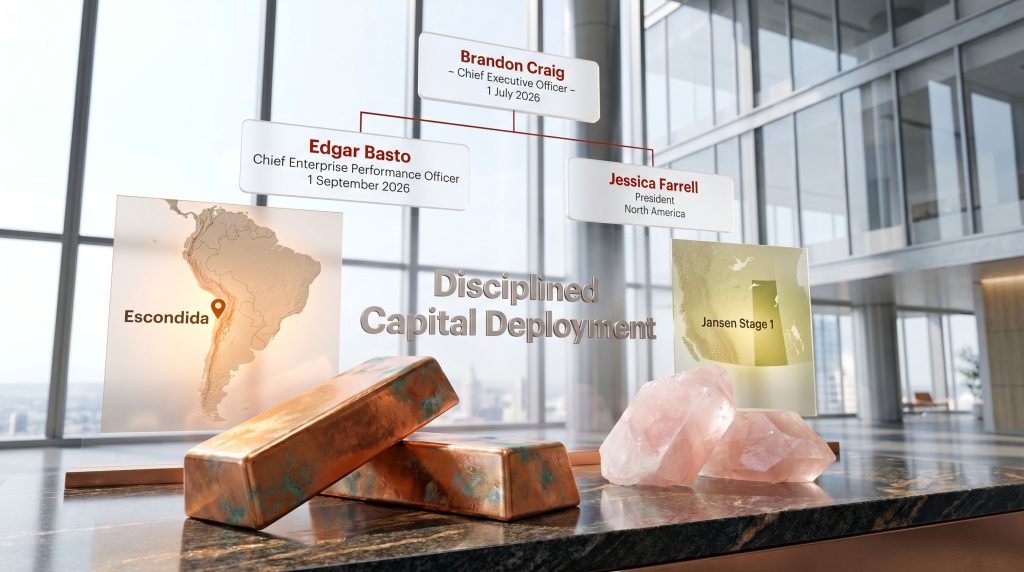
| Brandon Craig | Group Chief Executive Officer | 1 July 2026 |
| Jessica Farrell | President North America + Acting President South America | 1 July 2026 |
| Edgar Basto | Chief Enterprise Performance Officer | 1 September 2026 |
| Geraldine Slattery | President Australia (expanded, including Copper South Australia) | 1 September 2026 |
| Vandita Pant | Chief Financial Officer | Ongoing |
| Caroline Cox | Chief Legal, Governance & External Affairs Officer | Ongoing |
| Johan van Jaarsveld | Chief Technical Officer | Ongoing |
| Catherine Raw | Chief Development Officer | Ongoing |
| Jad Vodopija | Chief People Officer | Ongoing |
Three structural changes stand out as genuinely significant from an organisational strategy perspective.
The Americas Split: One Region Becomes Two
The division of the President Americas role into two distinct positions, President North America and President South America, is the most structurally significant decision in the entire restructure. This is not a minor administrative adjustment; it represents a fundamental change in how BHP allocates executive attention across its most strategically critical growth corridor.
North America houses the Jansen potash project in Saskatchewan, Canada, which is progressing through Stage 1 toward first production. Potash, derived from mined evaporite deposits, is a primary ingredient in agricultural fertilisers, and Jansen is positioned to make BHP a meaningful participant in global food security supply chains. The project is among the most capital-intensive in BHP's current portfolio.
South America, meanwhile, is home to Escondida in Chile, the world's largest copper mine by annual production volume. Escondida alone contributes a disproportionate share of BHP's copper output, and the Chile copper outlook remains a key variable for BHP's long-term revenue projections. Copper is BHP's highest-conviction growth commodity given its essential role in electrical wiring, motors, transformers, and grid infrastructure for the global energy transition.
Placing these two regions under a single president created a structural bottleneck. A single executive managing both Jansen's development milestones and Escondida's operational performance, while simultaneously navigating the distinct regulatory, community, and geopolitical environments of Canada and Chile, was an increasingly untenable span of control.
The Americas split is a textbook example of organisational design responding to strategic complexity. When a single role begins generating more coordination cost than executive value, division is the rational response.
Jessica Farrell: An Internal Appointment That Reflects Pipeline Confidence
Farrell's appointment as President North America draws on a career spanning two decades at BHP, including roles as Vice President Innovation and President of the Western Australia Nickel business. Her innovation background is particularly relevant given that North America's Jansen project will require sustained technical problem-solving as it transitions from construction into production ramp-up.
The decision to appoint Farrell as interim President South America during the permanent recruitment process is pragmatic. It avoids a leadership vacuum at a time when Escondida's operational continuity cannot be compromised, while allowing BHP to take the time required to identify the right permanent appointment for one of its most operationally complex roles.
BHP's preference for an internal candidate here, rather than external recruitment, carries its own signal: the company's leadership pipeline is considered sufficiently deep to meet immediate needs without going to market.
The Chief Enterprise Performance Officer: A New Role With Deep Implications
The creation of the Chief Enterprise Performance Officer position is arguably the most structurally novel element of the entire restructure. This title does not exist in the standard mining sector C-suite lexicon, and its creation reflects a deliberate choice to elevate operational systems and safety governance to the highest possible level of executive accountability.
Edgar Basto transitions from Chief Operating Officer into this new role from 1 September 2026, with a remit covering:
- Health, safety, and security standards across all BHP operations
- The BHP Operating System, the company's proprietary operational consistency and continuous improvement framework
- Contractor safety governance, a historically complex risk domain for large mining operations
- Enterprise-wide performance discipline
The creation of this role addresses two distinct concerns simultaneously. First, it protects the incoming CEO from being operationally consumed by day-to-day performance management, freeing Craig to focus on strategic leadership and stakeholder engagement across complex jurisdictions. Second, it places contractor safety under explicit C-suite accountability at a moment when the mining industry broadly faces sustained scrutiny over workforce safety outcomes.
Contractor fatalities remain a significant reputational and regulatory risk for Tier 1 miners. By making this a direct CEO-report function, BHP is institutionalising the message that performance governance is not a middle-management concern but a board-level priority.
Australia's Copper Story Gets a Unified Leader
From 1 September 2026, Geraldine Slattery's remit as President Australia will expand to encompass Copper South Australia, incorporating Olympic Dam, Carrapateena, and associated assets into a unified Australian operating portfolio.
Olympic Dam is geologically unique. It is one of the largest known polymetallic deposits on Earth, containing copper, uranium, gold, and silver within a single orebody hosted in a Proterozoic granite system. The deposit's scale is extraordinary: total measured and indicated mineral resources run into the tens of billions of tonnes, though the economic cut-off grades and processing complexities mean that actual recoverable reserves are a fraction of the in-situ resource.
BHP has long held ambitions to expand Olympic Dam's throughput capacity beyond the current underground mining and hydrometallurgical processing configuration. The consolidation of Copper South Australia under a single Australian president is a structural prerequisite for that kind of integrated expansion planning, removing the internal coordination friction that comes from having Australian copper assets report through a separate Americas-oriented leadership chain.
Unifying all Australian assets under one executive is less about administrative tidiness and more about creating a single decision-making centre for what may become BHP's most capital-intensive domestic investment cycle in a generation.
What the BHP Executive Team Shake-Up Means for Investors
Each structural decision in this restructure maps directly to an investor-relevant performance variable. The table below identifies the key watch points that flow from the new leadership architecture.
| Strategic Area | Leadership Owner | Investor Watch Point |
|---|---|---|
| Copper volume growth (South America) | President South America (TBC) | Escondida production targets, water access, labour agreements |
| Potash ramp-up (Jansen Stage 1) | Jessica Farrell (North America) | First production milestone, capital cost tracking |
| Australian copper expansion | Geraldine Slattery | Olympic Dam expansion scope decisions, capex allocation |
| Safety and performance governance | Edgar Basto (CEPO) | Contractor incident rates, BHP Operating System metrics |
| Capital returns | Brandon Craig / Vandita Pant | Dividend per share, buyback programme sustainability |
Several broader strategic themes are worth noting for investors assessing execution risk under the new structure:
-
Copper concentration risk: BHP's growth thesis is heavily dependent on copper price and volume. The Americas split concentrates executive attention on Escondida at a time when the mine faces medium-term grade decline challenges common to maturing porphyry copper deposits. Furthermore, the looming copper supply crunch adds urgency to managing throughput optimisation and processing efficiency as critical operational priorities.
-
Potash as a long-duration bet: Jansen's economics are sensitive to global potash pricing, which is influenced by supply dynamics from Belarus and Russia, two historically dominant producers facing ongoing geopolitical constraints. Dedicated North American leadership improves BHP's ability to manage the commercial and logistics dimensions of Jansen's market entry.
-
Safety liability: The creation of a dedicated CEPO role directly acknowledges that contractor safety incidents carry both human and financial costs. Investors monitoring environmental, social and governance metrics will treat Basto's performance in this role as a meaningful proxy for BHP's operational culture under Craig.
How BHP's Structure Compares to Peers
BHP's hybrid geographic-commodity model stands in contrast to the approaches adopted by its two closest peers. In addition, the growing critical minerals demand driven by the global energy transition is placing further pressure on all major miners to optimise their leadership structures for commodity-specific execution.
-
Rio Tinto operates a product group model, organising its business by commodity (Aluminium, Copper, Iron Ore, Minerals) rather than geography. Presidents are accountable for global commodity performance rather than regional stakeholder relationships.
-
Glencore uses a marketing-integrated model, where trading and industrial mining operations are managed under unified commodity business units. This structure prioritises price arbitrage and supply chain control over geographic operational focus.
BHP's 2026 restructure moves it toward greater geographic specificity in the Americas while simultaneously consolidating Australian commodity assets under unified national leadership. This dual-axis logic, regional precision in high-complexity international corridors combined with consolidated domestic management, is relatively uncommon at this scale and reflects the particular complexity of BHP's portfolio. Consequently, this approach may well influence mining industry consolidation trends among other Tier 1 diversified miners seeking to refine their own executive frameworks.
The next major ASX story will hit our subscribers first
Frequently Asked Questions: BHP Executive Team Shake-Up 2026
Who is replacing Mike Henry as BHP CEO?
Brandon Craig, formerly President Americas, assumes the Group CEO role on 1 July 2026. Henry led the company from 2020 through a period of significant portfolio transformation.
Why was the President Americas role split into two positions?
The scale and complexity of BHP's operations in both North America (Jansen potash project) and South America (Escondida copper mine) warranted dedicated executive oversight for each region. A single role had become a structural bottleneck given the distinct stakeholder, regulatory, and operational demands of each corridor.
What does the Chief Enterprise Performance Officer actually do?
Edgar Basto's new role centralises health, safety, security, contractor safety governance, and the BHP Operating System under a single executive reporting directly to the CEO. This elevates operational performance accountability to the highest executive level.
What Australian assets does Geraldine Slattery now oversee?
From 1 September 2026, Slattery's portfolio covers all BHP Australian operating assets, including the addition of Copper South Australia, which encompasses Olympic Dam and Carrapateena among other assets.
Is Jessica Farrell a new appointment to BHP?
No. Farrell is a 20-year BHP veteran who has held roles including Vice President Innovation and President of the Western Australia Nickel business. Her appointment to President North America is an internal promotion.
The Organisational Logic Behind the New BHP Leadership Model
Viewed in aggregate, the BHP executive team shake-up under Brandon Craig reflects three interconnected structural principles:
-
Geographic precision over regional aggregation – breaking large regional roles into more focused portfolios to match the complexity of individual operating environments and their distinct stakeholder ecosystems.
-
Commodity consolidation within geographies – unifying Australian assets under one president to reduce internal coordination friction and create a single decision-making centre for domestic capital allocation.
-
Performance governance elevation – separating operational systems and safety oversight from the traditional COO function and creating dedicated C-suite accountability for enterprise-wide performance discipline.
These are not independent decisions. They are interconnected choices that collectively position BHP to deploy capital at scale across copper and potash without the executive bandwidth constraints that a simpler organisational model would impose. For long-term investors, the quality of this structural alignment with strategic priorities is as important an indicator of future performance as any individual quarterly production figure.
Disclaimer: This article is intended for informational purposes only and does not constitute financial advice. Forecasts, strategic assessments, and interpretations of organisational decisions involve inherent uncertainty. Readers should conduct their own independent research before making any investment decisions. For further coverage of BHP and the broader Australian resources sector, visit Resources Review.
Want To Spot the Next Major ASX Mineral Discovery Before the Broader Market Does?
Discovery Alert's proprietary Discovery IQ model delivers real-time alerts on significant ASX mineral discoveries, instantly translating complex geological and commodity data into actionable investment insights for traders and long-term investors alike — explore historic discoveries and their returns to understand the scale of opportunity, then start your 14-day free trial at Discovery Alert to position yourself ahead of the market.