
June 19, 2026
The Hidden Economics of Potash Mega-Projects: Why Scale Rarely Equals Simplicity
Underground mining at industrial scale operates on a fundamentally different risk curve than surface operations. The deeper the dig, the more variables compound: ground pressure, water ingress, ventilation requirements, and the sheer logistics of moving materials and personnel through kilometres of excavated tunnel. When a project of this complexity is priced years before construction begins, the gap between estimate and reality is not just possible — it is historically predictable. The BHP Jansen potash project cost blowout is, in many ways, a masterclass in how even the world's most sophisticated mining companies encounter the structural limits of pre-construction forecasting.
When big ASX news breaks, our subscribers know first
From Approval to Actuality: Mapping the Jansen Cost Escalation
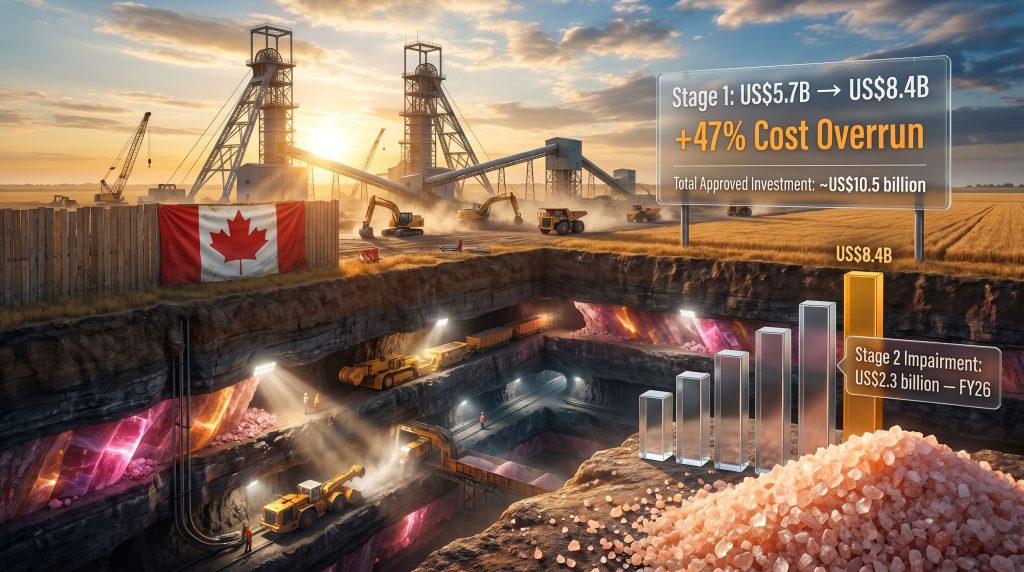
The financial trajectory of Jansen tells a story that investors in large-cap mining stocks would benefit from understanding in detail. When BHP's board sanctioned Stage 1 in August 2021, the approved budget sat at US$5.7 billion. By July 2025, that figure had already climbed into a revised range of US$7.0 to US$7.4 billion. The most recent estimate, released in January 2026, pushed the Stage 1 cost to US$8.4 billion — representing a blowout of approximately US$2.7 billion, or nearly 47% above the original sanction figure.
Stage 2 tells a parallel story. Approved in October 2023 at US$4.9 billion, the full investment estimate for Stage 2 has now risen to US$6.9 billion — an increase of roughly US$2.0 billion. The distinction between an "approval estimate" and a "full investment estimate" is technically important here. Much like a definitive feasibility study, approval estimates reflect capital committed at a specific decision point, while full investment estimates incorporate all capital required to reach completion, including revised contractor agreements, scope additions, and updated contingency provisions.
An approval estimate reflects the capital committed at a specific board decision point, while a full investment estimate incorporates all capital required to reach completion, including revised contractor agreements, scope additions, and updated contingency provisions. The US$2.0 billion gap at Stage 2 represents precisely this expansion in scope and cost recognition.
Together, the total approved Jansen investment now stands at approximately US$10.5 billion (CAD$14 billion), making it one of the largest single capital commitments in global mining history.
| Milestone | Estimated Cost | Date |
|---|---|---|
| Stage 1 Initial Approval | US$5.7 billion | August 2021 |
| Stage 1 Revised Estimate | US$7.0–US$7.4 billion | July 2025 |
| Stage 1 Latest Estimate | US$8.4 billion | January 2026 |
| Stage 2 Approval Estimate | US$4.9 billion | October 2023 |
| Stage 2 Full Investment Estimate | US$6.9 billion | June 2026 |
| Total Jansen Approved Investment | ~US$10.5 billion (CAD$14 billion) | Cumulative |
The Four Structural Cost Drivers Most Investors Overlook
The headline figures capture the magnitude of the overrun, but the underlying causes deserve closer examination. Four interrelated forces have driven Jansen's cost escalation:
- Inflationary pressure across Canadian construction markets — labour costs, steel, concrete, and specialist engineering services all rose materially during the multi-year build period following the COVID-19 supply chain disruption cycle
- Post-sanction design modifications — underground potash extraction at this depth and scale requires ongoing engineering refinement; changes introduced after approval add cost without being visible in the original budget
- Productivity shortfalls in underground construction phases — the physical reality of shaft sinking and tunnel construction frequently diverges from modelled productivity rates, extending labour hours and contractor durations
- Underestimation of construction input complexity — the original feasibility work did not fully capture the scope of specialist contractor requirements, a common weakness in projects priced during early engineering phases
Saskatchewan's Geological Advantage and Why Depth Drives Cost
One dimension of the BHP Jansen potash project cost blowout that rarely receives adequate coverage is the project's geology. Saskatchewan sits atop one of the world's most prolific potash-bearing formations — the Prairie Evaporite deposit — which formed roughly 380 million years ago when ancient inland seas evaporated and left behind concentrated salt and potassium-rich mineral layers.
The Jansen orebody sits at depths of approximately 1,000 to 1,100 metres below surface. For context, most Saskatchewan potash mines operate at similar depths, but the sheer scale of the Jansen development means the infrastructure required to access, ventilate, and extract ore at that depth is exponentially more complex than smaller operations. Two production shafts and two service shafts must maintain structural integrity across decades of operation, subject to ground pressure, brine incursions, and thermal gradients that no desktop model fully replicates.
This geological reality is not unique to Jansen, but it is amplified by the project's intended production capacity. When Stage 2 reaches full operation, it is designed to yield approximately 4.36 million tonnes of potash per year — a figure that places it among the highest-capacity single-mine operations globally. That scale requires infrastructure dimensioned far beyond what early-stage estimates can precisely price.
Potash Grade and Product Quality: What Jansen Will Produce
Saskatchewan's Prairie Evaporite is not just abundant — it is high quality. The dominant mineral in the formation is sylvinite, a mixture of sylvite (potassium chloride) and halite (sodium chloride). Standard muriate of potash (MOP) extracted from this formation typically grades between 60% and 62% K₂O equivalent, which is considered premium quality for agricultural application. Furthermore, understanding mining grade and permitting considerations is essential for evaluating why these quality characteristics translate into long-term commercial advantages.
Potassium chloride from Saskatchewan commands attention from global fertiliser buyers because of its consistent grade and low impurity profile. This quality characteristic is a long-term commercial asset for Jansen but does not reduce the capital intensity of getting the ore to surface.
Stage 1 vs. Stage 2: Timeline, Capacity, and the Production Horizon
Understanding the sequencing of Jansen's two stages is essential for investors calibrating the project's cash flow contribution timeline.
| Project Component | Status / Target |
|---|---|
| Stage 1 First Production | FY2027 (on track) |
| Stage 1 Revised Cost Estimate | US$4.9 billion to US$5.1 billion |
| Stage 2 Construction Completion | 16% complete (end of May 2026) |
| Stage 2 Engineering Completion | 83% complete (end of May 2026) |
| Stage 2 First Production Target | FY2031 (revised, two-year delay) |
| Stage 2 Annual Production Capacity | ~4.36 million tonnes/year |
The gap between 83% engineering completion and 16% physical construction completion at Stage 2 is analytically significant. Engineering-heavy projects that have recently transitioned into full physical construction are entering the phase where cost risk is highest. Design is largely settled, but execution variables — ground conditions, contractor performance, weather delays, and equipment lead times — are least controllable. This is precisely the period in a project's lifecycle where cost revisions historically cluster.
The two-year extension to Stage 2's first production timeline, pushing it from FY2029 to FY2031, reflects management's decision to reassess project delivery methodology before committing further capital tranches. BHP has indicated it will provide an updated Stage 1 timing and capital expenditure review before 31 December 2026. For additional context on how these dynamics affect broader operations, BHP's iron ore production trends and rising potash costs have been closely tracked by industry observers throughout this period.
The US$2.3 Billion Impairment: Accounting Reality and Investor Interpretation
Alongside the revised cost estimates, BHP flagged a US$2.3 billion impairment charge against Jansen Stage 2, to be recognised in FY26 results. For investors unfamiliar with impairment accounting, this distinction matters:
An impairment charge does not represent a cash outflow. It reflects a formal accounting acknowledgment that the carrying value of an asset on the balance sheet exceeds its estimated recoverable amount under revised assumptions. At Jansen Stage 2, the combination of higher capital costs and an extended production timeline has reduced the net present value of future cash flows below the previously recorded book value.
In practical terms, this charge will reduce BHP's reported net profit for FY26 but will not affect operating cash flow. The more strategically important question is whether the revised project economics — higher capital, later production — still support an acceptable return on invested capital once Jansen reaches full operational capacity in the early 2030s. BHP management has not formally abandoned the project's return targets, and the long-term demand thesis for potash remains structurally intact.
Why the BHP Share Price Fell 3.20% and What It Reveals About Market Psychology
Following the announcement, BHP shares fell 3.20% to $62.96 on the ASX. On the surface, this reaction may appear disproportionate given that the stock had already gained approximately 38% year-to-date in 2026 and roughly 74% over the prior 12 months. Understanding the psychology behind the selloff requires looking beyond the single-day move.
Markets respond to cost blowouts at mega-projects through several interconnected mechanisms:
- Capital efficiency re-rating — every dollar absorbed by overruns is a dollar not generating near-term returns; investors who bought on a particular capital deployment assumption are forced to revise their models
- Dividend and buyback displacement — in a capital-intensive period, BHP's capacity to return excess capital to shareholders is directly constrained by Jansen's ongoing demands
- Guidance credibility erosion — when a project produces multiple successive upward revisions, the market applies a credibility discount to all forward estimates, regardless of their technical merit
- Opportunity cost framing — with first cash flow from Stage 2 now not arriving until FY2031, investors with shorter time horizons may prefer to rotate capital into assets with nearer-term earnings contributions
Despite the single-session decline, the broader context suggests the market's reaction was measured rather than panicked. A 3.2% fall on a stock that had risen 74% over 12 months represents a recalibration, not a structural reassessment of BHP's investment thesis. However, the commodity price impact on BHP's overall performance remains a key consideration for investors monitoring the stock's trajectory alongside Jansen's delays. Investor concerns around returns from the potash division have, furthermore, been widely reported by financial analysts covering the sector.
The next major ASX story will hit our subscribers first
The Long-Term Potash Demand Case: Structural Forces Still Intact
Regardless of the construction execution challenges, the macro foundations that drove BHP's original decision to invest in Jansen have not materially weakened. Several structural demand drivers continue to underpin the potash market's long-term outlook:
- Population growth and agricultural intensification — global population is projected to approach 10 billion by 2050, requiring agricultural output growth on a fixed or declining arable land base
- Soil potassium depletion in high-yield farming regions — decades of intensive cropping across South America, South and Southeast Asia, and parts of Africa have progressively depleted soil potassium levels, increasing the marginal return on potash application
- Food security diversification by importing nations — countries heavily dependent on Belarusian and Russian potash exports have faced supply disruptions since 2022, accelerating interest in geographically diversified supply sources including Canadian production
- Crop yield optimisation — modern precision agriculture is increasing the efficiency of fertiliser application, but total potash demand remains positively correlated with global food production volumes
Saskatchewan's position as a stable, rule-of-law jurisdiction with established mining infrastructure makes Jansen's long-term commercial proposition genuinely differentiated from higher-risk production alternatives. In addition, the broader context of resource export challenges facing Australian miners reinforces why diversified commodity exposure, including potash, is increasingly valued by institutional investors.
What Jansen Teaches Investors About Mega-Project Capital Risk
The BHP Jansen potash project cost blowout offers a transferable framework for evaluating capital risk in other large-scale mining developments. Several patterns are worth internalising:
1. Approval estimates systematically understate final costs
Research across major infrastructure and mining projects consistently identifies a pattern of cost underestimation at the sanction stage. This is partly incentive-driven (projects must pass economic hurdle rates to gain approval) and partly a genuine limitation of pre-construction forecasting under geological uncertainty.
2. Underground projects carry disproportionate execution risk
Surface mining and processing facilities are more amenable to accurate cost modelling than underground operations. Ground conditions, ventilation requirements, and shaft infrastructure introduce variability that above-ground construction does not.
3. The gap between engineering and physical construction completion signals the highest-risk phase
When a project shows near-complete engineering but early-stage physical construction, it is entering the period of maximum cost exposure. This is the moment Jansen Stage 2 is currently in. Understanding cut-off grade economics is equally relevant here, as cost overruns can shift the economic viability of ore that was previously considered marginal.
4. Timeline extensions are often precursors to further cost revisions
A two-year production delay rarely arrives as a standalone event. The reassessment period that accompanies a timeline extension frequently surfaces additional cost recognition that the initial revision did not fully capture.
5. Impairment charges signal conservative accounting but do not resolve underlying economics
A willingness to recognise impairment early reflects financial discipline, but the long-term question of whether the project generates returns above its cost of capital remains unanswered until production is sustained and potash pricing is realised.
Disclaimer: This article contains general financial information only and does not constitute personal financial advice. Past performance of BHP Group Ltd (ASX: BHP) shares is not indicative of future results. Investors should consider their own circumstances and seek independent financial advice before making investment decisions. All cost figures, timelines, and financial data referenced in this article are sourced from publicly available BHP announcements and are subject to revision.
Want to Stay Ahead of Significant ASX Mineral Discoveries Before the Broader Market?
Discovery Alert's proprietary Discovery IQ model delivers real-time alerts on high-potential ASX announcements, instantly translating complex mineral data into actionable investment insights for both short-term traders and long-term investors — explore historic discoveries and their exceptional returns to understand the opportunity, and begin your 14-day free trial at Discovery Alert to position yourself ahead of the market.