Revolutionary Biotechnology Transforms Primary Sulfide Processing
The copper mining industry stands at the threshold of a technological revolution that fundamentally challenges decades-old metallurgical conventions. While traditional copper extraction has relied on energy-intensive concentration and smelting processes, biotechnological innovations now offer pathways to dramatically simplify mineral processing through biological mechanisms. This paradigm shift leverages naturally occurring microorganisms to extract copper directly from sulfide ore bodies, eliminating multiple processing stages while reducing environmental footprints.
The emergence of biohydrometallurgical solutions addresses critical industry challenges including rising energy costs, environmental regulations, and the need to process increasingly complex ore bodies. These biological systems harness microbial oxidation processes that occur naturally in mining environments, accelerating them through controlled engineering applications to achieve commercial extraction rates.
Rio Tinto Nuton Technology represents a culmination of three decades of research into microbial-assisted copper extraction, recently achieving its first commercial-scale production milestone. This breakthrough demonstrates how biological processes can replace traditional pyrometallurgical methods while maintaining product quality standards required for global copper markets.
Understanding Microbial Oxidation Mechanisms in Copper Extraction
The scientific foundation of biotechnological copper extraction rests on naturally occurring microorganisms capable of oxidizing sulfide minerals. These microbes facilitate chemical reactions that would typically require high-temperature smelting processes, effectively replacing industrial furnaces with biological systems.
Heat Generation Through Biological Processes
Microbial oxidation generates metabolic heat within heap leach systems, creating optimal conditions for mineral dissolution. This biological heat generation eliminates external energy requirements while maintaining temperatures necessary for efficient copper liberation from sulfide matrices.
The microorganisms target specific sulfide mineral phases, breaking molecular bonds that release copper ions into solution. This process occurs at ambient temperatures, contrasting sharply with conventional smelting operations that require temperatures exceeding 1,200 degrees Celsius.
Comparison with Traditional Biohydrometallurgy
While biohydrometallurgy has existed for decades in applications like gold heap leaching, Rio Tinto Nuton Technology advances these principles through integrated system design. Furthermore, AI in mining technology is enhancing these biological processes through digital monitoring systems, creating a comprehensive extraction platform rather than isolated biological treatment.
Traditional biohydrometallurgy often requires extensive pre-processing or operates as supplementary treatment. However, the Nuton approach eliminates concentration stages entirely, processing crushed ore directly through microbial oxidation systems.
Comprehensive Process Architecture and Technical Implementation
The technical architecture of biotechnological copper extraction represents a fundamental departure from conventional metallurgical flowsheets. Traditional copper processing follows a complex multi-stage pathway involving crushing, concentration, smelting, and refining across separate facilities.
Streamlined Processing Pathway
| Process Stage | Conventional Method | Nuton Technology |
|---|---|---|
| Initial Processing | Crushing → Concentration | Crushing → Direct Heap Leaching |
| Extraction | Smelting → Refining | Microbial Oxidation |
| Final Product | Multiple facility transfers | Mine-gate cathode production |
| Product Purity | 99.99% copper cathode | 99.99% copper cathode |
| Infrastructure | Separate processing facilities | Integrated mine-site system |
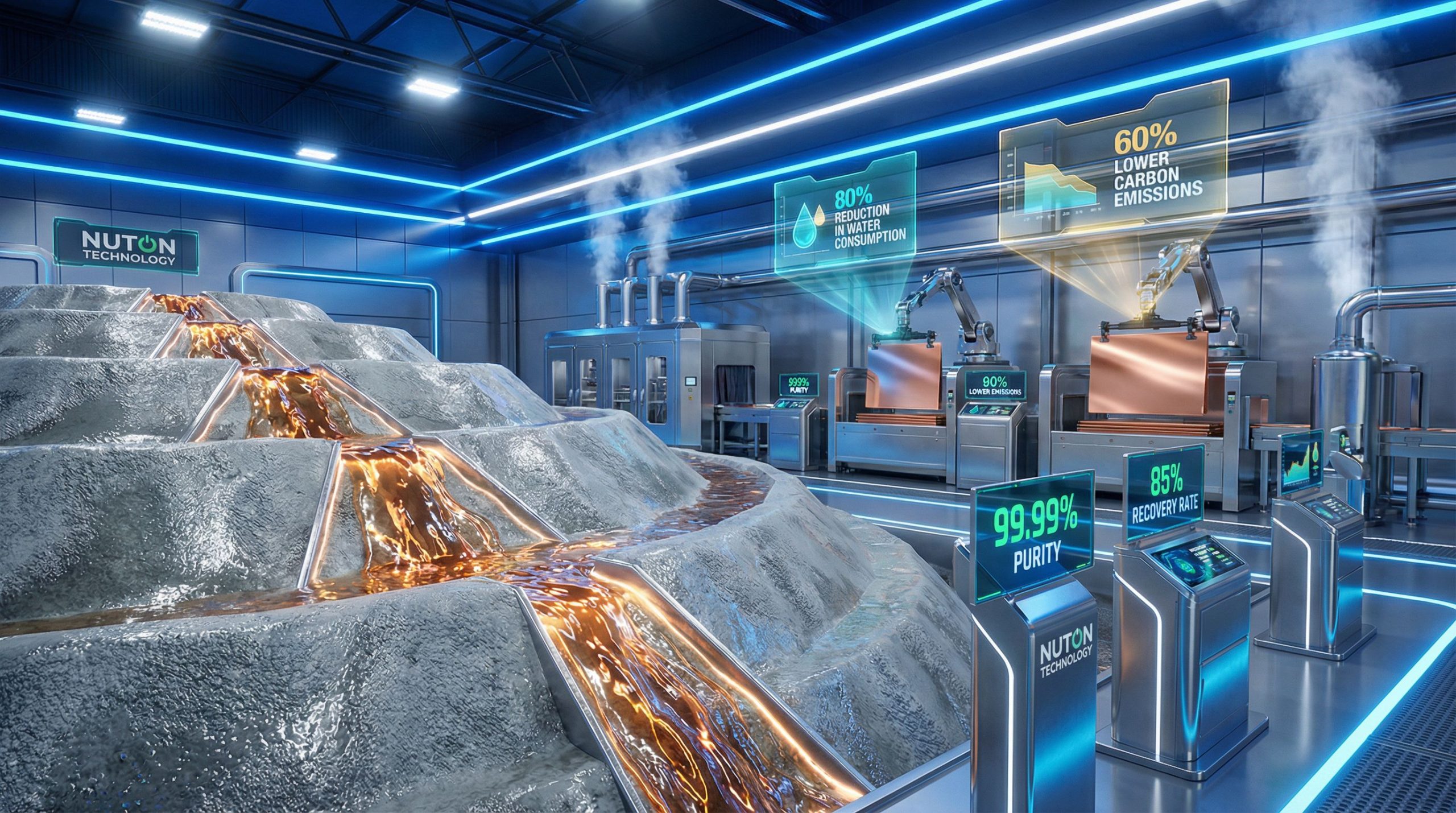
The elimination of concentration and smelting infrastructure represents significant capital and operational advantages. Mine operators can produce refined copper cathode directly at extraction sites, reducing transportation costs and supply chain complexity.
Modular System Integration
The modular approach integrates biology, chemistry, engineering, and digital monitoring into standardised technology packages. This design enables rapid deployment across diverse geological settings while accommodating site-specific ore characteristics.
Key technical components include:
- Biological inoculation systems for microbial population management
- Solution chemistry monitoring for optimal extraction conditions
- Heat management systems leveraging metabolic energy
- Digital controls for process optimisation and quality assurance
Environmental Performance and Economic Advantages
Biotechnological copper extraction offers substantial environmental benefits compared to traditional processing methods. The elimination of high-temperature smelting operations dramatically reduces energy consumption and associated carbon emissions.
Resource Efficiency Metrics
The technology achieves significant resource conservation through streamlined processing. In addition, data-driven mining operations further enhance these efficiencies:
- Water consumption reduction through closed-loop solution recycling
- Energy efficiency gains from elimination of smelting operations
- Infrastructure footprint minimisation via mine-gate production
- Transportation emission reductions through shortened supply chains
"The modular approach allows mining operations to adapt the technology package to their specific geological conditions, potentially unlocking resources previously considered uneconomic due to processing constraints."
Economic Impact Analysis
Capital expenditure requirements decrease substantially when mine-gate cathode production eliminates separate smelting and refining facilities. Operating costs benefit from reduced energy consumption and simplified logistics networks.
Economic advantages include:
- Lower infrastructure development costs
- Reduced energy expenditures throughout production cycles
- Simplified supply chain management
- Extended mine life through improved resource utilisation
Recovery rates from primary sulfide ores can achieve up to 85% efficiency, comparable to or exceeding conventional processing methods whilst reducing overall production costs. Furthermore, this aligns with the broader mining sustainability transformation occurring across the industry.
Johnson Camp Mine: First Commercial-Scale Demonstration
The Johnson Camp mine in Arizona represents the first commercial deployment of Rio Tinto Nuton Technology, marking a critical milestone in biotechnological copper extraction. This four-year demonstration project targets production of approximately 30,000 metric tons of refined copper through microbial processing systems.
Technical Validation Framework
The demonstration project encompasses comprehensive technical validation protocols:
- Multi-year performance testing for consistent recovery rates
- Independent third-party verification of production quality
- Environmental performance monitoring throughout operational cycles
- Economic viability assessment under commercial conditions
After more than 30 years of research and development, the first copper cathode was successfully produced in November 2025, validating decades of biotechnological innovation.
Industrial Implementation Success
The Johnson Camp project demonstrates practical scalability from laboratory research to industrial application. The mine processes primary sulfide materials through heap leach systems specifically designed for microbial oxidation processes.
Hypothetical application scenario: A mid-tier copper producer operating challenging sulfide ore deposits could potentially reduce processing costs by 30-40% whilst extending mine life through access to previously uneconomic resources via biotechnological extraction methods.
Resource Categories and Geological Applications
Biotechnological copper extraction enables processing of ore types traditionally considered marginal or uneconomic for conventional methods. The technology's flexibility accommodates diverse geological conditions and mineral assemblages.
Ore Body Compatibility Assessment
Primary sulfide ores represent the primary target for biotechnological processing. These materials often require expensive concentration before conventional smelting, making them candidates for direct biological treatment. For instance, this approach complements traditional gold and copper exploration efforts.
| Resource Type | Traditional Viability | Biotechnological Potential | Geographic Applications |
|---|---|---|---|
| Low-grade sulfides | Marginal economics | Enhanced viability | Western United States, Northern Chile |
| Complex mineralogy | Processing challenges | Improved selectivity | Peru, Australia |
| Remote deposits | Infrastructure-dependent | Reduced complexity | Canada, Mongolia |
| Weathered sulfides | Variable recovery | Consistent performance | Global applications |
Strategic Resource Development
The technology's modular design enables deployment in previously inaccessible locations where traditional processing infrastructure would be prohibitively expensive. Remote mining operations benefit particularly from reduced infrastructure requirements and simplified logistics.
Resource expansion potential includes:
- Previously uneconomic low-grade deposits
- Complex mineral assemblages requiring specialised treatment
- Remote locations lacking smelting infrastructure
- Environmentally sensitive areas requiring reduced industrial footprints
Supply Chain Transformation and Market Integration
Biotechnological copper extraction fundamentally alters traditional supply chain structures by enabling mine-gate cathode production. This transformation eliminates multiple transportation and processing stages whilst reducing supply chain vulnerabilities.
Mine-Gate Production Benefits
Direct cathode production at mining sites offers several strategic advantages:
- Elimination of concentrate transportation to separate smelting facilities
- Reduced processing facility dependencies for final product delivery
- Shortened supply chains improving cost efficiency and reliability
- Enhanced supply security for domestic markets
The ability to produce 99.99% pure copper cathode directly at mining locations represents a fundamental shift from traditional multi-facility processing networks to integrated mine-site operations.
Domestic Supply Chain Strengthening
For copper-importing nations, biotechnological extraction offers opportunities to strengthen domestic supply capabilities. The technology's reduced infrastructure requirements enable development of previously unviable domestic copper resources.
Katie Jackson, Rio Tinto Copper Chief Executive, emphasised that the technology proves cleaner, faster and more efficient copper production is possible at industrial scale. The modular system integrates biology, chemistry, engineering, and digital tools, allowing rapid scaling and tailoring to different ore bodies whilst unlocking historically challenging resources.
Commercial Deployment Strategy and Partnership Models
The commercial implementation of biotechnological copper extraction follows a technology package delivery model, enabling mining companies to adopt the system without developing in-house biological expertise. Consequently, this approach significantly reduces barriers to adoption.
Partnership Framework Development
The technology transfer approach focuses on comprehensive support systems:
- Technology package delivery including biological, chemical, and engineering components
- Operational training programmes for mining personnel
- Ongoing technical support throughout deployment phases
- Performance monitoring systems ensuring consistent results
The partnership between Rio Tinto and Gunnison Copper demonstrates successful collaboration between technology developers and mining operators, with Stephen Twyerould, Gunnison Copper CEO and president, characterising the Johnson Camp achievement as exceptional teamwork culminating in domestic supply chain strengthening.
Market Expansion Timeline
North and South American markets represent initial commercial targets, with expansion strategies focusing on:
- Domestic supply chain development in copper-importing regions
- Technology adaptation for diverse geological conditions
- Regulatory compliance support for biological processing applications
- Investment frameworks supporting commercial deployment
The modular technology design enables simultaneous deployment across multiple sites, potentially accelerating global adoption rates compared to traditional infrastructure development timelines. This approach also supports broader copper-uranium investment strategies.
Technical Challenges and Implementation Considerations
Despite significant advantages, biotechnological copper extraction faces several technical and operational challenges requiring careful management and ongoing development.
Process Optimisation Requirements
Successful implementation demands attention to several critical factors:
- Microbial population management across varying environmental conditions
- Solution chemistry optimisation for consistent extraction performance
- Heat distribution control within heap leach systems
- Long-term environmental performance validation and monitoring
Climate variations, particularly temperature and humidity fluctuations, can impact microbial activity and require adaptive management strategies. Heap leach pad design must accommodate biological processes whilst maintaining optimal physical conditions for ore processing.
Scalability and Infrastructure Integration
Commercial deployment requires substantial technical expertise and capital investment:
Implementation barriers include:
- Capital requirements for technology package deployment and site preparation
- Technical training needs for operational personnel and management
- Regulatory approval processes for biotechnological applications in mining
- Integration challenges with existing mining infrastructure and operations
The technology's biological foundation requires ongoing monitoring and management, contrasting with traditional mechanical and chemical processes that mining operations typically understand.
Competitive Technology Landscape and Market Position
Biotechnological copper extraction competes within a broader landscape of innovative metallurgical technologies addressing industry challenges including environmental regulations, energy costs, and ore grade decline.
Emerging Technology Comparison
| Technology | Primary Advantage | Development Status | Environmental Impact |
|---|---|---|---|
| Biotechnological heap leaching | Simplified processing | Commercial demonstration | Significant emission reduction |
| In-situ leaching | Minimal surface disturbance | Limited geological application | Variable environmental performance |
| Advanced flotation | Enhanced recovery rates | Commercially mature | Conventional environmental impact |
| Hydrometallurgy | Reduced smelting requirements | Established technology | Moderate improvement |
The biological approach offers unique advantages in processing primary sulfide ores whilst eliminating high-temperature smelting operations, positioning it distinctively within the competitive landscape.
Market Differentiation Factors
Key competitive advantages include:
- Complete elimination of concentration and smelting infrastructure
- Mine-gate cathode production reducing supply chain complexity
- Modular deployment enabling rapid scaling across diverse sites
- Environmental performance meeting increasingly stringent regulations
Long-term Industry Transformation Potential
The successful commercial deployment of biotechnological copper extraction could catalyse fundamental changes across the global mining industry, extending beyond copper to other metal extraction applications.
Paradigm Shift Implications
The transition from traditional concentration-smelting paradigms to direct biological extraction represents more than technological innovation. It fundamentally alters how mining companies approach resource development, infrastructure planning, and environmental management.
Industry transformation indicators:
- Resource base expansion through previously uneconomic deposit development
- Supply chain restructuring around mine-gate production capabilities
- Environmental compliance advantages in regulatory frameworks
- Technology transfer potential to other metallurgical applications
Strategic Investment Considerations
Mining companies evaluating biotechnological adoption must consider multiple strategic factors:
"Rio Tinto's three-decade research investment represents one of the mining industry's most significant biotechnology developments, with potential applications extending beyond copper to other metal extraction processes."
Investment evaluation criteria include:
- Competitive advantage assessment for processing challenging ore bodies
- Risk mitigation strategies reducing dependence on traditional processing infrastructure
- Future regulatory compliance positioning for environmental requirements
- Market positioning in an increasingly sustainability-focused industry
The Johnson Camp demonstration provides critical performance data enabling informed investment decisions by mining companies considering biotechnological adoption for their operations. Moreover, the Nuton technology continues to demonstrate its potential for widespread industry adoption.
Disclaimer: This analysis is based on publicly available information and industry reports. Performance projections and economic estimates should be verified through independent technical and financial analysis. Biotechnological extraction represents emerging technology with inherent risks and uncertainties that may affect commercial outcomes.
Could Your Mining Portfolio Benefit from Early Discovery Intelligence?
Discovery Alert's proprietary Discovery IQ model delivers instant notifications on significant ASX mineral discoveries, transforming complex geological announcements into actionable investment insights that can identify opportunities ahead of the broader market. Explore how historic mineral discoveries have delivered substantial returns for early investors, then begin your 30-day free trial to position yourself at the forefront of Australia's next major breakthrough.