Bison Resources Ltd
Bison Resources Kicks Off First-Ever Geophysical Survey Across Nevada Gold-Silver Portfolio
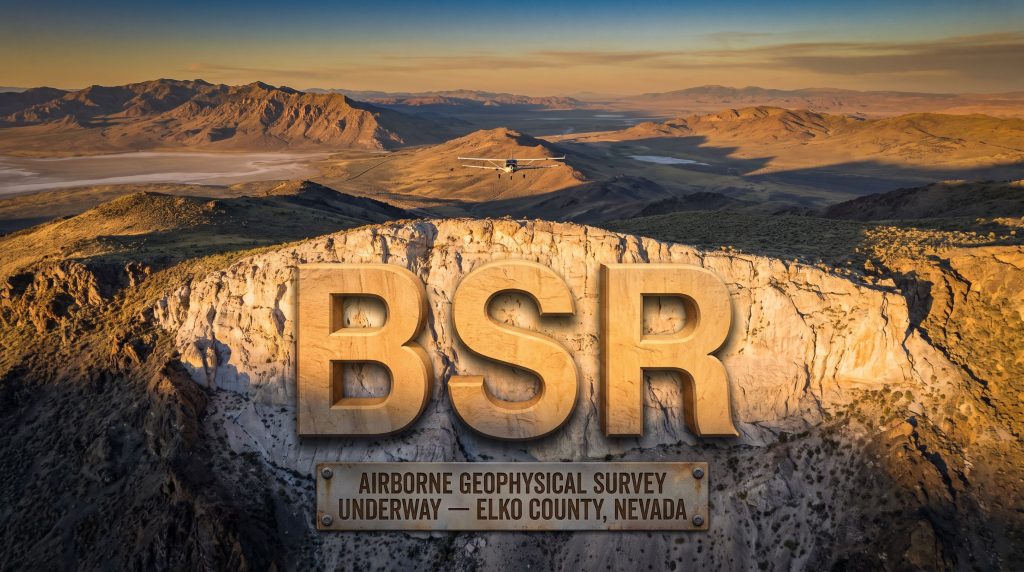
Bison Resources (ASX: BSR) has mobilised field crews to commence a 4,112 line-kilometre high-resolution airborne geophysical survey across its four Nevada projects, marking the company's first geophysical program since its recent ASX listing. The Bison Resources airborne geophysical survey Nevada projects initiative, contracted to specialist firm New Resolution Geophysics (NRG), covers the full extent of Bison's Elko County project portfolio and is designed to sharpen drill targeting ahead of a maiden drilling program.
"We are excited to have commenced our first geophysical survey program. This survey represents the first high-resolution geophysical survey ever flown over our project areas, and will greatly enhance our exploration and drill-hole targeting work, in combination with our existing spectral data and ongoing surface sampling programs," said Tim Mackellar, Chief Executive Officer of Bison Resources.
According to the company's announcement, this marks a significant step forward for a business that only recently entered public markets. For investors tracking Bison's early-stage exploration narrative, the commencement of airborne field activity indicates the work program is proceeding on schedule.
When big ASX news breaks, our subscribers know first
A Portfolio Positioned in a Premier Gold District
Bison's Nevada projects — Ruby Lake, Cherry Springs, Bald Peaks, and Medicine Range — collectively cover 312 unpatented lode mining claims across approximately 26.1 km², situated roughly 80 km southeast of Elko within the Carlin Trend.
The Carlin Trend is a well-established gold-producing corridor in Nevada, having hosted some of the largest gold deposits discovered in the region. Bison is targeting carbonate-hosted precious metal deposits, including Carlin-type gold systems and epithermal and carbonate replacement-style mineralisation, which the company describes as sharing geological and structural characteristics with major deposits nearby.
Bison's Bald Peaks project is located directly adjacent to Torex Gold Resources' (TSX: TXG) Medicine Springs Silver Project, and is proximal to Sun Silver's (ASX: SS1) Maverick Silver Project, which reports a 539 Moz AgEq resource. The company has noted geological and structural similarities between Bald Peaks and the Maverick Silver Project as a key part of its exploration rationale.
| Project | Claims | Area | Key Exploration Features |
|---|---|---|---|
| Ruby Lake | 128 | ~10.7 km² | Kaolinite, goethite and haematite spectral anomalies around the "Ruby Stock" intrusion; north and northeast fault intersection |
| Cherry Springs | 82 | ~6.9 km² | Two target zones near the "Cherry Stock" intrusion; 500m x 500m goethite-haematite anomaly on southern fault |
| Bald Peaks | 40 | ~3.3 km² | 800m kaolinite-jarosite anomaly; 1km goethite-haematite anomaly; 1.5km arsenic-antimony geochemical trend |
| Medicine Range | 62 | ~5.2 km² | Setting described as analogous to Maverick Springs silver deposit; key lithological contact dissected by structural corridor |
| Total | 312 | ~26.1 km² | Four complementary targets across Carlin Trend geology |
What Is an Airborne Magnetic and Radiometric Survey, and Why Does It Matter?
For investors less familiar with exploration geophysics, understanding what this survey does is useful context for gauging its significance.
Airborne magnetic surveying measures variations in the Earth's magnetic field caused by differences in the magnetic properties of subsurface rocks. Different rock types, and importantly, different alteration styles associated with mineralisation, produce distinct magnetic signatures. Flying at tightly spaced 100-metre line intervals over the project area, the survey is designed to create a detailed subsurface map capable of revealing geological structures, fault systems, and intrusive bodies not visible at surface.
Radiometric surveying measures the natural radioactivity emitted by rocks near the surface, allowing geologists to distinguish between rock types and identify zones of hydrothermal alteration — a common indicator of precious metal mineralisation.
According to the announcement, these tools are intended to help Bison's geologists:
- Build a three-dimensional picture of the geological architecture beneath each project
- Identify and prioritise fault structures and contacts that could host mineralisation
- Integrate geophysical data with existing spectral, geochemical, and geological datasets
- Generate a pipeline of drill targets to inform a maiden drilling program
Why it matters for investors: Geophysical surveys are considered a standard step in converting surface observations into drill-ready targets. Without this data, drill planning relies more heavily on surface indicators alone. With it, exploration teams can direct capital toward higher-confidence targets, which may consequently improve the efficiency of subsequent drill programs.
Quick Glossary
- Carlin-type deposit: A style of gold mineralisation common in Nevada, characterised by microscopic gold hosted in carbonate rocks, often associated with arsenic, antimony, and mercury pathfinder elements.
- Epithermal deposit: Precious metal mineralisation formed at shallow depths from hot hydrothermal fluids.
- Carbonate replacement deposit (CRD): Mineralisation formed when hydrothermal fluids replace carbonate host rocks with metal-bearing minerals.
- Pathfinder elements: Trace elements such as arsenic, antimony, mercury, and thallium that can indicate the presence of a larger mineral system, even where gold or silver grades are not yet directly measured.
- Hyperspectral or spectral anomaly: An area identified through remote sensing where the mineral composition of surface rocks or soils differs from the surrounding area, often suggesting hydrothermal alteration.
What the Data Already Shows: Existing Targets Ahead of the Survey
The survey is not being flown over unexamined ground. Bison has already accumulated data from spectral remote sensing and geochemical sampling programs, which the company says have defined priority targets at each project.
Bald Peaks has emerged as a near-term focus, with the announcement detailing:
- An 800-metre kaolinite-jarosite spectral anomaly along the eastern north-trending fault
- A 1-kilometre goethite-haematite anomaly immediately to the south of the above
- A 1.5-kilometre-strike arsenic-antimony geochemical anomaly associated with decalcification of host carbonates, silicification, gossanous breccias, and jasperoidal alteration — features the company associates with Carlin-type mineral systems
- A pathfinder elemental association (arsenic-antimony, with tungsten, mercury, and thallium) observed at surface, which the company says adds geological credibility to the target
Bald Peaks' adjacency to Torex Gold's Medicine Springs Silver Project, together with its reported structural and geological similarity to Sun Silver's Maverick Silver Project, positions it as a key focus area within the broader portfolio, according to the announcement.
Ruby Lake, Cherry Springs, and Medicine Range each carry defined spectral targets tied to intrusive bodies and fault intersections, with field validation through rock chip and soil sampling continuing alongside the Bison Resources airborne geophysical survey Nevada projects program.
Upcoming Milestones: A Path Toward Drill Targeting
The commencement of the survey is described as the first step in a sequence of planned exploration activities. Bison has outlined the following program of work:
| Milestone | Activity | Purpose |
|---|---|---|
| Now underway | 4,112 km airborne magnetic and radiometric survey | Structural interpretation, geological mapping, target refinement |
| Near-term | Integration of geophysical data with spectral and geochemical datasets | Build an exploration model across all four projects |
| Near-term | Continued rock chip and soil sampling | Surface validation of spectral anomalies |
| Upcoming | Drill target generation across priority prospects | Identify and rank maiden drill hole locations |
| Upcoming | Maiden drill program at priority prospects | Initial subsurface test of mineralisation potential |
The maiden drill program is described by the company as the next major milestone. Geophysical data from the current survey is intended to feed directly into drill target selection, positioning the present work as a precursor to a period of anticipated news flow for Bison.
The Investment Case: Early-Stage Access in a Recognised Mining Address
Bison Resources is at an early stage of exploration. For investors, the relevant consideration is whether the company holds the ingredients that could support meaningful exploration outcomes over time.
Location and Neighbouring Projects
Location within a recognised gold district. The Carlin Trend has historically hosted some of the more significant gold and silver deposits identified in North America. Bison's ground position sits firmly within this broader address.
Proximity to neighbouring projects. The adjacency of Bald Peaks to Torex Gold's Medicine Springs Silver Project, and proximity to Sun Silver's reported 539 Moz AgEq Maverick Silver Project, provides geological context that the company has referenced in its exploration rationale.
Data, Coverage, and Portfolio Diversification
Existing datasets inform the survey program. Defined spectral anomalies, a 1.5km geochemical trend at Bald Peaks, and pathfinder element signatures provide a base of information the Bison Resources airborne geophysical survey Nevada projects program is designed to build upon.
First survey of its kind over these areas. According to the announcement, no high-resolution geophysical survey has previously been flown over these project areas, meaning the resulting dataset would represent genuinely new information not previously available to the company or the market.
Diversified exposure across four projects. With four project areas spanning approximately 26.1 km², the portfolio offers exposure to multiple target types and geological settings within a single Nevada land package.
The next major ASX story will hit our subscribers first
Why Investors Should Keep Bison Resources on Their Watchlist
Bison Resources has moved from ASX listing into active field programs within a comparatively short period. The commencement of the Bison Resources airborne geophysical survey Nevada projects work marks the start of what the company anticipates will be a data-intensive phase of exploration.
The planned integration of magnetic, radiometric, spectral, and geochemical datasets across four projects — leading toward drill target generation and a maiden drill program — represents a sequence of milestones that investors in early-stage exploration companies typically monitor closely.
Key Takeaway: Bison Resources (ASX: BSR) has commenced a 4,112 km airborne geophysical survey, described as the first high-resolution survey conducted over its four-project Nevada portfolio within the Carlin Trend. With priority targets already defined at Bald Peaks and across the wider portfolio, and a maiden drill program identified as the next major milestone, the company is progressing steadily through its exploration program. Investors following early-stage precious metals exploration may consequently wish to monitor Bison's progress as the drill targeting phase approaches.
Want to Learn More About Bison Resources' Nevada Gold-Silver Projects?
With a maiden drill program on the horizon and the first-ever high-resolution geophysical survey now underway across its four-project Nevada portfolio, Bison Resources (ASX: BSR) is entering what could be a defining phase of its early-stage exploration journey. Investors seeking to understand the full scope of the company's Carlin Trend land package, its exploration strategy, and upcoming milestones can find out more by visiting the official Bison Resources website.