July 21, 2026
When One Mine Goes Quiet, the Whole Portfolio Has to Speak
European base metal mining operates on a fundamental tension that rarely surfaces in headline earnings figures: the deeper you go underground, the more unpredictable the geology becomes. Investors who anchor their expectations purely to commodity price movements often overlook the physical reality that a single seismic event, a malfunctioning roaster, or a slower-than-expected development face can unravel months of carefully constructed production schedules. Boliden's second quarter 2026 results offer a precise case study in how these operational variables interact, and why the Boliden Q2 forecasts miss due to Garpenberg disruption and Odda smelter delay deserves far more analytical attention than a standard earnings shortfall.
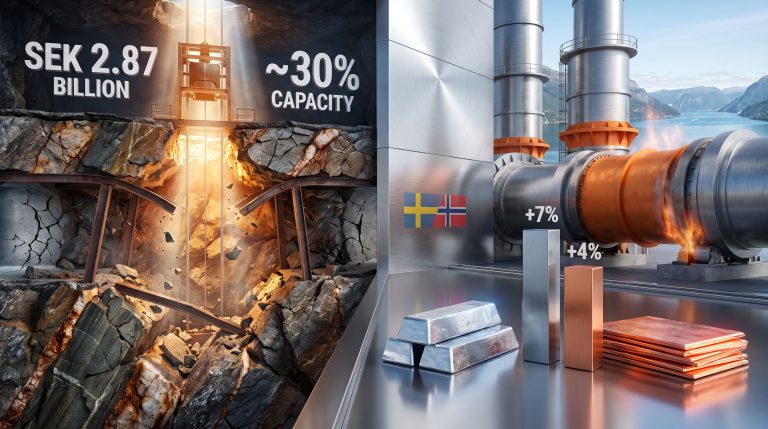
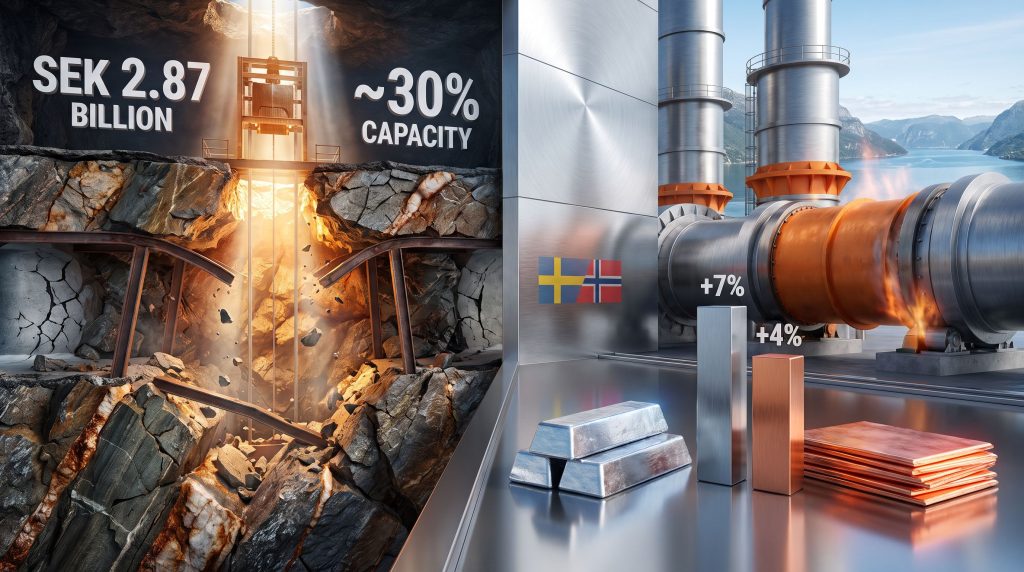
The numbers told a deceptively optimistic story at first glance. Adjusted operating profit more than doubled year-on-year to SEK 2.87 billion ($296.8 million). Yet the same result sat approximately SEK 390 million below the analyst consensus of SEK 3.26 billion, and represented a sharp decline from the SEK 4.43 billion posted in Q1 2026. Understanding why requires moving past the headline figure and into the operational mechanics beneath it.
When big ASX news breaks, our subscribers know first
Garpenberg's Seismic Event: More Than a Production Pause
What Underground Seismicity Actually Means for a High-Grade Zinc Mine
The Garpenberg mine in Sweden is not a marginal operation. It is one of the world's highest-grade underground zinc mines, processing ore with polymetallic characteristics that include zinc, lead, silver, copper, and gold. This mineralogical complexity means that a production interruption at Garpenberg carries disproportionate financial weight relative to its physical scale. Furthermore, understanding global zinc production trends helps contextualise just how significant this disruption is within the broader market.
On March 14, 2026, abnormal seismic activity triggered a rockfall that forced a complete halt to operations. Mining did not resume until the end of April, representing roughly seven weeks of zero output from one of Boliden's most productive assets. The ore hoist, a critical vertical infrastructure component that transports broken ore from depth to surface, sustained direct damage requiring full replacement or repair before operations could safely continue.
What makes the Garpenberg situation particularly consequential is not the temporary halt but the structural constraint that followed it. The Lappberget orebody, which accounts for approximately 70% of near-term planned mine volumes, remains inaccessible. Restart at Lappberget is not anticipated until at least Q2 2027, meaning the volume impact extends well beyond the quarter in question.
The Numbers Behind the Garpenberg Disruption
| Metric | Detail |
|---|---|
| Seismic Event Date | March 14, 2026 |
| Production Suspension Period | March 14 to end of April 2026 |
| Q2 2026 Milled Volume | Approximately 0.1 million tonnes |
| Estimated Operating Profit Impact | SEK 400 million negative |
| Current Operating Capacity | ~30% of normal throughput |
| 2026 Full-Year Milled Ore Guidance | 1.5 million tonnes |
| 2027 Full-Year Milled Ore Guidance | 2.3 million tonnes |
The mine is currently operating at roughly 30% of normal capacity, with production confined to sections of the orebody unaffected by the March event. Boliden maintained its full-year 2026 guidance of 1.5 million tonnes of milled ore, which implies a heavily back-weighted production schedule in the second half of the year. The 2027 guidance of 2.3 million tonnes signals a recovery trajectory, but one that extends across multiple reporting periods.
Analysts noted that Boliden's Q2 disclosures contained no materially new information regarding Garpenberg's recovery timeline. Market expectations had already been adjusted downward by approximately 14% on EBITDA estimates following earlier guidance revisions, meaning the operational picture was largely priced in before the results were released.
Ore Hoists, Lappberget, and the Geology of Recovery
For those unfamiliar with underground mining mechanics, the ore hoist is the functional equivalent of an elevator system for broken rock. Without it, ore cannot be brought to surface regardless of how much accessible material exists underground. Its repair was a precondition for even partial resumption, not a pathway to full recovery.
The Lappberget orebody sits within a geological zone that requires specific engineering assessment before safe re-entry. Development work in seismically affected areas involves detailed geotechnical analysis, ground support installation, and systematic seismic monitoring before production drilling can recommence. Accurate geological logging codes are essential during this phase to ensure that all subsurface data is reliably recorded and communicated. This process does not compress easily, which explains why the Q2 2027 restart timeline is not overly conservative.
The Odda Expansion: When First Feed Does Not Mean Full Throughput
Roaster Commissioning and the Hidden Complexity of Zinc Smelting
While Garpenberg dominated the production narrative, the Odda zinc smelter expansion in Norway added a separate layer of financial drag. The Odda facility represents one of the most significant zinc processing infrastructure investments in Europe in recent decades. After absorbing over €100 million in additional costs beyond original projections, the expanded plant achieved its first feed milestone in March 2026. However, achieving first feed and achieving commercial-scale throughput are fundamentally different milestones.
The bottleneck was the new roaster unit. In zinc smelting, roasting is the thermal processing stage that converts zinc sulfide concentrate into zinc oxide calcine, which then feeds into the leaching and electrowinning stages of the hydrometallurgical circuit. The roaster is not one component among many; it is the rate-governing unit for the entire production chain. When roaster performance falls below design parameters, every downstream process is constrained accordingly.
In base metal smelting, commissioning a new roaster is widely regarded within the industry as one of the highest-risk phases of any smelter expansion. Thermal cycling, refractory lining performance, gas handling, and feed rate optimisation all interact simultaneously during early operation, and deviation in any one variable cascades through the system.
Financial Consequences of the Slower Odda Ramp-Up
| Financial Metric | Q2 2026 Figure |
|---|---|
| Planned Maintenance Impact on Operating Profit | SEK -350 million |
| Free Cash Outflow | SEK 2.11 billion |
| Net Debt (End of Q2 2026) | SEK 19.15 billion |
| Net Debt (End of Q1 2026) | SEK 14.34 billion |
| Quarter-on-Quarter Net Debt Increase | SEK 4.81 billion |
The SEK 4.81 billion increase in net debt between Q1 and Q2 2026 is the figure most likely to attract investor concern, but its interpretation matters. The primary driver was a free cash outflow of SEK 2.11 billion, which itself reflected inventory accumulation during maintenance shutdowns and the Odda ramp-up phase. Smelter expansions during commissioning generate work-in-progress inventory that does not convert to revenue until throughput normalises. This is a timing phenomenon intrinsic to the industrial ramp-up cycle, not evidence of structural asset deterioration.
Boliden nonetheless reiterated its full-year 2026 capital expenditure guidance of SEK 15.5 billion, signalling management confidence in the recovery trajectory even as the balance sheet absorbed short-term pressure.
Portfolio Resilience: The Assets That Absorbed the Shock
Copper and Zinc Pricing as a Partial Counterweight
| Metal | Quarter-on-Quarter Price Change |
|---|---|
| Copper | +4% |
| Zinc | +7% |
Commodity price movements provided meaningful support during a period of volume weakness. A 7% quarter-on-quarter increase in zinc prices and a 4% rise in copper prices partially offset the earnings impact of reduced throughput across the group. Monitoring commodity prices and mining performance together reveals how price strength can mask volume weakness in aggregate reporting, but it cannot replicate the cash generation that comes from operating a major mine at full capacity.
Somincor and Zinkgruvan: The Underappreciated Contributors
Two assets carried disproportionate weight in supporting Q2 2026 earnings:
- Somincor (Portugal): The Neves-Corvo copper and zinc mine delivered strong operational performance, compensating meaningfully for Garpenberg's effective absence from group output.
- Zinkgruvan (Sweden): Contributing solid zinc and lead production, Zinkgruvan benefited from the improved price environment and operational consistency.
The Q2 2026 outcome demonstrates a structural characteristic of Boliden's portfolio that is easy to overlook during periods of normalised operations: a major mine can be effectively suspended for an extended period without triggering a group-level earnings collapse. Multi-jurisdiction, multi-commodity diversification across Sweden, Norway, Portugal, and Ireland provides an internal earnings buffer that single-asset producers categorically cannot replicate.
Tara Mine: A Separate and Developing Concern
Development Work as a Leading Indicator Investors Should Watch
Separate from the Garpenberg seismic event and the Odda commissioning difficulties, Boliden reduced its full-year 2026 milled volume forecast for the Tara mine in Ireland by 200,000 tonnes to 1.6 million tonnes. The stated reason was development work progressing below expectations. Well-structured drilling programs and systematic development advances are essential to maintaining mineable ore pipelines, and any shortfall in this area warrants close attention.
In underground mining terminology, development work refers to the excavation of access tunnels, drives, and raises that open up new ore blocks for future extraction. It is a leading indicator: the volume of development completed today directly determines how much ore will be accessible for production in subsequent quarters. Slower development does not affect current production immediately, but it constrains the pipeline of mineable ore in the near to medium term.
The critical question for Tara is whether this represents a single-quarter adjustment resulting from specific logistical or ground conditions, or whether it signals a broader deterioration in the mine's development advance rates. Investors should treat this guidance revision as a datapoint to monitor across the next two reporting periods rather than dismissing it as a footnote to the larger Garpenberg story.
Three-Period Earnings Context: Avoiding the Year-on-Year Trap
| Period | Adjusted Operating Profit | Key Driver |
|---|---|---|
| Q2 2025 | Severely depressed (EPS $2.02 vs. forecast $3.19) | Ore grade reduction at Garpenberg; Odda not operational |
| Q1 2026 | SEK 4.43 billion | Pre-seismic Garpenberg contribution; stronger throughput |
| Q2 2026 | SEK 2.87 billion | Garpenberg suspended; Odda slow ramp; metal price support |
The year-on-year profit improvement is arithmetically real but analytically misleading. Q2 2025 was an exceptionally weak period for Boliden, driven by a gradual degradation in ore grade at Garpenberg and a zinc smelter not yet capable of contributing to earnings. Comparing Q2 2026 against that depressed base produces an impressive percentage improvement that does not reflect the underlying operational trajectory.
The sequential comparison from Q1 to Q2 2026 is more instructive. The decline from SEK 4.43 billion to SEK 2.87 billion captures the actual financial cost of the seismic event and the smelter commissioning delays in a single quarter. That is the number that reflects the real operational setback.
The next major ASX story will hit our subscribers first
Macro Pressures Adding Complexity to an Already Difficult Quarter
Energy Costs and Interest Rate Dynamics in European Smelting
Boliden's smelting operations face a specific macro vulnerability that mining-focused analysis often underweights. Zinc smelting is among the most energy-intensive industrial processes in the metals sector, with electricity representing a substantial proportion of total operating costs. Geopolitical instability in the Middle East contributed to elevated energy prices during Q2 2026, applying cost pressure to smelting margins at precisely the moment when throughput was constrained by roaster commissioning issues. Consequently, understanding broader metal market dynamics is increasingly important for investors trying to contextualise energy-linked cost pressures across the sector.
Simultaneously, higher-for-longer interest rate expectations compound the financial carrying cost of net debt that reached SEK 19.15 billion by the end of June 2026. A dual pressure of slower throughput and higher input costs in the smelting segment, against a backdrop of elevated debt servicing requirements, creates a meaningful near-term financial challenge even as the underlying recovery mechanics remain intact.
Frequently Asked Questions
What caused Boliden to miss Q2 2026 earnings forecasts?
The shortfall against the analyst consensus of SEK 3.26 billion was driven by two primary factors: the near-total suspension of Garpenberg mine operations following the March 2026 seismic event and rockfall, and the slower-than-planned ramp-up of the expanded Odda zinc smelter due to roaster commissioning difficulties. Together, these created an estimated SEK 400 million volume impact and contributed to SEK 350 million in planned maintenance charges.
Is Garpenberg permanently impaired or is this a temporary disruption?
Current evidence points to a temporary but extended disruption. Production has resumed in unaffected sections at approximately 30% of normal capacity. However, the Lappberget orebody, which accounts for the majority of near-term production volumes, is not expected to return to operation until at least Q2 2027. Full-year 2026 milled ore guidance of 1.5 million tonnes and 2027 guidance of 2.3 million tonnes have been maintained.
Why did net debt increase so sharply in Q2 2026?
Net debt rose from SEK 14.34 billion at the end of Q1 2026 to SEK 19.15 billion by the end of Q2, an increase of approximately SEK 4.81 billion. The primary driver was a free cash outflow of SEK 2.11 billion, itself caused by inventory accumulation during smelter maintenance shutdowns and the Odda ramp-up phase, combined with ongoing capital expenditure commitments.
What is the current status of the Odda smelter expansion?
The Odda smelter achieved first feed in March 2026 and is in active ramp-up. The expansion encountered delays due to difficulties with the new roaster unit. Full operational capacity is being targeted progressively, with the ramp-up timeline extending beyond original projections.
What happened to Boliden's Tara mine guidance?
Boliden reduced its full-year 2026 milled volume forecast for the Tara mine in Ireland by 200,000 tonnes to 1.6 million tonnes, citing development work progressing below expectations. This represents a separate operational challenge from the Boliden Q2 forecasts miss due to Garpenberg disruption and Odda smelter delay and warrants monitoring across subsequent reporting periods.
This article is intended for informational purposes only and does not constitute financial advice. All figures and projections are sourced from publicly available company disclosures and analyst commentary. Forecasts and production guidance carry inherent uncertainty and are subject to revision. Readers should conduct independent research before making investment decisions.
For ongoing coverage of European base metal mining and commodity market developments, Mining Weekly provides regular reporting on sector performance and operational updates. Additional data on European metals producers can be found via the London Metal Exchange, which publishes benchmark pricing and market statistics relevant to zinc, copper, and lead.
Want to Stay Ahead of the Next Major ASX Mineral Discovery?
Discovery Alert's proprietary Discovery IQ model delivers real-time alerts on significant ASX mineral discoveries, instantly converting complex geological and commodity data into actionable investment insights for traders and long-term investors alike — explore historic discoveries and their returns to understand the magnitude of opportunity, then begin your 14-day free trial at Discovery Alert to position yourself ahead of the broader market.