Botswana's mining sector stands at a pivotal moment as the nation implements comprehensive reforms to capture opportunities within expanding technology mineral markets. The critical minerals energy transition creates unprecedented demand for battery materials and renewable energy components, fundamentally reshaping resource development strategies across Africa. This structural shift enables mineral-rich nations to diversify economic foundations while capturing higher value across commodity supply chains. The convergence of energy transition requirements, technological advancement, and evolving investment patterns establishes new competitive dynamics that reward countries implementing comprehensive resource governance frameworks.
Strategic Positioning Through Comprehensive Mineral Portfolio Development
Southern Africa's resource landscape reflects geological diversity spanning traditional precious metals and emerging technology-critical materials. The Botswana critical minerals strategy represents systematic economic diversification beyond historical single-commodity dependence, integrating exploration expansion with downstream processing capabilities.
This transformation methodology combines regulatory modernisation, international partnership development, and domestic value creation mechanisms. Countries implementing similar approaches demonstrate enhanced resilience against commodity price volatility while positioning themselves within expanding technology supply chains.
Strategic Implementation Components:
• Geological survey enhancement programmes expanding mineral resource knowledge
• Regulatory framework optimisation reducing investment uncertainty
• International cooperation agreements facilitating technology transfer
• Domestic processing infrastructure development
• Workforce development initiatives supporting technical capability expansion
The framework emphasises long-term institutional stability enabling multi-decade mining project development cycles. Investment security requirements for capital-intensive mineral extraction operations necessitate predictable policy environments spanning project feasibility through operational phases.
Technology-Critical Mineral Categories Driving Economic Transformation
Battery technology advancement creates unprecedented demand patterns for specific mineral categories essential in electrification systems. The clean energy transition requires substantial material inputs across lithium-ion batteries, permanent magnets, electrical transmission systems, and energy storage applications.
Primary Mineral Categories and Applications:
| Mineral Type | Primary Applications | Strategic Market Position |
|---|---|---|
| Copper | EV charging infrastructure, renewable energy systems | Essential conductor material with supply constraints |
| Nickel | Battery cathodes, stainless steel production | Class I nickel demand exceeding current production |
| Rare Earth Elements | Permanent magnets, electronic components | Concentrated supply chains creating diversification opportunities |
| Lithium | Energy storage, EV batteries | Exponential demand growth from transportation electrification |
Advanced battery technologies require specific mineral qualities and processing standards exceeding traditional industrial applications. Battery-grade lithium carbonate specifications differ substantially from technical-grade materials, requiring sophisticated beneficiation and purification processes.
Furthermore, rare earth element development presents particular complexity through separation and refining requirements. Heavy rare earth elements command premium pricing while requiring specialised processing infrastructure typically concentrated in limited geographic regions.
Market Demand Projections:
Global EV adoption trajectories indicate sustained mineral demand growth through 2035, with lithium requirements potentially increasing 300-400% from current consumption levels. This demand acceleration creates opportunities for new supply sources meeting environmental and social governance standards.
Renewable energy deployment targets established by major economies necessitate substantial copper, nickel, and rare earth element supplies. Wind turbine manufacturing alone requires approximately 200 tonnes of materials per installed megawatt, including copper wiring, rare earth permanent magnets, and steel components.
Regulatory Architecture Supporting Investment Security
Mining investment decisions require institutional predictability spanning exploration through mine closure phases. Regulatory stability encompasses licensing procedures, environmental oversight, taxation frameworks, and dispute resolution mechanisms enabling long-term capital deployment.
The Botswana critical minerals strategy emphasises transparent licensing administration through digital cadastre systems reducing bureaucratic delays. Online licensing platforms provide real-time application status updates while maintaining comprehensive geological and ownership databases.
Institutional Framework Advantages:
• Streamlined exploration permit approval processes
• Consistent environmental assessment criteria and timelines
• Transparent mineral rights allocation procedures
• Reduced ministerial discretion in licensing decisions
• Enhanced geological survey data accessibility
Environmental oversight integration balances development objectives with ecological protection requirements. Modern regulatory approaches incorporate baseline environmental assessments, community consultation processes, and progressive rehabilitation standards without creating prohibitive approval delays.
Policy Stability Assessment: Successful mineral sector development requires consistent regulatory application across political transitions, with institutional frameworks insulated from short-term policy fluctuations.
Geological data availability represents critical infrastructure supporting exploration investment. Comprehensive geological mapping, geochemical sampling, and structural analysis reduce early-stage exploration risks while accelerating resource identification timelines.
In addition, the regulatory framework addresses taxation predictability through stable royalty rates and clear profit-sharing mechanisms. Mining companies require long-term taxation visibility for project economics evaluation, particularly for capital-intensive operations with extended payback periods.
International Partnership Frameworks Enabling Technology Access
Advanced mining technologies require substantial capital investment and specialised expertise typically concentrated among established international operators. Strategic partnerships enable access to cutting-edge extraction methods, processing technologies, and global marketing networks while maintaining domestic ownership control.
Technology transfer agreements encompass equipment supply, operational training, and knowledge sharing across exploration, extraction, and processing phases. These arrangements provide developing mining sectors with proven methodologies while creating risk-sharing mechanisms for large-scale project development.
Partnership Structure Benefits:
• Access to advanced geological survey and exploration technologies
• Processing equipment and methodologies for complex mineral separation
• Global supply chain integration and market access facilitation
• Risk management through joint venture arrangements
• Workforce training and technical capability development
International cooperation extends beyond individual project partnerships toward sector-wide capacity building. Government-to-government agreements facilitate technical assistance, regulatory best practice sharing, and institutional development support across mining governance frameworks.
Supply chain integration represents particular value for countries developing critical mineral capabilities. Established trading relationships enable market access while providing price discovery mechanisms and quality certification systems essential for premium market positioning.
However, the De Beers partnership evolution demonstrates long-term collaboration benefits through sustained investment, technology development, and local capability enhancement. The relationship combines operational expertise with market access while maintaining domestic value capture through beneficiation requirements.
Value Addition Through Domestic Processing Development
Raw material export limitations constrain economic development potential through foregone processing margins and employment opportunities. Value addition strategies focus on capturing higher-margin processing activities while developing domestic industrial capabilities.
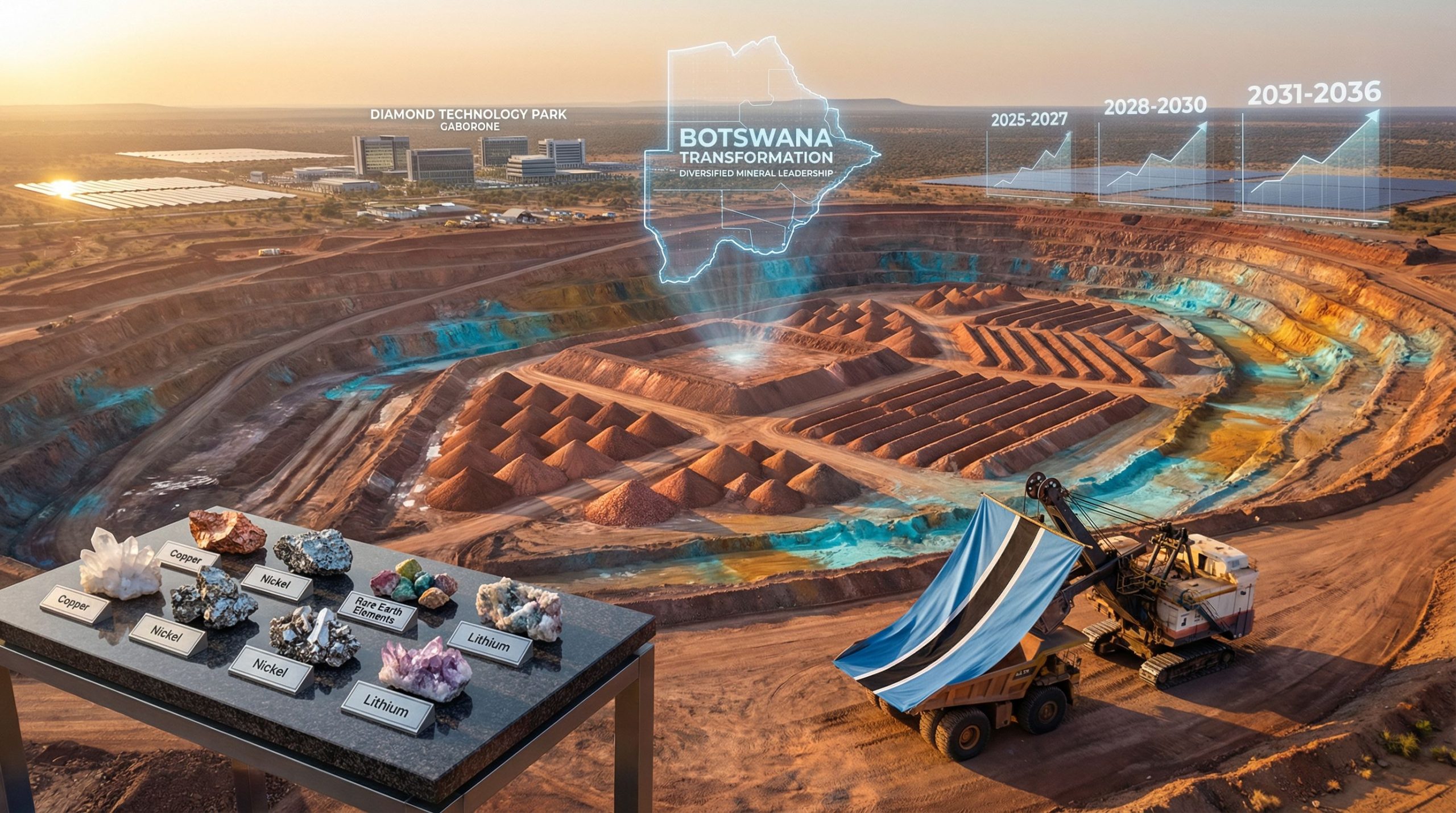
Diamond sector transformation illustrates successful beneficiation implementation through the Diamond Technology Park initiative in Gaborone. This facility combines cutting and polishing operations with technology development centres, creating integrated value chains extending beyond primary extraction.
Value Addition Infrastructure Components:
| Processing Level | Typical Activities | Value Capture Potential |
|---|---|---|
| Primary Processing | Crushing, grinding, flotation | 15-25% above raw material value |
| Secondary Processing | Smelting, refining, alloy production | 40-60% value enhancement |
| Advanced Manufacturing | Battery component production, electronics | 100-200% value multiplication |
Critical minerals processing requires sophisticated separation and purification technologies matching international quality standards. Battery-grade materials demand consistent purity levels and contamination controls exceeding traditional industrial specifications.
Renewable energy integration within processing operations reduces operational costs while supporting sustainability objectives. Solar installations at mining sites provide cost-competitive electricity reducing processing expenses and carbon footprint impacts.
Processing Facility Development Priorities:
• Copper concentrate production and refined copper manufacturing
• Nickel laterite processing and battery-grade nickel sulfate production
• Rare earth element separation and individual element purification
• Lithium carbonate and lithium hydroxide production from brine or hard-rock sources
Employment generation through value addition creates multiplier effects extending beyond direct processing activities. Supporting industries including equipment maintenance, logistics, and technical services develop alongside primary processing operations.
Furthermore, the comprehensive critical minerals strategy demonstrates how systematic approaches to lithium industry innovations can accelerate domestic processing capabilities while creating sustainable employment pathways.
Infrastructure Investment Supporting Comprehensive Development
Mining sector expansion requires coordinated infrastructure development spanning transportation, energy, telecommunications, and processing facilities. Strategic infrastructure investment creates synergies between mining operations and broader economic development objectives.
Solar energy installation priorities reflect both cost reduction objectives and environmental compliance requirements. Mining operations require substantial electricity supplies, creating opportunities for renewable energy deployment reducing operational expenses while supporting sustainability commitments.
Transportation network enhancements facilitate mineral export efficiency while supporting broader economic connectivity. Road and rail improvements benefit multiple economic sectors beyond mining while reducing transportation costs for mineral commodities.
Infrastructure Development Priorities:
• Solar energy installations reducing mining operational costs
• Digital infrastructure supporting automated mining technologies
• Transportation networks facilitating efficient mineral exports
• Processing facilities enabling domestic value addition
• Water management systems supporting mining and processing operations
Digital infrastructure enables advanced mining technologies including automated equipment operation, real-time monitoring systems, and data analytics platforms optimising extraction efficiency. These technologies reduce operational costs while improving safety and environmental performance.
Processing facility development requires substantial capital investment and technical expertise. Integrated development approaches combine processing infrastructure with supporting utilities, transportation access, and workforce housing creating comprehensive industrial development zones.
Global Supply Chain Integration and Risk Mitigation
International supply chain vulnerabilities create opportunities for new mineral suppliers offering geographic diversification and political stability. Recent supply disruptions demonstrate the strategic value of diversified sourcing arrangements for critical materials.
Botswana's positioning addresses key supply chain concerns through political stability, regulatory predictability, and quality assurance capabilities. These factors enable premium partnerships with developed economies seeking supply risk reduction while maintaining quality standards.
Supply Chain Positioning Advantages:
• Geographic diversification reducing concentration risks
• Political stability minimising supply disruption potential
• Regulatory transparency enabling long-term contract commitments
• Quality control systems meeting international specifications
• Transportation infrastructure supporting reliable delivery schedules
Supply chain integration extends beyond raw material supply toward processed product delivery. Countries developing processing capabilities capture additional value while providing supply chain partners with reduced logistics complexity and quality assurance.
Consequently, strategic stockpiling arrangements provide additional revenue streams while supporting consumer country supply security objectives. Long-term supply agreements with strategic reserves create predictable revenue flows while demonstrating supply reliability.
Moreover, the evolving landscape of mining decarbonisation benefits positions environmentally responsible suppliers for premium market access while supporting global sustainability objectives.
Long-Term Economic Development Implications
Mineral sector diversification creates structural economic changes extending beyond mining activities toward broader industrial development. Successful resource sector transformation generates employment, technological capability, and export revenue supporting comprehensive economic advancement.
Economic Development Timeline Projections:
| Development Phase | Timeframe | Expected Outcomes | Economic Impact Indicators |
|---|---|---|---|
| Initial Development | 2025-2027 | Mine commissioning, initial processing | Export diversification, employment growth |
| Expansion Phase | 2028-2030 | Value chain integration, technology adoption | Industrial capability development |
| Maturation Phase | 2031-2036 | Regional hub positioning, advanced manufacturing | Economic complexity enhancement |
Economic resilience improvement results from reduced commodity price volatility exposure through portfolio diversification. Multiple mineral production reduces dependence on single commodity cycles while creating cross-sector employment opportunities.
Technology capability development through mining sector advancement creates spillover effects benefiting other economic sectors. Technical skills, equipment maintenance capabilities, and industrial management expertise transfer to manufacturing, agriculture, and service industries.
Export revenue diversification strengthens foreign exchange earnings while reducing balance of payments vulnerability. Multiple mineral exports create more stable revenue streams compared to single-commodity dependence patterns.
Investment Flow Projections:
Foreign direct investment attraction through mining sector development creates demonstration effects encouraging investment in related sectors. Successful mining projects validate regulatory frameworks and operational environments for broader industrial development.
Additionally, domestic investment capacity expansion occurs through mining sector profits reinvestment in processing facilities, supporting industries, and economic diversification initiatives. Local capital accumulation supports indigenous business development and technological advancement.
The broader context of mining industry innovation trends demonstrates how technological advancement creates sustainable competitive advantages while supporting long-term economic diversification objectives.
Environmental and Social Integration Framework
Sustainable mining development requires comprehensive environmental management and community benefit integration. Modern mining approaches balance economic development with ecological protection and social licence maintenance.
Environmental restoration requirements create additional employment while ensuring long-term ecosystem protection. Progressive rehabilitation standards require concurrent restoration activities throughout mining operations rather than deferred environmental remediation.
Sustainability Integration Components:
• Environmental impact assessment and ongoing monitoring systems
• Community benefit-sharing mechanisms ensuring local development
• Skills development programmes supporting local employment opportunities
• Renewable energy integration reducing operational carbon footprint
• Water management systems protecting local water resources
Community engagement processes establish ongoing dialogue between mining operations and local populations. Benefit-sharing agreements ensure mining revenues contribute to local infrastructure, education, and economic development initiatives.
Skills development programmes create pathways for local employment while building technical capabilities supporting broader economic development. Training initiatives span technical mining skills, equipment operation, and business management capabilities.
Social Licence Maintenance: Successful mining operations require sustained community support through transparent communication, fair benefit distribution, and environmental stewardship demonstration.
Environmental monitoring systems provide ongoing assessment of mining impacts while ensuring compliance with international standards. Data transparency builds community confidence while demonstrating environmental responsibility to international partners.
What Are the Key Competitive Advantages for Long-Term Success?
Long-term mining sector success requires sustainable competitive advantages extending beyond geological endowments toward institutional capabilities and operational excellence. The Botswana critical minerals strategy combines natural resource advantages with governance quality and partnership reliability.
Institutional stability provides fundamental competitive advantage through predictable operating environments enabling long-term investment planning. Consistent policy application across political transitions creates investor confidence supporting sustained development.
Sustainable Competitive Advantages:
• Proven resource management track record building investor confidence
• Established relationships with major international mining operators
• Geographic positioning enabling multiple regional market access
• Institutional capacity for complex project development and oversight
• Environmental and social governance standards meeting international expectations
Quality assurance capabilities enable premium market positioning through consistent product specifications and reliable delivery schedules. International certification systems validate product quality while supporting brand development in global markets.
Technology adoption leadership creates operational efficiency advantages while demonstrating innovation capacity. Advanced mining technologies, environmental monitoring systems, and processing methodologies establish technical leadership positioning.
Regional market integration opportunities expand through economic coordination initiatives and transportation infrastructure development. Multi-country supply chain integration creates scale economies while reducing operational costs across the mineral sector.
How Will This Strategy Transform Regional Mining Dynamics?
The comprehensive approach demonstrated by the Botswana critical minerals strategy establishes a blueprint for sustainable resource sector transformation across Africa. This methodology combines geological advantages with institutional capabilities and strategic partnerships to create competitive positioning within expanding technology mineral markets.
Success in this diversification effort positions the country as a reliable supplier while creating sustainable economic development pathways. The integration of environmental stewardship, community benefit-sharing, and technological advancement demonstrates how modern mining approaches can deliver economic growth while maintaining social licence and environmental responsibility.
Furthermore, the emphasis on value addition through domestic processing creates employment opportunities extending beyond traditional mining activities. This comprehensive development approach generates multiplier effects supporting broader economic diversification while reducing dependence on raw material exports.
The strategic framework addresses key challenges including regulatory predictability, infrastructure development, and international partnership facilitation. These elements combine to create an investment environment supporting long-term capital deployment while ensuring sustainable resource development.
Disclaimer: This analysis is based on publicly available information and industry trends. Mineral sector development involves significant risks including commodity price volatility, operational challenges, and regulatory changes. Investment decisions should be based on comprehensive due diligence and professional advice.
Ready to Discover the Next Major Mineral Breakthrough?
Discovery Alert's proprietary Discovery IQ model delivers real-time notifications on significant ASX mineral discoveries, instantly transforming complex geological announcements into actionable investment insights. With critical minerals driving unprecedented demand growth, explore Discovery Alert's dedicated discoveries page to understand how historic mineral discoveries have generated substantial market returns, then begin your 30-day free trial to position yourself ahead of the market.