
June 19, 2026
The Engineering Bottleneck That Determines Whether Mining Projects Ever Get Built
In large-scale underground mining, the distance between a compelling feasibility study and a project that actually gets financed is rarely about the resource itself. It is almost entirely about engineering fidelity. Institutional lenders, export credit agencies, and development finance institutions do not lend against geological models or production forecasts alone. They lend against detailed engineering documentation that can withstand independent technical scrutiny. The Brazil Potash Autazes project FEED contract exemplifies precisely this dynamic.
For the vast majority of major underground mining projects that fail to reach construction, the breakdown occurs somewhere in this engineering-to-financing gap. Understanding this dynamic reframes what might otherwise appear to be routine procurement news into something considerably more significant. The completion of a dual-scope Front-End Engineering Design programme is, in practical terms, the pivotal event that separates a project with potential from a project with a pathway to capital.
When big ASX news breaks, our subscribers know first
Brazil's Agricultural Paradox: The World's Largest Farm Importing Its Own Inputs
Brazil occupies a remarkable and contradictory position in global agriculture. The country is the world's largest exporter of soybeans, sugar cane, and beef, with its agricultural sector contributing approximately 25% of GDP and generating a dominant share of the country's foreign exchange earnings. Yet despite this extraordinary agricultural output, Brazil imports roughly 95% of its domestic potash consumption every year.
Why Does This Import Dependency Matter?
This is not a marginal dependency. Potash is a non-substitutable macronutrient essential to crop yield and quality. For Brazil's soy and sugar industries, which compete on global commodity markets where input cost efficiency is critical, exposure to imported potash pricing creates a structural vulnerability that cannot be hedged away. Every shipment of potassium chloride arriving from Russia, Belarus, or Canada represents a foreign exchange outflow from one of the world's most productive farming nations.
The geopolitical dimension compounds this vulnerability. The global potash supply chain is heavily concentrated, with the majority of production controlled by a small number of countries, several of which carry significant geopolitical risk. Brazil's import dependency effectively means that disruptions in Eastern Europe or diplomatic tensions affecting Canadian export channels transmit directly into Brazilian farm gate input costs. These are the kinds of resource export challenges that resource-dependent economies increasingly must confront.
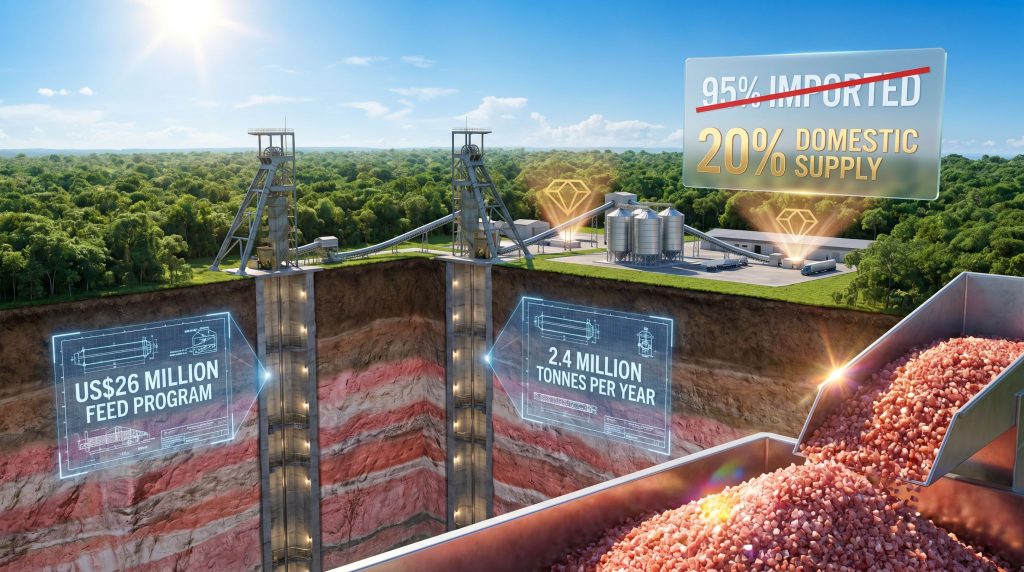
Furthermore, the Autazes potash deposit in Amazonas state represents one of the few credible large-scale opportunities in the Western Hemisphere to structurally alter this equation. At planned initial production capacity of up to 2.4 million tonnes per year, the project could supply approximately 20% of Brazil's current annual potash demand, representing a meaningful shift in the country's fertiliser import profile.
What FEED Actually Does and Why Lenders Refuse to Move Without It
The term Front-End Engineering Design is frequently cited in mining project announcements without adequate explanation of why it functions as such a decisive financing gate. Understanding the mechanics clarifies why the completion of FEED contracts across both surface and underground scopes at Autazes carries the significance it does.
Mining project development follows a staged engineering progression, with each phase producing progressively more accurate cost estimates and more detailed technical documentation:
| Engineering Phase | Cost Estimate Accuracy | Primary Purpose |
|---|---|---|
| Scoping / Conceptual | +/- 40-50% | Initial viability screening |
| Pre-Feasibility Study (PFS) | +/- 25-35% | Technical and economic screening |
| Feasibility Study | +/- 15-25% | Investment decision basis |
| FEED | +/- 10-15% | Lender due diligence and procurement |
| Detailed Design | +/- 5-10% | Construction execution |
FEED is specifically structured to produce the level of engineering definition that institutional lenders require before committing construction debt. This includes a definitive feasibility study-grade of detail in capital cost estimates, comprehensive equipment specifications enabling long-lead procurement, detailed risk assessments, and technical documentation capable of surviving independent engineer review.
Without completed FEED across the full project scope, development finance institutions and export credit agencies cannot conduct the technical due diligence necessary to approve financing commitments. This is not a bureaucratic preference; it reflects the reality that incomplete engineering at the financing stage is one of the primary causes of cost overruns and construction schedule failures in major mining projects.
The Two-Contract Structure That Closes the Engineering Loop
Brazil Potash Corporation, NYSE-listed and Canadian-headquartered, has now awarded FEED contracts covering the complete scope of the Autazes project. The structure divides engineering responsibility across two specialist contractor pairings:
| Scope | Lead Contractor | Subconsultant | Status |
|---|---|---|---|
| Surface facilities and infrastructure | Wood + Promon Engenharia | N/A | Previously awarded |
| Mine shafts and underground development | WSP UK Ltd. | Redpath Deilmann | Awarded June 2026 |
The total estimated FEED programme is valued at US$26 million, with the currently authorised Early Works phase covering US$4.3 million across a 12-month initial engineering period.
The significance of completing both contract awards is architectural rather than simply additive. A FEED programme that covers surface infrastructure but not underground development would still leave lenders without the unified technical foundation required for full project due diligence. Underground and surface scopes must reach equivalent levels of engineering fidelity before a consolidated, lender-ready technical package can be assembled. The award of the mine shafts and underground development contract to WSP UK Ltd. and Redpath Deilmann closes that gap entirely.
Why Shaft Sinking Defines Everything Else
For investors and observers unfamiliar with underground mining construction sequencing, it is worth understanding precisely why mine shafts occupy such a critical position in the project schedule. In underground potash mining, the shafts are not simply access points — they are the physical and logistical backbone of the entire operation. Every subsequent construction activity depends on their completion:
- Underground development headings and ore drives cannot be established until shaft infrastructure is in place
- Processing plant construction can proceed on surface, but commissioning requires ore access through completed shafts
- Tailings management facility development is sequenced against production readiness, which is shaft-dependent
- Ventilation systems, personnel access, emergency egress, and materials handling all route through the shaft network
What Makes Potash Shaft Sinking Particularly Complex?
The Autazes project requires two primary shafts. Any delay to shaft sinking propagates across the entire construction timeline without compression being possible elsewhere. This is what project professionals mean when they describe shaft sinking as the critical path: it is the sequence of activities that determines the minimum possible project duration, and delays extend the overall schedule directly and proportionally.
Shaft sinking in deep underground potash environments presents a distinctive set of technical challenges not encountered in hard rock mining. These include complex ground control through overlying sedimentary sequences, water management in aquifer-bearing formations, and in some conditions, freeze-wall engineering to stabilise shaft walls during sinking through water-bearing zones. Selecting a contractor with proven potash-specific shaft sinking credentials is therefore a material risk management decision with direct implications for construction schedule certainty and lender confidence.
Redpath Deilmann: The Credential That Matters Most to Lenders
The selection of Redpath Deilmann as subconsultants for the mine shafts scope is not incidental. Redpath has delivered shaft sinking works across more than 500 shafts globally, including numerous projects within the Saskatchewan potash basin in Canada, which remains the world's most prolific and technically demanding potash mining region.
Saskatchewan is relevant as a reference point precisely because its potash deposits present some of the most challenging shaft sinking conditions in the industry. Deep shafts penetrating multiple aquifer zones, requiring complex hydrogeological management, have been successfully delivered in that basin over decades. A contractor with a meaningful track record in Saskatchewan carries a credential that independent lender technical reviewers will recognise and weigh positively.
Brazil Potash's project director Raphael Bloise has noted that Redpath's standing as one of the most experienced potash shaft sinking teams globally provides the engineering rigour that lenders and project partners require to advance financing discussions with confidence. This framing is deliberate, signalling that contractor selection at this stage is being made with lender due diligence requirements in mind, not merely operational capability.
The next major ASX story will hit our subscribers first
The Financing Pathway: What Happens After FEED?
Brazil Potash is advancing construction debt financing discussions with development finance institutions and export credit agencies. These institutional financing channels typically operate according to a structured sequence of prerequisites:
- Completed FEED documentation across all project scopes, enabling independent technical review
- Definitive capital cost estimates supported by detailed engineering, typically within the +/- 10-15% accuracy range
- Environmental and social impact compliance documentation meeting institutional standards
- Independent engineer appointment and review of FEED outputs
- Term sheet and financing structure negotiation, leading to commitment stage
With both FEED contracts now awarded and the Early Works phase underway, the Brazil Potash Autazes project FEED contract process has established a clear engineering timeline toward full completion. This creates the unified technical package that satisfies institutional lender prerequisites for committing construction debt financing. The broader mining project financing trends across the sector suggest that projects with this level of engineering completeness attract significantly more competitive financing terms.
The 12-month Early Works phase authorised at US$4.3 million represents the initial engineering investment within the broader US$26 million FEED programme. Progression from Early Works through full FEED completion is the engineering journey that must conclude before financing commitments can advance to their final stages.
The Broader Supply Chain Context: Autazes as Agricultural Infrastructure
Framing the Brazil Potash Autazes project purely as a mining development understates its economic function. For Brazil's agricultural sector, the project represents something closer to critical infrastructure investment with national multiplier effects. Consider the downstream implications of domestic potash production at the scale Autazes is designed to achieve:
- Direct import substitution of approximately one-fifth of Brazil's annual potash consumption, reducing foreign exchange outflows
- Agricultural input cost stability for Brazilian farmers, reducing exposure to international potash price volatility driven by geopolitical events
- Domestic fertiliser blending industry development, as a local potash supply anchor enables the buildout of downstream blending and distribution logistics
- Regional economic development in Amazonas state, with employment, infrastructure, and procurement effects concentrated in one of Brazil's less economically developed regions
Furthermore, the concentration of global potash supply in Russia, Belarus, and Canada means that Brazilian farmers are structurally exposed to supply disruptions and pricing decisions made by producers and governments operating in entirely different economic and political contexts. In this sense, Autazes aligns closely with the kind of thinking embedded in a critical materials strategy that many nations are now actively developing. The project represents a partial but meaningful hedge against this exposure at a national scale.
However, the path from FEED completion to construction commencement is not without its own obstacles. Permitting challenges in ecologically sensitive regions such as Amazonas remain among the most consequential variables that project timelines must account for, regardless of engineering progress.
FAQ: Brazil Potash Autazes FEED Contract
What Is the Total Value of the Autazes FEED Programme?
The total estimated FEED programme is valued at US$26 million. The currently authorised Early Works phase is valued at US$4.3 million and spans a 12-month initial engineering period. For further detail, the full project FEED coverage announcement outlines the scope in detail.
Who Are the FEED Contractors for the Autazes Project?
- Surface facilities and infrastructure: Wood and Promon Engenharia
- Mine shafts and underground development: WSP UK Ltd. as lead contractor, with Redpath Deilmann as subconsultants
Why Is FEED Completion Important for Project Financing?
FEED completion produces the detailed engineering documentation required by development finance institutions and export credit agencies to conduct independent technical review and commit construction debt financing. Without it, institutional lenders cannot advance to commitment stage.
What Makes Shaft Sinking the Critical Path at Autazes?
The two mine shafts at Autazes are prerequisites for all subsequent underground and surface infrastructure commissioning. Any delay to shaft completion extends the overall project schedule directly, making shaft sinking the sequence that defines the minimum possible construction timeline.
What Is Redpath Deilmann's Relevant Experience?
Redpath Deilmann has delivered shaft sinking works on more than 500 shafts globally, including multiple projects in the Saskatchewan potash basin, the world's most technically demanding and productive potash mining region. The WSP and Redpath Deilmann appointment reflects this credential directly.
What Is the Planned Production Capacity at Autazes?
The project's initial planned production capacity is up to 2.4 million tonnes of potash per year, which could supply approximately 20% of Brazil's current annual potash demand. The Brazil Potash Autazes project FEED contract, now covering the full project scope, represents the critical engineering milestone on the path toward realising that capacity.
Disclaimer: This article contains forward-looking statements and projections relating to the Autazes project, including production capacity estimates and financing timelines. These are subject to material risks and uncertainties. Readers should not place undue reliance on such projections. This article does not constitute financial or investment advice.
Want to Identify the Next Major Mineral Discovery Before the Market Does?
Discovery Alert's proprietary Discovery IQ model scans ASX announcements in real time, instantly converting complex mineral data across more than 30 commodities into clear, actionable investment insights — giving subscribers a decisive edge the moment significant discoveries are announced. Explore historic discoveries and their returns to understand the scale of opportunity, then begin your 14-day free trial at Discovery Alert to position yourself ahead of the broader market.