August 24, 2026
Global rare earth supply chains face unprecedented transformation pressure as traditional dependencies on Chinese processing dominance collide with accelerating demand for electric vehicles, wind turbines, and defense technologies. Critical mineral security has evolved from economic consideration to strategic imperative, forcing nations to reconsider decades-old assumptions about resource access and industrial capability. This convergence of geological potential, capital deployment, and geopolitical necessity creates unique opportunities for nations possessing substantial rare earth endowments but lacking integrated processing infrastructure, particularly as the raw materials transition accelerates globally.
Brazil's rare earth processing potential represents precisely this type of strategic inflection point. While possessing the world's second-largest rare earth reserves, Brazil's industrial reality reveals a stark disconnect between geological wealth and value chain participation. The nation's position exemplifies a broader challenge facing resource-rich economies: converting mineral endowments into sustainable competitive advantages rather than perpetuating raw material export dependencies that characterized previous commodity cycles.
Market psychology around rare earth investment has shifted dramatically since 2020, driven by supply chain vulnerabilities exposed during global disruptions and accelerating clean energy transitions. Investors and policymakers now recognise that geological resources alone provide insufficient strategic security without corresponding processing capabilities and technological expertise. This realisation has unlocked unprecedented capital flows toward rare earth processing development outside traditional Chinese-dominated supply chains.
Brazilian Rare Earth Assets and Strategic Positioning
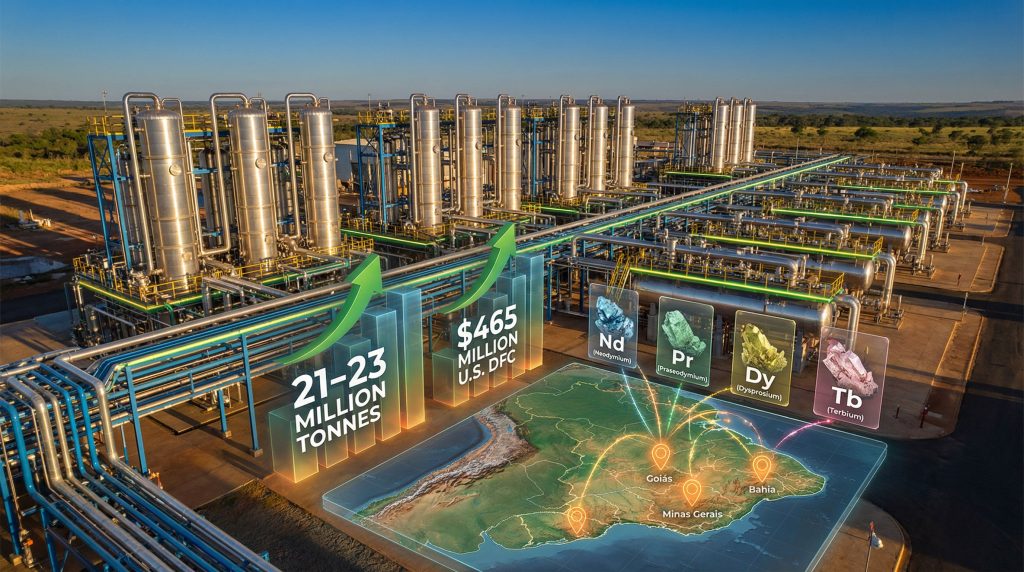
Brazil commands approximately 21 million tonnes of rare earth oxide reserves according to the U.S. Geological Survey, ranking second globally behind China's 44 million tonnes. This substantial endowment represents roughly 15% of global rare earth reserves, yet Brazil's production contributes less than 1% of annual global output of approximately 280,000 tonnes per year. The disconnect between geological potential and market participation illustrates the critical importance of processing infrastructure over raw material abundance.
The nation's rare earth deposits concentrate primarily in three regions: Minas Gerais, Goiás, and Bahia states. These ionic clay deposits, formed through weathering of granitic rocks, offer processing advantages compared to hard-rock carbonatite ores that require energy-intensive crushing and grinding operations. Ionic clay deposits allow for chemical leaching extraction methods that can be more environmentally manageable and economically efficient when properly implemented.
Brazil's strategic significance extends beyond rare earths to encompass broader critical mineral dominance. The country supplies over 90% of global niobium production, primarily from the Araçuaí complex in Minas Gerais, demonstrating proven capability in specialty metal extraction and processing. Additionally, Brazil possesses substantial lithium reserves in Minas Gerais, graphite deposits in Bahia, and growing alumina production capacity, creating potential for integrated critical minerals strategy development.
However, Brazil's historical pattern reveals a persistent challenge: exporting raw materials while importing manufactured products. The rare earth sector risks repeating this cycle unless processing capabilities develop alongside extraction activities. Current Brazilian rare earth initiatives primarily focus on producing concentrates or carbonate intermediates rather than separated oxides or finished products that capture maximum value.
China's processing dominance emerged through three decades of sustained investment in separation technology, metallurgical expertise, and integrated manufacturing ecosystems. Chinese facilities developed sophisticated solvent extraction capabilities, accumulated operational knowledge, and established quality control systems meeting international specifications. This industrial advantage cannot be replicated quickly through capital investment alone, requiring technology transfer partnerships and sustained commitment to capability building.
Furthermore, the untapped potential across Brazil's territory adds another dimension to the strategic equation. Geological surveys have covered less than 30% of Brazilian territory comprehensively for rare earth occurrences, suggesting additional discoveries remain probable. The Amazon Basin and Atlantic coastal regions represent particularly under-explored areas where ionic clay deposits could exist but remain undetected due to limited systematic exploration.
When big ASX news breaks, our subscribers know first
Critical Processing Infrastructure Development Projects
Brazil's rare earth processing potential centers on three major development initiatives, each representing different approaches to value chain integration and international partnerships. These projects collectively could establish Brazil as a significant non-Chinese processing hub within the Western Hemisphere, fundamentally altering global supply chain dynamics.
Serra Verde Pela Ema Project (Goiás State) represents the most advanced Brazilian rare earth processing initiative, backed by up to $465 million from the U.S. International Development Finance Corporation. This project targets 5,000 tonnes per year of rare earth oxides, with particular emphasis on heavy rare earth elements including dysprosium and terbium. The facility's significance extends beyond production capacity to encompass strategic supply chain diversification away from Chinese-controlled sources.
The Serra Verde deposit's ionic clay characteristics provide several advantages for processing development. Unlike hard-rock rare earth deposits requiring extensive crushing and flotation operations, ionic clay materials can be processed through acid leaching and precipitation methods that reduce capital requirements and environmental impact. The presence of meaningful heavy rare earth concentrations distinguishes this project from many global rare earth deposits that contain predominantly light rare earth elements with limited strategic value.
Heavy rare earth elements like dysprosium and terbium command premium pricing due to their critical role in high-performance permanent magnets. Dysprosium enables permanent magnets to operate at elevated temperatures without losing magnetic strength, essential for electric vehicle motors and wind turbine generators. Terbium provides similar temperature stability while reducing magnet weight, crucial for aerospace and defence applications where weight optimisation drives performance.
Minas Gerais Processing Hub Development
Minas Gerais Processing Hub Development focuses on the Poços de Caldas volcanic complex, where Meteoric Resources and Viridis Mining have identified an estimated 7 billion tonne ionic clay resource. This partnership represents Australia-Brazil technology transfer arrangements designed to establish Latin America's first integrated rare earth separation facility. The project's scope encompasses both carbonate production and downstream separation capabilities.
The Poços de Caldas complex offers unique geological advantages as a volcanic-hosted rare earth system. Volcanic environments often concentrate rare earth elements through hydrothermal processes, creating higher-grade zones that improve processing economics. The site's proximity to São Paulo's industrial corridor provides access to skilled workforce, transportation infrastructure, and potential downstream manufacturing customers.
Technology transfer partnerships with Australian firms leverage proven processing methodologies developed for similar ionic clay deposits. Australia's rare earth industry has accumulated significant expertise in solvent extraction techniques, environmental management protocols, and product specification achievement. These partnerships potentially compress development timelines by providing established technical solutions rather than requiring independent research and development.
Brazilian Rare Earths Camaçari Refinery
Brazilian Rare Earths (BRE) Camaçari Refinery represents a different strategic approach, emphasising refining capabilities rather than integrated mining and processing. Located in Bahia state's established petrochemical industrial complex, this facility targets 300-500% value addition over raw concentrate inputs through sophisticated separation and purification operations.
| Processing Stage | Value Multiple | Technical Complexity | Capital Requirements |
|---|---|---|---|
| Raw concentrate | 1x baseline | Mining operations | $50-100 million |
| Rare earth carbonate | 2-3x | Chemical processing | $150-300 million |
| Separated oxides | 4-6x | Solvent extraction | $300-600 million |
| Magnet alloys | 8-12x | Metallurgy + manufacturing | $500+ million |
The Camaçari location provides several infrastructure advantages for rare earth processing development. The existing petrochemical complex offers established power generation capacity, chemical supply chains, and experienced industrial workforce. Port facilities can accommodate both raw material imports and finished product exports, essential for processing operations serving international markets.
BRE's partnership with France's Carester brings European rare earth separation technology to Brazilian operations. Carester's expertise in solvent extraction circuit design and operation provides technical foundation for achieving commercial production specifications. This France-Brazil partnership model balances technology transfer with domestic capability development, creating sustainable processing knowledge rather than dependent operational relationships.
The $78 million private capital commitment plus Brazilian state investment represents substantial financial backing for processing capability development. However, rare earth separation facilities typically require sustained capital investment over multiple years before achieving full operational capacity and product specification consistency.
Moreover, environmental considerations affect all three projects differently based on their locations and processing approaches. Ionic clay processing generates lower radioactive waste levels compared to hard-rock rare earth operations, but still requires careful management of process chemicals and water treatment systems. Brazilian environmental licensing processes have become more stringent, particularly for mining operations near sensitive ecosystems or indigenous territories.
Advanced Separation Technologies and Manufacturing Integration
Rare earth element separation represents one of the most technically challenging aspects of the entire supply chain, requiring sophisticated chemical processes that few companies globally have mastered at commercial scale. Brazilian processing development must overcome decades of accumulated Chinese expertise while establishing quality control systems meeting international specifications for high-tech applications, particularly as global mining industry trends shift toward advanced automation and precision processing.
Solvent extraction technology forms the core of modern rare earth separation operations. This process involves liquid-liquid extraction using organic solvents to separate individual rare earth elements based on subtle differences in ionic radius and chemical behaviour. Commercial separation circuits typically require 10-30 counter-current extraction stages to achieve the 99.9%+ purity levels demanded by magnet and electronics manufacturers.
The technical complexity increases exponentially when separating adjacent rare earth elements on the periodic table. Neodymium and praseodymium separation, for example, requires extremely precise control of extractant concentrations, pH levels, and temperature conditions throughout multiple extraction stages. Small deviations can result in product contamination that renders materials unsuitable for permanent magnet applications.
Critical Separation Challenges for Brazilian Facilities
Brazilian facilities must master several critical separation challenges:
• Heavy rare earth element recovery from ionic clay deposits requires specialised extractant chemistry different from light rare earth processing
• Dysprosium and terbium separation demands exceptional precision due to their similar chemical properties and high value differential
• Europium recovery for phosphor applications requires unique processing pathways to avoid oxidation damage
• Yttrium group separation involves complex multi-stage circuits due to the element's unique position between light and heavy rare earth groups
Technology transfer partnerships provide the most viable path for Brazilian facilities to achieve competitive separation capabilities within reasonable timeframes. The traditional approach of independent technology development requires 7-10 years of process optimisation and hundreds of millions of dollars in research and development investment.
Australian rare earth processing companies have developed expertise specifically relevant to ionic clay deposits through projects like Northern Minerals' Browns Range and Lynas Corporation's Malaysian operations. Technology licensing arrangements can provide proven circuit designs, operational parameters, and troubleshooting protocols that compress learning curves significantly.
European partnerships offer different advantages, particularly in environmental management and automation technologies. French and German rare earth processing firms have developed advanced process control systems and waste minimisation techniques that address increasingly stringent environmental regulations, reflecting broader European critical minerals supply chain initiatives.
Downstream Manufacturing Integration
CIT SENAI ITR's permanent magnet manufacturing initiative represents downstream integration attempts that could capture higher value addition beyond separated oxides. Magnet manufacturing requires additional technical capabilities including:
• Alloy composition optimisation for specific magnetic performance characteristics
• Powder metallurgy techniques for creating uniform microstructures
• Sintering process control to achieve target density and magnetic properties
• Coating application for corrosion resistance in harsh operating environments
The facility represents South America's first attempt at rare earth permanent magnet production, addressing regional demand from wind turbine manufacturers, electric vehicle producers, and industrial motor applications. However, magnet manufacturing faces even steeper technical learning curves than separation chemistry.
Global permanent magnet demand projections indicate 15-20% annual growth through 2030, driven primarily by electric vehicle adoption and renewable energy infrastructure development. Brazil's rare earth processing potential in magnet production could serve Western Hemisphere markets while reducing dependence on Chinese-manufactured components.
Quality control and certification requirements for magnet applications create additional technical barriers. Automotive and aerospace customers require extensive testing protocols, supply chain documentation, and performance consistency that takes years to establish. Defence applications involve even more stringent qualification requirements.
Processing chemistry innovations could provide competitive advantages for Brazilian operations. Ionic liquid extractants represent emerging separation technologies that offer improved selectivity and reduced environmental impact compared to traditional organic solvents. Brazilian research institutions could contribute to advancing these technologies while building domestic expertise.
Water treatment and chemical recycling systems become increasingly important as environmental regulations tighten globally. Brazilian facilities implementing closed-loop processing with minimal waste generation could establish competitive positioning based on sustainability credentials rather than solely cost considerations.
Consequently, the learning curve compression challenge remains formidable despite technology transfer opportunities. Rare earth separation involves tacit knowledge accumulated through years of operational experience that cannot be fully transferred through documentation or training programs. Brazilian facilities require sustained operational periods to develop competitive processing capabilities.
Strategic Partnerships and Capital Deployment Models
United States engagement in Brazilian rare earth development represents a fundamental shift from market-based allocation toward strategic supply chain construction. The U.S. International Development Finance Corporation's $465 million commitment to Serra Verde signals institutional recognition that private capital alone cannot solve rare earth supply chain vulnerabilities within acceptable timeframes, particularly following the Trump critical minerals order prioritising domestic supply chain security.
DFC investment strategy focuses on supply chain diversification rather than cost optimisation. This approach acknowledges that Chinese rare earth processing advantages derive from decades of industrial policy support and cannot be competed against through conventional market mechanisms. American capital deployment therefore emphasises strategic value over short-term financial returns.
The geopolitical timing creates unique opportunities for Brazil-U.S. rare earth cooperation. President Trump's administration has prioritised critical mineral security through Defense Production Act authorities and allied nation partnerships. Simultaneously, Brazil seeks to diversify economic relationships beyond traditional commodity export dependencies.
However, American strategic priorities may not align perfectly with Brazilian industrial development objectives. U.S. supply chain diversification goals require reliable access to processed rare earth materials but do not necessarily require Brazilian ownership of processing capabilities. This tension affects partnership structures and technology transfer arrangements.
Alternative Partnership Models
European investment approaches offer alternative models for Brazilian rare earth development. The European Union's Critical Raw Materials Act establishes procurement targets for non-Chinese sources while emphasising sustainability standards. French partnerships through companies like Carester provide technology access without the geopolitical complexities of U.S. relationships.
Joint venture structures must balance several competing considerations:
• Technology transfer depth versus intellectual property protection
• Operational control between international partners and Brazilian entities
• Market access rights for processed materials
• Environmental standards meeting international certification requirements
• Local content requirements supporting Brazilian workforce development
Brazilian National Development Bank (BNDES) support provides domestic capital for rare earth processing development. The institution's $920 million programme across ten rare earth projects represents significant public sector commitment to value chain integration. BNDES financing typically requires Brazilian content commitments and domestic capability building.
State-level incentives add another layer of support for processing facility development. Bahia state's 3.5 billion reais investment commitment demonstrates regional government willingness to provide infrastructure support, tax incentives, and regulatory facilitation for rare earth projects. However, state-level support often comes with location requirements that may not optimise operational efficiency.
Financial Structures and Risk Mitigation
Private capital integration faces unique challenges in rare earth processing development. Traditional mining finance focuses on resource extraction with established commodity pricing mechanisms. Processing operations require different financial structures accounting for technology risks, market development timelines, and customer qualification periods.
Risk mitigation becomes particularly important for international investors considering long-term commitments to Brazilian processing development. Currency hedging, political risk insurance, and operational guarantee structures help address investor concerns about exchange rate volatility and regulatory changes.
Off-take agreement structures provide revenue certainty for processing facilities while addressing customer supply security requirements. Long-term contracts with automotive manufacturers, wind turbine producers, and defence contractors create stable cash flows supporting project financing. For instance, Brazilian miners are exploring partnerships with international manufacturers to secure stable demand channels.
The technology transfer pricing model affects project economics significantly. Licensing fees, royalty structures, and ongoing technical support arrangements can add substantial costs to processing operations. However, attempting to develop separation technology independently typically requires longer timelines and higher total capital requirements.
Market development strategies must account for customer qualification timelines and specification requirements. Rare earth customers, particularly in defence and automotive applications, require extensive supplier qualification processes that can take 2-3 years even for established processing facilities. Furthermore, Brazil's strategic positioning in critical minerals could accelerate this qualification process through government-level trade agreements.
Brazilian processing facilities face the challenge of establishing market credibility while building operational capabilities simultaneously. Early production from processing facilities often fails to meet full specifications, requiring customer patience and gradual capability improvement.
Challenges Limiting Processing Success
Brazil's rare earth processing potential confronts formidable technical, competitive, and regulatory obstacles that have historically prevented successful development outside Chinese-controlled supply chains. Understanding these constraints provides realistic perspective on development timelines and success probabilities.
Metallurgical expertise gaps represent perhaps the most significant barrier to competitive processing capability. Rare earth separation chemistry involves highly specialised knowledge accumulated over decades of operational experience. Brazil currently lacks the concentration of trained chemists, metallurgists, and process engineers required for world-class separation facilities.
Universities and research institutions in Brazil have limited rare earth processing programmes compared to Chinese facilities that have developed comprehensive academic and industrial training systems. Workforce development timelines for producing qualified rare earth processing technicians typically require 5-7 years even with intensive training programmes.
Infrastructure and Operational Constraints
Power grid infrastructure presents critical constraints for energy-intensive rare earth processing operations. Solvent extraction circuits require consistent electrical supply for heating, mixing, and pumping systems that operate continuously. Power costs in remote mining areas can exceed $0.15-0.20 per kilowatt-hour, significantly impacting processing economics.
Transportation infrastructure connecting deposits to processing facilities adds operational complexity and cost. Brazilian rare earth deposits often occur in regions with limited road access, requiring infrastructure investment before large-scale processing operations become viable. Logistics costs for moving materials and equipment to remote locations can add 15-25% to overall project costs.
Quality control and analytical capabilities demand sophisticated laboratory equipment and trained personnel. Rare earth processing facilities require on-site analytical laboratories capable of measuring elemental purity to parts-per-million levels. Establishing these capabilities requires $5-10 million in analytical equipment plus qualified laboratory technicians.
Competitive dynamics against established Chinese processing create ongoing market pressures. Chinese facilities benefit from integrated supply chains, economies of scale, and accumulated cost optimisations that new Brazilian operations cannot match immediately. Price competition during market downturns can force new processing facilities into losses before achieving full operational efficiency.
Chinese rare earth processing costs benefit from several structural advantages:
• Integrated mining and processing reducing transportation and logistics costs
• Established supplier networks for processing chemicals and equipment
• Skilled workforce availability with decades of industry experience
• Government subsidies supporting strategic industry development
• Economies of scale across multiple large-scale processing facilities
Environmental and Regulatory Challenges
Environmental regulatory compliance adds complexity and cost to Brazilian processing operations. Environmental impact assessments for rare earth processing facilities can require 18-36 months for approval, during which project financing costs accumulate without revenue generation.
Water usage requirements for solvent extraction operations can conflict with local community needs and environmental protection requirements. Processing facilities typically require 10-15 cubic metres of water per tonne of rare earth oxides produced, creating potential conflicts in water-scarce regions.
Waste management protocols for rare earth processing require specialised treatment systems for radioactive materials naturally associated with rare earth deposits. Although ionic clay deposits contain lower radioactivity levels than hard-rock deposits, disposal and storage requirements still add operational complexity.
Market volatility affects processing facility economics significantly. Rare earth prices can fluctuate 50-100% within short timeframes due to supply disruptions, demand changes, or geopolitical tensions. Processing facilities with high fixed costs struggle to maintain profitability during price downturns.
Customer qualification timelines extend project payback periods beyond typical mining operations. Automotive and electronics manufacturers require extensive supplier audits, product testing, and supply chain documentation before approving new rare earth sources. These qualification processes can require 12-24 months even for established processing facilities.
Long-term Competitive Risks
Technology obsolescence risks affect long-term processing facility competitiveness. Rare earth separation technologies continue evolving, with newer processes offering improved efficiency or environmental performance. Facilities using older separation technologies may require expensive upgrades to remain competitive.
Community relations and social licence challenges affect project development timelines and operational stability. Brazilian mining operations increasingly face community opposition and indigenous land rights considerations. 187 mining applications currently overlap rural settlements across Bahia and Goiás, creating potential social conflicts.
Regulatory uncertainty regarding Brazilian mining policies affects investor confidence in long-term projects. Changes in environmental regulations, taxation policies, or mining codes can significantly impact project economics after construction begins.
In addition, the Amazon region development protocols add additional regulatory complexity for rare earth projects near protected areas or indigenous territories. Environmental licensing requirements become more stringent, community consultation processes extend development timelines, and operational restrictions may limit processing options.
The next major ASX story will hit our subscribers first
Global Market Transformation Scenarios
Brazil's successful rare earth processing development could fundamentally alter global supply chain dynamics that have remained stable for over two decades. Market transformation scenarios range from modest supply diversification to substantial rebalancing of processing capacity away from Chinese dominance.
Supply chain diversification impact modelling suggests Brazilian processing capacity reaching 15,000-20,000 tonnes per year of separated rare earth oxides could reduce Chinese market share from current 85-90% to 75-80%. While seemingly modest, this shift would provide meaningful alternative sources for Western hemisphere manufacturers and defence applications.
The strategic stockpile implications of reliable Western hemisphere processing extend beyond immediate supply requirements. United States and allied nations could establish buffer inventories of processed rare earth materials without depending on potentially unreliable supply chains during geopolitical tensions.
Price stabilisation effects from increased processing competition could benefit downstream manufacturers while creating pressure on Chinese processing margins. Historical analysis suggests that monopolistic pricing premiums add 20-30% to rare earth costs compared to competitive market scenarios.
Development Timeline Scenarios
Western hemisphere processing capacity development could proceed along several timeline scenarios:
Accelerated Development (5-7 years):
• Multiple Brazilian facilities achieving commercial production simultaneously
• Substantial technology transfer and capital deployment
• Government support through streamlined permitting and infrastructure investment
• Results in 25,000-30,000 tonnes annual capacity across Brazil
Moderate Development (8-12 years):
• Gradual facility development with typical permitting and construction timelines
• Technology transfer occurring through partnership agreements
• Market-based financing with some government support
• Results in 15,000-20,000 tonnes annual capacity across Brazil
Delayed Development (15+ years):
• Regulatory barriers and financing constraints slowing development
• Limited technology transfer requiring independent capability building
• Market volatility discouraging sustained investment
• Results in 5,000-10,000 tonnes annual capacity across Brazil
Technology transfer and innovation spillover effects could extend Brazilian capabilities beyond rare earth processing. Solvent extraction expertise transfers to other metallurgical applications including copper, nickel, and lithium processing. Research institution development in critical mineral processing creates intellectual capital supporting broader industrial upgrading.
Regional and Geopolitical Implications
South-South technology cooperation represents potential expansion of Brazilian processing expertise to other resource-rich developing nations. Countries like Nigeria, Madagascar, and Tanzania possess rare earth deposits but lack processing capabilities. Brazilian companies developing separation expertise could establish international consulting and technology licensing businesses.
Regional leadership implications position Brazil as a middle power in critical mineral diplomacy. Successful processing development demonstrates that emerging economies can compete in sophisticated industrial sectors traditionally dominated by developed nations and China.
Innovation ecosystem development around rare earth processing could stimulate broader technological advancement. Metallurgical research programmes, analytical chemistry capabilities, and process automation technologies developed for rare earth applications often transfer to other industrial sectors.
The geopolitical rebalancing effects of Brazilian processing success extend to broader critical mineral supply chains. Demonstration that technology transfer and patient capital can establish competitive processing capabilities outside China encourages similar investments in lithium, graphite, and other critical materials.
Long-term partnership evolution between Brazil and consuming nations could establish template agreements for resource development that balance supplier and customer interests. These arrangements might include technology sharing, market access guarantees, and environmental standards that benefit all parties.
Market Psychology and Strategic Responses
Market psychology transformation represents perhaps the most significant long-term impact. Successful Brazilian processing development would demonstrate that Chinese rare earth dominance results from policy choices rather than insurmountable technical or economic advantages. This realisation could unlock additional investment in alternative processing capacity globally.
However, scenario planning must account for potential Chinese responses to market share erosion. China could respond through aggressive pricing, acquisition attempts of Brazilian processing assets, or acceleration of downstream manufacturing integration that reduces rare earth export requirements.
Demand growth projections through 2030 suggest global rare earth requirements increasing 40-60% primarily driven by electric vehicle adoption and renewable energy infrastructure. Brazilian processing development timing could benefit from this demand expansion if capabilities come online during supply constraint periods.
Brazil's rare earth processing potential represents a convergence of geological advantage, capital availability, and strategic necessity. Success requires executing technology transfer partnerships while building sustainable domestic capabilities that balance economic competitiveness with environmental responsibility.
Investment considerations for stakeholders evaluating Brazilian rare earth opportunities should focus on specific project execution capabilities rather than general market potential. Processing development success depends more on technical competence and operational excellence than resource endowments or favourable market conditions.
The transformation of Brazil from rare earth exporter to integrated processor would demonstrate that emerging economies can compete in sophisticated industrial sectors through strategic partnerships and sustained commitment to capability development. This achievement could inspire similar initiatives in other critical mineral supply chains where developing nations possess resources but lack processing expertise.
Disclaimer: This analysis involves future projections and market scenarios that contain inherent uncertainties. Rare earth processing development involves technical, financial, and regulatory risks that could significantly impact project timelines and success rates. Readers should conduct independent due diligence before making investment decisions related to rare earth processing projects.
Looking to Capitalise on Brazil's Rare Earth Processing Revolution?
With Brazil positioned to become a major non-Chinese rare earth processor, significant investment opportunities are emerging across the critical minerals sector. Discovery Alert's proprietary Discovery IQ model delivers real-time alerts on significant ASX mineral discoveries, empowering investors to identify actionable opportunities in rare earths, lithium, and other critical minerals ahead of the broader market. Begin your 30-day free trial today to position yourself strategically as global supply chains transform.