Broken Hill Gold Ltd
- ASX Code: BH6
- Market Cap: $88,152,767
Broken Hill Gold Identifies Multiple Gold-Copper Targets at White Dam as 30,000m Exploration Push Takes Shape
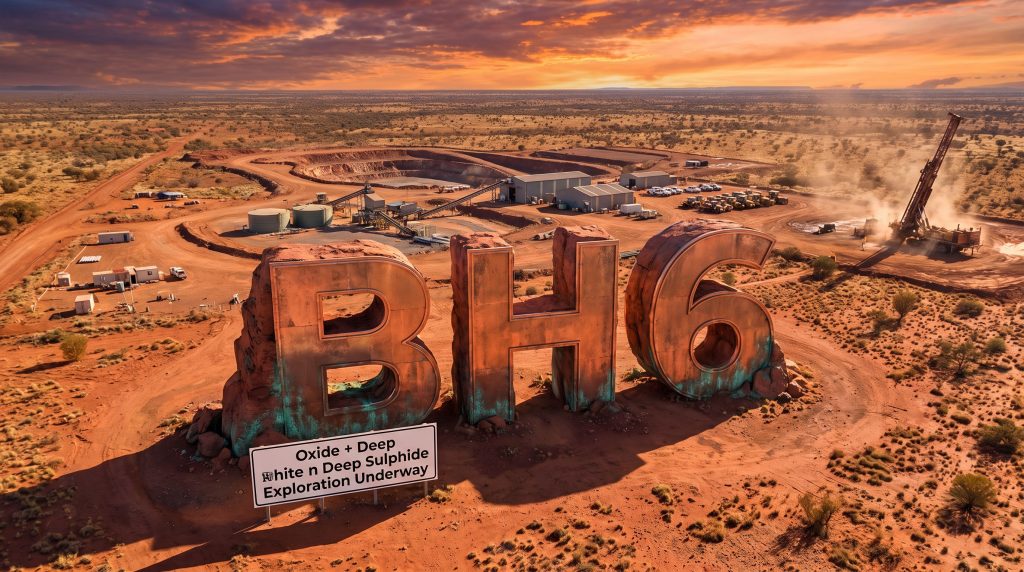
Broken Hill Gold (ASX: BH6) has reported a broad exploration update from its 100%-owned White Dam Gold Project in South Australia's Curnamona Province, highlighting multiple near-mine and regional gold-copper targets from a historical database review. According to the ASX announcement, many of these prospects contain shallow oxide gold and copper intersections from earlier drilling, while very limited deeper drilling has been completed to test for primary sulphide mineralisation.
The update matters because it shifts attention beyond White Dam's established oxide gold inventory and toward the possibility of a larger sulphide-hosted gold-copper system. In the announcement, Broken Hill Gold linked this change in thinking to its recent Icebreaker discovery, previously known as White Dam North, where shallow high-grade gold-copper sulphide mineralisation was reported in July 2026.
Why investors are watching this update:
- Multiple historical targets have now been prioritised across mining and exploration licences
- Several targets share structural and geophysical similarities with known White Dam deposits
- Surface sampling returned up to 13.0% copper and 5.3 g/t gold at Mary Mine
- The company plans more than 30,000 metres of drilling over the next 18 months
- IP and magnetic geophysics are due to begin shortly to refine deeper drill targets
- An updated oxide Mineral Resource Estimate (MRE) is targeted for Q4 2026
"The Icebreaker discovery has really shifted our focus to the potential for a significant sulphide hosted copper-gold system near surface at and nearby the central White Dam project area," said Matthew Boyes, Managing Director of Broken Hill Gold.
"The area has never been systematically explored for a major copper-gold system with recent exploration only targeting shallow oxide mineralisation and extensions to known outcropping systems."
When big ASX news breaks, our subscribers know first
What Changed at White Dam?
According to the exploration update, historical work at White Dam was largely directed toward shallow oxide resources suitable for heap leach processing. That work supported prior mining and production from the project, but it also meant deeper sulphide zones were only lightly tested.
The company said the recent Icebreaker result has altered that approach. Rather than viewing the project only as a group of shallow oxide gold deposits, Broken Hill Gold is now assessing whether those oxide caps may sit above a more extensive IOCG-style gold-copper system.
Why Does the Oxide-to-Sulphide Distinction Matter?
This distinction is important. Oxide mineralisation occurs near surface where weathering has altered the original rock, while primary sulphide mineralisation refers to the fresher, unweathered source rock at depth where copper and gold can occur in sulphide minerals.
In many mining districts, shallow oxide zones can be the surface expression of larger mineral systems below. At White Dam, the company stated that deeper sulphide-hosted mineralisation beneath Vertigo and Hannaford has been intersected in only a limited number of historical holes.
One example cited in the announcement was WD111, which returned 29m at 0.7 g/t gold and 0.02% copper from 315m, beneath the Hannaford pit, and remains open along strike and down dip.
For investors, that introduces a second value driver. White Dam is no longer being framed only as a potential oxide mine restart story, but also as a district-scale exploration play targeting deeper gold-copper systems.
Existing White Dam Mineral Resources Provide the Base Case
In the report, Broken Hill Gold reiterated the existing JORC 2012 White Dam MRE, originally published in August 2020. The resource remains centred on oxide material across four deposits.
| Deposit | Tonnes | Gold grade | Contained gold |
|---|---|---|---|
| Hannaford | 4,600,000t | 0.7 g/t Au | 101,900 oz |
| Vertigo | 1,700,000t | 0.8 g/t Au | 43,300 oz |
| Unnamed deposit | 1,700,000t | 0.7 g/t Au | 38,300 oz |
| White Dam North (Icebreaker) | 1,200,000t | 0.5 g/t Au | 20,300 oz |
| Total | 9,200,000t | 203,800 oz |
These resources are split between Indicated and Inferred categories. Broken Hill Gold's near-term objective, according to the announcement, is to upgrade existing inferred material at Vertigo, Hannaford and Icebreaker to support open pit optimisation and mine planning.
That near-term work has practical relevance. White Dam already contains open pits, a heap leach facility and a fully operational gold extraction plant, according to the company. Furthermore, if resource confidence improves, management aims to advance mine plans for a restart of open pit operations.
However, the larger exploration interest in this update sits outside the current oxide resource. The existing MRE does not account for any deeper sulphide inventory.
Near-Mine Targets Point to Deeper Drilling Potential
The historical review highlighted a cluster of near-mine prospects on the mining licences, many of them close to the existing Hannaford and Vertigo pits.
| Target | Location | Historical result | Interpretation from update |
|---|---|---|---|
| Rolling | 800m north of Hannaford | 1m at 8.0 g/t Au and 0.3% Cu from 36m | Same magnetic feature as Icebreaker |
| Hannaford North | 400m north of Hannaford | 4m at 3.0 g/t Au and 0.02% Cu from 20m | Oxide mineralisation open at depth |
| White Dam East | 800m east of Hannaford | 8m at 0.6 g/t Au from 22m | Sits on the South Fault |
| Hannaford Northeast | 100m north of Hannaford | 4m at 1.0 g/t Au and 0.8% Cu from 45m | Single shallow hole only |
| Vertigo West | South-west of Hannaford | 9m at 1.5 g/t Au and 0.5% Cu from 41m | Possible extension of oxide resource |
| Hannaford/Vertigo Deep | Beneath existing pits | 29m at 0.7 g/t Au and 0.02% Cu from 315m | Open along strike and down dip |
The common theme across these targets is limited depth testing. As outlined in the ASX release, most historic drillholes did not extend beyond about 80m vertical depth. That means many targets have evidence of near-surface mineralisation, but limited data on whether stronger sulphide zones continue below.
Rolling appears especially relevant to the new model because it sits on the same magnetic trend as Icebreaker. Magnetic surveys can help identify iron-rich rocks and structures often associated with gold-copper systems in this style of geology.
Regional Targets Extend the White Dam Search Area
Beyond the central mining area, the company also outlined several regional historical prospects across its exploration licences.
| Prospect | Distance from White Dam | Historical drill result | Surface rock chip result |
|---|---|---|---|
| Mary Mine | 12km west | 16m at 0.9 g/t Au and 2.2% Cu from 13m | 5.3 g/t Au and 13.0% Cu |
| Wilkins Prospect | 12km south | 9m at 0.9 g/t Au and 0.5% Cu from 89m, incl. 1m at 4.0 g/t Au | 7.9 g/t Au and 8.2% Cu |
| Green and Gold Mine | 16km south-west | 36m at 1.0 g/t Au and 0.3% Cu from 56m, incl. 4m at 3.8 g/t Au | 3.0 g/t Au and 7.6% Cu |
| Wadnaminga | 80km south-west | No systematic drilling | Historical production of 19,962 oz at 37.88 g/t Au |
Mary Mine stands out for copper grade, with one historical hole returning 16m at 2.2% copper and 0.9 g/t gold from 13m. Wilkins and Green and Gold also show a mix of gold and copper in both drilling and surface samples.
Wadnaminga is different again. According to the announcement, this project contains three granted mining leases over a series of historical high-grade gold workings, but has seen no systematic drilling. The company said an undeveloped lode has been mapped over about 700m of strike, with oxidised material outcropping at surface.
For investors, these regional prospects broaden the opportunity set. Rather than relying on a single target, Broken Hill Gold is assembling a pipeline of prospects with historical evidence of mineralisation and varying levels of prior testing.
Understanding IOCG Mineralisation and Why It Matters
IOCG stands for Iron-Oxide-Copper-Gold. It is a deposit type where gold and copper are associated with iron-rich minerals such as magnetite and hematite, often along with strong alteration caused by hot mineral-bearing fluids moving through the rocks.
In simpler terms, IOCG systems can form when large volumes of heated fluid travel through faults and reactive rock layers, depositing metals over broad areas. These systems can range from small prospects to very large deposits.
What Features at White Dam Support an IOCG Interpretation?
At White Dam, Broken Hill Gold said several features seen across the Curnamona Province are also present on its ground:
- A shallow oxide gold cap above deeper transitional and primary sulphide zones
- Stratabound mineralisation, meaning metals occur along certain rock layers
- Structural feeder zones, which are faults or breaks in the rock that may have channelled mineral-rich fluids
- A link between mineralisation and iron-rich or carbonate-rich metasediments
- Alteration including chlorite and phlogopite, which are minerals commonly associated with hydrothermal systems
The regional context is also relevant. In the report, the company pointed to nearby IOCG deposits including:
| Project | Approximate distance | Copper | Gold | Cobalt |
|---|---|---|---|---|
| Kalkaroo | 40km north | 1.1Mt Cu | 3.1Moz Au | 23kt Co |
| North Portia | 75km north | 0.1Mt Cu | 0.26Moz Au | |
| Mutooroo | Regional | 0.2Mt Cu | 82koz Au | 20kt Co |
This does not confirm White Dam hosts a similar deposit. However, it does show that the broader province is known for this deposit style, which helps explain why the company is now prioritising deeper geophysics and drilling.
2026 to 2027 Work Programme and Expected Catalysts
Broken Hill Gold has set out an 18-month work plan combining resource work near the mine with broader exploration across the tenement package.
| Activity | Timing | Purpose |
|---|---|---|
| IP and magnetic surveys | Imminent | Define deeper drill targets |
| Icebreaker drilling | Underway | Support oxide resource update |
| Vertigo North Extended drilling | August to September 2026 | MRE input |
| Hannaford drilling | August to September 2026 | MRE input |
| Updated oxide MRE | Q4 2026 | Resource upgrade |
| Open pit optimisation and mine planning | Post-Q4 2026 | Assess restart potential |
| Regional drilling and fieldwork | 2026 to 2027 | Test discovery targets |
Permitting applications for near-mine drilling have been submitted to South Australia's Department for Energy and Mining, while heritage clearances for regional prospects are scheduled to start in mid-August 2026.
The scale of the planned programme is also material. According to the company, work over the tenement package is expected to include more than 30,000m of drilling, as well as geophysics, geochemistry and reprocessing of historical datasets.
The next major ASX story will hit our subscribers first
Why This White Dam Update Matters to ASX Investors
This ASX exploration update presents Broken Hill Gold as a company with two parallel paths at White Dam.
The first is the more immediate path: upgrade oxide resources, complete mine planning work and assess a restart scenario using existing site infrastructure. The second is the higher-risk, higher-upside path: test whether the project area hosts a broader sulphide-hosted gold-copper system that historical oxide-focused drilling largely missed.
Neither outcome is guaranteed, and the company's next phase depends on follow-up geophysics, drilling and resource work. Even so, the announcement establishes a clearer framework for upcoming news flow.
The main points investors are likely to monitor over the coming quarters include:
- Results from IP and magnetic surveys
- Assays from Icebreaker, Vertigo and Hannaford drilling
- Progress toward the Q4 2026 oxide MRE update
- Initial drilling on regional targets such as Mary Mine, Wilkins and Green and Gold
- Any signs that shallow oxide mineralisation extends into stronger sulphide-hosted gold-copper zones at depth
For a junior explorer, that combination of established mine-site infrastructure and district-scale target generation is likely to keep White Dam on the market's watchlist as the 2026 to 2027 programme advances.
Want to Catch the Next Major ASX Gold-Copper Discovery Before the Market Does?
Discovery Alert's proprietary Discovery IQ model scans ASX announcements in real time, instantly identifying significant mineral discoveries like emerging gold-copper systems and translating complex data into actionable opportunities — explore historic discoveries that have delivered exceptional returns and begin your 14-day free trial at Discovery Alert to position yourself ahead of the broader market.